
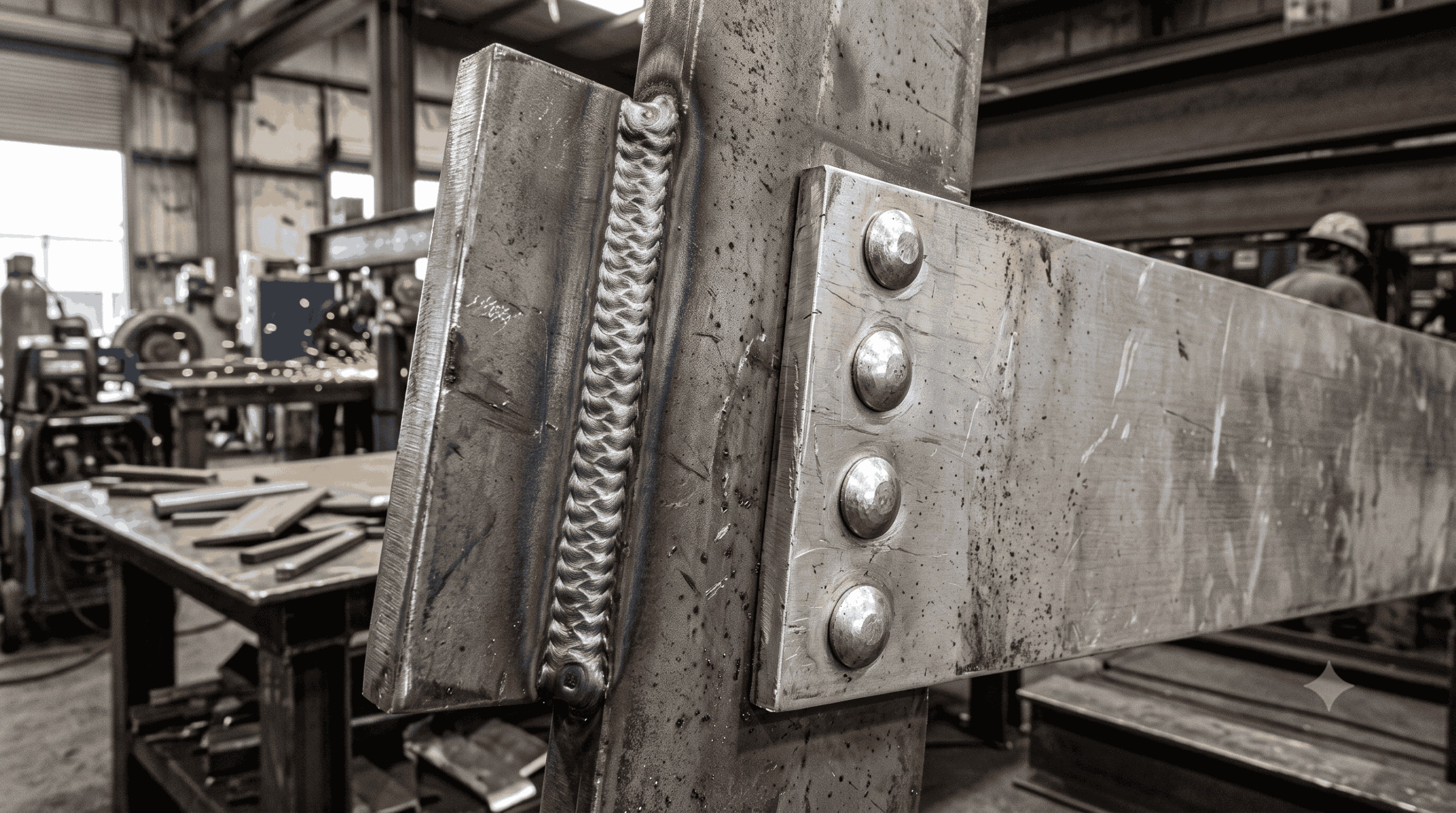
Sourcing high-performance structural parts often leads procurement managers and product designers straight into the overtightened specification trap. It is a quiet project-killer. Many custom drafts for heavy equipment frames, industrial cabinets, or bracket systems automatically default to an all-welded construction requirement.
The decision makes sense on paper. There is a common assumption that melting metals together into a single, fused piece always guarantees a longer lifespan. But real-world dynamic field stresses do not care about paper theories. In the field, it is rarely raw static tensile strength that fails first. Underestimating fatigue limits, dynamic operational stresses, and the rough vibrations of shipping leads to early field failures, unexpected warranty claims, and budgets that spiral out of control.
For B2B wholesale buyers, sourcing managers, and engineering teams, choosing how to join metal sheets is a pivotal business decision. This choice ripples through your entire project. It directly shapes your total cost of ownership, supply chain safety margins, regulatory compliance, and production lead times.
When your structural assemblies go into active service—whether they are automotive chassis, outdoor battery enclosures, or industrial machinery—they must survive a harsh mix of vibration, temperature swings, and corrosive forces. To build custom metal products that endure decades of service, we have to look past basic pros-and-cons lists.
At YISHANG, we help our partners evaluate these physical, metallurgical, and financial trade-offs to keep production runs highly cost-efficient and structurally sound. Our comprehensive services in engineering logistics and advanced manufacturing ensure your designs are optimized for real-world reliability from day one.
1. Microstructural Integrity: Assessing Material Transformation under Thermal and Mechanical Stress
Every permanent assembly method leaves its own permanent physical mark on the base material. Understanding how fabrication processes alter your metal’s microstructure is the first line of defense against unexpected field failures.
Thermal Degradation in Fused Alloys: The HAZ and Grain Boundary Sensitization
Welding works by localized molecular fusion, injecting intense thermal energy directly into the joint. While this creates a solid monolithic structure, it also subjects the neighboring metal to a severe thermal gradient. This area is the Heat-Affected Zone, or HAZ, and it undergoes microstructural changes that can permanently weaken your chosen alloy.
In premium alloys like 304 and 316 stainless steel, this sudden heat spike and rapid cooling can cause grain boundary sensitization. Between 450 degrees Celsius and 850 degrees Celsius, chromium carbides precipitate along the grain boundaries. This chemical reaction robs the surrounding metal of its corrosion-resistant chromium, leaving it vulnerable to rust along the weld seams.
For heat-treated metals like 6000-series aluminum, the heat from TIG or MIG welding acts as an uncontrolled annealing process. This local softening can drop the yield strength in the HAZ by 30% to 50%, transforming a high-strength chassis into a structurally soft assembly.
On top of that, as the molten pool cools down, volumetric shrinkage occurs. This contraction traps high residual tensile stresses deep inside the joint. Without post-weld heat treatment, these hidden stresses act as early initiation points for stress corrosion cracking under normal loads.
Geometric Stress Concentrations in Pierced Sheet Metals
Riveting avoids heat-related material damage entirely by using cold-working mechanical assembly methods. Because there is no high-heat cycle, the original temper, grain structure, and anti-corrosive coatings of galvanized steel or aluminum remain completely untouched.
This process eliminates the risks of heat-induced warping. As a result, your production line avoids the costly post-assembly flattening steps common with thin sheet metal fabrication.
But mechanical riveting does introduce its own structural challenge. To place a solid fastener, the raw metal must undergo punch-piercing or CNC drilling.
This physical penetration breaks the continuous metal matrix, creating a geometric stress raiser. In a solid plate, stress flow lines run smoothly through the material. When a fastener hole is introduced, these stress flow lines are compressed and forced to squeeze around the boundary of the hole.
This is where the stress concentration factor, commonly represented as Kt, comes into play. For a standard circular hole under tensile load, the stress concentration at the hole edge is equal to 3.
This means the stress immediately surrounding the rivet hole is roughly three times higher than the nominal load applied to the part. If holes are punched using dull tooling or incorrect clearances, micro-fissures can form along the sheared edge, growing into fatigue cracks over time.
2. Macro-Structural Performance: Dynamic Loads, Harmonic Vibration, and Crack Mitigation
Once an assembly leaves our manufacturing facility and goes into active service, its joint characteristics determine how the overall structure handles vibration and dynamic forces.
| Joint Parameter | Welded Fusion Joint (TIG/MIG) | Riveted Mechanical Joint |
|---|---|---|
| Joint Efficiency | High (90% to 100%) | Moderate (60% to 85%) |
| Dynamic Fatigue Resistance | Low (susceptible to rapid crack propagation) | High (frictional damping & crack arresting) |
| Hermetic & Fluid Sealing | Excellent (naturally gas- and liquid-tight) | Poor (requires auxiliary gaskets/sealants) |
| Stress Distribution Profile | Uniform along the continuous weld seam | Discontinuous (localized around fastener holes) |
| Dissimilar Metal Compatibility | Extremely poor (metallurgical limitations) | Excellent (purely mechanical clamping) |
Monolithic Crack Propagation in Rigid Structures
Welded joints provide a single, continuous molecular lattice across the entire structure. This continuous path is excellent for transferring heavy static loads, giving properly executed welds an efficiency of 90% to 100%.
However, this rigid continuous path can become a liability when the product experiences continuous vibration. This is common in automotive brackets, outdoor generator housings, or heavy transport frames.
If a fatigue crack begins in a weld seam or its heat-affected zone due to vibration, it faces no physical boundaries. The crack can travel freely across the continuous grain structure of the assembly.
This is known as catastrophic monolithic failure. In rigid cabinets, a crack starting at a single stressed corner can easily run through the weld line and across adjacent panels, causing a sudden failure of the entire unit.
Micro-Compliance and Interfacial Dampening in Riveted Assemblies
By contrast, a riveted joint is a mechanical system of overlapping plates held together by clamping force. This physical boundary provides two key advantages under dynamic loads: energy dissipation and crack arresting.
First, because riveted connections rely on friction clamping, they offer a tiny amount of micro-compliance. Under extreme vibration or cyclic twisting, the overlapping sheets can experience microscopic relative slippage.
This micro-slip acts as an internal dampener. It absorbs and spreads out vibration energy that would otherwise concentrate and cause cracks in a rigid weld.
Second, if a fatigue crack does start in a riveted panel, its propagation path is physically blocked. When the crack reaches the edge of the sheet or hits an adjacent rivet hole, the physical gap stops its progress.
The circular geometry of the rivet hole disperses the stress at the crack tip, acting as a natural crack arrester. This built-in redundancy ensures a single cracked panel can be easily replaced during routine maintenance.
3. Environmental Survival: Temperature Variations and Galvanic Isolation
Custom metal fabrications must survive challenging operating environments, including extreme outdoor temperature swings and corrosive atmospheres.
Managing Linear Thermal Expansion and Shearing Stress
Outdoor metal systems, like telecommunication enclosures, solar mounting racks, and industrial cabinets, go through constant thermal cycling.
Every metal has its own Coefficient of Thermal Expansion, or CTE, which controls how much it expands or contracts per degree of temperature change. The calculation for this thermal expansion is straightforward: the change in length is equal to the material’s expansion coefficient, multiplied by the original length and the change in temperature.
In a rigid, welded framework, if metals of different thicknesses or compositions expand at different rates, the assembly cannot flex to relieve the stress.
This thermal mismatch causes internal shear stresses to build up within the stiff weld joints. This often leads to bowed panels, warped sheet metal skins, or micro-cracks along the weld throat.
Riveted connections, with their slight mechanical clearances, give the assembly vital breathing room to handle these shifts.
The minute clearance inside the fastener holes allows individual parts to expand and contract naturally without creating internal stresses. This keeps the external panels flat, professional, and free of warp.
Galvanic Isolation Protocols for Dissimilar Metal Joints
Modern lightweight designs often pair aluminum panels with heavy-duty steel or stainless steel support frames to balance weight and strength.
Directly welding dissimilar metals is generally impossible in production due to vastly different melting temperatures and the formation of brittle chemical compounds at the fusion line.
Riveting solves this by applying a purely mechanical clamping force that does not require material melting. However, placing different metals in direct contact in humid or outdoor settings can cause rapid galvanic corrosion.
Because riveting is a mechanical assembly process, our team can easily place a dielectric barrier between the overlapping sheets and around the rivet shank.
This dielectric barrier can consist of a non-conductive composite gasket, polyimide film, or specialized isolation washers. This setup completely separates the two metals electrically, securing the joint while eliminating the risk of galvanic oxidation.
4. Design-for-Manufacturability (DFM): Spatial Access, Flange Demands, and Surface Finishes
A major difference between top-tier fabrications and basic designs is how joining methods affect geometry, raw material yield, and surface finishing workflows during production.
Single-Sided Blind Fastening vs. Welding Torch Clearance
Complex structural configurations, such as deep, narrow double-walled enclosures, often limit interior physical access.
Welding requires enough physical clearance for a MIG or TIG torch, as well as the operator’s protective helmet and hands, to maintain a consistent angle. Without this clearance, welds can suffer from poor penetration and structural weakness.
Mechanical riveting, specifically blind riveting, resolves this spatial constraint.
As long as the operator or automated tooling can access one side of the pre-drilled assembly hole, a permanent mechanical connection can be completed in milliseconds.
This makes blind riveting highly effective for hard-to-reach internal brackets, wire routing channels, and complex multi-layered assemblies.
The Overlap Flange Penalty: Impact on Material Yield
While riveting simplifies assembly access, it introduces a specific material cost penalty that is often overlooked during the design phase.
Unlike welding, which allows for edge-to-edge butt joints, riveting requires overlapping flanges to accommodate the rivet shank and meet minimum edge-distance specifications.
To prevent tear-out under load, a rivet hole must be positioned at a distance of at least twice the rivet’s diameter from the sheet metal edge. These extra flanges increase the overall surface area of raw sheet metal needed for each part.
Across high-volume production runs of thousands of units, this flange penalty can increase sheet metal consumption and raw material scrap rates by 5% to 15%.
When budgeting for high-volume custom metal fabrication, our engineering team balances this material cost increase against the labor savings of faster assembly times.
Protecting Pre-Finished and Coated Sheet Metals
Sourcing pre-finished sheets—such as pre-galvanized, anodized, or powder-coated metals—is a common way for procurement teams to lower manufacturing costs.
However, welding these pre-finished surfaces is difficult because the extreme heat burns off protective zinc coatings and ruins cosmetic finishes.
This requires slow, manual post-weld touch-ups that can lead to inconsistent corrosion resistance and cosmetic variation.
Riveting acts as a purely mechanical, heat-free process that preserves pre-finished surfaces.
Because there is no heat-induced paint bubbling or coating degradation, assemblies can be completed after powder-coating without risking cosmetic defects.
This simplifies production workflows, eliminates post-assembly refinishing bottlenecks, and ensures consistent quality control standards.
5. The Production Ledger: Sourcing Logistics, Quality Assurance, and Total Cost of Ownership (TCO)
Sourcing decisions cannot be based on engineering theory alone; they must be balanced against manufacturing lead times, labor costs, and quality control budgets.
Fabrication Cycle Times and Post-Weld Labor Bottlenecks
Welding is a labor-intensive, multi-step process. Beyond the actual torch time, a massive portion of fabrication labor goes into preparation and post-weld finishing.
Weld spatter must be ground flat, heat discoloration must be chemically pickled or blasted, and warped parts must be mechanically aligned.
Additionally, welding is heavily dependent on certified manual labor. The global shortage of skilled welders has driven up labor costs and created production delays.
Riveting, conversely, is built for rapid, predictable manufacturing cycles.
The riveting process is highly automatable using pneumatic feed systems or multi-point riveting presses. Once the holes are CNC punched, the fastening step takes milliseconds.
No post-fastener grinding or dressing is needed. The joint is instantly ready for powder coating or final assembly, significantly reducing production cycle times.
Non-Destructive Testing (NDT) vs. Visual Quality Control Workflows
Ensuring the quality of a welded assembly is a high-cost, specialized task.
Welds are susceptible to internal, subsurface defects like hydrogen embrittlement, micro-porosity, lack of root fusion, and slag inclusions.
To guarantee quality under strict ISO 9001 standards, sourcing teams must often budget for expensive Non-Destructive Testing (NDT) methods, such as ultrasonic testing or radiography.
For riveted connections, the Cost of Quality (COQ) is much lower.
Because riveting relies on visible, external fasteners, quality inspection is straightforward and non-destructive.
Our quality assurance inspectors can quickly check joint integrity with a simple visual check—verifying correct rivet head formation and seating—or with a quick torque tool check.
This fast, highly reliable quality workflow removes the need for expensive NDT technicians, allowing us to pass direct cost savings back to your purchasing budget.
6. The DFM Hybrid Approach: Maximizing Lifecycle Efficiency in Industrial Enclosures and Frame Systems
For high-performance custom metal fabrications, the ideal solution is rarely an all-or-nothing choice between welding and riveting.
Instead, seasoned B2B partners use a hybrid Design for Manufacturing (DFM) approach that strategically combines both joining methods into a single assembly to optimize weight, cost, and strength.
Consider the structural design of a heavy-duty outdoor power distribution cabinet or a mobile medical cart.
The main structural frame, which must carry static loads and resist twisting forces, is best fabricated using a welded steel frame to ensure maximum rigidity and a seamless, solid chassis.
However, the outer enclosing panels, internal shelving brackets, and accessory mounting plates are subject to vibration, thermal expansion, and need for periodic replacement.
By riveting these lightweight aluminum or galvanized steel panels to the welded steel frame, you gain several key advantages:
- Weight Optimization: Minimizes overall weight by combining a rigid structural frame with thin-gauge riveted panel covers.
- Thermal Breathing Room: Allows the outer panels to expand and contract independently under temperature swings, preventing warping.
- Vibrational Isolation: Frictional mechanical joints act as natural energy dampeners, protecting sensitive internal electronics.
- Maintenance Logistics: Individual panels can be easily drilled out and replaced in the field if damaged, avoiding the need to scrap the entire welded chassis.
At YISHANG, we help you analyze these fatigue limits, environmental risks, and production economics during the design stage.
By running a strict quality workflow that conforms to ISO 9001 and RoHS standards, we ensure your finished products are optimized for maximum durability, assembly efficiency, and lower overall procurement costs.
Are you looking to optimize your next production run for both cost and field reliability? Request a quote or contact the engineering team at YISHANG today to discuss your project’s custom metal fabrication requirements.