
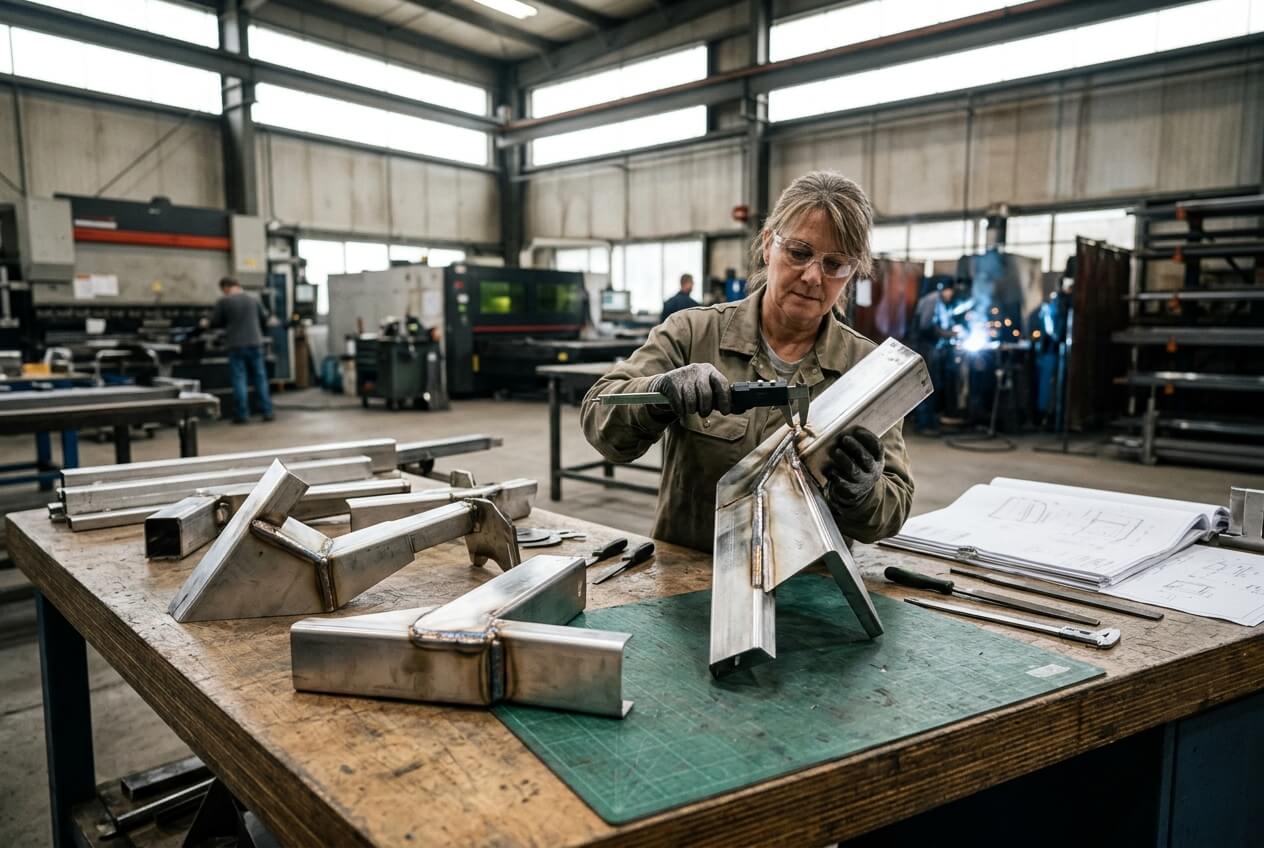
An OEM buyer sends a drawing for a powder-coated steel enclosure. The assembly includes a welded inner frame, hinge brackets, mounting holes, and a plastic cover that snaps into place. Three suppliers return prices. One quote looks attractive, but the RFQ only says “weld as required.” The drawing does not mark cosmetic seams, sealed seams, post-weld inspection dimensions, or the holes that must align during final assembly.
That small gap turns the welding of metals into a procurement risk. Each supplier may quote a different weld length, fixture method, grinding level, distortion allowance, and inspection scope. One quote may include full seam welding and dressing. Another may include short stitch welds with basic spatter removal. A third may assume manual fitting during assembly.
The drawing appears identical to the buyer. The production assumptions do not match. When that happens, price comparison becomes unreliable before fabrication even starts. The risk is not only a weak weld. It is a chain of hidden cost, delayed approval, poor fit, cosmetic rejection, and batch inconsistency.
For custom sheet metal fabrication, welded features affect cabinet squareness, door gaps, mounting hole alignment, coating appearance, packing stability, and final assembly. This article focuses on one dominant risk: unclear RFQ and drawing assumptions for welded parts. Buyers can reduce that risk by defining the welded result before they compare quotes.
Where vague weld notes make supplier quotes impossible to compare
A weld note can look harmless on a drawing. Phrases such as “weld all around,” “weld as needed,” or “clean weld” leave too much room for interpretation. The supplier must decide whether the joint needs strength, sealing, positioning, appearance, or a mix of those requirements. That decision changes the price immediately.
Continuous welding takes more labor and adds more heat. Stitch welding can reduce distortion and cost, but it may not seal a cabinet seam. Tack welding may hold a bracket during assembly, yet it may fail under vibration or handling. Plug welding may suit hidden reinforcement plates, but it needs hole size and location control. Each option creates a different manufacturing route.
A buyer may see two quotes for the same metal enclosure and assume the lower price reflects better efficiency. In reality, the cheaper supplier may have excluded weld dressing, post-weld straightening, or inspection after cooling. The higher supplier may have included those operations because the part has visible seams and tight door fit.
Example: enclosure seams quoted three ways
Consider a wall-mounted control enclosure made from 1.5 mm carbon steel. The front edge stays visible after powder coating. The back seam sits against a wall. If the RFQ does not separate those surfaces, one supplier may grind every seam flush. Another may grind only the front edge. A third may leave all weld beads as functional welds and remove only spatter.
All three suppliers can claim they followed the drawing. Only one may match the buyer’s expectation. The problem starts with unclear weld intent. It then affects labor hours, coating preparation, unit price, and acceptance criteria. The buyer discovers the gap after samples arrive, when rework costs more and lead time becomes harder to recover.
Before quoting, mark weld locations near visible panels, doors, brackets, and load points. State whether each joint needs continuous welding, stitch welding, tack welding, plug welding, or positioning welds. Also explain why the weld exists. A joint for sealing needs different treatment from a hidden joint that only prevents movement.
When Yishang reviews sheet metal drawings for welded enclosures, frames, brackets, and assemblies, the most useful RFQ notes often stay simple: visible after assembly, hidden after assembly, flush grind before coating, no cosmetic grinding required, check hole pattern after welding, or keep frame square after cooling. These notes help suppliers quote the same work.
How missing post-weld dimensions turn good laser-cut parts into bad assemblies
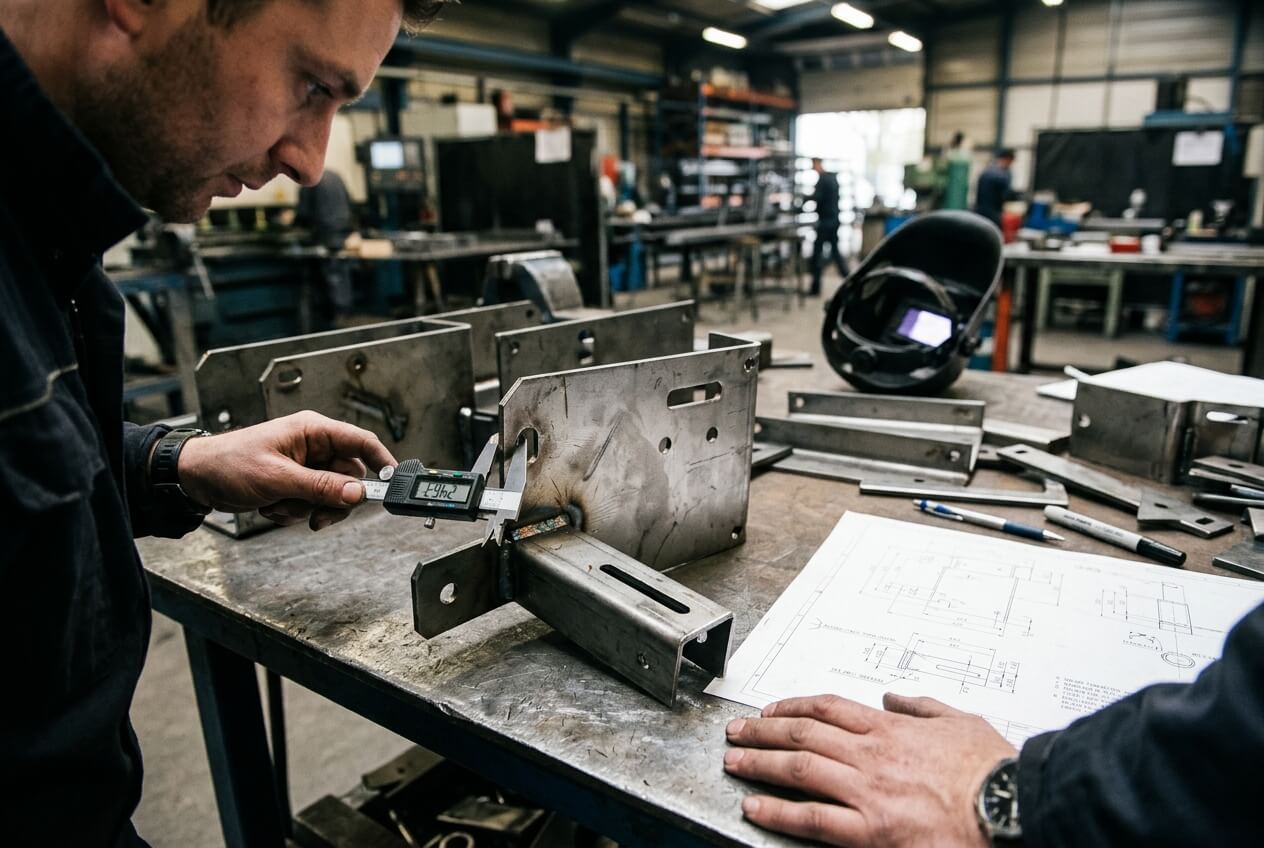
Laser cutting and bending can produce accurate parts before welding. Heat then changes the situation. Welds shrink as they cool. That shrinkage can pull a bracket, bow a panel, close a gap, or move a hole pattern. The CAD model still looks perfect, but the welded assembly may not fit the buyer’s product.
This risk often hides inside general tolerances. A drawing may apply a standard tolerance block to every dimension. The supplier then treats all dimensions as similar. In real assemblies, some dimensions matter far more than others. Hinge lines, latch points, mounting holes, mating edges, gasket surfaces, and diagonal squareness control installation.
If the RFQ does not identify these dimensions as post-weld requirements, the supplier may inspect them too early. A hole pattern can pass inspection after laser cutting. A bracket can pass after bending. After welding, the same hole pattern may shift enough to cause assembly problems.
Example: hinge bracket shift after prototype approval
An OEM orders stainless steel cabinet doors with welded hinge reinforcement plates. The drawing gives tight hinge-hole positions, but it does not say those holes must meet tolerance after welding and polishing. The prototype fits because a worker adjusts the hinge area by hand before shipment. The buyer approves the sample.
During a 300-piece batch, the same heat pull appears again. Some doors rub against the cabinet frame. Others need hand fitting. The issue did not begin with careless production. It began when the drawing failed to identify the hinge line as an assembly-critical post-weld dimension. The quote also did not include a fixture or inspection plan for that feature.
A similar chain appears with equipment frames. Four mounting plates sit on a welded rectangular frame. The buyer checks only overall length and width. After welding, the plates pull upward slightly. At the final assembly plant, the machine feet do not sit flat. Workers shim the machine, reject frames, or delay installation.
Buyers do not need to tighten every tolerance. Over-tolerancing increases cost, inspection time, and supplier confusion. Instead, highlight the dimensions that control assembly. Ask the supplier which features they will hold in a fixture, which weld sequence they will use, and which dimensions they will inspect after cooling.
Material and thickness also influence the assumption. Thin carbon steel panels can bow near long seams. Stainless steel may require extra care around discoloration and exposed surfaces. Aluminum can move more during welding and may need different fixture planning. These details matter because they affect how much control the quote must include.
Why finish expectations fail when weld appearance is priced too late
A welded part can meet strength requirements and still fail the buyer’s appearance standard. This happens when the RFQ names the final finish but does not define the welded surface before finishing. Powder coating, brushing, polishing, and plating do not erase every weld decision.
Powder coating hides color differences better than surface shape differences. It will not hide heavy weld buildup, deep grinding marks, spatter, sharp transitions, or uneven corners. A front-facing enclosure seam may need flush grinding before coating. A hidden internal bracket may need only spatter removal and safe edges.
Stainless steel display racks create another version of the same risk. Weld discoloration, polishing direction, and grinding consistency can decide whether the part looks acceptable in a retail environment. If the RFQ says only “brushed finish,” suppliers may price very different work around welded joints.
Cosmetic language needs measurable limits
Words such as “smooth,” “neat,” and “good appearance” do not protect the buyer during quotation. Smooth may mean no sharp edges to one supplier. It may mean no visible weld bead to another. It may mean no grinding wave under reflected light to the final customer.
A better RFQ separates surfaces by function. Mark A-surfaces that customers see after assembly. Mark hidden surfaces inside cabinets, under frames, or behind covers. Then define the treatment for each area. For example, the front seam may require flush grinding before powder coating. The rear seam may allow a visible bead if it has no spatter and no sharp edge.
This clarification also protects lead time. Weld grinding before coating adds labor, but it fits the normal process flow. Reworking seams after coating creates a worse chain. The supplier may need to strip the coating, regrind the weld, recoat the part, and repeat inspection. Export projects suffer even more because shipping schedules and customer launch dates leave little room for rework.
Finish details should not sit outside the welding discussion. They belong in the same RFQ review because the weld condition controls the final surface. Buyers can send reference photos, approved samples, or marked PDF notes. These tools reduce arguments over whether a visible weld shadow counts as a defect.
For projects involving metal enclosures, display racks, cabinets, and welded frames, Yishang can review drawings with the buyer to separate cosmetic weld areas from functional weld areas before pricing. That review does not need to make every surface premium. It should protect the surfaces that affect customer acceptance.
Why one approved prototype can hide repeatability cost in batch welding
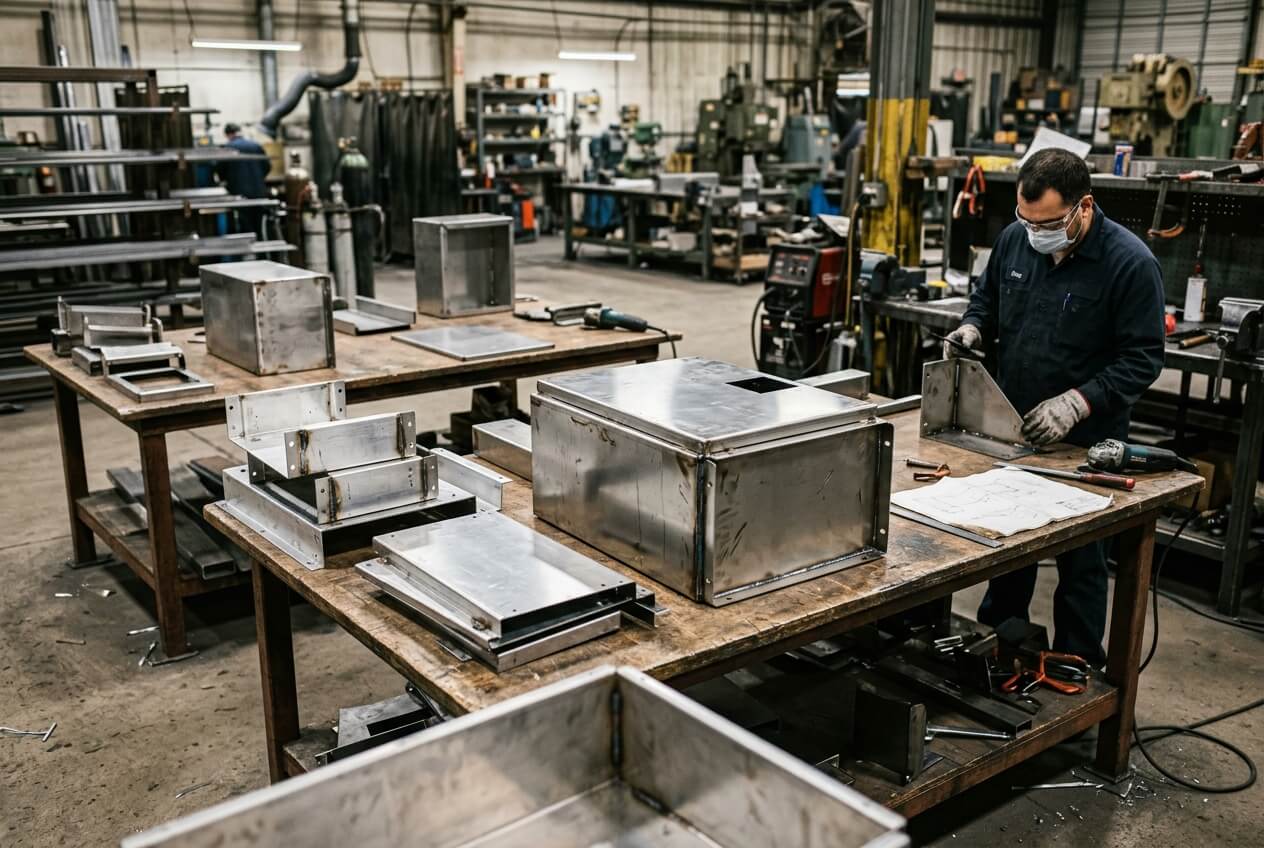
Prototype approval often gives buyers false confidence. A sample may look correct because the fabricator straightened it, opened holes, adjusted brackets, or hand-fitted a door before shipment. The buyer receives a working sample and approves it. Batch production then exposes the missing process control.
The prototype proves that the design can be made once. It does not prove that 500 parts can repeat the same result at the quoted price. Repeatability needs weld sequence control, fixtures, inspection points, and clear limits on manual correction. Without those details, production teams may spend unplanned time making each part match the approved sample.
A welded display rack shows the problem clearly. The first sample stands level because workers correct the leg angles after welding. The drawing does not capture that correction. Production begins. Small angular differences accumulate across shelves and legs. Some racks rock on the floor after packing. Others require rework before shipment.
The buyer remembers the approved sample. The supplier remembers the drawing and the quotation. That gap creates a dispute. The buyer expected repeatability. The supplier priced a process that depended on manual adjustment.
Turn sample lessons into production rules
After prototype approval, record every correction that affected fit or appearance. If workers enlarged holes, update the drawing. If a weld length changed to reduce distortion, add that note. If a fixture held a frame square, define whether batch production will use the same fixture. If a visible seam needed extra grinding, confirm whether the batch price includes it.
Inspection timing also matters. For welded sheet metal parts, inspection after cutting or bending cannot replace inspection after welding and cooling. A sensible control plan focuses on assembly-critical dimensions. It may include hole patterns, door gaps, diagonals, mounting plate flatness, bracket angles, or frame levelness.
Supplier communication should focus on process assumptions, not only delivery dates. Ask whether the prototype needed manual correction. Ask which welds caused pull or bowing. Ask which areas will use fixtures. Ask what the supplier will do if parts move outside the agreed limits. These questions protect cost, schedule, and assembly fit before batch production starts.
What to clarify before treating a welded-part quote as final
Buyers often compare welded-part quotes by unit price because purchasing schedules move fast. That approach works only when the suppliers quote the same assumptions. With welded assemblies, they often do not. The lowest price may exclude the controls that make the part usable.
Before selecting a supplier, review the quotation against the product risk. For a metal enclosure, focus on door gaps, hinge alignment, sealed corners, mounting holes, and visible powder-coated faces. For a welded frame, focus on diagonal squareness, load-bearing joints, and mounting plate flatness. For brackets and subassemblies, focus on hole alignment, mating faces, and weld access.
Cost drivers should become explicit. Weld length, weld type, fixture requirements, grinding level, post-weld inspection, packing protection, and cosmetic finishing all affect price. Lead time also changes when the part needs a dedicated fixture, sample approval, coating trials, or additional inspection after welding. A supplier cannot price these items accurately if the RFQ hides the welded result.
Do not make every weld premium. That can waste budget and slow production. Instead, separate must-have controls from low-risk details. A hidden internal weld may not need cosmetic grinding. A visible front panel seam may need careful dressing. A non-critical cover may allow wider flatness than a gasketed door.
A strong RFQ for the welding of metals includes drawings, material grade and thickness, quantities, finish requirements, critical post-weld dimensions, cosmetic surface notes, prototype history, and assembly context. If possible, include photos or samples that show acceptable weld appearance. Mark any features that must fit another part at the buyer’s plant.
If your project includes welded sheet metal parts, metal enclosures, cabinets, brackets, frames, or welded assemblies, send Yishang your drawings, material requirements, quantities, tolerances, and finish expectations. Include assembly notes, target volumes, and any prototype rework history. The team can review weld locations, distortion-sensitive features, cosmetic surfaces, and RFQ assumptions before the quotation becomes the production baseline.
Frequently Asked Questions
What weld details should buyers include in an RFQ for sheet metal parts?
Include weld locations, weld type, visible and hidden surfaces, required grinding level, sealing needs, load points, and post-weld inspection dimensions. Also note material grade, thickness, finish, quantities, and how the part fits into the final assembly.
How does welding of metals affect mounting hole alignment?
Heat from welding causes shrinkage as the joint cools. That movement can pull nearby brackets, ribs, panels, and hole patterns. Buyers should mark assembly-critical holes and require inspection after welding, not only after cutting or punching.
When should a buyer specify continuous welds instead of stitch welds?
Specify continuous welds when the joint needs sealing, higher strength, or continuous load transfer. Stitch welds may reduce heat and cost, but they may not meet sealing or strength requirements. The RFQ should state the function of each welded joint.
Why can powder coating fail to hide weld defects?
Powder coating covers color variation better than surface irregularity. It may still show weld buildup, spatter, deep grinding marks, pinholes, and uneven corners. Buyers should mark visible A-surfaces and define weld dressing before coating.
Does prototype approval guarantee batch consistency for welded assemblies?
No. A prototype may require manual straightening, hole adjustment, or extra grinding before approval. Batch consistency needs updated drawings, fixture control, weld sequence planning, and inspection points based on what happened during the sample build.
What should buyers send before requesting a quote for welded enclosures or frames?
Send 2D drawings, 3D files if available, material and thickness requirements, quantities, tolerances, finish expectations, weld appearance notes, and assembly-critical dimensions. Photos, samples, and prototype rework notes also help suppliers quote the correct process.