
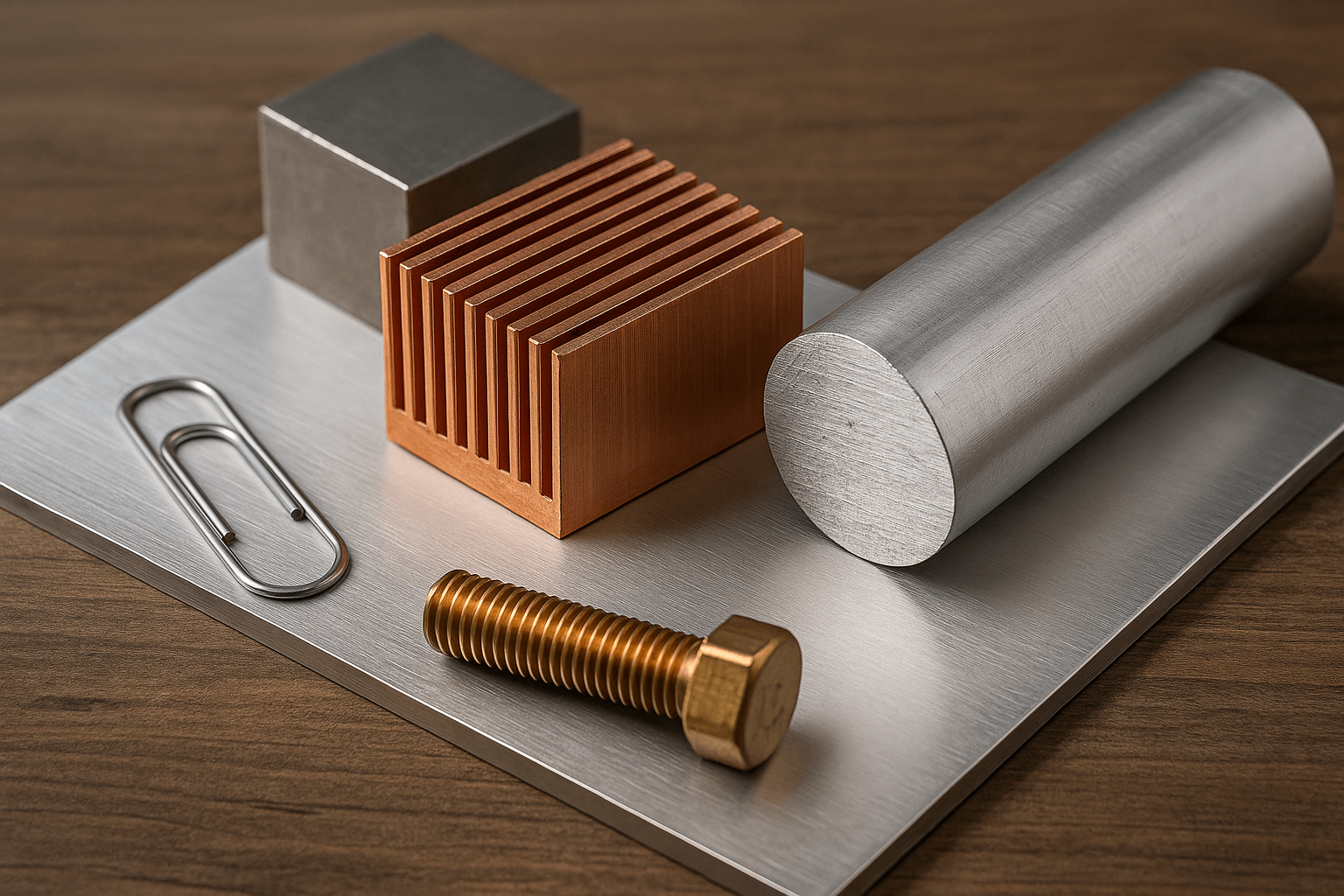
Basic Definition: What Is a Thermal Conductor?
In metal manufacturing, a thermal conductor is not just a material with a high conductivity value on a datasheet. For OEM buyers and project engineers, it is a material that must move heat efficiently and remain practical to cut, bend, weld, machine, assemble, and ship at scale.
That is why thermal design and manufacturing cannot be separated. A metal that performs well in theory may still create production difficulty, cost instability, or unnecessary scrap if the fabrication process is not matched to the material correctly.
Manufacturing Perspective: More Than Just a Number
In production, thermal conductivity is not only a product-performance property. It is also a process variable. High-conductivity metals remove heat from weld pools, cutting zones, and tooling interfaces more aggressively, which can make manufacturing less forgiving.
For buyers, this means material selection should always be evaluated together with the factory’s real process capability.
Is Air a Good Thermal Conductor? Why Air Is Your Hidden Enemy
Air is a poor thermal conductor, which is why even small interface gaps can damage thermal performance. In metal assemblies, trapped air often becomes the hidden reason a well-designed part underperforms in the field.
For procurement teams, this matters because surface contact quality, flatness control, and assembly consistency can influence thermal results almost as much as the base material itself.
Thermal Energy Conductors vs. Insulators (Simple Examples)
Thermal conductors move heat efficiently. Thermal insulators resist it. In practical product design, both are often needed: metals to carry heat away from sensitive zones, and insulating materials to block heat where transfer would be harmful.
Why Thermal Conductors Matter in Metal Parts and Enclosures
Thermal conductors matter because many industrial metal parts now serve two jobs at once: they provide mechanical structure and they also act as part of the thermal path.
This is common in battery systems, telecom cabinets, LED housings, industrial control boxes, cooling plates, and power-electronics assemblies. In these products, poor thermal design can shorten component life, increase service failures, or force expensive redesign later.
Choosing Metals for Thermal Conduction: Aluminum, Copper and Steel
For most OEM and wholesale projects, the main thermal-conductor metals are aluminum, copper, and steel. Each offers a different balance of heat transfer, weight, strength, corrosion resistance, and manufacturing practicality.
Aluminum Alloys – The Standard Choice for Heat Dissipation
Aluminum is often the default choice for thermal metal parts because it combines good heat transfer, low weight, useful corrosion resistance, and relatively favorable cost.
For fabrication, though, the alloy matters.
6061-T6 is usually stronger and more stable for CNC machining, thick plates, and machined heatsinks.
5052-H32 is usually better for sheet metal enclosures and bent parts because it forms more reliably and is less prone to cracking during bending.
For buyers, this is an important RFQ point. Writing only “aluminum” into a drawing often creates avoidable confusion, quotation variance, and production risk.
Copper (C11000 and Similar Grades) — Use Where Heat Is Extreme
Copper offers much higher thermal conductivity than aluminum, which makes it valuable where heat load is especially concentrated. But it also brings higher cost, heavier weight, and more difficult fabrication.
For most projects, copper works best in localized thermal zones rather than as the material for the entire enclosure or structure.
Stainless Steel and Low‑Carbon Steel — Structural First, Thermal Second
Steel-based materials are usually selected for structure first and thermal performance second. They are not ideal where fast heat transfer is the main requirement, but they remain useful where stiffness, durability, appearance, or corrosion performance drive the design.
This is why many real products use mixed-material strategies: aluminum or copper for heat transfer, and steel for structural support or exterior housing.
Why High‑Conductivity Metals Are Difficult to Fabricate
High-conductivity metals can be harder to fabricate precisely because they remove heat from the process zone so efficiently. That affects laser cutting, welding stability, machining behavior, and tool life.
Laser Cutting Copper and Thick Aluminum
Copper and thick aluminum can be difficult to laser cut cleanly. Their heat transfer behavior and, in copper’s case, strong reflectivity can require higher machine capability and tighter process control.
For buyers, this is a supplier-screening issue as much as a material issue.
Welding Aluminum and Copper: Heat Loss and Distortion
When welding aluminum or copper, heat leaves the weld zone faster than it does with steel. That can make fusion control more difficult and can raise distortion risk if the process is not managed properly.
Good DFM often reduces this risk by improving joint design before production begins.
CNC Machining “Gummy” or Soft Metals
Some high-conductivity metals are also soft or “gummy” in machining, which can reduce surface quality and increase tool problems. Stable machining therefore depends heavily on tool selection, fixturing, coolant, and parameter control.
The Hidden Factor: Thermal Contact Resistance (Rc)
One of the most overlooked thermal problems is contact resistance between mating parts. Even if both components are made from good thermal conductor metals, poor surface contact can limit heat flow dramatically.
Micro‑Gaps and Real Contact Area
Surfaces that look smooth to the eye are still uneven at microscopic scale. That means real metal-to-metal contact is often much smaller than the apparent area, while the rest is occupied by air gaps.
Roughness (Ra) vs. Flatness – Which Matters More?
For many thermal interfaces, flatness and contact behavior matter more than chasing extremely fine roughness values. Over-specifying surface finish can increase machining cost without delivering proportional thermal improvement.
Using Thermal Interface Materials (TIMs) Correctly
TIMs are useful for filling unavoidable gaps, but they should not be used to compensate for poor surface preparation or weak assembly design. Their performance depends strongly on thickness, compression, and coverage quality.
Cooling Metal Enclosures: Natural vs. Forced Convection
Thermal conductor parts often operate inside enclosures, so cooling strategy must be considered together with the metal part itself. In many cases, enclosure layout and airflow planning are just as important as base material choice.
Passive Cooling (Natural Convection) in Sheet Metal Enclosures
Passive cooling uses natural airflow without moving parts. It is often preferred where reliability, low maintenance, and simple long-term operation matter more than maximum cooling intensity.
Forced Convection (Fans and Filters)
Where heat density is too high for passive cooling alone, fans and filters become necessary. That adds new fabrication requirements, including mounts, service access, vibration control, and airflow-safe internal layout.
Radiation, Color and Surface Finish
Surface finish and color can also influence thermal behavior, especially in outdoor applications. Coating choice should therefore be reviewed not only for appearance and corrosion resistance, but also for emissivity and solar-gain behavior.
Practical RFQ Checklist for Thermal‑Critical Metal Parts
A strong RFQ helps suppliers quote correctly and helps buyers reduce thermal-performance risk before production begins. The clearest RFQs explain not only geometry and material, but also thermal role, contact surfaces, coating logic, interface details, and inspection priorities.
Why Work With an Experienced Metal Fabricator for Thermal Conductors
Thermal-critical metal parts demand more than basic fabrication capacity. They require a supplier that understands both heat-transfer intent and shop-floor process limitations.
For procurement teams, that means the fabricator should be able to discuss material choice, forming limits, thermal interface surfaces, cutting method, and assembly logic in the same conversation.
FAQ: Common Questions From Overseas Buyers
A. Material Selection & Thermal Conductivity
Q1: Is copper always better than aluminum for thermal conductors?
Not always. Copper moves heat better, but aluminum often gives a better overall balance of performance, cost, weight, and manufacturability.
Q2: Which aluminum alloy is best for heatsinks and cooling plates?
For machined parts, 6061-T6 is often preferred. For bent enclosures and formed sheet metal parts, 5052-H32 is often the safer production choice.
Q3: Is air a good thermal conductor?
No. Air is a poor thermal conductor, which is why even small trapped gaps can reduce interface performance sharply.
B. Manufacturing & Process Considerations
Q4: Does powder coating reduce heat dissipation?
Not necessarily. In some cases, coating can improve radiative behavior through higher emissivity, although excessive thickness or the wrong enclosure design can still work against thermal goals.
Q5: What is the best way to cut copper thermal parts?
That depends on thickness and geometry, but high-capability fiber laser systems, waterjet cutting, or mechanical cutting may each be appropriate depending on the project.
Q6: Why is 5052 aluminum commonly used for thermal enclosures?
Because it combines good corrosion resistance, stable forming performance, and practical sheet-metal manufacturability.
C. Thermal Design & RFQ Preparation
Q7: What is the “10°C Rule” in electronics?
It is a common rule-of-thumb stating that increased operating temperature can significantly reduce component life, which is why thermal control matters so much in enclosure and parts design.
Q8: What should I include when preparing a thermal‑critical RFQ?
Include the material and temper, thermal role of the part, contact-surface requirements, coating details, interface/TIM information, and any temperature or inspection expectations relevant to the product.
Conclusion
At Yishang Metal Products Co., Ltd., we support OEM and wholesale customers with custom metal fabrication for heatsinks, cooling plates, enclosures, structural frames, and other industrial metal parts where thermal behavior matters alongside manufacturing precision. With 26+ years of manufacturing experience, we support processes including laser cutting, bending, stamping, welding, CNC machining, surface treatment, assembly, packaging, inspection, and shipment.
For projects involving thermal-critical metal parts, we help customers align material choice, fabrication route, interface requirements, and export-ready quality control with real application needs.
📩 If you are evaluating heatsinks, cooling enclosures, or other thermal-management metal parts for your next project, send us your drawings or requirements to discuss the most suitable manufacturing approach.