I. Introduction — Written for How Wholesale Buyers Actually Search
When a procurement manager types “what is sheet metal used for”, “define sheet metal,” or “sheet metal definition,” they are not looking for a school-style explanation. They want clarity that helps them make sourcing decisions:
- Is sheet metal suitable for my product?
- How will it affect cost, lead time, durability, and shipping?
- What risks should I avoid before mass production?
- How do I evaluate suppliers by their true capabilities rather than their quotes?
Most articles online only list industries or provide shallow definitions. This guide is written specifically for overseas wholesale buyers, sourcing teams, brand owners, and OEM/ODM procurement managers.
It combines practical engineering knowledge, real-world manufacturing logic, and buyer‑side decision frameworks, created from YISHANG’s 26+ years of OEM sheet metal fabrication experience supplying global industrial customers.
To ensure SEO clarity, let us begin with a concise, Google‑friendly definition.
II. Sheet Metal Definition — A Clear Answer in Simple Terms
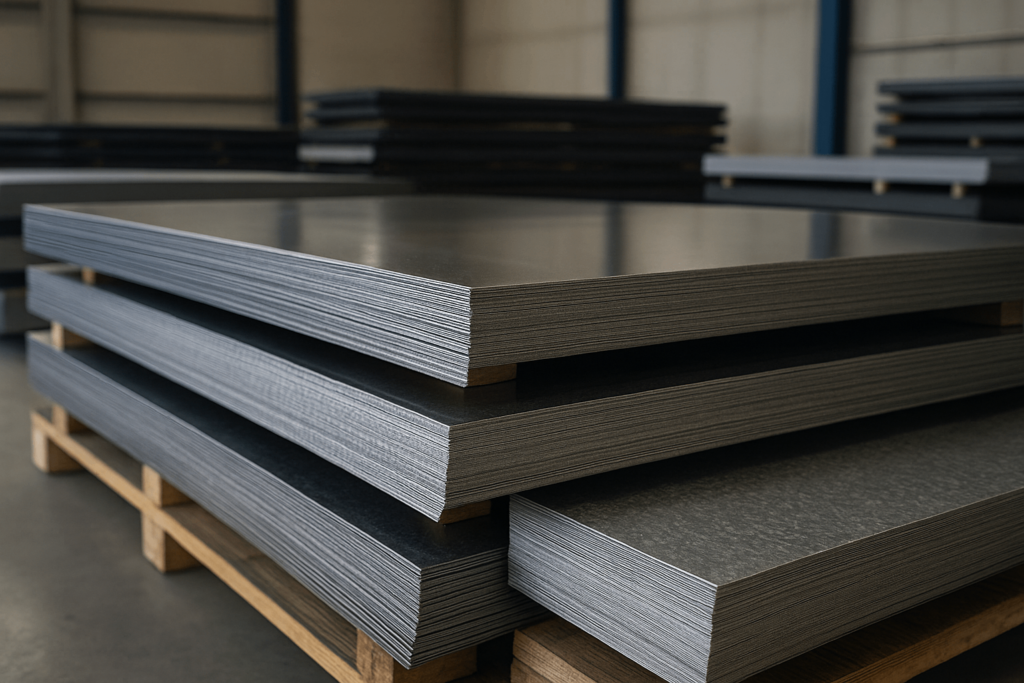
Sheet metal is metal formed into thin, flat pieces—typically between 0.5 mm and 6 mm thick—that can be precisely cut, bent, and shaped to create functional parts and structural components.
It is widely used because it combines strength, manufacturability, cost‑efficiency, and design flexibility. Common sheet metals include mild steel, galvanized steel, stainless steel 304/316, and aluminium alloys.
This definition directly addresses queries such as define sheet metal, sheet metal definition, and what is sheet metal used for.
III. Quick Summary — What Sheet Metal Is Commonly Used For
Before we dive into engineering logic, here is a concise overview of typical sheet‑metal applications:
- Enclosures and cabinets (electrical boxes, control panels, telecom housings)
- Equipment frames and structural racks (vending machines, kiosks, EV chargers)
- Machine covers and protective guards
- OEM components for industrial, automotive, HVAC, and appliance sectors
- Panels, doors, and user‑interaction surfaces
- HVAC ducting, roofing, and architectural cladding
These represent the most frequently searched sheet metal applications across global B2B markets.
Now we move to the real core—why engineers choose sheet metal and what this means for procurement decisions.
IV. Sheet Metal as a Structural and Manufacturing Language
Experienced engineers treat sheet metal not as a commodity but as a design and fabrication language. Understanding this perspective helps buyers evaluate supplier capabilities, pricing structures, quality risks, and long‑term manufacturability.
Sheet Metal Gains Strength From Geometry
Instead of relying solely on thickness, sheet metal becomes strong through engineered forms:
- bends
- flanges
- box sections
- channels
These geometries let 1.0–2.0 mm steel achieve high rigidity, which is why so many commercial products—industrial cabinets, battery enclosures, EV charging housings, vending machines—use sheet-metal structures.
The Flat‑to‑Form Manufacturing Workflow
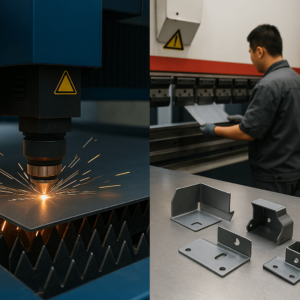
A standard sheet metal fabrication process includes:
- Cutting — CNC laser, punching, or turret press
- Bending — press‑brake forming with precise tooling
- Welding & assembly — spot welding, MIG/TIG, riveting, fastening
- Surface finishing — powder coating, anodizing, galvanizing, brushing
For buyers, this workflow means:
- predictable lead times
- inexpensive design changes
- consistency from prototype to mass production
- scalable cost structures
- easier supplier benchmarking
This is why sheet metal is a dominant choice in OEM manufacturing.
V. Engineering Conditions That Naturally Lead to Sheet‑Metal Solutions
Rather than listing industries, the most accurate way to understand sheet-metal usage is to examine the engineering conditions that make it the logical choice.
These conditions directly influence a buyer’s sourcing decisions.
1. When the Product Must Withstand Load, Stress, or Impact
Sheet metal is used in structural components when a product must survive:
- transportation and handling
- long‑term vibration
- equipment weight loads
- installation impacts
Common examples:
- internal machine frames
- EV charger skeletons
- vending machine structures
- rack systems and industrial stands
Buyer impact:
- Poor structure → deformation, twisting, warranty claims
- Good sheet‑metal design → stability, longevity, fewer after‑sales costs
2. When Precision and Repeatability Are Needed at Scale
CNC cutting and bending provide tight tolerances:
- typically ±0.1–0.3 mm depending on material and thickness
For buyers, this translates into:
- consistent assembly fit
- reduced rework
- cross‑batch interchangeability
During RFQs, ask suppliers about:
- tolerance standards (e.g., ISO 2768)
- tooling accuracy
- inspection reports (FAI, PPAP)
- process capability management
These answers reveal whether a supplier is experienced or merely quoting low prices.
3. When Durability and Environmental Resistance Matter
Many products sourced for global markets face humidity, UV exposure, chemicals, cleaning cycles, or coastal corrosion.
Sheet metal excels when material and finish are correctly selected:
- Stainless steel 304/316 — high corrosion resistance
- Galvanized steel (GI/SGCC) — outdoor durability at manageable cost
- Aluminium alloys — lightweight + corrosion resistance
- Cold‑rolled steel + powder coating — economical for indoor applications
Procurement relevance:
- incorrect coating → early rust, discoloration, field failures
- wrong material → high complaint rate and replacement cost
This is why “environment‑fit material selection” is a critical buyer responsibility.
VI. Functional Uses of Sheet Metal — A Buyer‑Centric Explanation
Unlike most competitor articles, this section categorizes sheet‑metal usage by functional role rather than industry. This gives procurement teams clearer insight into performance, cost drivers, and supplier capabilities.
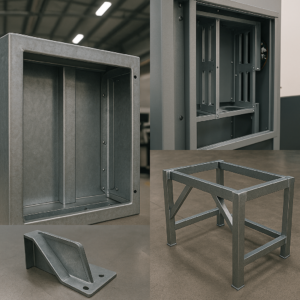
1. Protective Enclosures & Housings
Used in:
- industrial cabinets
- telecom boxes
- vending machine shells
- charging station housings
- power‑system enclosures
Why sheet metal?
- impact resistance
- stable mounting points
- EMI shielding potential
- ventilation design flexibility
Buyer considerations:
- flatness affects door alignment
- stiffening design affects vibration
- powder‑coat quality affects long‑term appearance
- hinge & lock alignment impacts user experience
2. Structural Frames, Racks & Load‑Bearing Modules
Sheet metal can be shaped into rigid frameworks replacing heavier solid profiles.
Buyer benefits:
- customizable strength without high material usage
- knock‑down structural designs reduce container volume
- precision welding ensures stable assembly
Supplier capability indicators:
- welding fixturing
- bending consistency
- large‑frame experience
3. Thermal Management & EMC Functions
Sheet metal supports heat dissipation and electrical conductivity, essential for:
- power equipment
- energy storage systems
- LED drivers and luminaires
- telecom housings
Buyer impact:
- material choice affects heat performance
- coating may influence grounding paths
- airflow cutouts must align with thermal design
4. User‑Facing Panels & Access Points
These parts control the end‑user’s perception of quality.
Issues like warping, misalignment, and poor coating are major complaint drivers.
Procurement focus:
- reinforcement of large doors
- surface grain direction
- powder‑coating curing consistency
- protective packaging for shipping
VII. Risks, Limitations & Common Failure Points Buyers Must Know
Even excellent sheet‑metal designs can fail if constraints are ignored.
Typical risks include:
■ Geometries not suited for sheet metal
Deep curves, sculpted shapes, and complex contours require casting or machining. Forcing them into sheet metal causes:
- excessive welding
- distortion
- unpredictable tolerances
■ Poor bending and hole‑placement decisions
- holes too close to bends → deformation
- insufficient bend radius → cracking
- no springback compensation → angle errors
■ Welding‑induced deformation
Improper heat control leads to:
- oil‑canning on large panels
- warped edges
- inconsistent appearance
■ Material–environment mismatch
- indoor coating used outdoors → rapid rust
- mild steel in coastal markets → early failure
A knowledgeable supplier should proactively identify these risks during DFM—not hide them until mass production.
VIII. A Practical Decision Framework for Procurement Teams
To help buyers make confident decisions, here is a structured evaluation workflow.
Step 1 — Identify the Component’s Core Function
Is it structural? Protective? Thermal? Aesthetic?
Function determines material and thickness choices.
Step 2 — Confirm the Geometry Is Fabrication‑Friendly
Request DFM feedback early. If multiple suppliers raise the same concern, the design likely needs modification.
Step 3 — Align Tolerances With Realistic Capabilities
Overtight tolerances = higher cost + lower yield.
Over‑loose tolerances = assembly problems.
Use ISO 2768 for baseline guidance.
Step 4 — Match the Finish to Real‑World Environment
- galvanized → outdoors
- powder coating → indoor/general outdoor
- stainless steel → hygiene/chemical resistance
- anodized aluminium → lightweight outdoor parts
Step 5 — Validate Through Prototypes
Samples reveal:
- fit & alignment
- structural rigidity
- surface quality
- packaging effectiveness
This stage prevents expensive surprises in mass production.
IX. FAQs About Sheet Metal for Wholesale Buyers
1. What is sheet metal in simple terms?
Sheet metal is thin, flat metal shaped by cutting and bending to produce components such as enclosures, frames, and panels. It typically ranges from 0.5 mm to 6 mm thick.
2. What thickness is considered sheet metal?
Engineering references commonly classify sheet metal as below 6 mm. Above that range, it is often called plate.
3. What are the most common industrial uses of sheet metal?
Enclosures, cabinets, structural frames, HVAC systems, panels, guards, machine covers, and architectural components.
4. How do I know if a design is appropriate for sheet metal fabrication?
If the part can be unfolded into a flat pattern and formed with reasonable bending angles, it is likely suitable. Deep curves or heavy sculpting indicate the need for another manufacturing method.
5. What should I include in an RFQ for sheet metal parts?
Material grade, thickness, tolerances, finish specifications, assembly requirements, usage environment, and sample approval standards.
X. Why This Knowledge Matters for Procurement Teams
Understanding sheet metal allows buyers to:
- compare suppliers beyond price
- spot unrealistic promises early
- avoid over‑engineered or risky designs
- reduce long‑term field‑failure rates
- create more stable supply chains
Technical literacy empowers procurement teams to secure reliable, scalable, and cost‑efficient manufacturing partnerships.
XI. Conclusion — Sheet Metal as a Strategic Sourcing Choice
Sheet metal is widely used not simply because it is common, but because it reliably meets structural, functional, and durability requirements across countless commercial products.
For wholesale buyers, the real advantage lies in understanding when sheet metal is the right choice—and how to select suppliers and designs that minimize risk.
If you are evaluating a new OEM/ODM project or need practical manufacturability guidance, YISHANG can support you with engineering feedback and feasibility reviews. A short conversation often prevents costly redesign and accelerates your path to stable production.