

Introduction
Tampo printing, more widely known as pad printing, is a high-precision marking method used to transfer logos, symbols, serial marks, and functional graphics onto flat, curved, textured, and irregular surfaces. In industrial sourcing, it is valued not just for print quality, but for something even more important: repeatability across large production runs.
For overseas buyers, especially those sourcing OEM and ODM parts, the question is rarely “What is pad printing?” in a general sense. The more practical question is whether the process can deliver durable, compliant, and visually consistent marks on the actual materials used in mass production.
That is where tampo printing stands out. It works well on metal, plastic, coated components, and shaped housings, making it highly relevant for industries such as electronics, medical devices, appliances, vending systems, automotive parts, and industrial controls.
This guide explains tampo printing from a procurement and production perspective—including how the process works, where it performs best, what quality risks buyers should watch for, and how to evaluate a supplier before placing volume orders.
Why Tampo Printing Is a Strategic Fit for Industrial Procurement
For procurement teams, a printing method has value only when it supports three things at the same time: consistency, substrate flexibility, and inspection reliability. Tampo printing performs well on all three.
Unlike processes that require a flat or highly standardized surface, pad printing adapts to small parts, curved housings, recessed areas, textured plastics, and coated metal components. That gives it a clear advantage in production environments where components vary in shape but still need sharp, repeatable marks.
From a sourcing standpoint, tampo printing helps reduce:
batch-to-batch visual inconsistency
rejected parts caused by distorted graphics
pre-shipment disputes over symbols, logos, or label legibility
rework caused by poor mark positioning on irregular surfaces
It is particularly useful when buyers need regulatory icons, durable small-format labeling, or multi-color branding without redesigning the part around the printing method.
What Is Tampo (Pad) Printing? From Swiss Precision to Scalable Manufacturing
Tampo printing originated in the Swiss watch industry, where manufacturers needed a reliable way to print extremely fine graphics onto very small, uneven parts. That same principle is now widely used in industrial manufacturing, but on a much broader scale.
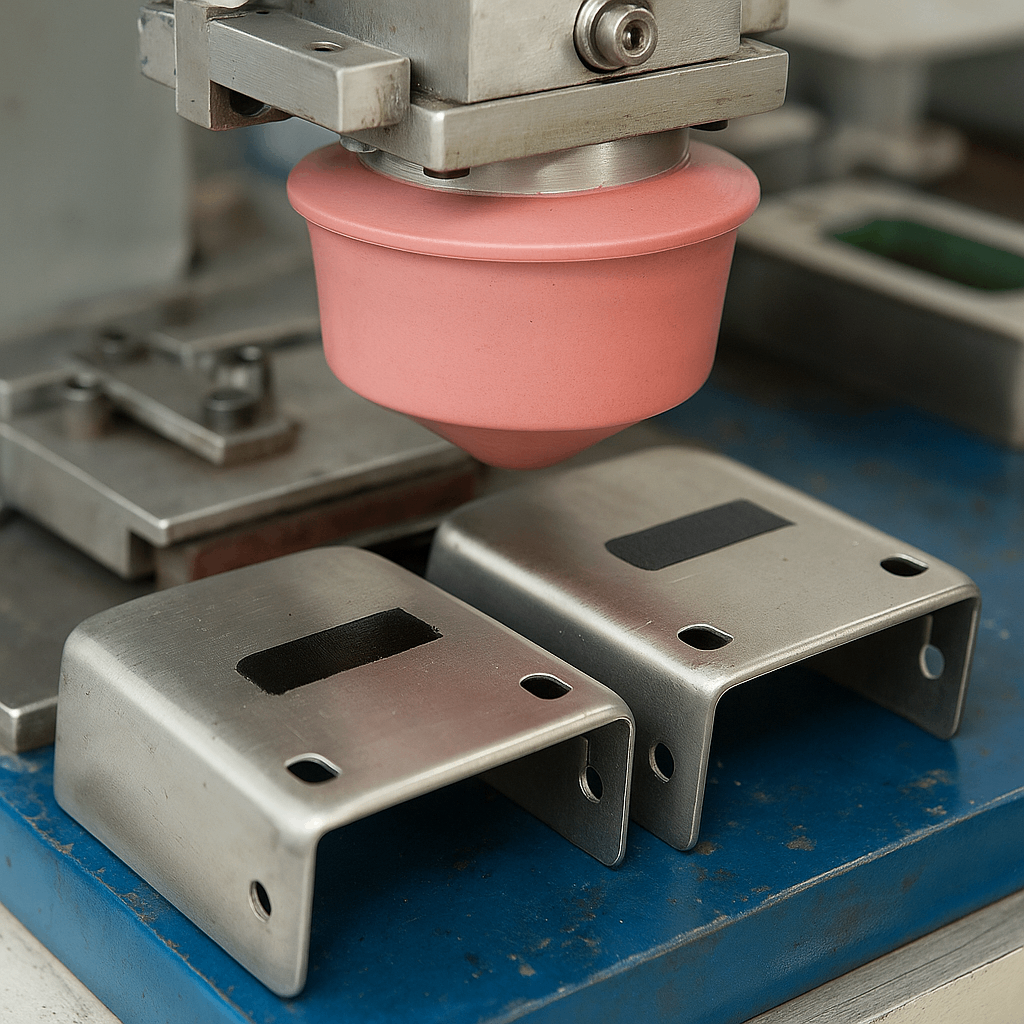
The process uses a flexible silicone pad to pick up ink from an etched plate and transfer it onto the part surface. Because the pad can deform slightly during contact, it can print onto surfaces that would be difficult for flat-contact methods to handle.
That makes tampo printing especially useful for:
buttons and control panels
medical housings and device shells
consumer appliance components
metal and plastic enclosures
curved or recessed industrial parts
In modern production, pad printing is no longer limited to small decorative markings. It now supports serial identification, functional symbols, warning marks, compliance icons, and brand graphics across high-volume manufacturing programs.
How the Tampo Printing Process Works — In Buyer-Relevant Terms
At a process level, tampo printing is straightforward: ink is transferred from an etched plate to a silicone pad, then from the pad to the part surface. What makes it industrially valuable is the level of control possible at each stage.
Basic Process Flow
| Step | What Happens | Why It Matters to Buyers |
| 1. Plate preparation | The artwork is etched into a cliché plate | Defines print accuracy and repeatability |
| 2. Ink pickup | The silicone pad lifts ink from the etched image | Controls print clarity and transfer stability |
| 3. Transfer to part | The pad deposits the image onto the component | Allows printing on curved or uneven surfaces |
| 4. Drying or curing | Ink sets through solvent evaporation or UV curing | Affects durability, adhesion, and handling speed |
For procurement teams, the real concern is not the mechanics alone. It is whether the process stays stable across long production runs, multiple SKUs, and different substrates.
A good tampo printing line should control:
print registration
pad pressure and pad hardness
ink viscosity
fixture repeatability
drying or curing consistency
These are the factors that determine whether a printed icon still looks sharp after packaging, shipping, and end use.
Core Elements Behind Reliable Tampo Print Quality
1. Material Compatibility and Surface Preparation
Tampo printing works on a wide range of substrates, including:
stainless steel
aluminum
ABS
polycarbonate
painted or powder-coated components
But material compatibility is not automatic. Adhesion depends heavily on surface energy, cleanliness, and pretreatment.
For example, components may require:
flame treatment
corona treatment
surface cleaning or degreasing
controlled handling to avoid oil contamination
This is especially important on parts exposed to frequent contact, abrasion, or repeated handling, such as switch panels, machine buttons, casings, and operator controls.
2. Ink Selection and Regulatory Fit
The ink system matters just as much as the printing equipment. In industrial pad printing, the most common choices are:
| Ink Type | Main Strength | Common Buyer Consideration |
| Solvent-based ink | Strong adhesion on many industrial materials | Often preferred for metal and coated parts |
| UV-curable ink | Fast curing and lower VOC profile | Useful where cycle speed and environmental fit matter |
In regulated sectors such as medical, cosmetics, food-adjacent equipment, and electronics, buyers should confirm whether the ink system aligns with requirements such as:
RoHS
REACH
customer-specific material restrictions
traceability requirements for exported products
How Tampo Printing Solves Real Production Problems
Small-Format Legibility
Some applications require marks that remain readable even when printed at very small size. This is common in:
medical devices
electronics housings
appliance controls
serialized industrial components
Tampo printing is well suited to this because it can deliver fine detail on compact parts, including:
micro logos
serial numbers
data codes
small regulatory symbols
3D and Irregular Surface Printing
Many industrial parts are not flat. Buttons, knobs, housings, and molded shells often have curves, recesses, or angled surfaces. The silicone pad can conform to these shapes better than flat-print methods, making tampo printing a practical solution where screen or digital printing would be more limited.
Durable Multi-Color Branding
For products that need brand recognition in the field, tampo printing supports repeatable multi-color image transfer without major distortion. This is valuable in appliances, vending equipment, tools, and branded industrial products where appearance must remain consistent across large batches.
Functional and Compliance Labeling
In many export programs, the printed content is not decorative—it is functional. Buyers may need:
warning symbols
operating icons
CE or other compliance marks
part identification linked to audits or warranty systems
That makes print durability a quality issue, not just a branding issue.
Why Tampo Printing Often Outperforms Other Printing Methods in Procurement Contexts
When buyers compare printing processes, the best option depends on surface geometry, batch size, print precision, and compliance requirements.
Comparison Table
| Feature | Tampo Printing | Screen Printing | Digital Printing |
| 3D Surface Compatibility | Excellent | Poor | Limited |
| Fine Detail Resolution | High | Moderate | Moderate |
| Multi-Color Registration | High | Lower on complex parts | Moderate |
| Suitability for Irregular Parts | Strong | Weak | Limited |
| Mass-Production Unit Economics | Efficient | Labor-dependent | Setup and substrate dependent |
| Compliance / Functional Marking | Strong | Conditional | Inconsistent in some industrial uses |
From a procurement perspective, tampo printing is often preferred because it combines shape flexibility, repeatable detail, and scalable output in one process.
Evaluating a Supplier’s Tampo Printing Capabilities
Before approving a supplier, buyers should look beyond sample photos. The real question is whether the factory can maintain adhesion, print registration, and batch consistency across actual production volume.
What Buyers Should Ask For
test prints on the actual substrate
ink specifications and curing method details
pad hardness range and pad replacement logic
evidence of pretreatment methods
defect control records for alignment, ghosting, or smearing
Useful Supplier Checkpoints
| Capability Area | What to Confirm |
| Pad selection | Whether Shore hardness is chosen based on part geometry and detail requirements |
| Print resolution control | Minimum line width or detail level the supplier can hold consistently |
| Surface prep | How the factory prepares coated, metal, or plastic parts before printing |
| Ink curing | Whether UV or solvent curing is validated and recorded |
| Compliance support | Availability of RoHS, REACH, or customer-specific material declarations |
| Quality documentation | Adhesion tests, curing logs, print validation, and inspection records |
A strong tampo supplier should be able to explain why the print process works, not just show that one sample looked good.
Can Tampo Printing Scale with Demand?
One of the most practical buyer concerns is scalability. A process may look excellent in sampling, but fail when order quantities increase. Tampo printing is attractive because it can scale from small validation batches to high-volume repeat production without requiring a completely different marking method.
That makes it suitable for programs where buyers need:
consistent print quality across repeat orders
multi-SKU management
stable marking on different part geometries
fast turnover for export-oriented manufacturing
When integrated well into upstream fabrication and downstream assembly, tampo printing supports smoother mass production and fewer last-minute inspection issues.
Conclusion: Smart Part Marking Starts with Process Control
Tampo printing remains one of the most practical industrial marking methods for buyers who need precision, flexibility, and scalable production performance.
Its value is especially clear when the application involves:
irregular or curved surfaces
small but readable functional marks
multi-color branding
repeatable compliance labeling across large batches
For B2B procurement teams, the real advantage of tampo printing is not just the print itself. It is the ability to combine visual consistency, material compatibility, and audit-ready process control into one reliable production method.