
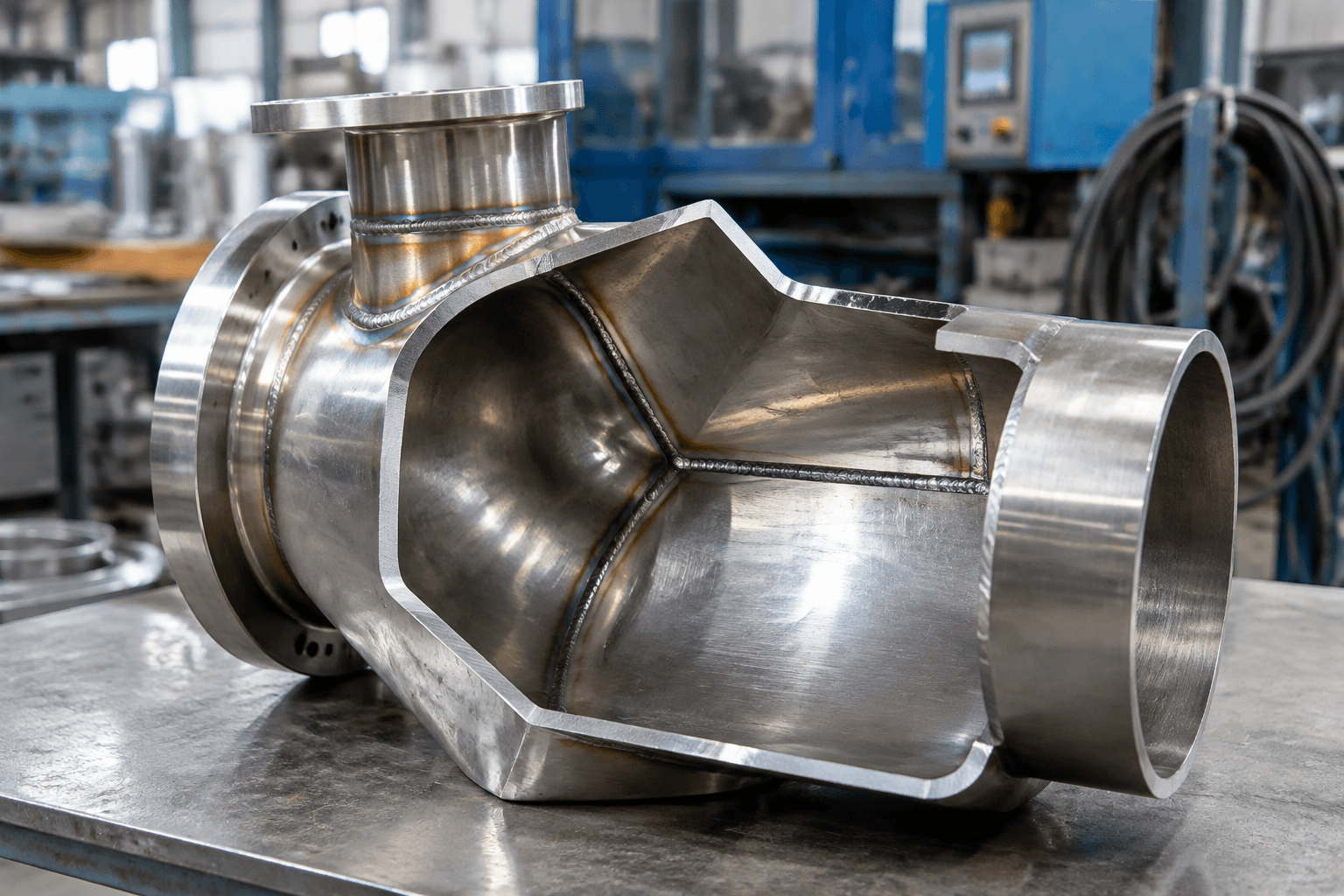
304 stainless steel can tolerate many heated environments, but it does not have one universal maximum safe-use temperature. Its suitability depends on what must be prevented: oxidation, scaling, loss of strength, creep, distortion, sensitization, unacceptable discoloration, or melting. The exposure pattern, atmosphere, mechanical load, and fabricated-part geometry determine which limit controls the design.
A published temperature is meaningful only when it is connected to a material specification, product condition, test method, exposure duration, atmosphere, and acceptance criterion. A temperature associated with oxidation behavior, for example, cannot automatically be used as the allowable temperature for a load-bearing bracket or a tightly toleranced welded enclosure.
Heat Resistance Is Not a Single Material Property
The phrase 304 stainless steel heat resistance often combines several properties that must be evaluated separately. Stainless steel may remain solid and appear intact while losing mechanical strength, changing dimensions, developing surface scale, or becoming less resistant to corrosion in a particular environment.
| Heat-related property | Question it answers | What it does not establish |
|---|---|---|
| Oxidation resistance | How well does the exposed surface resist reaction with a hot atmosphere? | Load capacity or dimensional stability |
| Elevated-temperature strength | How much strength remains at the operating temperature? | Long-term resistance to creep |
| Creep resistance | Will the material deform gradually under sustained load and heat? | Performance during short, unloaded temperature peaks |
| Thermal expansion and distortion | How much movement or shape change may occur as the part heats and cools? | Resistance to scaling or corrosive attack |
| Metallurgical stability | Can time at temperature change the microstructure or corrosion behavior? | A universal safe operating limit |
| Melting range | When does the alloy begin transitioning from solid to liquid? | An allowable service temperature |
This separation matters during material selection. A thin heat shield with no structural load may be governed by oxidation, distortion, or appearance. A loaded support may instead be governed by strength retention and creep. A welded vessel or food-equipment component may require additional attention to heat tint, sensitization, cleaning exposure, surface finish, and contamination. The same grade designation does not make these applications equivalent.
Heat-Related Failure Modes in 304 Stainless Steel
Heating can produce several independent or interacting failure modes. The relevant concern should be identified before a temperature figure is accepted.
| Failure mode | What may be observed | Conditions that influence it |
|---|---|---|
| Oxidation and scaling | Oxide growth, roughening, flaking, or material loss at the surface | Temperature, time, oxygen availability, combustion gases, contaminants, and surface condition |
| Discoloration | Heat tint or color change without necessarily causing immediate structural failure | Peak temperature, exposure time, atmosphere, finish, and aesthetic acceptance limits |
| Strength loss | Reduced ability to carry an applied load while hot | Temperature, material condition, load direction, section size, and design safety requirements |
| Creep | Permanent, time-dependent deformation under sustained stress | Temperature, stress, dwell time, geometry, and expected service life |
| Distortion | Warping, bowing, joint movement, or loss of assembly fit | Thermal gradients, restraint, sheet thickness, bends, welds, and uneven section geometry |
| Thermal-cycle damage | Progressive movement, loosening, cracking, or fatigue near restrained features | Heating and cooling rate, cycle count, expansion mismatch, joints, and stress concentrations |
| Sensitization | Microstructural changes that can reduce corrosion resistance in susceptible conditions | Composition, prior processing, time-temperature history, weld heat input, and later corrosive exposure |
| Melting | Loss of the solid material state | Alloy composition and actual metal temperature |
Sensitization also should not be confused with sigma-phase discussions. A statement about whether a phase is likely to form within a particular metallurgical study does not establish general heat resistance, structural suitability, or a safe service-temperature range. The component still has to be checked against its actual atmosphere, load, duty cycle, surface requirements, and fabrication condition.
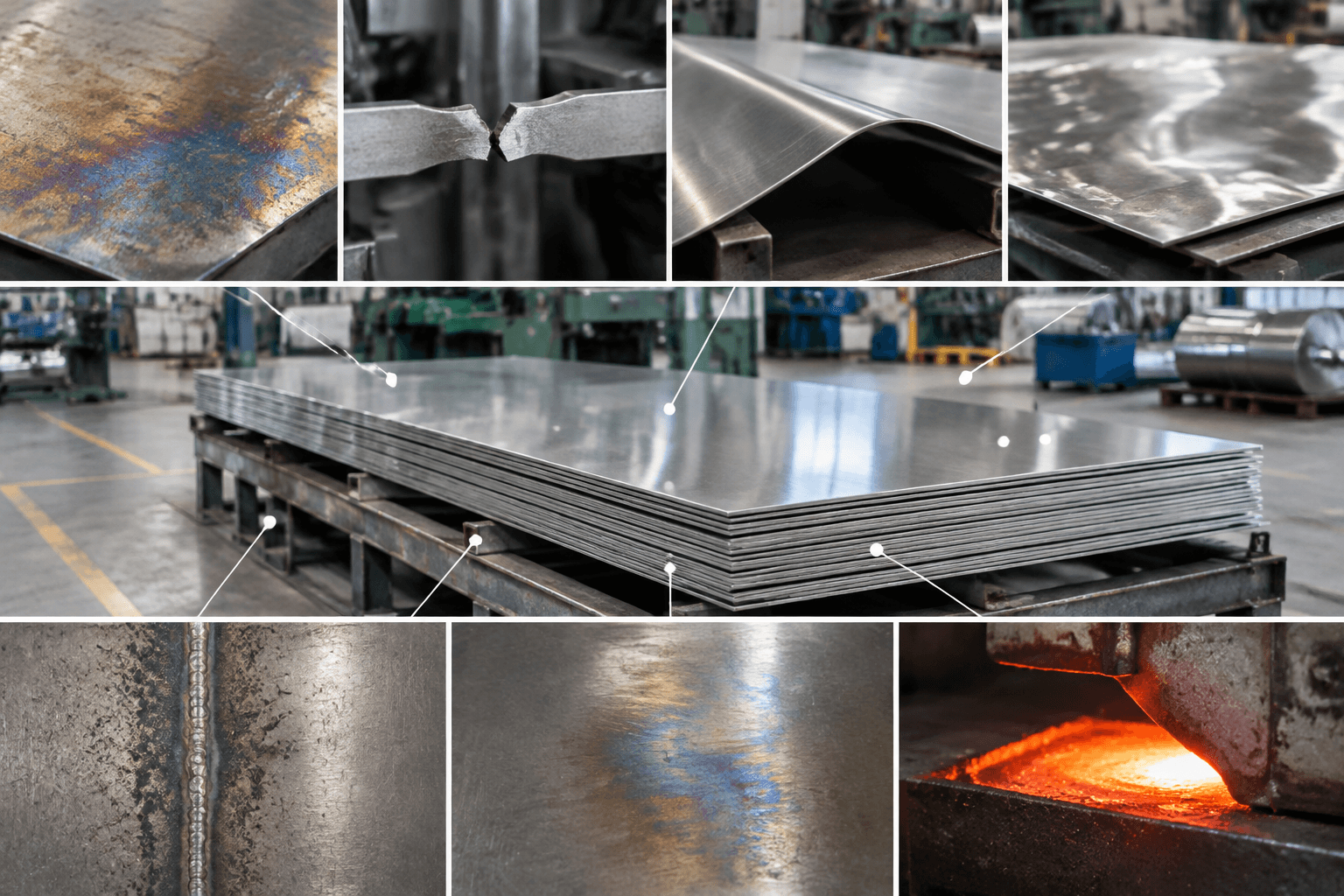
Service Conditions That Decide Whether 304 Is Suitable
Continuous exposure gives oxidation, creep, and metallurgical changes more time to develop. Data used for this duty should cover an appropriate duration and atmosphere, not merely show that a specimen survived a short laboratory exposure.
Short temperature peaks may not produce the same long-term oxidation or creep as continuous operation, but they can still reduce strength temporarily, create thermal gradients, discolor the finish, or move a thin assembly out of tolerance. Peak duration, heating rate, and whether the part is loaded during the event all matter.
Repeated thermal cycles introduce another problem: expansion and contraction occur again and again. A sheet panel, welded frame, fastener, and attached component may not expand by the same amount or at the same rate. Restrained movement can accumulate deformation or concentrate stress around corners, weld toes, mounting holes, and thin-to-thick transitions.
The atmosphere can be as important as temperature. Clean air, oxygen-poor gas, humid exhaust, sulfur-bearing gases, salt deposits, cleaning residues, and process chemicals do not create the same surface reaction. Molybdenum makes 316 useful in some corrosive environments, but that corrosion advantage does not prove that 316 is automatically the better material for every high-temperature application.
Mechanical demand must also be explicit. An unloaded cover has a different acceptance criterion from a shelf, bracket, rack, pressure-retaining component, or fixture carrying weight while hot. The engineer should use temperature-dependent material data applicable to the specified product form and condition, then apply the relevant design rules for the component.
Match the Service Condition to the Property That Matters
| Service condition | Primary concern to investigate | Information needed for review |
|---|---|---|
| Long exposure in hot air | Oxidation, scaling, strength retention, and creep if loaded | Continuous temperature, total duration, atmosphere, load, and allowable surface change |
| Brief startup or fault peak | Temporary strength reduction, thermal gradient, distortion, and discoloration | Peak metal temperature, dwell time, heating rate, load state, and recovery requirement |
| Frequent heating and cooling | Thermal fatigue, joint movement, fastener loosening, and loss of fit | Temperature range, cycle frequency, restraint, joint design, and expected cycle life |
| Hot process with chemical residue | Combined oxidation and corrosion | Chemical identity, concentration, deposits, humidity, cleaning method, and temperature |
| Thin cosmetic panel near a heat source | Discoloration, oil canning, bowing, and finish variation | Heat-source location, temperature distribution, thickness, finish, and visual standard |
| Welded load-bearing assembly | Strength retention, creep, weld-zone condition, and distortion | Load, weld locations, joint restraint, duty cycle, dimensions, and inspection criteria |
Published figures should be checked against four questions: Who produced the data? Under what test or service condition? For how long was the material exposed? What counted as failure? A recommended oxidation range, a tensile test at temperature, and a melting range answer different engineering questions. Combining them into a single “304 stainless steel heat resistance chart” can create a false pass-or-fail boundary.
Why the Fabricated Part May Behave Differently From a Test Specimen
A material-data specimen is usually simpler than a production component. A fabricated part can contain broad panels, narrow flanges, formed corners, cutouts, spot or seam welds, fasteners, and sections exposed to different temperatures. These features change restraint and heat flow.
Thickness: Thin sheet responds quickly to local heating and has less stiffness against bowing. A thicker section may heat more slowly, creating a temperature difference where it joins a thin wall. Thickness alone does not determine suitability; span, support, temperature distribution, and load must be considered together.
Bends and formed features: Bends stiffen panels but can also restrain thermal movement. Closely controlled hole positions, return flanges, and mating edges may shift if expansion is not accommodated. For custom sheet metal enclosures around heat-producing equipment, assembly clearance can be as important as the nominal alloy grade.
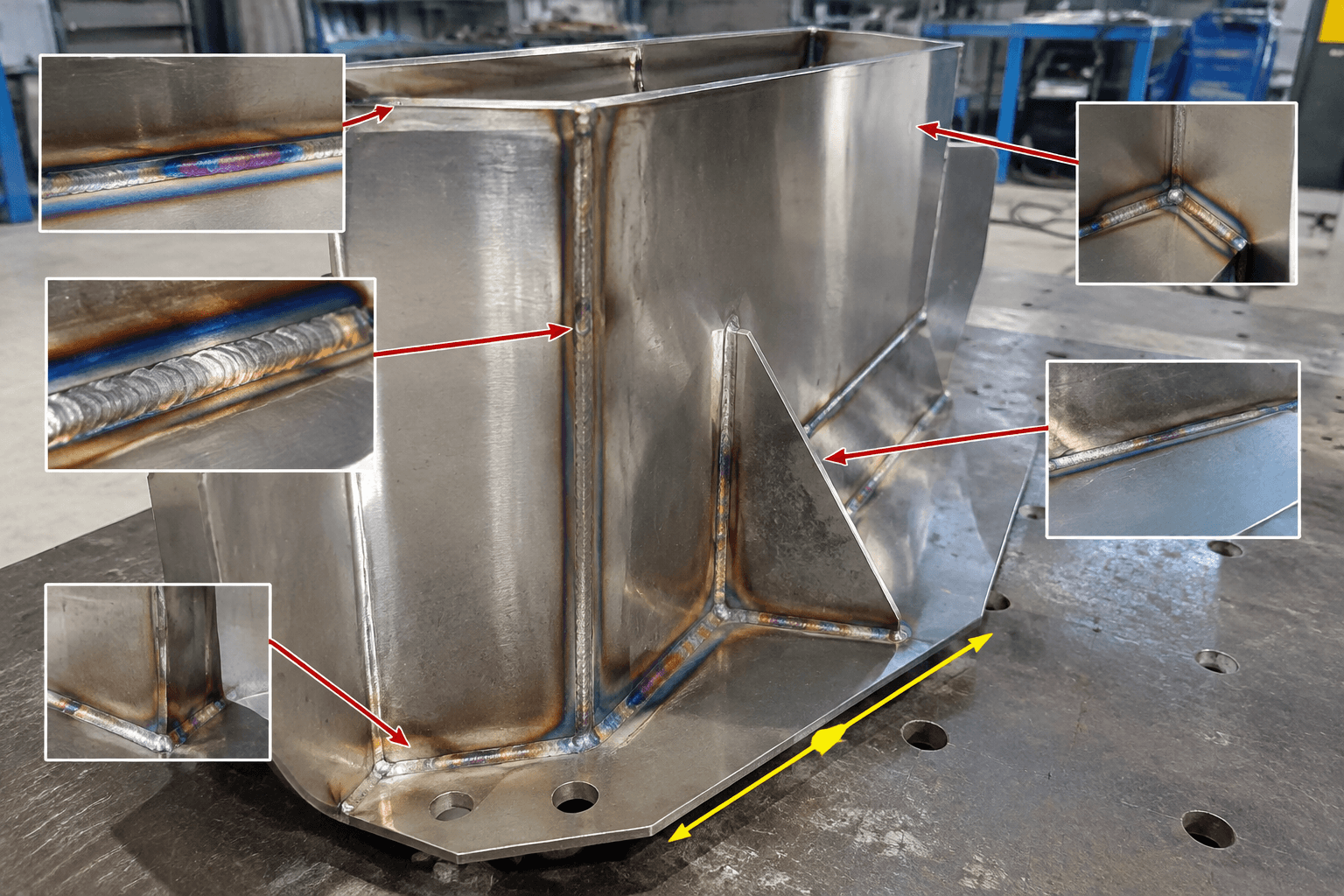
Welds: Welding introduces localized heat, residual stress, possible distortion, and heat tint. Weld position and sequence can influence whether a panel remains flat before it ever enters service. The post-weld surface condition also matters where corrosion resistance or cleanability is required. Heat tint acceptance, cleaning, passivation requirements, and weld inspection should therefore be stated on the drawing or associated specification.
Finish and contamination: Mill finish, brushed surfaces, polished areas, weld discoloration, embedded iron contamination, and process residues can produce different appearances or corrosion behavior after heating. For fabricated food and beverage equipment parts, thermal exposure must be reviewed together with alloy verification, construction, surface finish, cleaning chemicals, and the actual contact environment. Grade 304 alone does not establish food-contact or oven suitability.
Localized heat: In lighting housings and similar assemblies, a nearby lamp, driver, or power component can create a hot zone while the surrounding sheet remains cooler. This gradient may control distortion around mounting points. The design review for fabricated lighting fixtures and equipment should therefore use measured or calculated component temperatures rather than only ambient temperature.
304 vs 316 vs 430 for Heated Parts
| Grade | Potential reason to consider it | Heat-related caution |
|---|---|---|
| 304 | Common austenitic stainless grade used for many formed and welded components | Suitability still depends on oxidation, hot strength, creep, distortion, sensitization risk, and environment |
| 316 | Often selected where its alloy composition provides better resistance to certain corrosive media | Improved corrosion resistance in a relevant environment does not automatically mean superior oxidation resistance, strength retention, or dimensional stability at every temperature |
| 430 | Ferritic grade that may be considered when thermal movement, oxidation behavior, forming requirements, and cost favor it for the specific duty | Its expansion behavior, elevated-temperature mechanical properties, weldability, and corrosion resistance differ from those of austenitic 304; comparisons must use equivalent product conditions and exposure criteria |
There is no unconditional winner. If chloride-bearing moisture or cleaning chemistry remains present, 316 may deserve consideration for corrosion reasons. If thermal movement is central, comparable expansion data and the restraint of the complete assembly may change the decision. If the part carries load, elevated-temperature mechanical properties for the specified grade and product condition are required. For severe heat exposure, the correct answer may also lie outside 304, 316, and 430, but another grade should not be selected without matching verified data to the duty.
Before finalizing the material specification or drawing, send Yishang the continuous and peak temperatures, exposure duration, cycle frequency, atmosphere and contaminants, mechanical load, required dimensional stability, material condition, weld locations, finish, and acceptance criteria. Yishang can review whether the specified material and fabricated-part design align with the stated thermal duty before production requirements are finalized. Final material approval should remain based on applicable engineering data and validation for the intended application.
Frequently Asked Questions
What is the temperature resistance of 304 stainless steel?
There is no single temperature that defines every type of resistance. The relevant limit may concern oxidation, retained strength, creep, distortion, sensitization, surface appearance, or another acceptance criterion. Use data that states the atmosphere, exposure time, material condition, product form, and test method.
Is 304 or 316 better for heat?
Neither is automatically better for every heated application. Grade 316 may offer an advantage where specific corrosive media are present, while oxidation behavior, elevated-temperature strength, thermal movement, fabrication, and cost require separate comparison using equivalent data.
Can 304 stainless steel be used in an oven?
It may be suitable for some oven components, but the grade name alone is insufficient. Confirm the actual metal temperature, cycle pattern, load, construction, weld and joint design, finish, contamination controls, cleaning exposure, and dimensional requirements. Food contact also requires applicable material and regulatory verification rather than an assumption based only on grade.
Why is the melting range not the same as a safe service temperature?
A component can lose strength, creep, distort, scale, discolor, or undergo harmful metallurgical or surface changes while it remains solid. Melting data identify a physical transition, not an allowable design temperature or service-life criterion.