
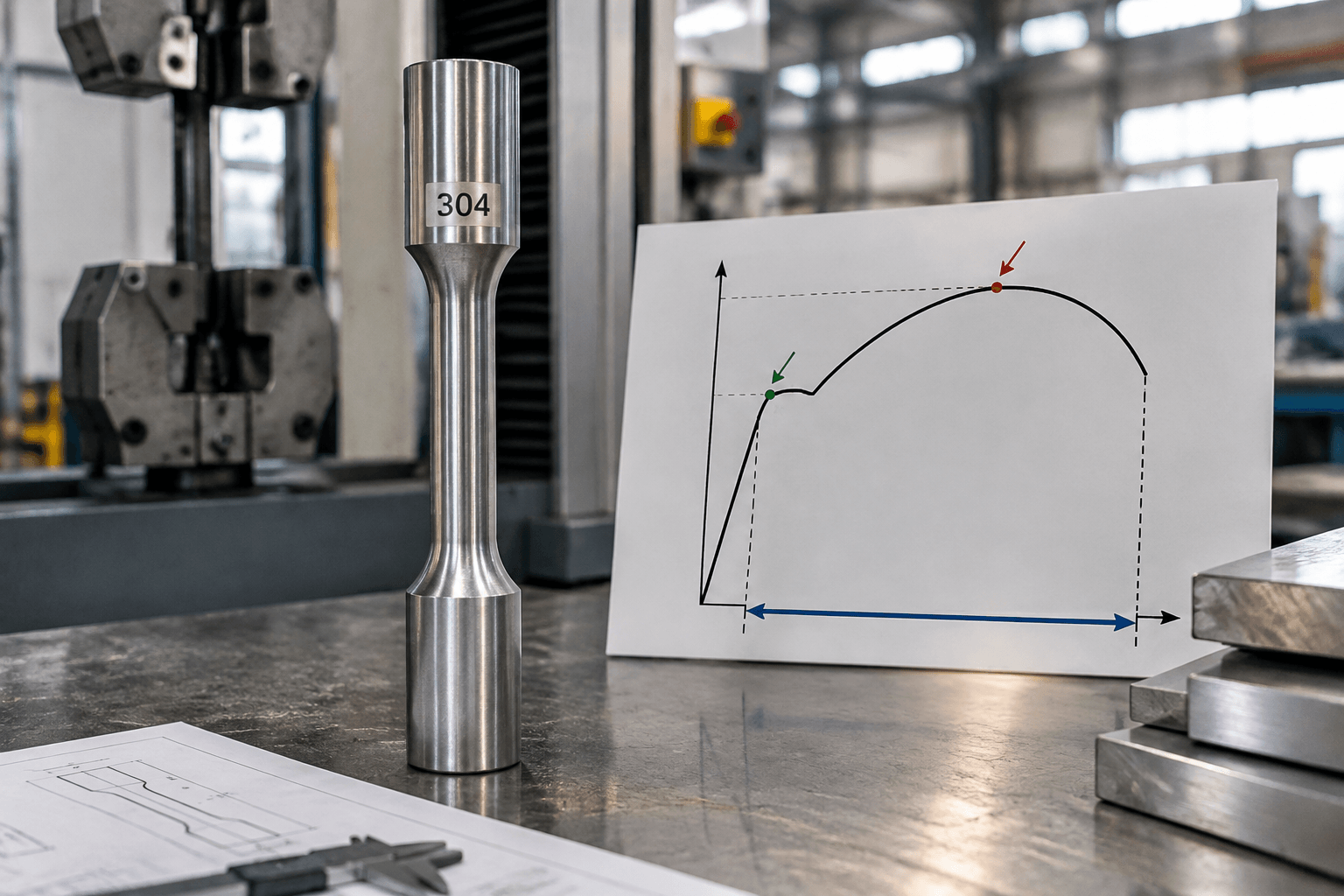
304 stainless steel has useful strength and ductility, but no single strength value applies to every 304 product. Its tensile and yield strength must be identified by product form, material condition, thickness, test temperature, orientation, and governing specification.
For annealed 304 sheet, plate, and strip covered by ASTM A240/A240M, commonly cited room-temperature minimums are 515 MPa (about 75 ksi) ultimate tensile strength and 205 MPa (about 30 ksi) 0.2% offset yield strength. These are specification minimums for a defined product and condition, not universal design allowables.
304 Stainless Steel Tensile and Yield Strength
Three properties are often read together when evaluating 304 stainless steel strength: ultimate tensile strength, 0.2% offset yield strength, and elongation. They describe different parts of the tensile response.
- Ultimate tensile strength is the highest engineering stress reached during a tensile test. It is relevant to rupture, but a component may undergo unacceptable permanent deformation well before reaching this value.
- 0.2% offset yield strength estimates the stress at which measurable permanent deformation begins. Austenitic stainless steels do not normally show the sharp yield point found in some carbon steels, so the 0.2% offset method is used.
- Elongation indicates tensile ductility under the specified test method and gauge length. It does not directly establish bendability for every thickness, bend radius, or grain orientation.
| Example material basis | Ultimate tensile strength | 0.2% offset yield strength | How to use the figures |
|---|---|---|---|
| Annealed Type 304 sheet, plate, or strip under ASTM A240/A240M | 515 MPa minimum approximately 75 ksi |
205 MPa minimum approximately 30 ksi |
Use as procurement minimums only when that specification, grade, product form, condition, and applicable thickness provisions are confirmed. |
| Producer test certificate or data sheet | May exceed the specification minimum | May exceed the specification minimum | Identify whether values are actual test results, typical values, or guaranteed limits. |
| Cold-worked 304 | Condition-specific | Condition-specific and often substantially higher than annealed material | State the temper or required mechanical properties. Do not apply annealed values to a cold-worked product. |
The conversion used here is 1 MPa = 0.145 ksi. Rounded conversions are suitable for communication, but calculations should retain adequate precision and follow the units used by the governing design method.
Yield strength is commonly the more relevant starting point when permanent deformation would make a bracket, panel, enclosure, or support unusable. Ultimate tensile strength remains important for rupture-related checks. Neither number alone establishes the allowable load: the design also needs geometry, load direction, connection details, service conditions, and an appropriate safety or resistance factor.
Why Published 304 Strength Data Do Not Always Match
A value such as 90 ksi tensile strength or 42 ksi yield strength can be plausible for a particular batch, thickness, or worked condition, but it should not be presented as a universal 304 minimum. Before using any published number, read its source label in the following order.
- Check the governing specification and product form. Sheet and plate, bar, tube, wire, forgings, and fasteners can be governed by different standards. Even when they share the 304 designation, their mechanical-property requirements may not be identical.
- Identify minimum, typical, or actual values. A specification minimum is a procurement threshold. A typical value describes representative production but is not necessarily guaranteed. An actual value belongs to the tested heat, lot, or specimen documented by the material certificate.
- Confirm material condition. Annealed 304 combines moderate yield strength with high ductility. Rolling, drawing, bending, or other cold work increases dislocation density, generally raising yield and tensile strength while reducing elongation. The amount depends on the reduction, strain path, and starting material.
- Review thickness, section size, and orientation. Specifications can apply different elongation requirements or test provisions by thickness. Rolling direction may also influence test results and forming behavior. A longitudinal coupon result should not automatically be treated as a complete description of transverse component behavior.
- Check temperature and test method. Room-temperature values should not be used unmodified for elevated-temperature design. Test specimen geometry, gauge length, strain rate, and the referenced test method also matter.
A useful source label would read: “ASTM A240/A240M Type 304 annealed sheet, stated minimum at room temperature, subject to the applicable edition and thickness provisions.” By contrast, “304 yield strength: 42 ksi” leaves the reader unable to determine whether the figure is a minimum, a typical result, or data for partially cold-worked stock.
Fabrication can introduce local differences as well. A formed corner may be work-hardened relative to a flat area, while welding creates a heat-affected region and changes residual stress. These effects do not justify assigning a new strength to the whole assembly without qualified data or analysis.
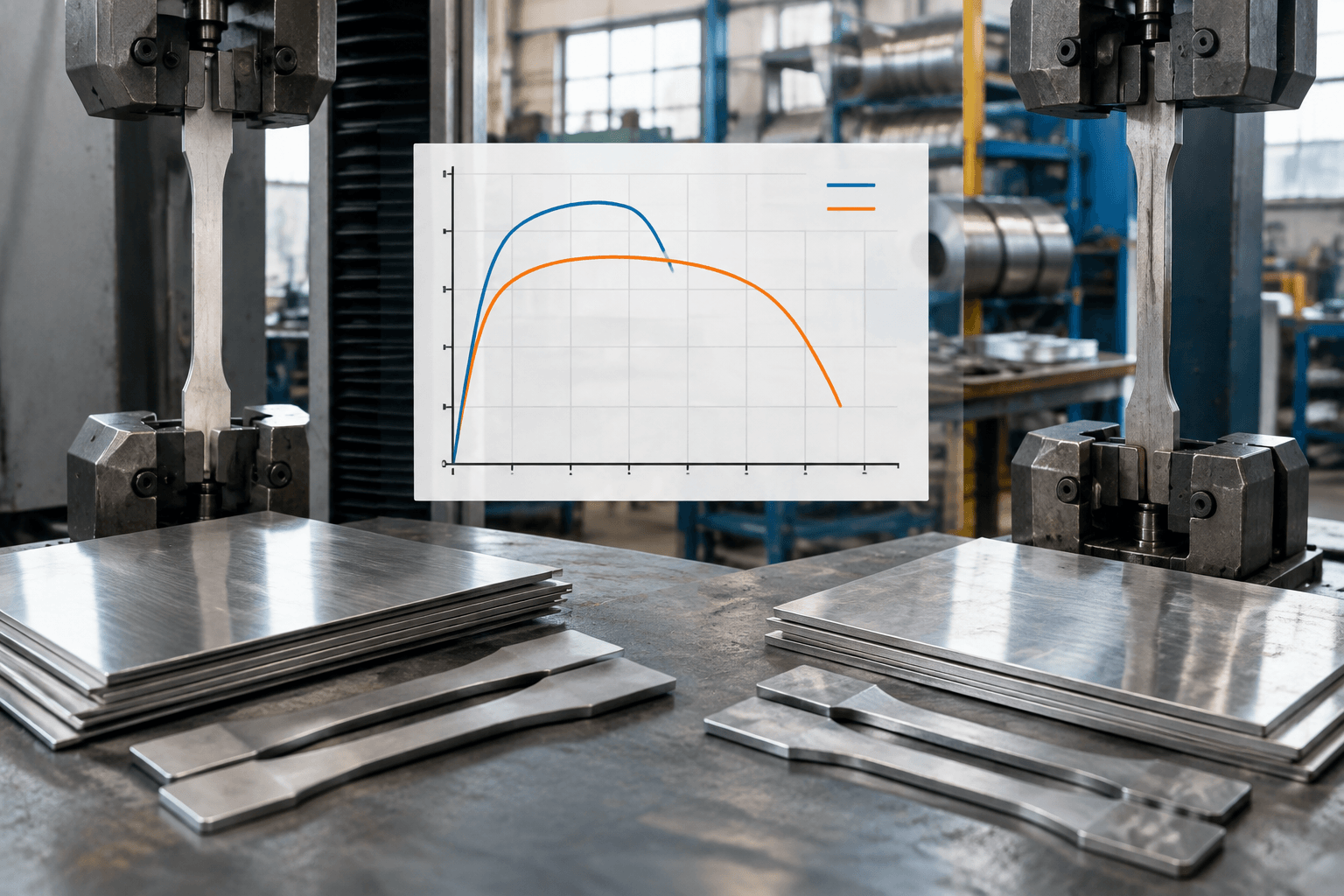
304 Compared with 304L, 316, and Grade 8 Fastener Steel
Strength comparisons are meaningful only when the materials have matched product forms, conditions, dimensions, test temperatures, and specifications. A sheet alloy and a heat-treated bolt grade are not interchangeable merely because both have published tensile values.
| Comparison | Qualified strength context | Selection implication |
|---|---|---|
| 304 versus 304L | Under common ASTM composition limits, 304 has up to 0.08% carbon, while 304L has up to 0.03%. For annealed plate, sheet, and strip under ASTM A240/A240M, commonly cited minimums are 515 MPa tensile and 205 MPa yield for 304, versus 485 MPa (about 70 ksi) tensile and 170 MPa (about 25 ksi) yield for 304L. | 304L’s lower carbon content helps limit sensitization during welding. Its lower specification minimums can matter in a load calculation, although actual mill values may be higher. Dual-certified 304/304L material must meet the documented requirements claimed on its certification. |
| 304 versus 316 | Annealed 304 and 316 products can have the same minimum tensile and yield requirements under some matched product specifications. This does not prove that all 304 and 316 products have identical strength. | 316 is often selected for improved resistance in certain chloride-bearing environments, not because it is categorically stronger. Corrosion exposure, fabrication, product form, and mechanical requirements should be evaluated separately. |
| 304 versus SAE Grade 8 | SAE J429 Grade 8 refers to quenched-and-tempered alloy-steel fasteners within defined sizes and requirements. Frequently quoted minimums for smaller covered diameters include 150 ksi (about 1,034 MPa) tensile strength and 130 ksi (about 896 MPa) yield strength, but requirements vary with diameter and specification edition. | A Grade 8 bolt cannot be treated as an equivalent material for 304 sheet, bar, or a stainless fastener. Compare complete fastener specifications, diameter range, proof load, thread area, corrosion exposure, temperature, and joint design. |
From Yield Strength to Preliminary Load Capacity
A simple axial-stress calculation can screen an early design, provided it is treated as a preliminary check rather than a final allowable-load rating.
Nominal axial stress: σ = F / Anet
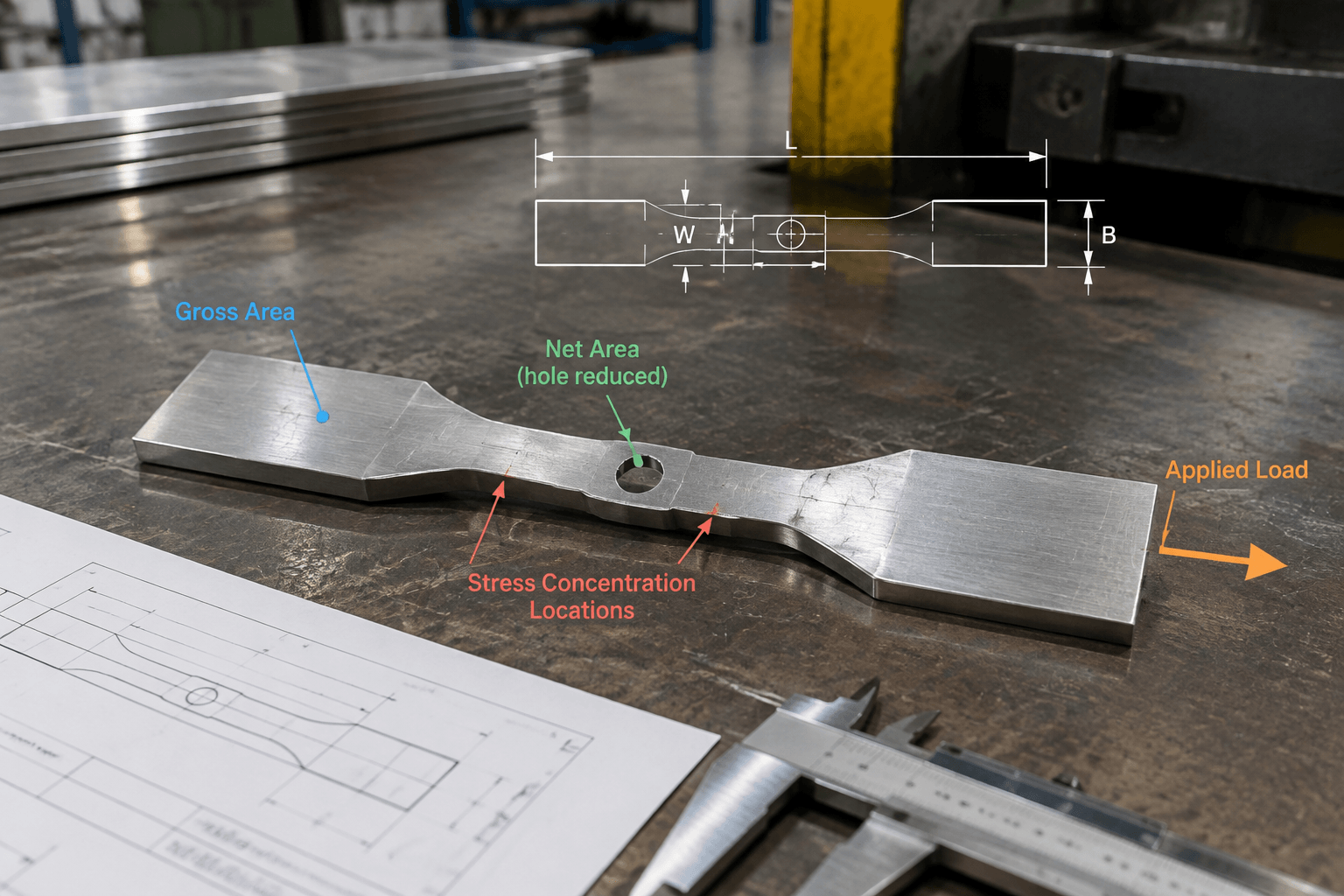
Here, σ is nominal stress, F is the axial load, and Anet is the minimum net cross-sectional area normal to the load. For a flat strip with one hole crossing the critical section, a simplified net area is:
Anet = (w − d) × t
where w is strip width, d is hole diameter, and t is thickness. This formula does not capture the local stress concentration around the hole.
Hypothetical screening example
Consider an annealed 304 strip that is 40 mm wide and 3 mm thick, with a 10 mm hole crossing the critical tensile section. Assume a centered static axial load of 12 kN and, only for this preliminary example, a verified minimum yield strength of 205 MPa under the applicable material specification.
- Net area = (40 − 10) × 3 = 90 mm².
- Nominal stress = 12,000 N / 90 mm² = 133 MPa, or approximately 19.3 ksi.
- Nominal yield ratio = 205 / 133 = approximately 1.54.
This ratio is not automatically an acceptable safety factor or load rating. The hole increases local stress, and the calculation has not considered edge distance, bearing, tear-out, bending, weld strength, fastener behavior, fatigue, dimensional tolerances, or load eccentricity. If the member is slender and loaded in compression, buckling may govern before material yield. If loading is repeated, fatigue evaluation may govern even when nominal stress remains below yield.
A practical worksheet should therefore record the qualified yield value and its source, minimum net area, load direction, static or cyclic duty, stress raisers, welds and connections, temperature, corrosion allowance, and the design factor required by the applicable code or responsible engineer. For a custom metal bracket built to a drawing, bend position, hole spacing, load offset, grain direction, and attachment method can materially change capacity.
How to Specify Strength Requirements on a Drawing
“Strong 304 stainless steel” is not a complete material requirement. A specification-ready drawing or purchase document should identify the grade, product form, condition, governing material specification, thickness or section size, and required documentation.
Illustrative drawing note: Type 304 stainless steel sheet, annealed condition, 3.0 mm nominal thickness, to the specified edition of ASTM A240/A240M; provide material certification showing grade and required mechanical properties. Critical load acts in the indicated direction through the defined mounting holes.
This is an example, not a universal note. The purchaser and responsible engineer must select the correct standard, edition, dimensional tolerances, finish, and acceptance criteria. If cold-worked strength is required, define the temper or explicit mechanical-property range and confirm that forming and welding will not invalidate the assumed condition.
For a technical drawing and material-specification review, provide the part drawing, product form and thickness, intended condition, required load and load direction, and applicable material specification or mechanical-property requirement. Yishang supports B2B OEM and ODM custom manufacturing and can review whether the stated 304 form and condition align with the component geometry and requested documentation before production.
Frequently Asked Questions
Is 304 stainless steel considered strong?
Yes, 304 provides useful strength together with substantial ductility in the annealed condition. Whether it is strong enough depends on the specified product, condition, cross-section, geometry, connections, load type, environment, and required design factor.
Does cold working make 304 stainless steel stronger?
Cold working generally raises the yield and tensile strength of 304, often with a pronounced increase in yield strength, while reducing elongation. The resulting properties depend on the degree and direction of work, so the temper or required property range must be specified rather than assumed.
Does 304L provide less strength than 304?
Some matched specifications give annealed 304L lower minimum tensile and yield values than 304. However, actual values can overlap, and dual-certified products are common. Use the certified properties and governing specification for the supplied product, especially when strength is calculation-critical.
Can 304 stainless steel be compared directly with Grade 8 fasteners?
No. Grade 8 is a fastener grade with heat treatment, diameter-dependent requirements, and joint-specific design rules. A valid comparison must match product specifications and consider proof load, tensile stress area, threads, corrosion, temperature, preload, and the connected 304 component.