
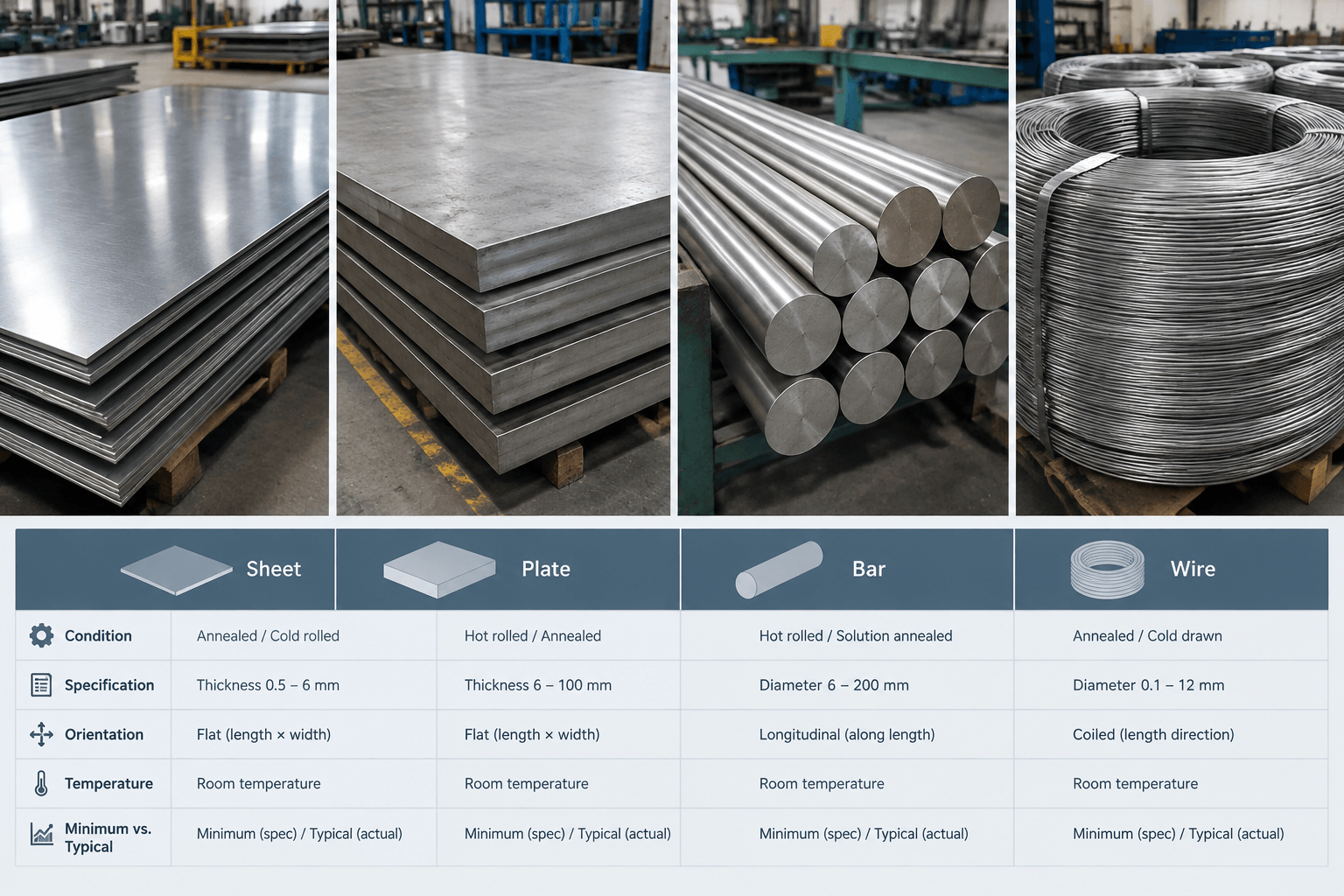
304 yield strength is not one universal number. The applicable value depends on the product form, material condition, governing specification, test temperature, specimen orientation, and whether the published figure is a specified minimum or a representative result.
Quick answer: A cited value of 42 ksi for 304 stainless steel may be a source-dependent reported 0.2% offset yield-strength value, equivalent to approximately 290 MPa or 42,000 psi. It must not be treated as the yield strength of every 304 product. A reported 35 ksi value for 304L, approximately 241 MPa or 35,000 psi, is also context-dependent and requires the same verification.
For an engineering calculation or purchasing requirement, do not specify only 304. Match the grade to the ordered product form, condition, applicable material specification, required minimum properties, and material documentation.
What does 304 yield strength actually describe?
Yield strength is the stress at which a material begins to undergo permanent plastic deformation. Below that point, a component may return close to its original shape when the load is removed. Beyond it, some deformation remains. In a bracket, cover, support, or formed enclosure, this distinction matters because a part can remain intact while no longer holding its designed geometry.
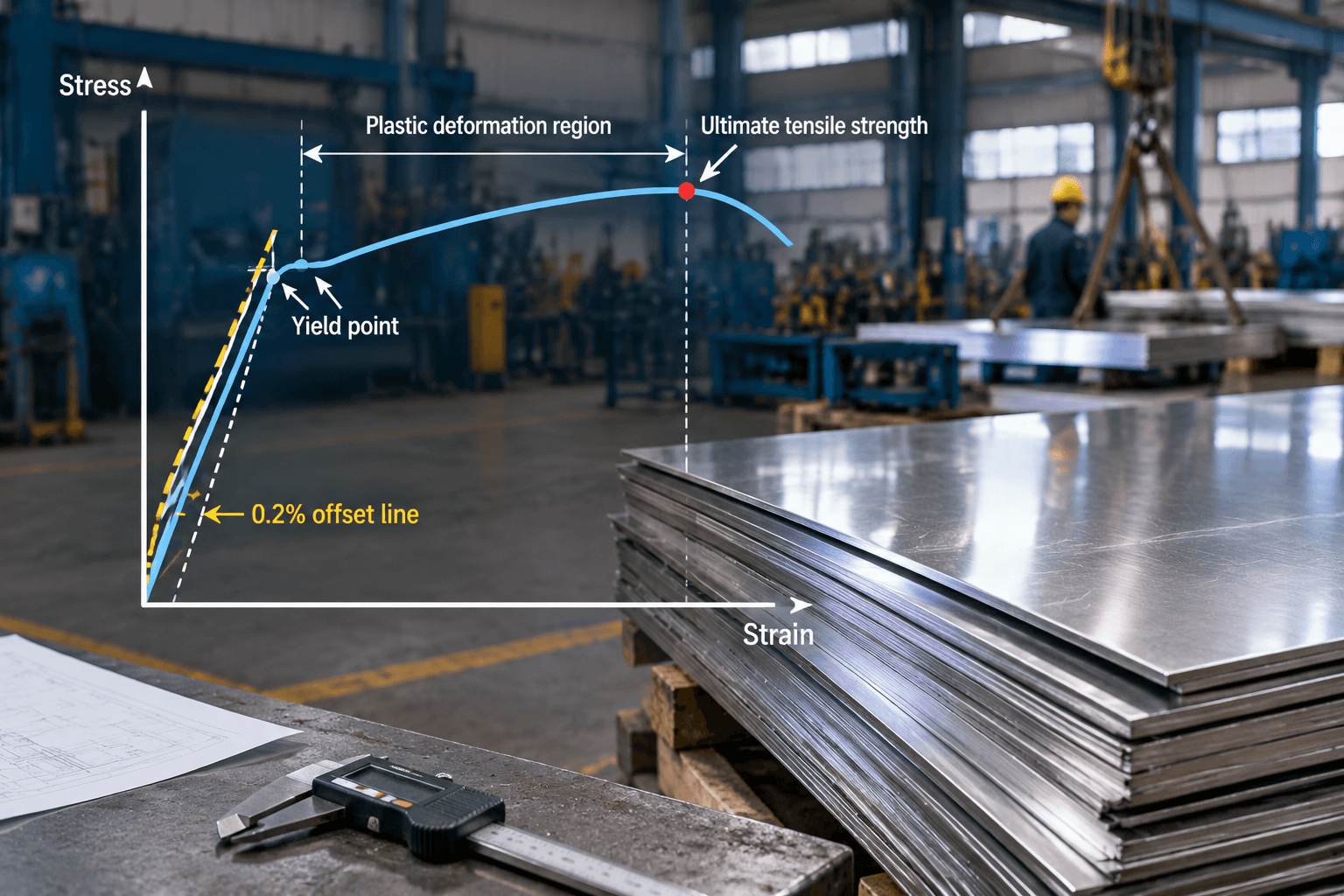
Stainless steels such as 304 do not always show a sharply defined yield point on a stress-strain curve. For that reason, published data commonly use 0.2% offset yield strength. The test first establishes the initial elastic slope of the stress-strain curve. A line is then drawn parallel to that slope but offset by a strain of 0.002, or 0.2%. The stress where this offset line intersects the curve is reported as the 0.2% proof or yield strength.
This is a defined measurement convention, not a statement that every part suddenly fails at that stress. Real design behavior also depends on geometry, residual stress, holes, bends, weld areas, load direction, temperature, and the selected design safety approach.
Yield strength should also be separated from ultimate tensile strength. Yield strength concerns the onset of specified permanent deformation. Ultimate tensile strength is the highest engineering stress reached during a tensile test before the specimen proceeds toward necking and fracture. A material can have a useful ultimate tensile strength while still being unsuitable for a design if it yields too early under the service load.
Values may be shown in MPa, ksi, or psi:
- 1 ksi equals 1,000 psi.
- 42 ksi equals 42,000 psi, or approximately 290 MPa.
- 35 ksi equals 35,000 psi, or approximately 241 MPa.
Conversions help compare documents, but they do not make two values equivalent if their product forms, specifications, or test conditions differ.
Why can published 304 values disagree?
Two documents can both refer to 304 stainless steel and still report different yield-strength figures without either document being wrong. The missing context is often more important than the grade name.
- Specified minimum or representative value: A specification may require a minimum yield strength that the supplied material must meet. A mill datasheet may instead show a typical or representative result from a particular production lot. A typical value is not automatically a guaranteed design minimum.
- Product form: Sheet, plate, bar, wire, tube, and other forms may be covered by different requirements. Thickness and manufacturing route can also affect the reported result. A value for wire should not be transferred to sheet without checking the applicable document.
- Material condition: Annealed 304 and cold-worked 304 are not interchangeable property conditions. Cold work can raise strength and hardness, while reducing ductility. A drawing that requires a particular condition must not be satisfied by a grade-only description.
- Test temperature: Mechanical properties change with temperature. Room-temperature data may not represent performance in a cryogenic, heated, or cyclic service environment.
- Specimen orientation: Rolled or formed products can show direction-dependent behavior. Longitudinal and transverse specimens may not produce identical results, especially where rolling, drawing, or forming has created directional structure.
- Test method and reporting basis: The test method, specimen preparation, gauge dimensions, strain measurement, rounding, and reporting rules influence how a result is obtained and presented. The governing specification should identify the relevant test basis.
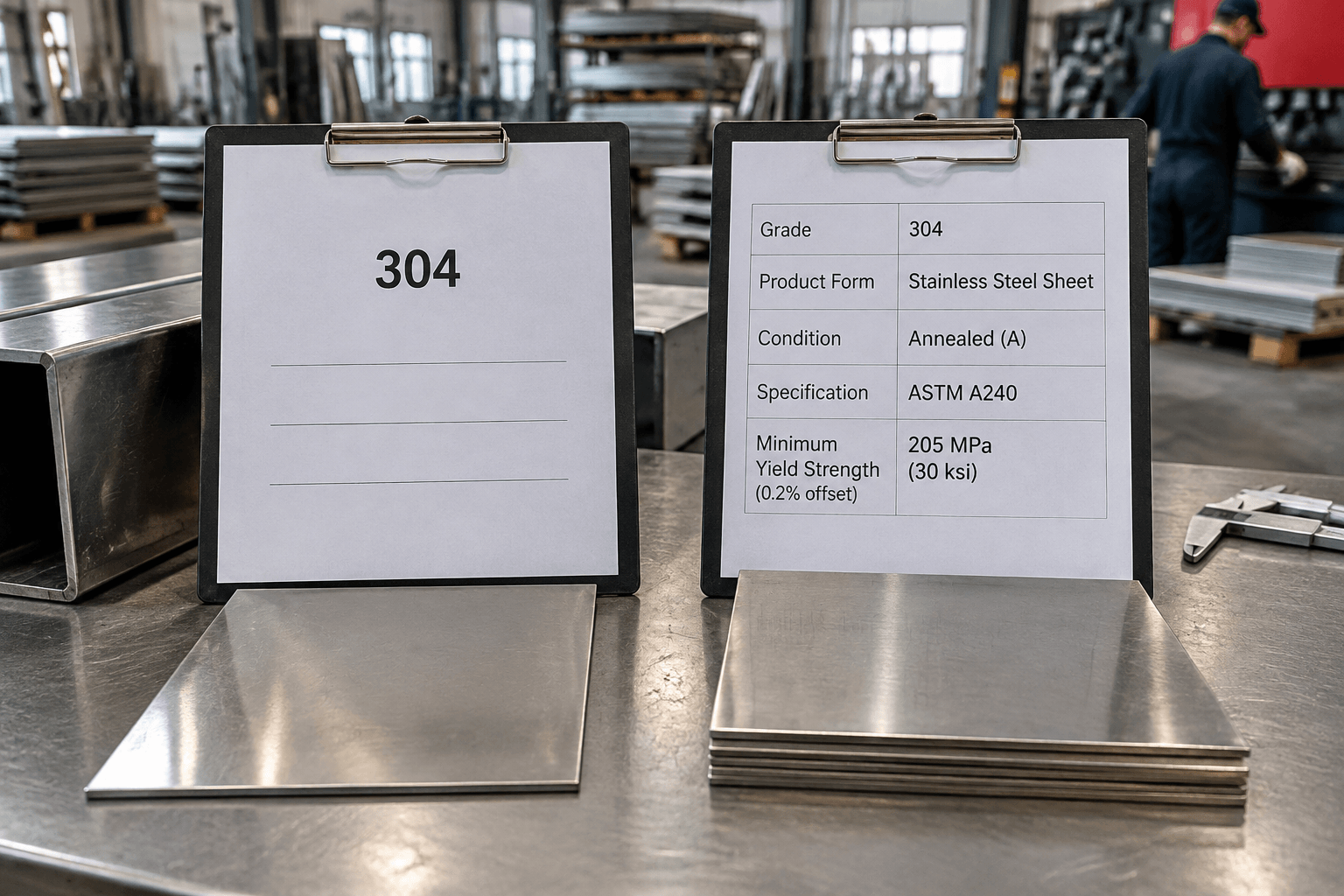
Therefore, a supplier document that says only 304 yield strength is incomplete for design control. The useful entry identifies the grade, product form, thickness or size where relevant, condition, specification and revision, test temperature, orientation, test method, and whether the number is a minimum or a typical result.
304, 304L, and 316: compare the requirement, not just the grade
304 and 304L are closely related austenitic stainless-steel grades. The principal distinction is the lower maximum carbon content associated with 304L. That chemistry difference can make 304L preferable for some fabrication and welding requirements, but it does not establish a universal strength ranking.
The supplied figures of 42 ksi for 304 and 35 ksi for 304L should be treated only as source-dependent reported values. Converted approximately, they are 290 MPa and 241 MPa respectively, with a difference of about 7 ksi or 48 MPa. Before using that comparison, confirm that both values refer to comparable product forms, conditions, specifications, temperatures, orientations, and minimum-versus-typical status. If those conditions do not match, the apparent difference may not describe the materials fairly.
| Comparison question | What must be checked | Why it matters |
|---|---|---|
| 304 versus 304L | Carbon limits, product form, ordered condition, and the applicable mechanical-property requirement | 304L may be selected for its chemistry and fabrication requirements even when a reported strength value differs from a 304 document. |
| 304 versus 316 | Comparable form, condition, temperature, orientation, and specification | Neither grade should be declared universally stronger from a generic chart. Corrosion-service requirements may be more important than a small grade-level strength comparison. |
| Any published value | Specified minimum or representative result | A typical result should not replace a required minimum in a drawing or design basis. |
Before using a 304 yield-strength number, match these conditions
The following matrix is a practical way to screen a datasheet or certificate before transferring its value into a calculation or drawing requirement.
| Document field | Acceptable question | Decision if missing |
|---|---|---|
| Grade | Is the material identified as 304, 304L, or another specified grade? | Do not infer the design property from a general stainless-steel label. |
| Product form | Is it sheet, plate, bar, wire, tube, or another form? | Find the property requirement for the ordered form. |
| Condition | Is the material annealed, cold-worked, or otherwise condition-controlled? | Do not substitute a condition with a different strength basis. |
| Specification and revision | Which governing document defines chemistry and mechanical properties? | Ask the supplier or engineer to identify the controlling requirement. |
| Test basis | What temperature, orientation, and method produced the result? | Do not compare it directly with an unspecified value. |
| Status of value | Is it a certified minimum, an acceptance requirement, or a typical result? | Use a minimum when the design requires a guaranteed lower bound. |
For a defensible design input, follow this sequence:
- Define the service loads, geometry, joints, temperature, and allowable deformation.
- Choose the product form and material condition needed for forming, fabrication, and service.
- Identify the governing material specification and its revision.
- Obtain material documentation that identifies the supplied product and reports the relevant mechanical properties.
- Use the required minimum or the approved design value, not an attractive typical number copied from an unrelated chart.
- Have the responsible engineer validate the stress calculation, safety factors, local concentrations, and failure modes.
For example, a custom bracket drawing that states only 304 leaves open whether the buyer requires annealed sheet, a cold-worked condition, a thickness-specific minimum, or a particular documentation package. A drawing for custom metal brackets built to your drawings should define the material requirement beyond the grade name when strength is a design input.
If you are preparing an OEM or ODM production package, Yishang can review the technical relationship between the drawing and the ordered material information. Share the drawing or part geometry, required minimum yield strength, product form and material condition, governing specification if already defined, service temperature, and critical loading information. This document review is intended to align the design requirement and material evidence before custom production, rather than quote against an unqualified grade-level value.
Frequently Asked Questions
What is the difference between 304 and 304L yield strength?
There is no single universal difference. A supplied comparison may report 42 ksi for 304 and 35 ksi for 304L, but those are source-dependent figures. Confirm that the product form, condition, specification, test conditions, and minimum-versus-typical status are comparable before using the 7 ksi difference in design.
Does 316 stainless steel have a higher yield strength than 304?
Not automatically. The answer depends on the product form, condition, specification, temperature, and test basis. Compare documented requirements under equivalent conditions instead of using a generic grade chart.
Is 304 stainless steel as strong as Grade 8 fastener material?
Do not treat 304 stainless steel as directly equivalent to Grade 8 fastener material. They are different material classifications and product systems with different specifications and property requirements. A fastener designation cannot be used as a substitute for a 304 material evaluation.
Can cold-worked 304 have a higher yield strength than annealed 304?
Yes, cold work can increase the yield strength of 304 compared with an annealed condition. The amount depends on the degree and process of cold work, while ductility and forming behavior may change. The ordered condition must therefore be stated and verified.