
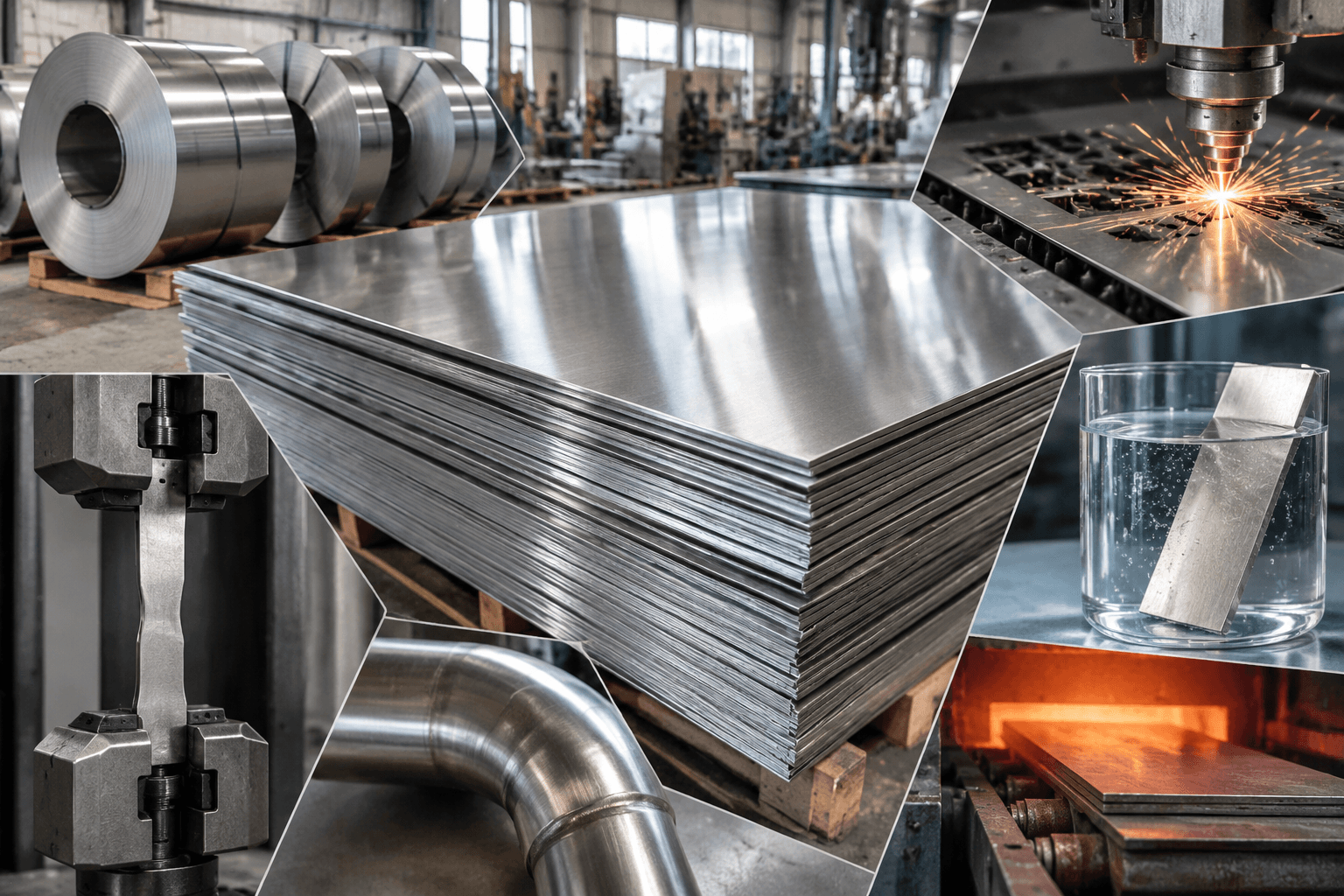
316 stainless steel is a molybdenum-bearing austenitic stainless steel valued for improved resistance to localized corrosion compared with 304. Its mechanical, physical, and corrosion properties are not universal: product form, thickness, metallurgical condition, temperature, fabrication history, surface condition, and the governing material specification all affect which values apply.
The tables below separate specification minimums from typical reference values. For procurement and design, the specified standard and the material certificate should take precedence over generic online data.
What Defines 316 Stainless Steel?
Grade 316 belongs to the chromium-nickel austenitic stainless steel family. Chromium supports formation of the passive oxide film responsible for stainless behavior. Nickel stabilizes the austenitic structure and contributes to ductility and fabrication performance. Molybdenum improves resistance to pitting and crevice corrosion, particularly in chloride-contaminated environments. Carbon affects strength but can also contribute to chromium-carbide precipitation and sensitization when unsuitable material is exposed to certain thermal cycles.
The following limits are for Type 316 plate, sheet, and strip under ASTM A240/A240M. The edition referenced by the purchase order remains controlling.
| Element | ASTM A240/A240M Type 316 limit, mass % | Primary relevance |
|---|---|---|
| Carbon | 0.08 maximum | Strength and sensitization behavior |
| Chromium | 16.0–18.0 | Passive-film formation and general corrosion resistance |
| Nickel | 10.0–14.0 | Austenitic structure and ductility |
| Molybdenum | 2.00–3.00 | Improved pitting and crevice-corrosion resistance |
| Manganese | 2.00 maximum | Steelmaking and austenite balance |
| Silicon | 0.75 maximum | Deoxidation and oxidation behavior |
| Phosphorus | 0.045 maximum | Controlled residual element |
| Sulfur | 0.030 maximum | Controlled residual affecting inclusions |
| Nitrogen | 0.10 maximum | Strength and phase balance |
A composition limit is not a typical heat analysis. Actual chemistry should be taken from the mill certificate, while alloy identity should be confirmed through documentation or suitable positive material identification when required. Appearance and magnet response cannot conclusively distinguish 304 from 316.
Mechanical Properties: Condition and Product Form Matter
For annealed 316 flat products, ASTM A240/A240M provides minimum tensile requirements and maximum hardness requirements. Testing is performed using the methods referenced by the specification, commonly ASTM A370 for mechanical testing. These are acceptance values rather than predictions of exactly how a formed component will behave.
| Property | Annealed Type 316 requirement | Basis and applicability |
|---|---|---|
| 0.2% offset yield strength | 205 MPa minimum (30 ksi) | Room-temperature requirement for ASTM A240 plate, sheet, and strip |
| Tensile strength | 515 MPa minimum (75 ksi) | Room-temperature requirement |
| Elongation | 40% minimum in 50 mm or 2 in | Subject to the specimen and thickness provisions in the applicable specification |
| Hardness | 217 HBW maximum or 95 HRB maximum | Acceptance maximum; the specified hardness scale and test method apply |
Product-form note: these figures apply to flat products ordered within the scope and dimensional definitions of ASTM A240/A480. They do not automatically govern tube, pipe, bar, forgings, castings, fasteners, or wire. The ordered thickness must also be checked because specimen geometry and thin-gauge elongation provisions may qualify the requirement.
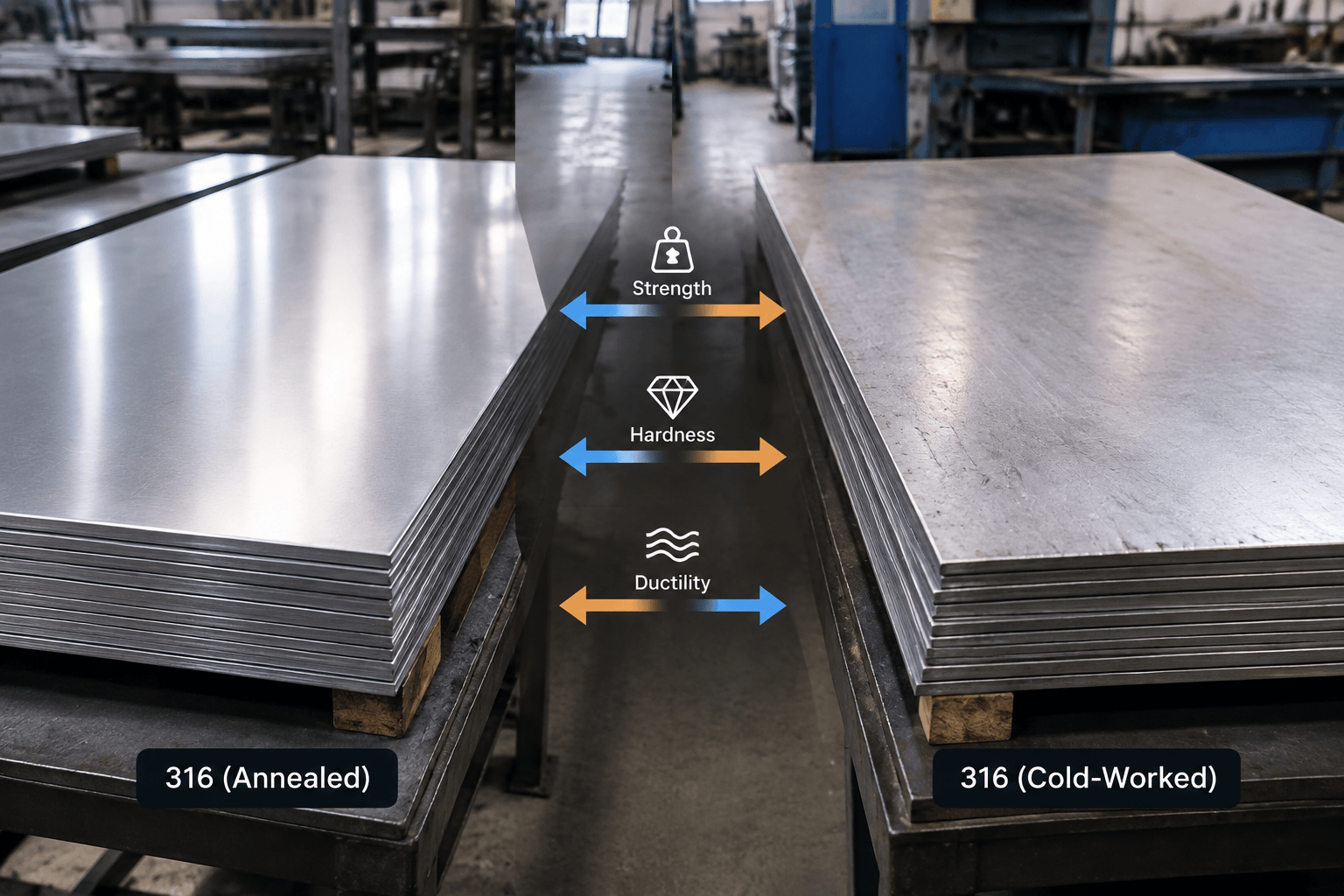
Cold-worked 316 requires a different property basis. Rolling, bending, drawing, and other plastic deformation generally increase yield strength, tensile strength, and hardness while reducing remaining ductility. ASTM A666 defines several cold-worked conditions for austenitic stainless flat products, but there is no single “cold-worked 316” value. The ordered condition, product dimensions, grain direction, and applicable property table must be stated.
Cold work can also create some strain-induced magnetic response, even though solution-annealed 316 is generally described as non-magnetic. Welding may produce local structural and property changes in the weld and heat-affected zone. Consequently, a mill certificate for incoming sheet does not by itself certify every property of the completed assembly.
Annealed Physical, Thermal, and Electrical Properties
The following are typical engineering reference values for annealed 316-family material, based on published Atlas Steels and ASM reference data. Unlike the ASTM mechanical minimums above, these values are generally not guaranteed acceptance criteria. Small differences between reputable datasheets may result from temperature, composition, test method, or rounding.
| Property | SI value | Imperial value | Temperature or basis |
|---|---|---|---|
| Density | 8.0 g/cm³ | 0.289 lb/in³ | Typical, ambient temperature |
| Modulus of elasticity | 193 GPa | 28.0 × 10⁶ psi | Typical, about 20°C |
| Poisson’s ratio | 0.30 | 0.30 | Typical elastic value, ambient temperature |
| Mean thermal expansion | 15.9 µm/m·°C | 8.8 µin/in·°F | Mean from 0–100°C |
| Thermal conductivity | 16.3 W/m·K | 9.4 Btu/h·ft·°F | Typical at 100°C |
| Specific heat capacity | 500 J/kg·K | 0.119 Btu/lb·°F | Typical near room temperature |
| Electrical resistivity | 0.74 µΩ·m | 29.1 µΩ·in | Typical at about 20°C |
Temperature should remain attached to the value in calculations. Elastic modulus normally decreases as temperature rises, while thermal expansion accumulates over a temperature interval rather than at a single point. For pressure equipment, elevated-temperature structures, fatigue analysis, or thermal cycling, use design data from the governing code instead of extrapolating this table.
Corrosion Performance Depends on the Exposure
Molybdenum gives 316 better resistance than 304 to chloride-related pitting and crevice corrosion, but it does not make the alloy corrosion-proof. Authoritative guidance from organizations such as the Nickel Institute and British Stainless Steel Association emphasizes evaluating the complete environment rather than relying on the informal label “marine grade.”
| Exposure situation | How 316 generally performs | Conditions that still require review |
|---|---|---|
| Mild industrial or outdoor atmosphere | Often offers good general atmospheric resistance | Salt deposits, polluted moisture, cleaning frequency, finish, drainage, and sheltered areas |
| Polluted marine atmosphere | Usually more resistant than 304 | Distance from salt sources alone is not decisive; deposits and persistent wetness can initiate staining or pitting |
| Chloride-contaminated liquid | Molybdenum improves localized-corrosion resistance | Chloride concentration, temperature, pH, oxidizing conditions, deposits, exposure time, and fluid renewal |
| Natural seawater | May be considered for some controlled exposures | Continuous immersion, warm water, low flow, biofouling, crevices, and stagnant zones can make 316 unsuitable |
| Acetic acid or its vapors | Can perform well in certain concentrations and temperatures | Contaminants, aeration, condensation, concentration, and operating temperature must be defined |
| Welded construction | Commonly fabricated successfully | Heat tint, sensitization risk, filler selection, oxide removal, contamination, and crevice geometry affect performance |
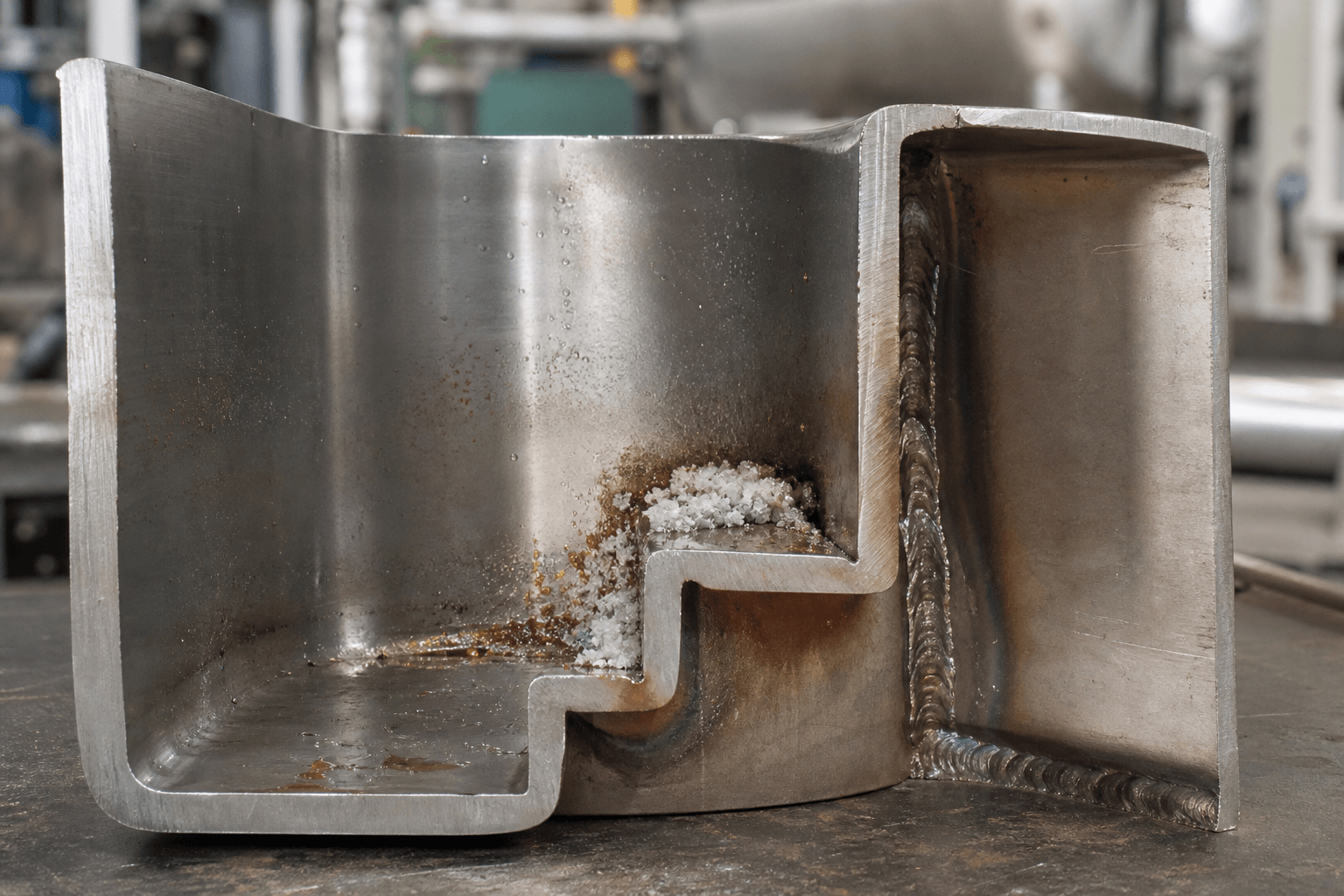
Crevice corrosion can occur under gaskets, lap joints, deposits, fastener heads, and poorly drained seams because oxygen depletion prevents the passive film from recovering normally. Pitting may begin beneath chloride deposits even when the surrounding surface looks sound. Surface roughness, embedded iron contamination, weld discoloration, and inadequate cleaning can therefore reduce the practical corrosion performance of otherwise compliant material.
For products such as custom sheet metal enclosures, material selection should consider rain shedding, joints, outdoor contaminants, finish, and maintenance—not just the grade shown on the drawing.
Choosing Among 304, 316, 316L, and 316Ti
These grades are related, but they should not be treated as interchangeable without checking the drawing, service environment, welding exposure, product standard, and availability in the required form.
| Grade | When to investigate it | Main qualification |
|---|---|---|
| 304 | General atmospheric or process service where molybdenum-enhanced chloride resistance is unnecessary | Often lower in material cost, but less resistant than 316 to chloride pitting under comparable conditions |
| 316 | Service involving more aggressive atmospheres, chloride contamination, or process media where molybdenum is beneficial | Not automatically suitable for seawater, every chemical, or every temperature |
| 316L | Welded components where reducing carbon-related heat-affected-zone sensitization is important | Low carbon does not make it universally stronger or more corrosion-resistant in every environment |
| 316Ti | Applications requiring a titanium-stabilized grade, particularly where prolonged elevated-temperature exposure makes stabilization relevant | Availability, fabrication route, governing material specification, design code, and service temperature must be checked |
Grade designation alone also does not establish hygienic or regulatory suitability. For stainless components used in food and beverage equipment, surface finish, joint design, cleaning access, fabrication contamination, process media, and applicable requirements remain part of the assessment.
Before Using a 316 Property Value, Confirm These Five Conditions
- Product form: Record whether the material is sheet, plate, strip, bar, tube, pipe, forging, or casting. Do not transfer flat-product requirements to another form.
- Thickness: Check whether specimen dimensions, elongation rules, or dimensional categories change at the ordered thickness.
- Metallurgical condition: Identify solution annealed, cold worked, or another specified condition. Account for forming performed after delivery.
- Temperature: Attach the test or reference temperature to mechanical, elastic, thermal, and electrical values.
- Governing specification: Record the standard, edition, grade designation, acceptance tests, and certificate requirements beside each design value.
This worksheet prevents a common specification error: treating a typical datasheet figure as a guaranteed property for the finished component. Where safety or regulatory compliance is involved, the responsible engineer should use the applicable design code and verified material documentation.
Frequently Asked Questions
Which is better, 304 or 316 stainless steel?
Neither is universally better. 316 is generally preferred when its molybdenum-enhanced resistance to chloride pitting and crevice corrosion justifies the added material cost. For less aggressive service, 304 may meet the requirement economically. Temperature, chemical composition, deposits, cleaning, finish, geometry, and governing standards should determine the choice.
What are the disadvantages of 316 stainless steel?
316 normally costs more than 304, work hardens during forming, and remains vulnerable to pitting, crevice corrosion, stress-corrosion cracking, and staining under unfavorable chloride conditions. Its “marine grade” reputation can encourage overgeneralization. Fabrication condition, maintenance, and actual exposure still require assessment.
How can 304 and 316 be distinguished reliably?
Use traceable material certificates, controlled material identification, or an appropriate chemical-analysis or positive-material-identification method. Visual appearance is inconclusive. A magnet test is also unreliable because both grades are austenitic, while cold working and welding can introduce varying magnetic response.
Does 316 automatically mean food-safe or non-toxic?
No. An alloy designation alone does not establish food-contact, medical, or regulatory compliance. Suitability also depends on surface condition, fabrication residues, weld quality, cleaning chemicals, corrosion products, contamination control, component design, service conditions, and the applicable legal or industry requirements.