
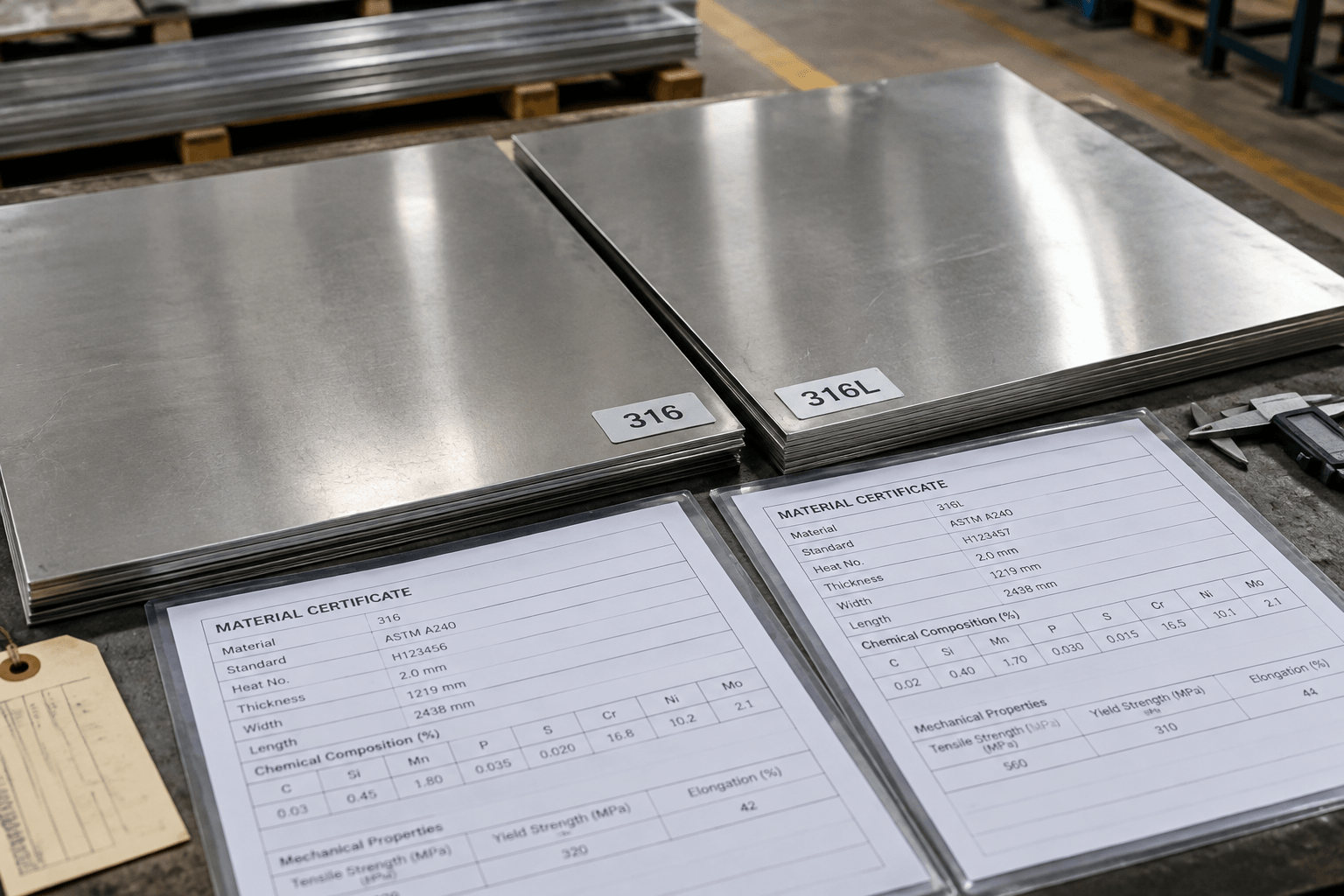
316L is the lower-carbon designation within the 316 stainless steel family. The distinction is most likely to matter when welding or another thermal cycle creates concern about sensitization and intergranular corrosion, but the correct choice still depends on the product form, governing specification, fabrication route, and service environment. Appearance and magnetic response cannot confirm whether material is 316 or 316L.
316 Versus 316L: The Essential Difference
The defining compositional difference is the lower maximum carbon requirement associated with 316L. The exact composition limits must be taken from the material specification that applies to the relevant sheet, plate, bar, tube, casting, or other product form. A chemical limit quoted without its product standard and grade designation can be misleading.
Reducing carbon limits the potential for chromium carbide precipitation during certain thermal exposures. This is particularly relevant around the heat-affected zone of a weld, where an unfavorable combination of time and temperature can reduce local resistance to intergranular corrosion. It does not mean that 316L is automatically stronger, more corrosion resistant, or more suitable for every environment.
| 316 | 316L |
|---|---|
| Standard-carbon designation within the 316 family, subject to the applicable product specification. | Lower-carbon designation, subject to the applicable product specification. |
| May be suitable for unwelded parts, applications with controlled thermal history, or designs whose governing requirements explicitly call for 316. | Often specified for welded fabrication when the design seeks to reduce sensitization concerns without relying on post-weld solution heat treatment. |
| Properties depend on product form, thickness, condition, and specification. | Properties also depend on product form, thickness, condition, and specification; the L suffix does not establish universal superiority. |
| Must not be inferred from appearance or a magnet test. | Requires carbon-sensitive documentation or analysis to distinguish it conclusively from 316. |
A material heat may be certified to both designations when it satisfies the requirements for each and the material records explicitly say so. Buyers should not assume dual certification from a verbal description such as “316 stainless.”
How to Choose Between 316 and 316L for the Application
Selection should begin with the engineering conditions rather than a general belief that one grade is better. For example, a welded enclosure exposed to a corrosive washdown environment presents different questions from an unwelded interior bracket. Stainless components used in food and beverage equipment fabrication may also require careful control of surface finish, cleaning, hygiene-related details, and material records in addition to the grade decision.
| Project condition | Question to resolve | Likely specification focus | Evidence required |
|---|---|---|---|
| Welded sheet metal assembly | Will weld thermal cycles and service exposure create a sensitization concern? | 316L is frequently considered, but the design authority and welding requirements govern. | Grade designation, welding procedure requirements, filler selection, and material certificate. |
| Unwelded or lightly formed component | Does the drawing, customer standard, or service specification require one grade? | Either designation may be appropriate; do not substitute based only on apparent similarity. | Applicable product specification and approved drawing or bill of materials. |
| Elevated-temperature service | Are strength, oxidation, or long-duration exposure requirements controlling? | Do not assume the low-carbon grade is preferable. Evaluate the specified temperature regime and property basis. | Design code, product standard, material condition, and engineering approval. |
| Aggressive chemical or chloride exposure | Is 316-family stainless adequate for the actual concentration, temperature, cleaning chemistry, and geometry? | The 316/316L choice alone may not resolve corrosion risk. | Service-environment data and corrosion assessment. |
| Strict material traceability | Must each part remain linked to a heat or lot? | State the exact grade and prevent uncontrolled mixing during storage and production. | Material report, receiving records, part identification, and traceability procedure. |
Post-weld heat treatment availability can also influence the decision. Large or complex sheet metal assemblies are not always suitable for solution heat treatment after welding, which is one reason the lower-carbon designation is often considered. The final selection must nevertheless follow the governing design and service requirements.
How 316 and 316L Affect Fabrication and Assembly
Sheet metal forming
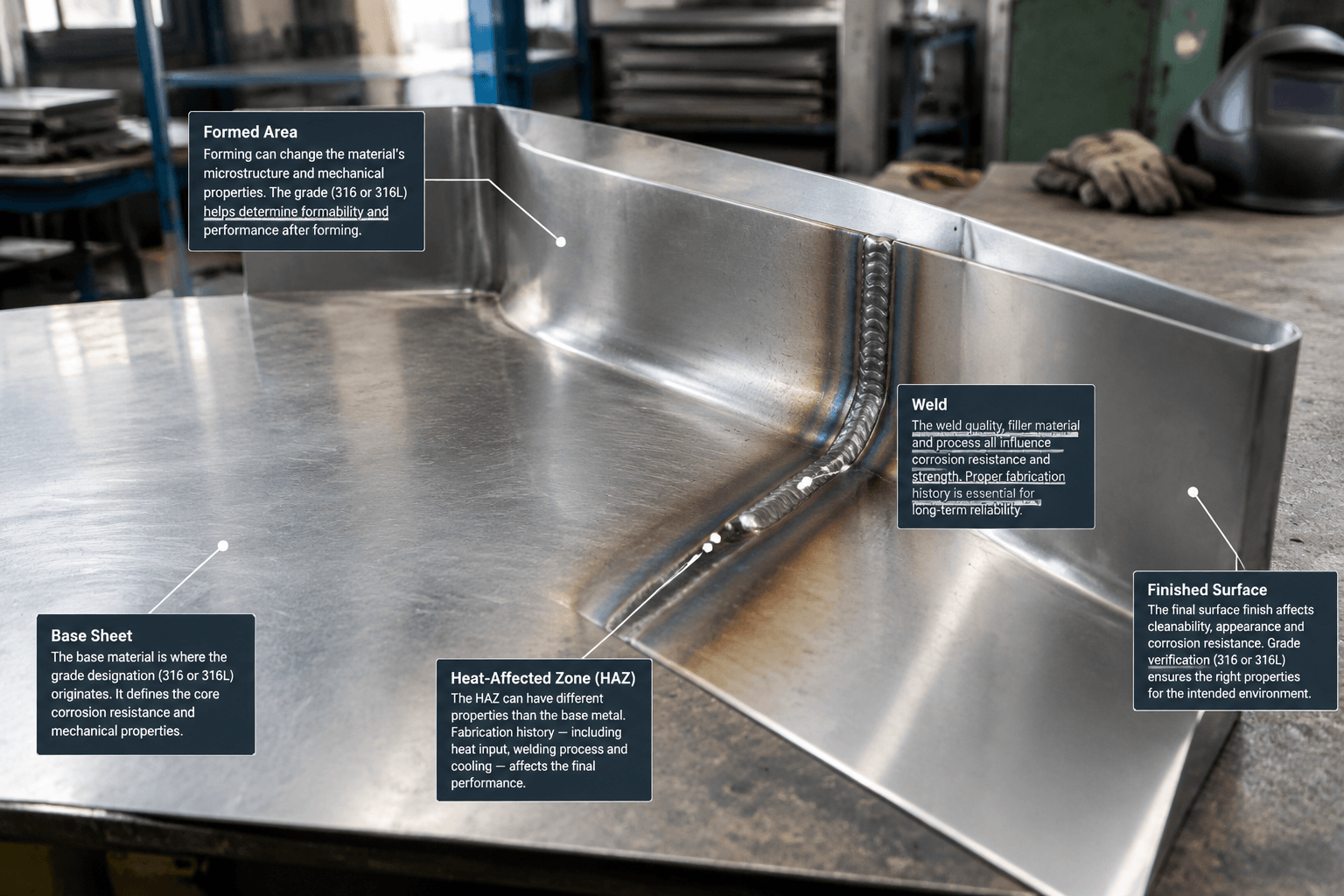
316 and 316L are processed with broadly similar sheet metal methods, but forming behavior cannot be predicted from the L suffix alone. Thickness, mill condition, grain direction, bend geometry, tooling, and prior cold work affect forming loads, springback, edge quality, and cracking risk. Material should be qualified against the actual product specification and condition used for production.
Cold forming can also change magnetic response locally. A formed corner may attract a magnet more noticeably than an unworked area even when both came from the same austenitic stainless sheet.
Welding
The welding plan should address joint design, heat input, shielding, distortion control, filler metal, and the service environment. Filler selection must follow the qualified welding procedure or project requirement; it should not be chosen solely because its trade designation appears similar to the base metal. If 316 and 316L parts are joined, the engineering and welding documentation should identify both materials and the approved filler.
Finishing and surface restoration
Weld tint, embedded carbon-steel contamination, rough crevices, and residues can impair the intended corrosion performance regardless of whether the base material is 316 or 316L. Fabrication planning may therefore include segregation from carbon steel, dedicated or properly controlled tools, cleaning, mechanical finishing, pickling, or passivation. These operations have different purposes and should be specified according to the required surface condition rather than treated as interchangeable.
For products such as custom stainless sheet metal enclosures, drawings should define visible finish direction, acceptable weld treatment, protected surfaces, and assembly requirements where they affect appearance or service.
Assembly and machined interfaces
Fasteners, inserts, hinges, and adjoining metals should be selected for the mechanical load and exposure conditions. Galling, crevices, trapped cleaning chemicals, and galvanic interactions may matter more than the difference between 316 and 316L. When an assembly includes separately machined stainless shafts, bosses, or threaded components, treat CNC machining as a distinct manufacturing process and specify the applicable bar or machining-stock standard separately from the sheet metal standard.
A Magnet Is an Indicator, Not a 316 or 316L Grade Test
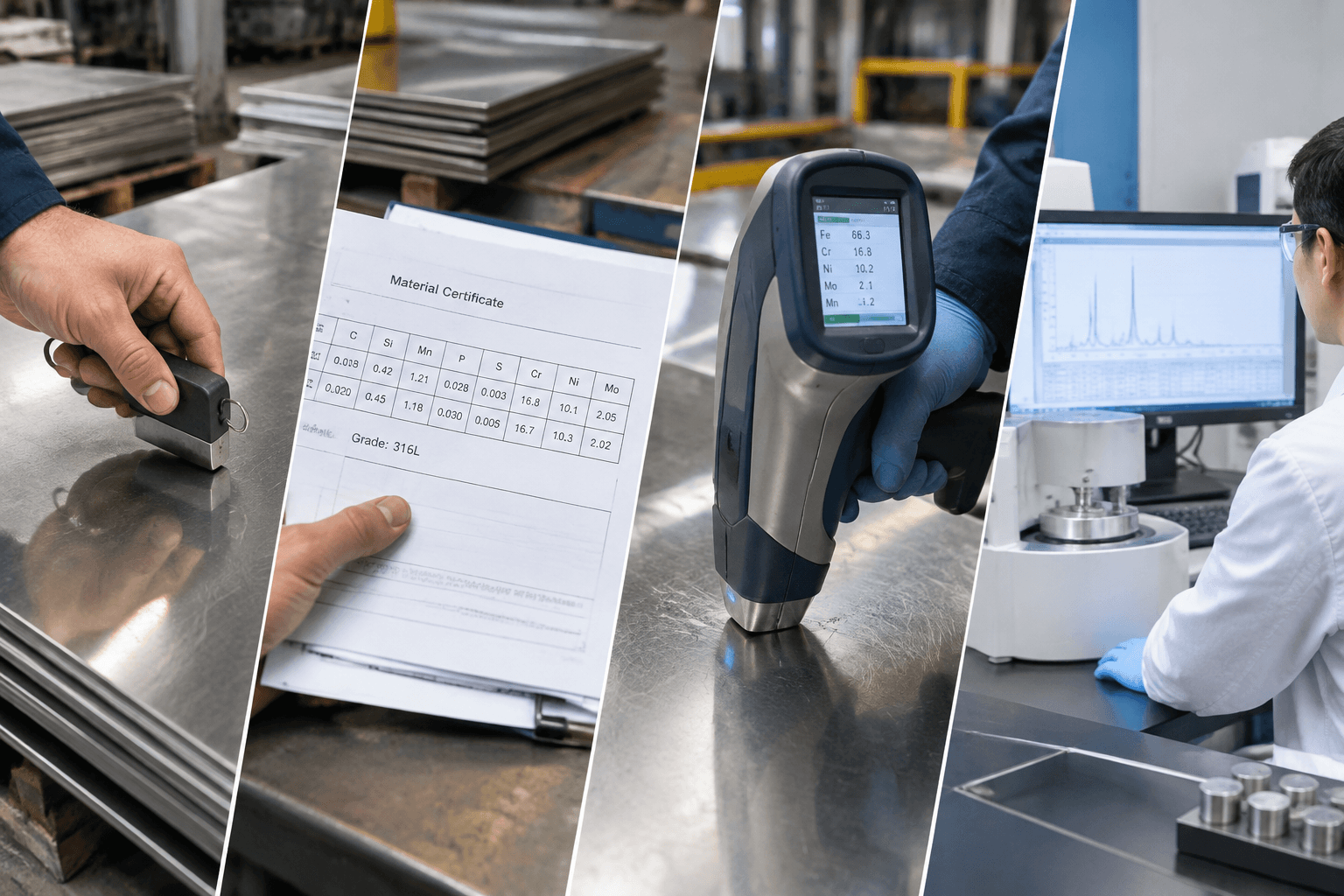
A handheld magnet cannot establish that stainless steel is 316, and it cannot distinguish 316 from 316L. Austenitic stainless steel is commonly associated with low magnetic response in its solution-treated condition, but actual response can change because of cold work, forming, weld-metal structure, filler metal, or local processing history.
Consequently, both conclusions—“it attracts a magnet, so it cannot be 316” and “it is non-magnetic, so it must be 316”—are technically unsafe. Magnet testing may help identify an unexpected difference between parts or areas, but the result is only a screening observation requiring investigation.
Verification methods answer different questions:
- Material certificate review checks the declared grade, specification, heat chemistry, and reported properties while preserving the link to the supplied heat or lot.
- Handheld XRF can identify many alloying elements and help separate alloy families. Because conventional handheld XRF does not reliably measure the low carbon level defining the L designation, it cannot by itself confirm 316L rather than 316.
- Optical emission spectroscopy may measure carbon when suitable equipment, calibration, sample preparation, and procedures are used.
- Laboratory carbon analysis, such as an appropriate combustion method, may be specified when carbon-sensitive confirmation is required.
The verification plan should reflect the consequence of error. Certificate review and traceability may be sufficient for one project, while a regulated or critical application may require independent positive material identification and carbon-sensitive testing.
How to Specify and Preserve the Material Requirement
“Stainless steel,” “SS316,” or “316/316L” can leave unresolved questions. A complete requirement identifies the exact grade, product form, governing material specification, dimensions, condition or finish where relevant, and documentation expectations. The specification should also state whether substitution or dual-certified material is acceptable.
Example drawing note for flat sheet
Material: Type 316L stainless steel sheet, UNS S31603, to ASTM A240/A240M, contract-specified revision; thickness and finish as shown. Material test report required. Maintain heat or lot traceability through fabrication.
This example identifies the grade and a product-form-appropriate specification. The purchaser still needs to insert the required thickness, finish, revision policy, and any project-specific acceptance criteria.
Example bill-of-materials entry
Item 12 — formed bracket — 316L stainless steel sheet — applicable sheet specification per drawing — brushed finish direction as indicated — no substitution with 316 unless approved in writing.
The restriction is useful when the L designation is a design requirement. If either grade is genuinely acceptable, state that deliberately and define the documentation needed for the material actually supplied.
Purchase-document and inspection notes
- Require a material test report or specified inspection document linked to the delivered heat or lot.
- Define how incoming sheet, remnants, work in progress, and finished parts will retain their identity.
- State whether dual-certified 316/316L material is acceptable.
- Identify any independent PMI requirement and whether carbon-sensitive analysis is necessary.
- Specify weld treatment, surface finish, cleaning, passivation, and protective-film requirements separately.
- Include service conditions that influence material or fabrication decisions.
Traceability is a chain, not a certificate stored separately from the parts. Purchasing records, receiving labels, stock identification, cutting records, and final inspection documents must remain connected well enough to support the required level of assurance.
Frequently Asked Questions
Is 316L always more corrosion resistant than 316?
No. The lower carbon level can reduce sensitization-related concerns after certain thermal exposures, but overall corrosion performance depends on the environment, surface condition, fabrication history, geometry, and governing material specification. 316L is not universally better for every application.
Can a magnet confirm that a part is 316 stainless steel?
No. Magnetic response is affected by cold work, forming, welding, and microstructure. A magnet may provide a preliminary indication that two areas or parts behave differently, but it cannot identify 316 or exclude it conclusively.
Can handheld XRF distinguish 316 from 316L?
Not reliably on the defining low-carbon distinction. XRF is useful for identifying many alloying elements and screening alloy families, but conventional handheld instruments do not adequately measure the carbon level needed to confirm the L designation. Use traceable certificates or an appropriate carbon-sensitive method.
Can 316 and 316L components be used or welded together?
They can be combined in some designs, but acceptance depends on the governing specification, welding procedure, filler metal, service conditions, and traceability requirements. Do not substitute or mix the grades when a drawing explicitly requires 316L unless the responsible engineering authority approves the change.