
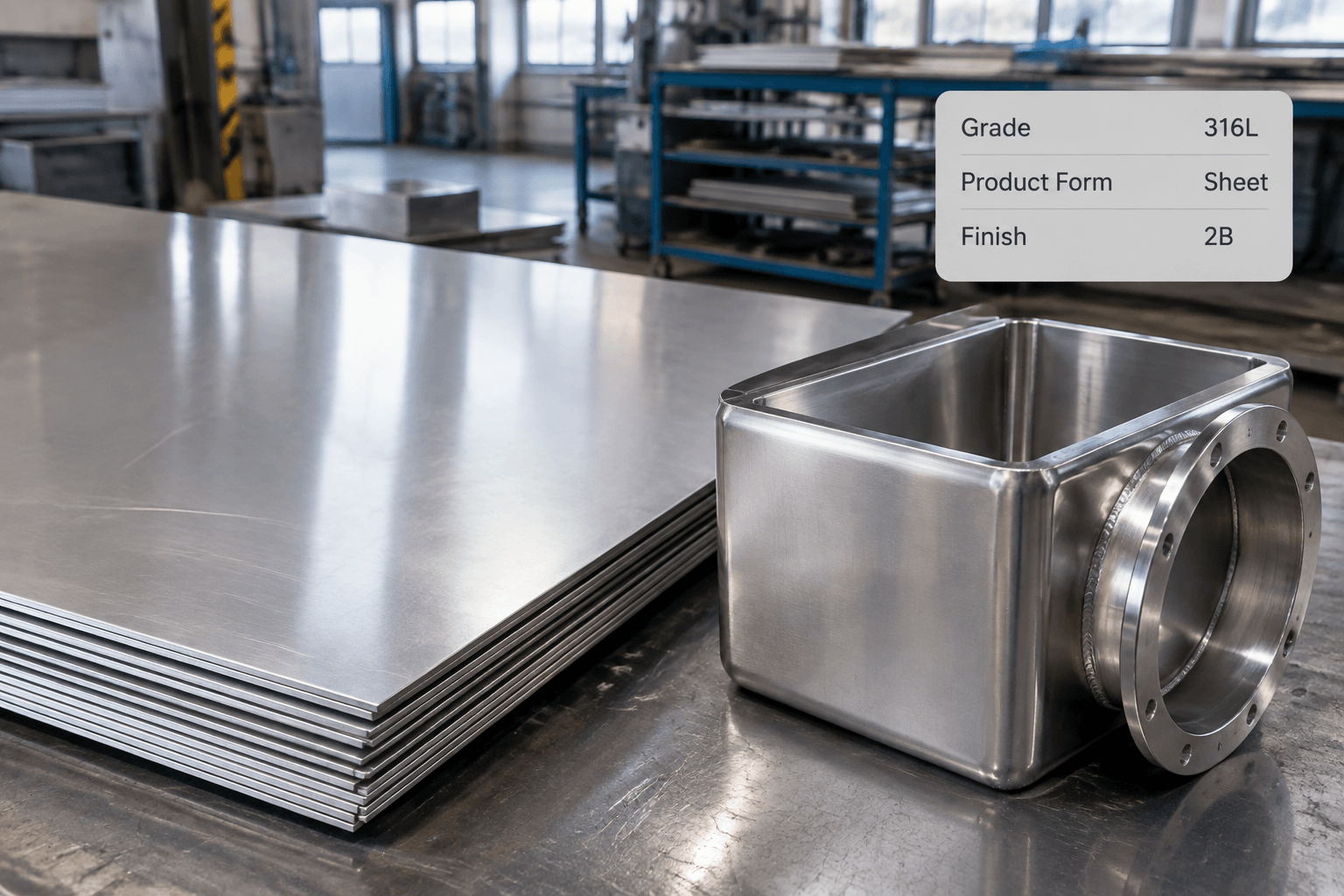
316L stainless steel is a molybdenum-bearing austenitic stainless steel grade. The “L” means a lower carbon limit than conventional 316; this can reduce weld-related sensitization risk, but it does not make the material immune to corrosion.
Whether 316L is appropriate depends on the service environment, product form, material condition, fabrication route, and required surface condition. A sheet-metal drawing should therefore specify more than “316L stainless,” especially when appearance, welded seams, critical dimensions, or inspection records matter.
What 316L Means: Alloy Family and the L Designation
316L belongs to the austenitic stainless steel family. Like 316, it contains molybdenum, which generally improves resistance to localized corrosion compared with 304, particularly in some chloride-bearing environments. This is a relative advantage, not a guarantee that the finished part will resist every chemical, salt concentration, temperature, or cleaning process.
- 316: Identifies the molybdenum-bearing stainless grade family.
- L: Indicates a lower-carbon version of 316. It does not mean low alloy, low strength, or a different stainless family.
- Stainless: Describes an alloy capable of maintaining a protective passive surface under suitable conditions. It does not mean rustproof.
The complete composition limits must come from the applicable material specification for the requested product form. Sheet, plate, bar, tube, and other forms may be purchased under different specifications, and their mechanical-property requirements can differ. Published values should not be treated as universal unless the product form, thickness, condition, and test basis match the project.
Choosing Between 304, 316, and 316L by Exposure
There is no universal answer to whether 304 or 316L is “better.” For a dry indoor enclosure, 304 may provide adequate performance at a lower material cost. Where salts, chlorides, process chemicals, repeated washdown, or persistent moisture are involved, 316 or 316L may offer a useful corrosion-resistance advantage. The decision still requires an examination of the actual exposure.
| Decision condition | 304 | 316 | 316L |
|---|---|---|---|
| Molybdenum-bearing grade | No | Yes | Yes |
| Mild indoor exposure | Often considered, subject to cleaning and contamination | May exceed the environmental requirement | May exceed the environmental requirement |
| Chloride-bearing or more aggressive exposure | Generally less resistant to localized attack | Generally better positioned than 304 | Generally similar alloy positioning to 316, with lower carbon |
| Extensive welding with corrosion-sensitive service | Requires grade- and procedure-specific review | Requires control of welding and surface restoration | Lower carbon can reduce sensitization risk, but welding controls still matter |
Corrosion resistance is affected by concentration, temperature, exposure time, oxygen availability, deposits, cleaning residues, and surface finish. Tight joints, overlapping sheets, gasket interfaces, and poorly drained corners can retain solution and create crevice conditions. Pitting can begin at local surface defects even when broad areas remain visually unchanged.
Welding introduces another variable. Heat tint and nearby oxide layers can leave the weld area less corrosion resistant than properly restored parent material. Carbon-steel particles introduced by shared tooling, grinding dust, or handling can also produce surface staining that may be mistaken for failure of the 316L itself.
Applications involving food or beverage equipment illustrate why alloy identity is only one requirement. Surface geometry, cleanability, joints, finishing procedures, and the applicable regulatory criteria must be evaluated separately. See this overview of fabricated food and beverage equipment for application context; specifying 316L alone does not establish sanitary or regulatory suitability.
316 Versus 316L: The Practical Difference
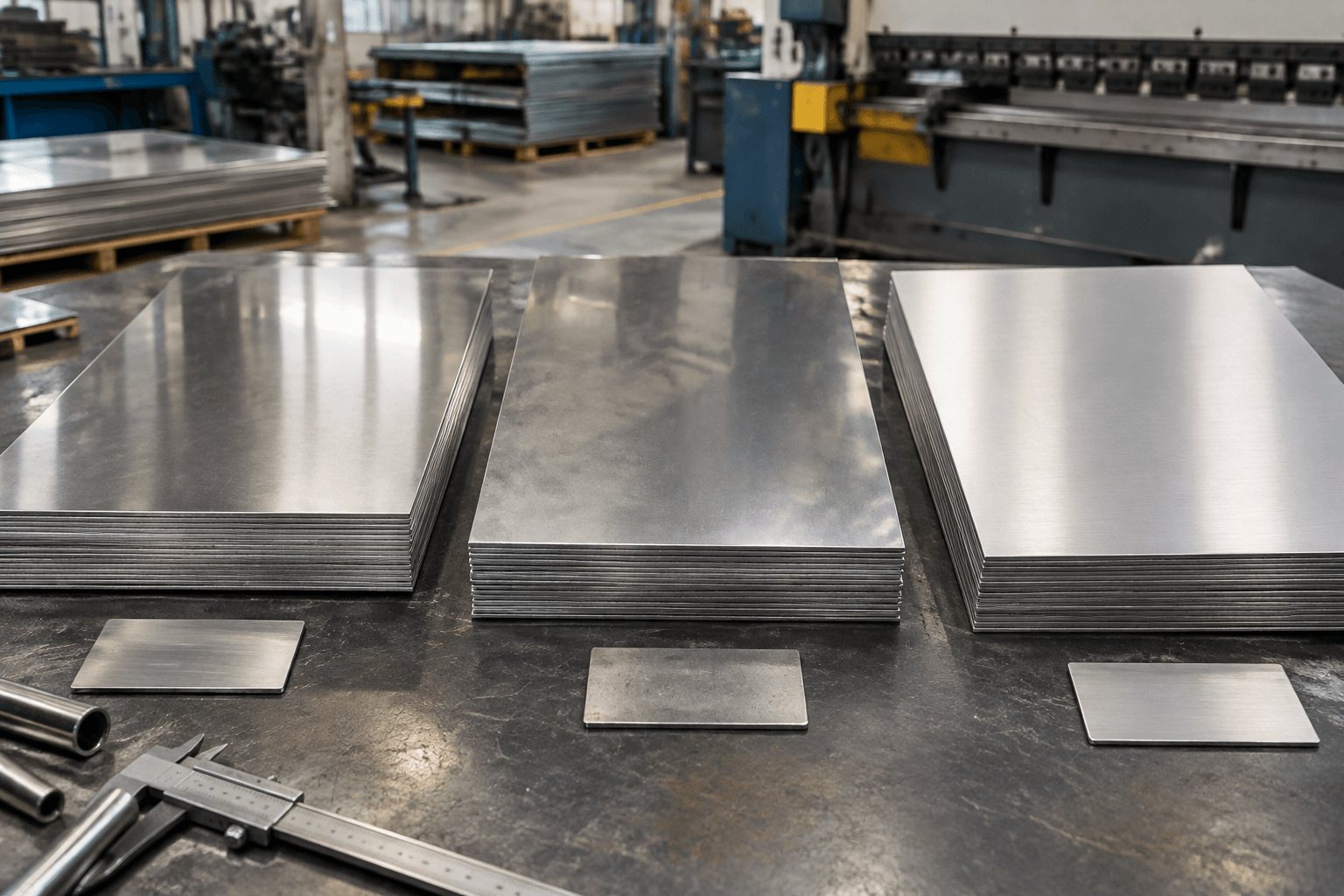
The principal distinction is the lower carbon limit associated with 316L. During unsuitable thermal exposure, chromium can combine with carbon near grain boundaries, reducing corrosion resistance in those local areas. Lower carbon reduces this sensitization risk, which is why 316L is frequently considered for welded parts that will operate in corrosion-sensitive environments.
That advantage should not be overstated. Lower carbon does not correct poor shielding, excessive oxidation, embedded contamination, an unsuitable filler selection, or inadequate post-weld cleaning. Nor does it guarantee identical strength between every 316 and 316L product. Mechanical properties depend on the applicable material specification, product form, thickness, annealed or cold-worked condition, and processing history.
If a design requires minimum strength, hardness, elongation, or other mechanical performance, state the required property and governing material specification rather than assuming that the grade name supplies every necessary value.
From Flat Sheet to Finished 316L Component
Material receipt and cutting: Confirm that the incoming product is the specified form, thickness, condition, and finish. Protective film, sheet orientation, and traceability expectations should be agreed before cutting. Dedicated or thoroughly cleaned contact surfaces help prevent contamination by carbon steel or other metals.
Forming: Austenitic stainless steel work-hardens as it is deformed. Bend sequence, inside radius, grain direction, thickness, tooling clearance, and springback allowance can therefore affect angle consistency and cracking risk. A cosmetic finish adds another constraint: tooling marks that are acceptable on an internal bracket may be unacceptable on an exposed enclosure panel.
Flat-pattern development must reflect the actual material, tooling, and bend geometry. Replacing one stainless grade, thickness, or condition with another without reviewing the bend setup can alter the finished dimensions. Critical hole-to-bend and flange dimensions should be identified on the drawing so inspection focuses on assembly function rather than only the flat blank.
Welding: Joint design, fit-up, heat input, shielding, filler selection, and weld sequence affect distortion and surface condition. The lower carbon level of 316L addresses only one part of this system. If discoloration is unacceptable or corrosion resistance must be restored after welding, define the required treatment and the surfaces to which it applies. Terms such as cleaned, pickled, passivated, blended, or brushed should not be used interchangeably.
Finishing and assembly: A directional finish needs an identified grain direction, especially across adjacent doors, panels, or covers. Weld blending can change local reflectivity, while aggressive grinding may alter thickness or edge definition. For custom stainless sheet-metal enclosures, finish alignment, seam appearance, flatness, hardware interfaces, and assembly clearances should be reviewed together.
CNC machining is a separate process, even when machined features or turned inserts are incorporated into a fabricated assembly. Machining requirements such as threads, bores, inserts, or mating faces should receive their own dimensions and inspection criteria rather than being treated as part of the sheet-metal grade callout.
What a Complete 316L Material Callout Needs to Communicate
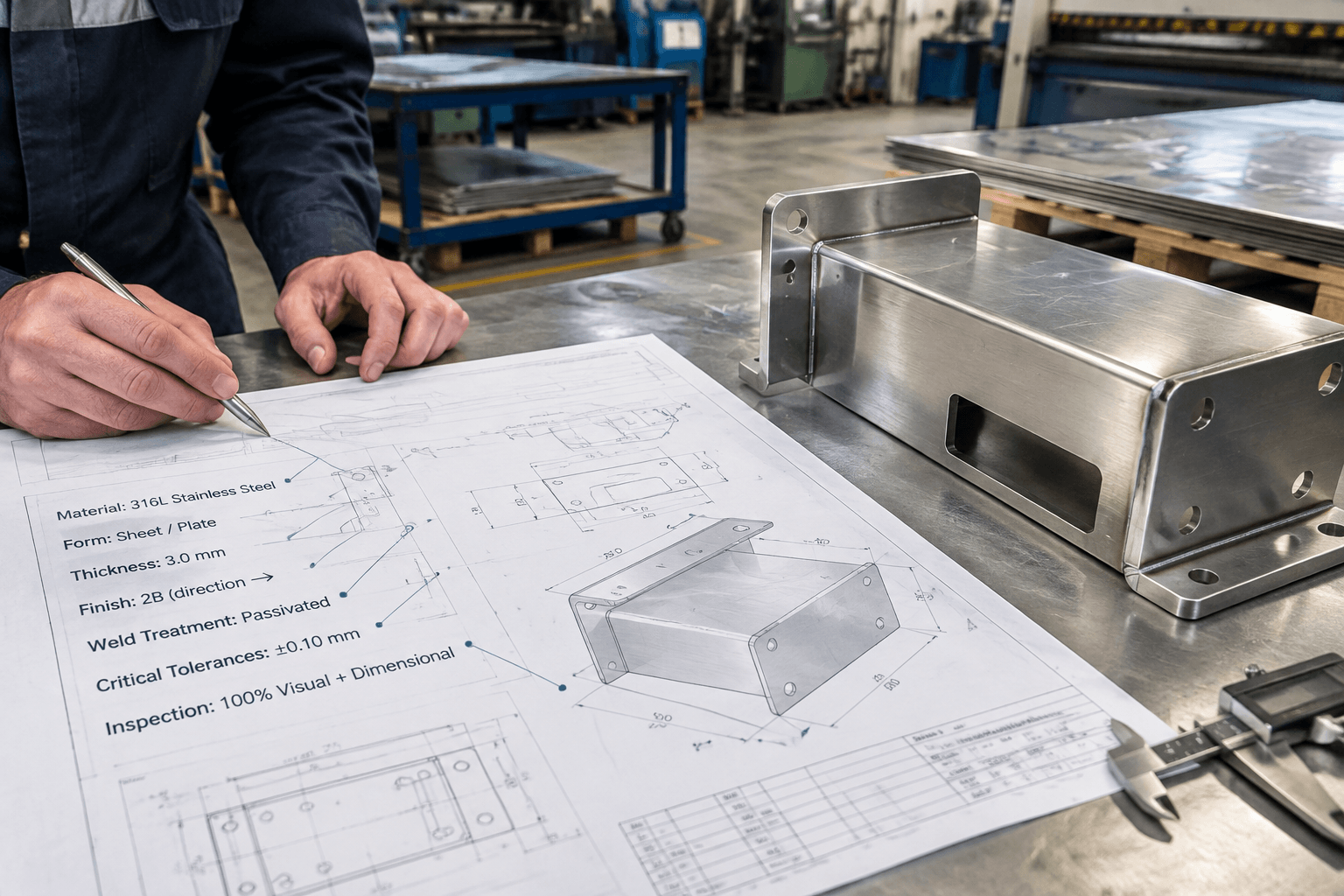
The following is an annotated callout builder, not a universal specification. Replace each bracketed field with project-specific information and identify the applicable material standard where required.
Material: 316L stainless steel, [sheet/plate/tube/other product form], compliant with [applicable product specification and revision]
Size and condition: [nominal thickness or section size], [thickness tolerance if functionally important], [annealed or other required supply condition]
Surface: [mill, brushed, polished, blasted, or project-defined finish]; direction [shown on drawing/not applicable]; protected faces [identified]
Fabrication: Forming direction and critical bend requirements [defined]; weld type and extent [defined by symbols or notes]
Post-weld treatment: [cleaning, oxide removal, blending, pickling, passivation, or other specified procedure]; appearance acceptance [drawing note, sample, or agreed visual criterion]
Inspection: Critical dimensions and datums [identified]; surface defects and weld acceptance [defined]; required material or inspection documentation [listed]
The grade and product form should appear together because “316L” alone does not identify whether the buyer needs sheet, plate, bar, or tube. Thickness tolerance, flatness, mechanical condition, and finish availability can depend on that form and its governing specification.
Finish descriptions also require care. A generic word such as “brushed” may not define texture, direction, allowable weld shadow, edge appearance, or consistency between production batches. When appearance is critical, a controlled reference sample or an objective finish requirement can reduce interpretation. The drawing should also distinguish cosmetic surfaces from hidden or noncritical areas.
Finally, connect inspection to function. Identify dimensions that control assembly fit, sealing, door alignment, hardware position, or interfaces with machined components. Avoid applying unnecessarily tight tolerances to every feature, since forming and welding introduce different variation from machining.
Frequently Asked Questions
Can 316L stainless steel rust or develop surface staining?
Yes. 316L is corrosion resistant, not rustproof. Staining or localized corrosion can result from chloride exposure, deposits, crevices, high temperature, unsuitable cleaning chemicals, damaged surfaces, weld oxidation, or embedded carbon-steel contamination. Investigation should consider both the environment and the fabrication history rather than judging the alloy designation alone.
Is 316L magnetic, and can forming or welding change the observed response?
Annealed 316L is generally regarded as essentially nonmagnetic, but cold forming can produce some magnetic response. A welded area may also respond differently depending on weld-metal structure, filler, and process conditions. If magnetic behavior is functionally important, define an appropriate acceptance method instead of relying on a handheld magnet as proof of grade.
How should the weight of a 316L part be estimated?
Use density from a verified source applicable to the specified material, then multiply it by the finished material volume. A sheet estimate should deduct holes and cutouts and include separate components, weld additions, or hardware where relevant. CAD mass properties can be useful when the model represents finished geometry, but the density setting and component list must be checked.
Does 316L have a fixed scrap or resale value?
No. Value varies with alloy-market conditions, location, quantity, product form, sorting, contamination, and the buyer’s verification method. Clean, identified offcuts may be evaluated differently from mixed fabricated scrap. A current quote from a qualified local recycler is more reliable than a universal price found online.