
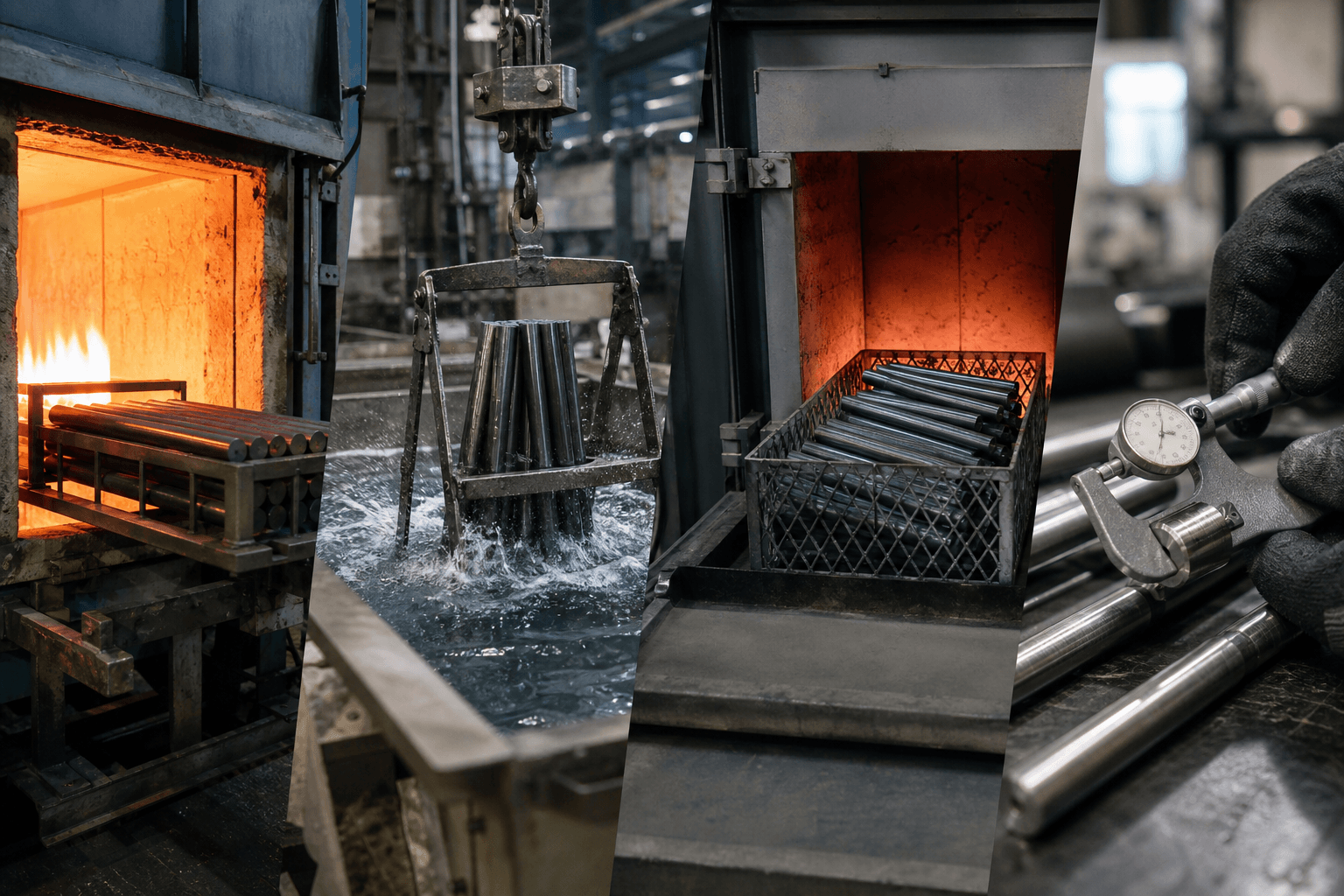
4130 does not have one universal heat-treatment recipe or required final condition. The correct route depends on the specified product form, section size, target properties, governing material or purchasing specification, and downstream operations. 4130 is a chromium-molybdenum alloy steel, but its chemistry alone does not define whether a supplied part is annealed, normalized, quenched and tempered, cold-drawn, or in another condition.
Before production, agree on the required material designation, product form, supply condition, final heat-treatment condition, acceptance criteria, and inspection records. Temperatures, holding times, cooling requirements, quench media, and permitted property values must come from the applicable specification and a qualified process. Generic 4130 property tables should not be treated as universal requirements for every bar, tube, plate, sheet, forging, or finished component.
What 4130 Heat Treatment Is Intended to Control
Heat treatment changes the condition of 4130 so that the material is better suited to its intended function and manufacturing sequence. Depending on the selected route, it can affect strength, hardness, ductility, toughness, residual stress, machinability, and dimensional stability. These objectives can conflict. A condition selected for higher strength may require more attention to machining, welding, distortion, or inspection than a softer condition selected for fabrication.
The first decision is therefore not a furnace setting. It is the required final condition of the product. A load-bearing component may need a specified combination of strength, hardness, and toughness. A machined component may need stable dimensions and predictable cutting behavior. A part that will be welded may require the material condition and welding sequence to be reviewed together. A formed or thin product may respond differently from a thick section treated under apparently similar instructions.
Product form and section size are part of the process definition. They affect how uniformly the material heats, how quickly heat leaves the section during cooling, whether the desired transformation occurs through the full section, and how much residual stress or distortion develops. Furnace practice, loading, holding time, cooling conditions, and quench severity also affect the result. The final requirement should be stated against the applicable product specification rather than inferred from the alloy name alone.
How the Main 4130 Treatment Routes Differ
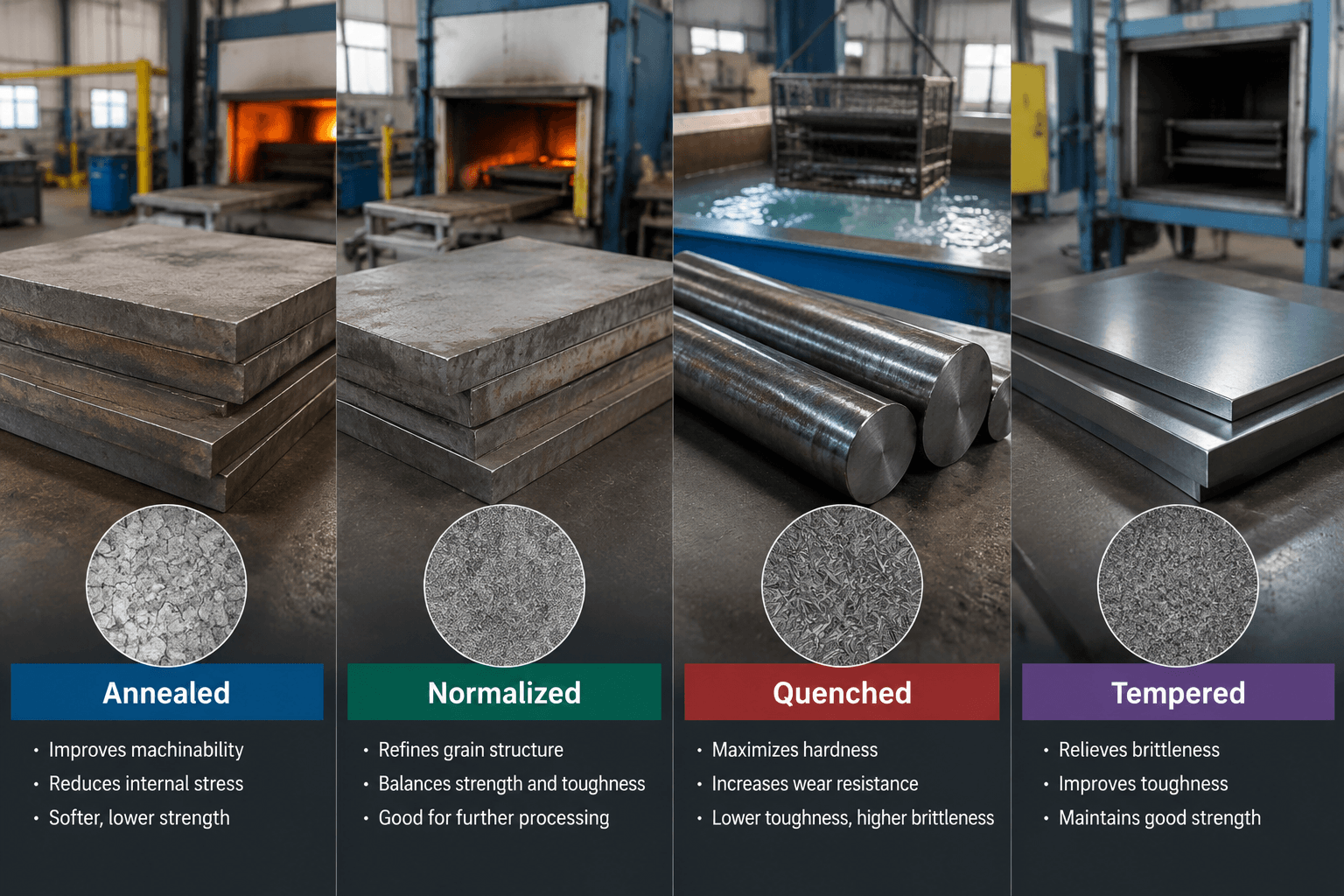
Annealing, normalizing, hardening, quenching, and tempering are related but not interchangeable terms. Some describe complete routes, while others describe individual steps within a route.
| Treatment or route | Primary purpose | Points to control | Possible downstream relevance |
|---|---|---|---|
| Annealing | Produce a softer, more workable condition and reduce or redistribute stresses, subject to the governing specification. | Heating practice, soak or holding requirements, furnace loading, and the specified cooling method. | May support machining or forming, but the supplied condition and dimensional requirements still need confirmation. |
| Normalizing | Refine or reset the material structure and establish a specified normalized condition. | Product form, section size, uniform heating, holding requirements, and controlled cooling after the treatment. | Can provide a defined starting condition before later processing or final treatment. |
| Hardening | Develop a harder transformed structure as part of a specified treatment route. | Austenitizing requirements, section thickness, transfer to cooling, quench severity, and distortion or cracking controls. | Usually requires a subsequent tempering decision when the final condition must balance hardness, toughness, and dimensional behavior. |
| Quenching | Rapidly cool the heated material to produce the transformation required by the hardening route. | Specified quench medium, agitation or circulation, part orientation, transfer time, and section size. | Cooling rate influences hardness development, residual stress, distortion, and cracking risk. It is a process step, not automatically a complete final condition. |
| Tempering | Condition the hardened material to adjust the balance of hardness, strength, toughness, ductility, and residual stress. | Tempering temperature, holding requirements, number of cycles if specified, and cooling after tempering. | Often determines the usable final quenched-and-tempered condition and its suitability for machining, welding review, and service. |
The actual temperatures, holding times, cooling rates, and quench media must be taken from the governing specification, purchase order, drawing, or qualified process instruction. They should not be copied from a general 4130 chart without checking product form, section size, condition, and required test method. The same alloy designation can be processed differently when the supplied product or final property requirement changes.
Hardening and quenching should also be kept conceptually separate. Hardening describes the intended material transformation; quenching describes the cooling step used to achieve it. Tempering is a separate step used to modify the as-quenched condition. A request for “quenched 4130” may therefore be incomplete if it does not state whether tempering is required and what final acceptance criteria apply.
How Supply Condition and Section Size Change the Expected Result
4130 may be supplied in an annealed, normalized, quenched-and-tempered, cold-drawn, or other condition. The starting condition affects the material’s response to machining, forming, welding, and any subsequent heat treatment. A treatment instruction that is suitable for one starting condition may not define the required result for another.
| Condition to identify | What it tells the production team | What still must be confirmed |
|---|---|---|
| Annealed | The material was supplied in a softer condition established by an annealing route. | The applicable product specification, permitted properties, product form, and whether a later final treatment is required. |
| Normalized | The material was supplied in a normalized condition intended to provide a defined structure and property range. | The normalization requirements, section limits, test location, and whether the normalized condition is final or only an intermediate condition. |
| Quenched and tempered | The material has undergone hardening-related cooling followed by tempering to establish a specified final condition. | The governing specification, final acceptance values, traceability, test method, and compatibility with machining or welding plans. |
| Cold-drawn | The product has been mechanically worked after forming, which can affect strength, residual stress, and dimensional behavior. | The product-form requirements and whether additional heat treatment is permitted or required. |
| Other or unspecified | The condition cannot be assumed from the alloy designation alone. | A complete material and purchasing requirement before production planning. |
Section thickness is especially important because the surface and center of a section may not experience the same heating or cooling history. A thin component can cool differently from a thick component, while a large or complex geometry may develop temperature differences between exposed and shielded areas. Those differences can affect through-hardening, residual stress, distortion, and the location at which a test result represents the product.
For example, a drawing for a machined 4130 bracket should identify whether the material is to be machined in an annealed or normalized supply condition and whether a final treatment follows machining. A thick shaft or heavily sectioned component may require a separate review of section size, quench practice, distortion control, and test location. These are specification decisions, not universal conclusions based only on the 4130 name.
Hardness and tensile values also need context. A reported number is difficult to interpret without the product form, starting condition, final treatment, section size, specimen or test location, test standard, and acceptance requirement. A published table may describe one product and condition while being unsuitable for another. This is why generic property tables should support an engineering review, not replace the governing specification.
How to Choose and Specify a 4130 Condition
Select the condition by working backward from the part’s function and manufacturing sequence:
- Define the required material designation and product form, such as the form specified for the purchased material.
- Identify the required supply condition and final heat-treatment condition. State whether annealed, normalized, quenched and tempered, cold-drawn, or another condition is required.
- Define the properties that matter to the part, including strength, hardness, ductility, toughness, machinability, dimensional stability, or other specified requirements.
- Record the controlling section thickness and any geometry that may affect heating, cooling, distortion, or inspection.
- Review the order of machining, turning, milling, forming, welding, finishing, and assembly. These operations are separate manufacturing activities and should not be treated as heat-treatment steps.
- State the acceptance tests, test locations, documentation, and traceability required before release.
A drawing or purchase order should normally identify the material designation, product form, governing specification, supply condition, final heat-treatment condition, acceptance tests, and reporting requirements. It should also identify any critical dimensions or surfaces that must remain stable after treatment. If the part will be machined before or after heat treatment, that sequence should be agreed rather than left to supplier assumption.
For CNC machining, turning, or milling, the relevant question is whether the selected condition provides the required balance of cutting behavior, tool access, dimensional stability, and final properties. See Custom CNC Machining From First Sample to Repeat Production for the machining scope; the material condition and heat-treatment requirement still need to be specified separately.
For welding, review the supplied and final material conditions together with the qualified welding plan and the part’s requirements. Welding is not a substitute for annealing, normalizing, hardening, quenching, or tempering. Likewise, finishing and assembly do not establish the metallurgical condition. A bracket, frame, or other fabricated component may require only selected operations from this list. The drawing should identify which operations are actually required.
For custom bracket work, the material condition, geometry, critical interfaces, and inspection requirements should be coordinated from the drawing rather than inferred from the application label. See Custom Metal Brackets Built to Your Drawings for the product context.
4130 Heat-Treatment Selection: Condition, Objective, and Verification
| Requirement to compare | Specification question | Verification route |
|---|---|---|
| Required condition | What supply and final conditions are permitted or required? | Material certificate, treatment record, traceability, and applicable acceptance review. |
| Mechanical objective | Which strength, hardness, ductility, or toughness requirements control? | Hardness, tensile, or other specified testing using the stated method and location. |
| Geometry and section size | What section thickness, product form, and shape affect heating or cooling? | Dimensional inspection and review of the process record against the qualified route. |
| Downstream operation | Will machining, turning, milling, welding, finishing, or assembly occur before or after treatment? | Review the sequence, critical dimensions, and any required post-process inspection. |
| Documentation | What records must accompany the lot or finished part? | Certificate information, heat-treatment records, lot traceability, test reports, and release records as required. |
How to Verify the Treated 4130
Verification begins with documents, not with an isolated hardness reading. Review the material certificate or other required certificate information, lot and heat traceability, supplied condition, final treatment record, and the process route used for the product form and section size. The record should be adequate to show that the specified treatment was applied to the identified material.
Hardness, tensile, dimensional, or other testing should be performed when required by the governing specification, drawing, or purchase order. The requirement should state the test method, test location, specimen or product form, sampling basis, and acceptance criteria. Without those details, a result may be technically correct but still unsuitable for acceptance or comparison.
| Verification item | What to confirm before interpreting the result |
|---|---|
| Heat-treatment record | Material identity, lot traceability, treatment route, required process controls, and record completeness. |
| Hardness test | Specified method, test location, surface condition, sampling requirement, and permitted range or limit. |
| Tensile or other mechanical test | Specimen or product form, orientation or location where applicable, test standard, and acceptance values. |
| Dimensional inspection | Critical dimensions, datum references, distortion limits if specified, and inspection timing. |
| Final documentation | Required certificates, reports, nonconformance handling, and release authorization. |
Before production planning, a technical specification review can align the requested 4130 condition with the part geometry, downstream manufacturing sequence, and documentation requirements. Provide the part drawing or 3D model, material designation and product form, required supply or final heat-treatment condition, applicable purchasing specification and acceptance criteria, section thickness, planned machining or welding sequence, and required inspection or documentation.
Ready to Review This RFQ Before Production?
If your project involves 4130 heat treatment, send Yishang your drawings, material requirements, quantities, tolerance notes, finish expectations, photos, samples, and assembly needs through custom sheet metal fabrication support. A clearer review before quoting can reduce avoidable clarification rounds, rework, and production uncertainty.

Frequently Asked Questions
What 4130 heat treatment details should buyers define before requesting a quote?
Buyers should define the functional requirement, drawing notes, critical dimensions, material or process expectations, and any inspection points related to 4130 heat treatment. This helps suppliers quote the same manufacturing scope instead of making different assumptions.
How can RFQ details affect cost, fit, or lead time?
RFQ details can change tooling, forming, welding, finishing, inspection, or rework requirements. If buyers do not clarify it early, two supplier quotes may look comparable while covering different production risks.
Why should drawing requirements be reviewed before prototype approval?
drawing requirements may look acceptable on a single sample but become harder to control during batch production. Buyers should confirm whether the prototype reflects the same process, finish, and inspection conditions expected for production.
What inspection points matter most for 4130 heat treatment projects?
Important inspection points usually include fit-critical dimensions, holes or mating areas, cosmetic surfaces, finish build-up, welded or formed features, and any dimensions that affect downstream assembly. These points should appear in the RFQ or drawing notes.
How can buyers reduce prototype approval risk before batch production?
Buyers can reduce risk by clarifying drawings, locking key material and finish assumptions, defining inspection timing, approving a representative sample, and confirming which dimensions or surfaces require tighter process control.
How can Yishang help review 4130 heat treatment requirements?
Yishang can review drawings, RFQ notes, material requirements, tolerance expectations, finish details, samples, and assembly needs to identify unclear assumptions before quoting or batch production.