
What Is the Modulus of Elasticity of 4130 Steel?
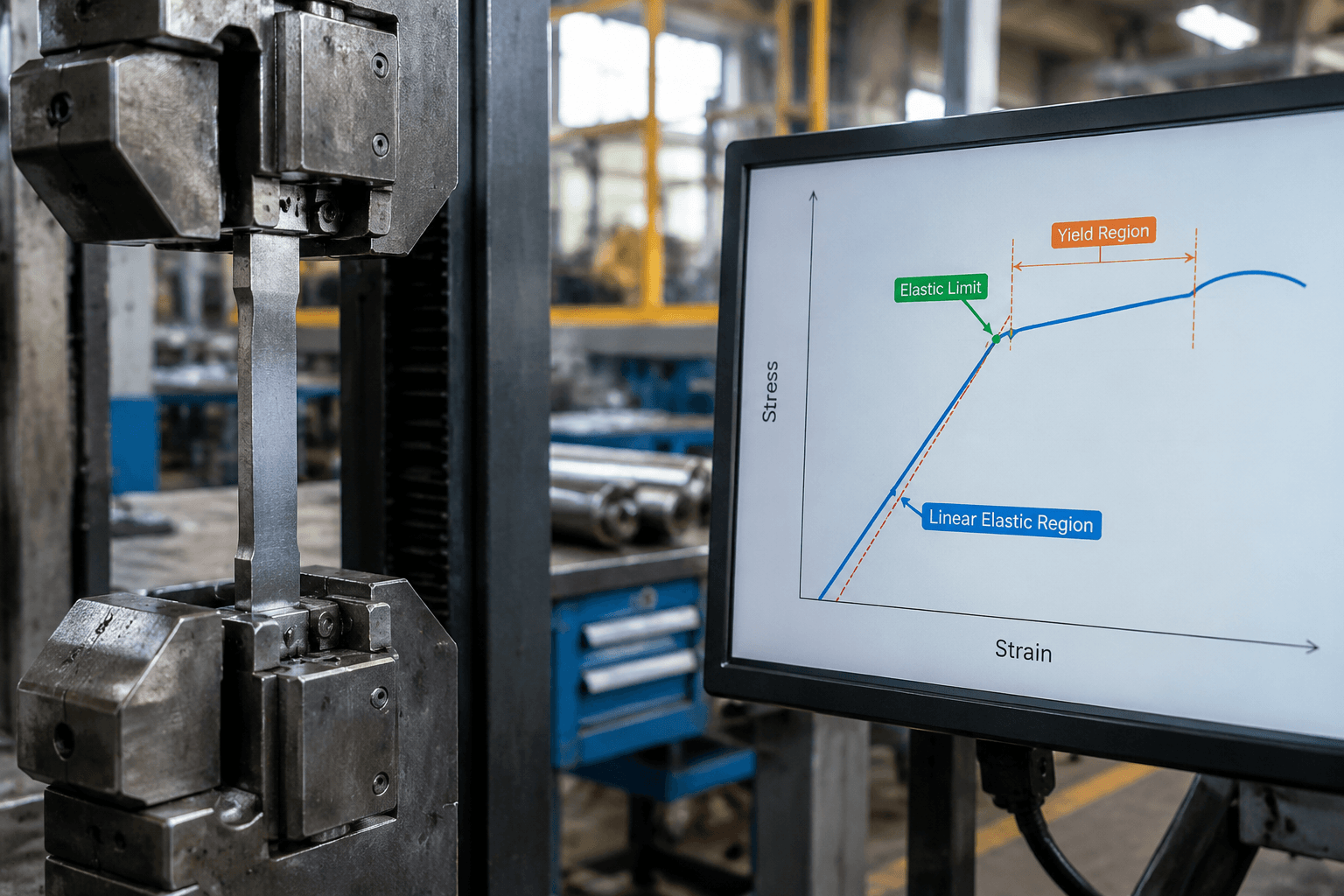
At room temperature, the modulus of elasticity of AISI 4130 steel is commonly taken as approximately 205 GPa, or 29.7 million psi, based on the grade-level value reported in ASM Handbook, Volume 1: Properties and Selection: Irons, Steels, and High-Performance Alloys. Young’s modulus represents the slope of the linear elastic portion of the stress-strain curve, not the strength or hardness of the steel.
This value describes the elastic response of the material itself. It does not, by itself, determine how much a finished tube, bracket, frame, or welded assembly will deflect because component stiffness also depends on geometry, span, load direction, supports, and joints.
| Property | Representative value | Context |
|---|---|---|
| Young’s modulus, E | Approximately 205 GPa | Room-temperature, grade-level handbook value for AISI 4130 |
| Young’s modulus, E | Approximately 29.7 million psi | Converted from 205 GPa; rounded for engineering communication |
The ASM value is a general material reference rather than a guaranteed property for every sheet, tube, bar, forging, heat-treatment condition, or production heat. A project may instead require a value from its governing material specification, an approved design-data source, or testing applicable to the actual product form and temperature.
Elastic modulus is normally expressed as stress divided by strain. Because strain is dimensionless, modulus has units of stress, such as gigapascals, megapascals, or pounds per square inch. A higher modulus means more stress is required to produce the same elastic strain.
Where Modulus Appears on the Stress-Strain Curve
Stress is the applied force divided by the original loaded area. Strain is the resulting change in length divided by the original gauge length. In the initial straight portion of a tensile stress-strain curve, stress and strain are approximately proportional, and their ratio is Young’s modulus:
E = stress / strain
If loading remains within the recoverable elastic range, the specimen returns approximately to its original dimensions when the load is removed. Once loading produces plastic deformation, some dimensional change remains. The proportional limit, elastic limit, and reported yield strength are related concepts, but they are not interchangeable. Yield strength is often established using a specified offset method because the transition from elastic to plastic behavior is not always sharply defined.
ASTM E111 provides recognized methods for determining Young’s modulus, tangent modulus, and chord modulus. A handbook value should not automatically be treated as though it were a test result for the actual purchased material, especially where temperature, loading direction, or product form matters.
Stiffness Is Not Strength, Hardness, or Toughness
| Property | What it describes | What it does not establish |
|---|---|---|
| Young’s modulus | Resistance to elastic strain in the linear region | The load at which permanent deformation or fracture occurs |
| Yield strength | Stress associated with the onset of specified permanent deformation | Elastic deflection at a lower working stress |
| Tensile strength | Maximum engineering stress reached in a tensile test | Component rigidity or impact resistance |
| Hardness | Resistance to localized indentation under a defined test | Overall structural stiffness |
| Toughness | Ability to absorb energy before fracture under defined conditions | Modulus or dimensional rigidity by itself |
Heat treatment can substantially alter the microstructure of 4130 and therefore its yield strength, tensile strength, hardness, ductility, and toughness. The elastic modulus is controlled mainly by interatomic bonding, so ordinary heat-treatment changes do not normally produce a comparable change in room-temperature modulus.
For example, annealed and quenched-and-tempered 4130 may behave very differently as stress approaches yielding, even though their initial stress-strain slopes remain broadly similar. The stronger condition can carry more stress before permanent deformation, but it should not be assumed to deflect substantially less under the same low elastic stress and identical geometry.
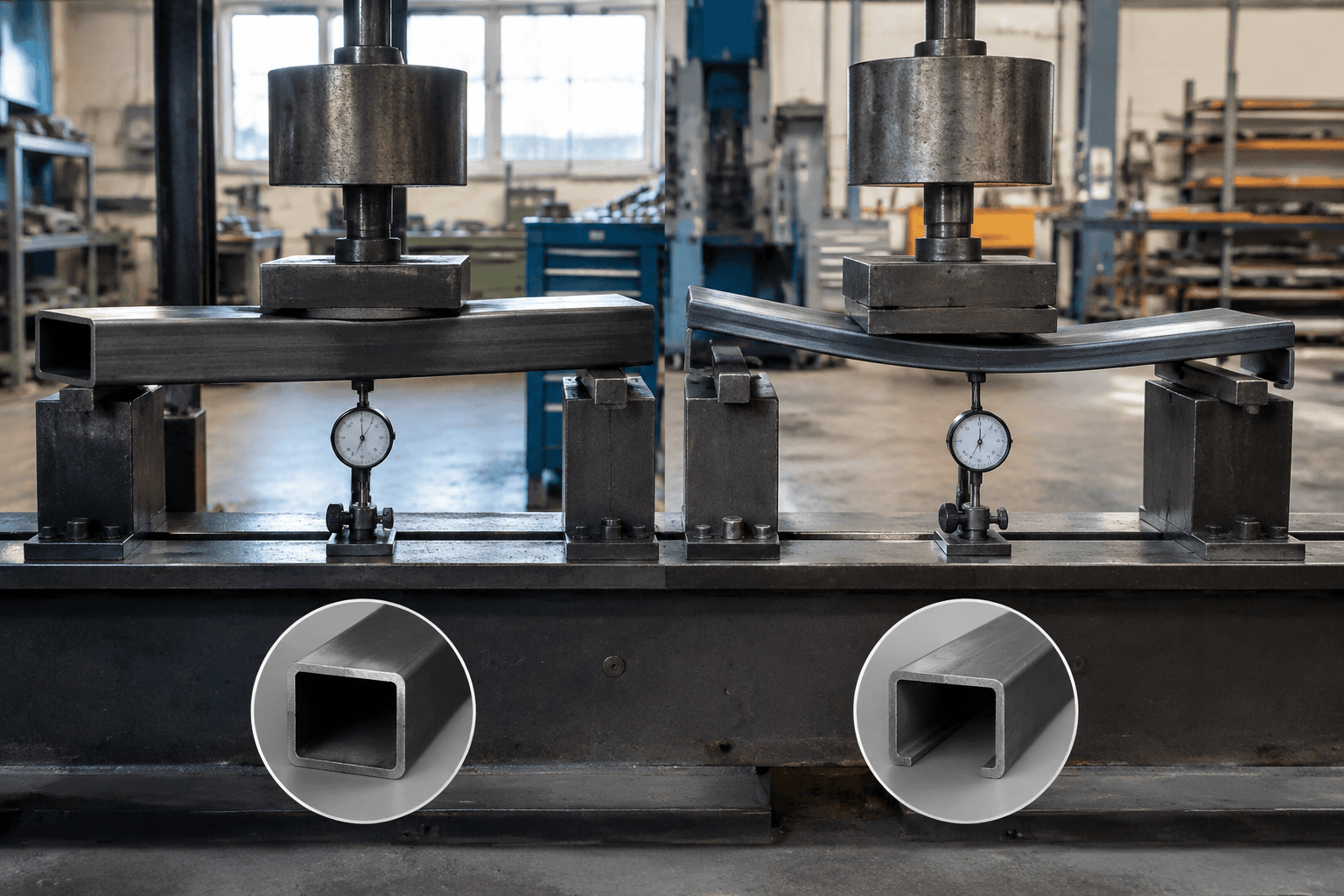
Same 4130 Modulus, Different Deflection: What Geometry Changes
Consider an illustrative cantilever beam with an end load. Under ideal, small-deflection, linear-elastic assumptions, its tip deflection is:
Deflection = FL3 / 3EI
Here, F is the applied load, L is the unsupported length, E is Young’s modulus, and I is the second moment of area in the bending direction. The equation assumes a straight, uniform beam, a rigid support, ideal load placement, and deformation within the elastic range. It does not account for local buckling, residual stress, joint flexibility, holes, contact, or complex load paths.
| Change while other variables remain constant | Illustrative effect on elastic deflection |
|---|---|
| Double the load, F | Deflection doubles |
| Increase span, L, by 25% | Deflection becomes about 1.95 times greater because span is cubed |
| Double the second moment of area, I | Deflection is halved |
| Change heat treatment but retain similar E and geometry | Elastic deflection is broadly similar until nonlinear or permanent behavior becomes relevant |
Section dimensions can therefore outweigh small differences between published modulus values. Increasing tube diameter, changing wall thickness, adding a return flange to a sheet metal bracket, or orienting a rectangular section about its stronger axis can greatly increase bending stiffness. Two parts made from the same 4130 material may feel entirely different because their second moments of area differ.
Connections also matter. A welded corner, bolted joint, formed bend, gusset, or mounting interface can introduce rotation and local deformation that a simple beam calculation omits. In fabricated custom metal frames, member section, joint layout, weld sequence, attachment points, and assembly fit all influence the measured response of the finished structure. Material modulus remains one input rather than a complete prediction.
Using a Published 4130 Modulus in Design
Start by identifying the source and purpose of the value. A grade-level handbook value may be appropriate for preliminary room-temperature calculations, while a regulated or critical application may require data from a specified design-data source. The drawing and purchase specification should clearly identify whether the 4130 is sheet, plate, tube, bar, or another product form, along with the required material condition.
Temperature must also be considered. The elastic modulus of steel generally decreases as temperature rises, so a room-temperature value should not be carried into elevated-temperature analysis without suitable data. Loading direction may matter for products or manufacturing histories that produce directional behavior, while welds and heat-affected zones can require separate treatment in a detailed analysis.
Before drawing conclusions from E, define the actual loads, support conditions, deflection limit, section dimensions, holes, bends, joints, and load cycles. Then check other applicable failure modes, including yielding, buckling, fatigue, fracture, joint slip, and local deformation. Final validation may require appropriate engineering analysis or physical testing; modulus alone cannot establish that a component is safe or suitable.
Frequently Asked Questions
Does heat treatment change the modulus of elasticity of 4130 steel?
Heat treatment can cause small variations, but it generally changes the strength, hardness, ductility, and toughness of 4130 much more than its room-temperature Young’s modulus. Use condition-specific data when required, but do not assume that a harder or stronger condition is proportionally stiffer in the elastic region.
Is 4130 stiffer than 4140 steel?
Not in a practically universal sense. Both are low-alloy steels with broadly similar room-temperature elastic moduli. Their carbon content, heat-treatment response, strength, hardness, and toughness can differ, but grade strength differences should not be interpreted as equivalent differences in elastic stiffness.
How does 4130 compare with A36 for stiffness and strength?
4130 and steel supplied to ASTM A36 requirements can have broadly similar elastic modulus values, so identical geometries may show similar elastic deflection under the same load. Their specified and achievable strength properties can differ considerably depending on product, thickness, condition, and governing specification. Compare strength separately from modulus.
Does 4130 chromoly have a different modulus from ordinary steel?
Chromoly is an informal name for chromium-molybdenum alloy steel; 4130 is one such grade. The alloying supports useful hardenability and strength combinations, but it does not create a separate category of exceptionally high elastic modulus. Geometry is usually the larger reason a 4130 tube or frame differs in rigidity from another steel component.