
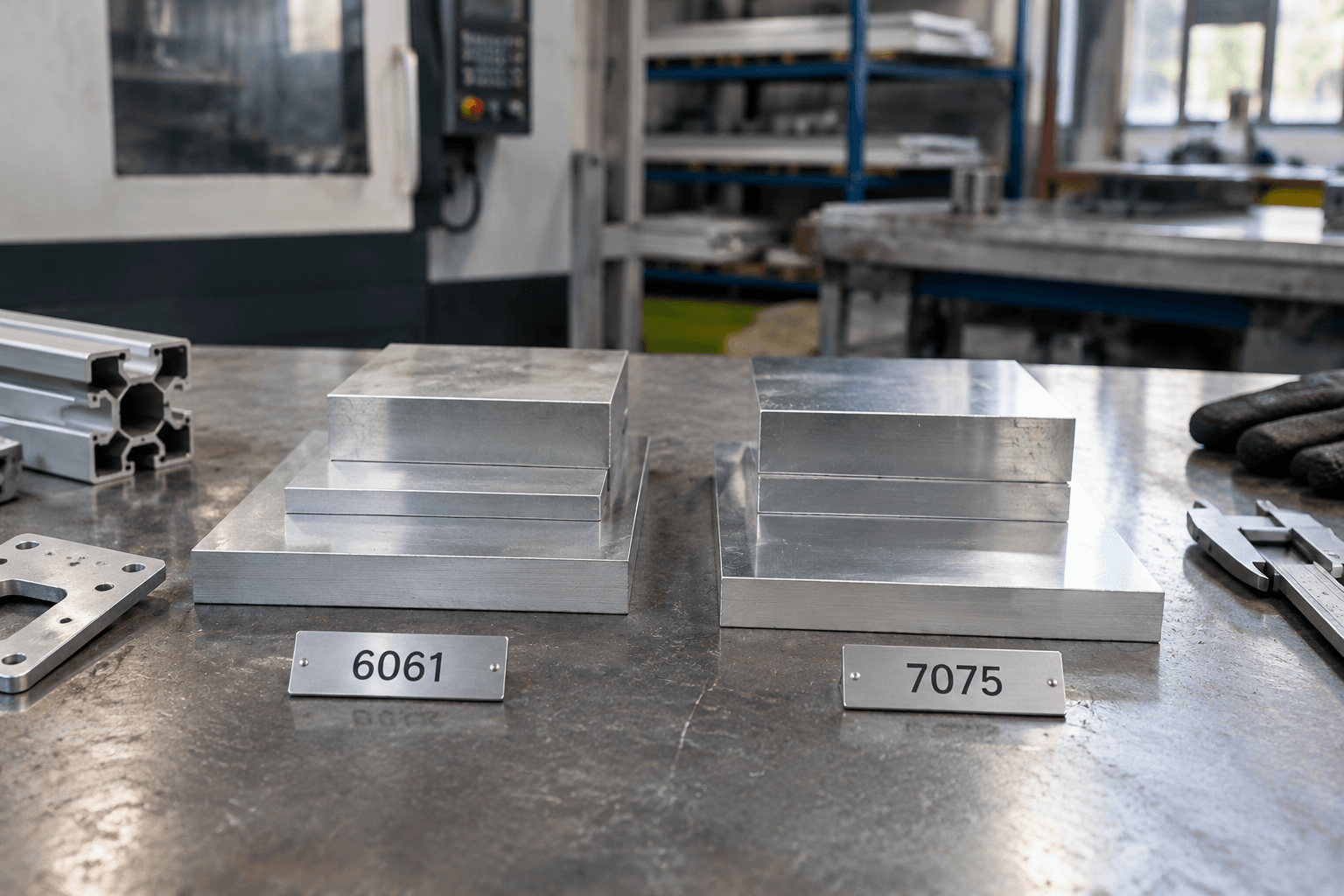
6061 is usually the practical choice when corrosion resistance, forming, welding, availability, and general-purpose fabrication are the leading priorities. 7075 is usually preferred when substantially higher strength is essential and its joining, forming, and corrosion limitations can be managed.
However, comparing only 6061 and 7075 is incomplete: temper, thickness, product form, grain direction, loading, and applicable material specifications must be considered before numerical properties are used.
6061 vs 7075: The Short Comparison
Favor 6061 when the part needs:
- Reliable general corrosion resistance
- Conventional welding and fabricated assemblies
- Bending or forming, especially in a suitable temper
- Extrusions, sheet, plate, tube, or other widely available forms
- Predictable decorative or protective anodizing
- A balanced combination of strength, cost, and manufacturability
Consider 7075 when the part needs:
- Much higher yield and tensile strength
- High strength-to-weight performance
- Resistance to demanding cyclic loads, subject to detailed fatigue design
- Machined structural features rather than welded construction
- A product form and temper specifically available for the design
- Controlled corrosion protection and service conditions
Neither alloy is universally better. Substitution can affect section thickness, fastener loads, fatigue life, forming sequence, heat-affected zones, corrosion protection, and compliance with the drawing or engineering specification.
Alloy Number, Temper, and Product Form Must Be Read Together
6061 belongs to the 6xxx series. Its principal alloying additions are magnesium and silicon, which form the basis of its heat-treatable response. Recognized composition limits commonly specify approximately 0.8–1.2% magnesium and 0.4–0.8% silicon, with controlled amounts of copper, chromium, iron, and other elements.
7075 is a 7xxx-series aluminum based mainly on zinc and magnesium, with a significant copper addition. Common composition limits include approximately 5.1–6.1% zinc, 2.1–2.9% magnesium, and 1.2–2.0% copper. This chemistry helps produce much higher strength after heat treatment, but it also changes corrosion behavior, welding suitability, forming response, and anodized appearance.
The temper suffix describes processing after the alloy is produced. T6 generally means solution heat treated and artificially aged. T651 adds stress relief by controlled stretching, commonly for plate, although exact definitions and requirements should be taken from the governing specification. For 7075, overaged tempers such as T73 or stress-relieved derivatives are often considered where improved stress-corrosion resistance is more important than retaining maximum T6-level strength.
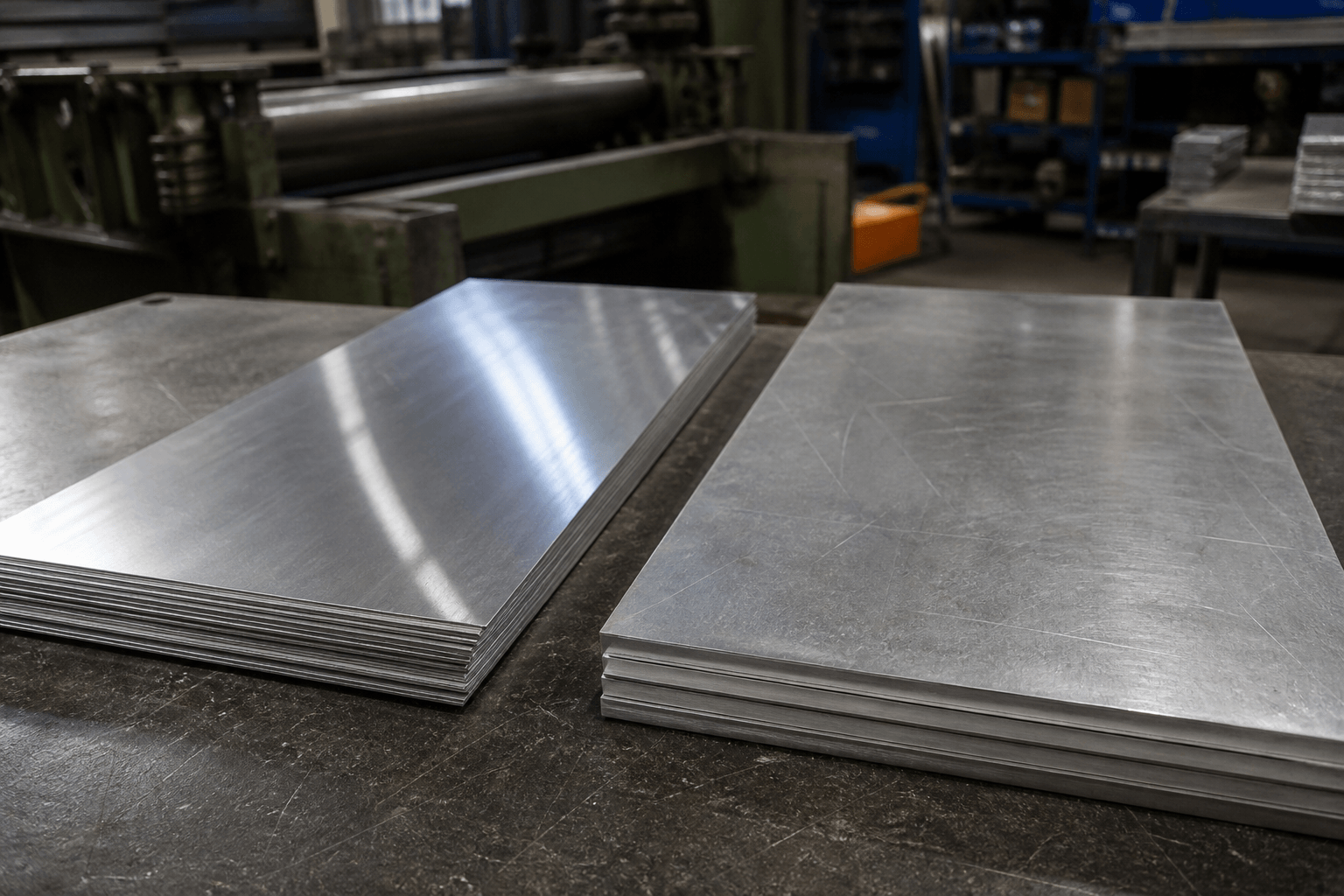
Product form matters as well. Sheet, extruded profiles, plate, bar, and forgings can have different minimum properties, grain structures, residual stresses, thickness effects, and directional behavior. A value from a thin 6061-T6 extrusion should not automatically be assigned to thick plate, and a 7075-T651 plate value should not be treated as universal for every 7075 product.
Properties That Affect Real Design and Production Decisions
The following values are representative room-temperature figures often published for wrought plate in T6/T651-type conditions. They are useful for preliminary comparison, not as drawing requirements or incoming-inspection acceptance limits. Procurement values must come from the applicable material specification and product-form datasheet.
| Decision factor | 6061-T6/T651 | 7075-T6/T651 |
|---|---|---|
| Representative yield strength | About 240–276 MPa, depending on form, thickness, and source condition | About 460–503 MPa, depending on form, thickness, orientation, and specification |
| Representative tensile strength | About 290–310 MPa | About 540–572 MPa |
| Density | Approximately 2.70 g/cm³ | Approximately 2.81 g/cm³ |
| Corrosion behavior | Generally good atmospheric corrosion resistance | More dependent on temper, exposure, protective finish, and stress-corrosion control |
| Machining | Good general machinability; widely used for mixed fabricated and machined parts | Often machines cleanly with favorable chip control, but residual stress and part stability still require attention |
| Conventional fusion welding | Commonly weldable using an appropriate process and filler; heat-affected-zone softening must be considered | Generally not recommended for conventional fusion-welded structural fabrication because of cracking and property concerns |
| Forming | More accommodating, particularly in annealed or T4 conditions; T6 has reduced formability | Limited in high-strength tempers; bends require careful radius, direction, and temper review |
| Finishing | Usually responds consistently to anodizing, although color still varies with process and lot | Can be anodized, but its copper and zinc content may influence color, uniformity, and corrosion strategy |
| Availability | Broadly available in sheet, plate, bar, tube, and extrusion | Common in plate, bar, and selected forged or extruded forms, but not as universally available |
7075 is roughly 4% denser than 6061, so an equal-volume 7075 component is slightly heavier. That difference is usually less important than what the higher strength permits the designer to do. If loads and stability allow a thinner or smaller section, a redesigned 7075 component may weigh less than a 6061 version. A direct same-geometry substitution, however, normally makes the 7075 part slightly heavier.
Strength also should not be confused with stiffness. The elastic moduli of the two alloys are relatively close, so changing to 7075 may not solve a deflection problem unless geometry changes. Fatigue performance is similarly influenced by surface finish, stress concentrations, holes, threads, corrosion, mean stress, and loading direction—not alloy name alone.
How to Verify Whether Material Is 6061 or 7075
Bare 6061 and 7075 can look very similar. Surface color, machining marks, apparent hardness, or anodized appearance cannot reliably prove alloy grade or temper.
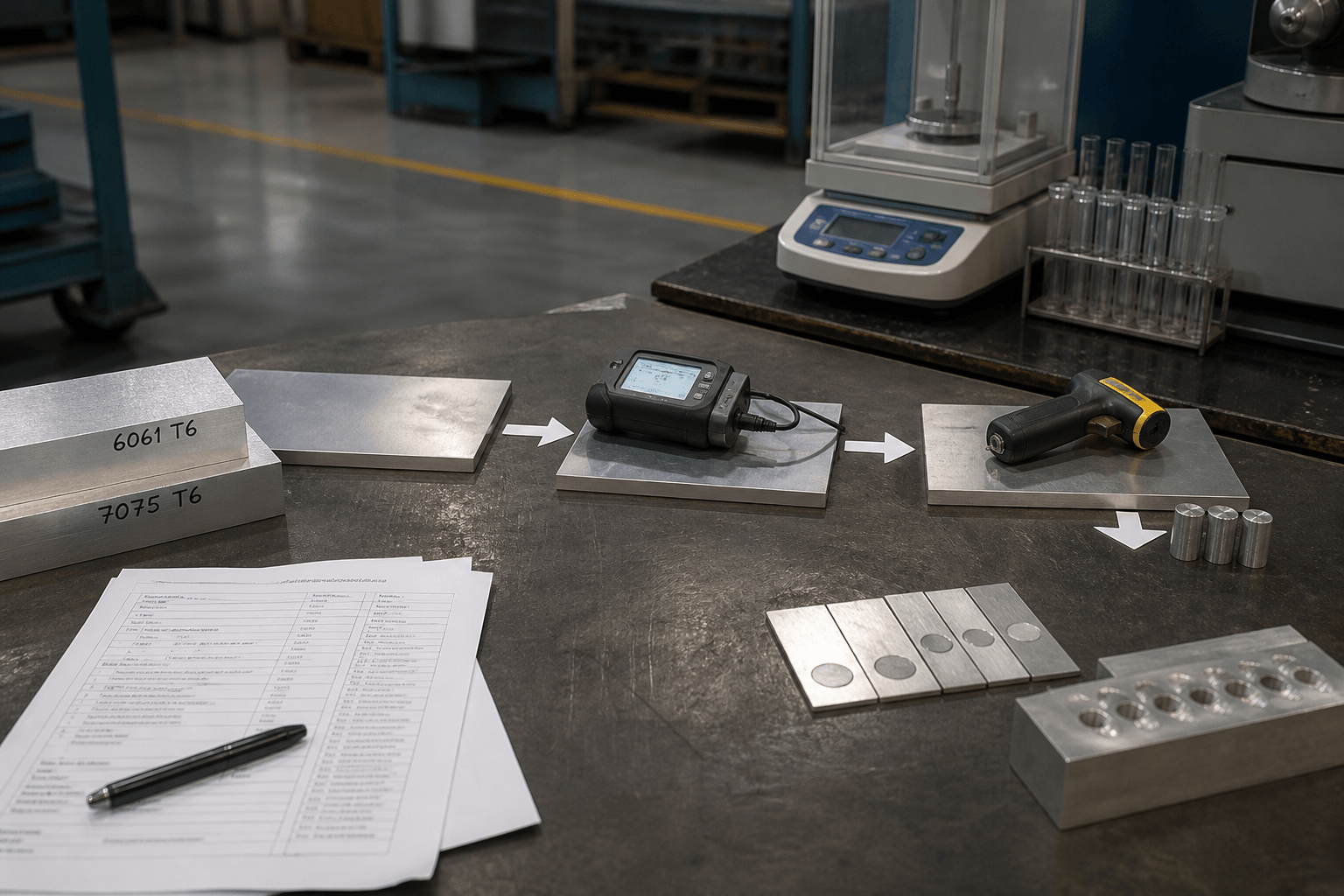
- Start with traceability. Review the purchase specification, supplier identification, heat or lot markings, and material certificate. Confirm that the document states alloy, temper, product form, dimensions, and the applicable specification.
- Preserve identity during production. Separate remnants and work-in-process parts by lot. Transfer identification when original mill markings are removed by cutting.
- Use composition screening appropriately. Calibrated positive material identification can often distinguish zinc-rich 7075 from 6061. Handheld X-ray fluorescence is useful for many heavier elements, but its ability to quantify light elements such as magnesium or silicon depends on the instrument, calibration, surface condition, and test method.
- Escalate uncertain results. Optical emission spectroscopy or suitable laboratory chemical analysis may be required when grade confirmation is critical. Hardness and electrical conductivity can support alloy-and-temper screening, but neither normally proves the complete designation by itself.
Verification requirements should be defined before production, especially when mixed aluminum inventories, safety-related loads, or specified tempers are involved.
Choose 6061 or 7075 by Design Priority
| Design situation | Starting preference | Reason and review point |
|---|---|---|
| Welded frame, housing, or support | 6061 | Better-established conventional welding route; account for reduced strength around welds and any post-weld requirements. |
| Bent sheet or formed bracket | Usually 6061 | More practical forming options. Confirm temper, thickness, grain direction, inside radius, and whether forming occurs before final heat treatment. |
| Highly loaded machined fitting | Consider 7075 | Higher strength may support a compact section, provided corrosion, fatigue, joining, and material orientation are addressed. |
| Outdoor general-purpose component | Usually 6061 | Its corrosion resistance and finishing response are often more convenient, although exposure and coating requirements still matter. |
| Strength-critical component under repeated loads | Consider 7075 | Higher static and fatigue strength can be valuable, but notches, fastener holes, surface condition, stress corrosion, and inspection criteria require engineering review. |
| Complex extrusion-led assembly | Usually 6061 | 6061 is widely used for custom aluminum extrusion components; profile availability and temper after processing must still be confirmed. |
For custom metal bracket designs, 6061 is often the more practical starting point when bending, welding, corrosion resistance, and normal structural performance must be balanced. A machined 7075 bracket may be justified when loads demand greater strength and welded construction is unnecessary.
Similar tradeoffs appear in automotive and transportation metal components. Weight targets alone do not decide the alloy. Designers must also review vibration, impact, road-salt exposure, fastened joints, repair methods, section stiffness, and the availability of the required product form.
Frequently Asked Questions
What is better, 6061 or 7075 aluminum?
6061 is generally better for broad fabrication, welding, forming, corrosion resistance, and availability. 7075 is generally better when substantially higher strength is required. The correct choice depends on temper, geometry, loads, environment, joining method, and governing engineering requirements.
Can you reliably tell 7075 from 6061 by appearance?
No. Visual inspection is inconclusive. Use traceable material documentation and markings first, followed by calibrated composition testing when required. Hardness or conductivity can support screening, but results must be interpreted against possible alloys, tempers, and product forms.
Is 6061 or 7075 aluminum heavier, and is the difference meaningful?
7075 is slightly denser: approximately 2.81 g/cm³ compared with about 2.70 g/cm³ for 6061. At identical volume it is roughly 4% heavier, but strength-driven geometry changes may have a larger influence on final part weight.
What is 7075-T6 commonly used for, and when is 6061 a better alternative?
7075-T6 is commonly considered for highly loaded machined structural parts, fittings, and fatigue-sensitive components where high strength-to-weight performance is important. 6061 is often the better alternative for welded assemblies, formed parts, general outdoor service, complex extrusions, and designs that do not need 7075-level strength.