Framing the Problem
Motorized TV lift systems are no longer luxury add-ons; they are essential in commercial environments where space, safety, and seamless operation matter. Yet despite growing demand, many B2B buyers still face technical mismatches, high failure rates, and poor integration during implementation.
This article is written for professional buyers, engineers, and OEM project managers who are looking for actionable, engineering-informed insights—not surface-level fluff. Whether you’re sourcing drop-down TV lifts for hotels or pop-up units for medical carts, we’ll walk you through the design constraints, materials logic, motion path rules, and procurement strategies that actually drive long-term ROI.
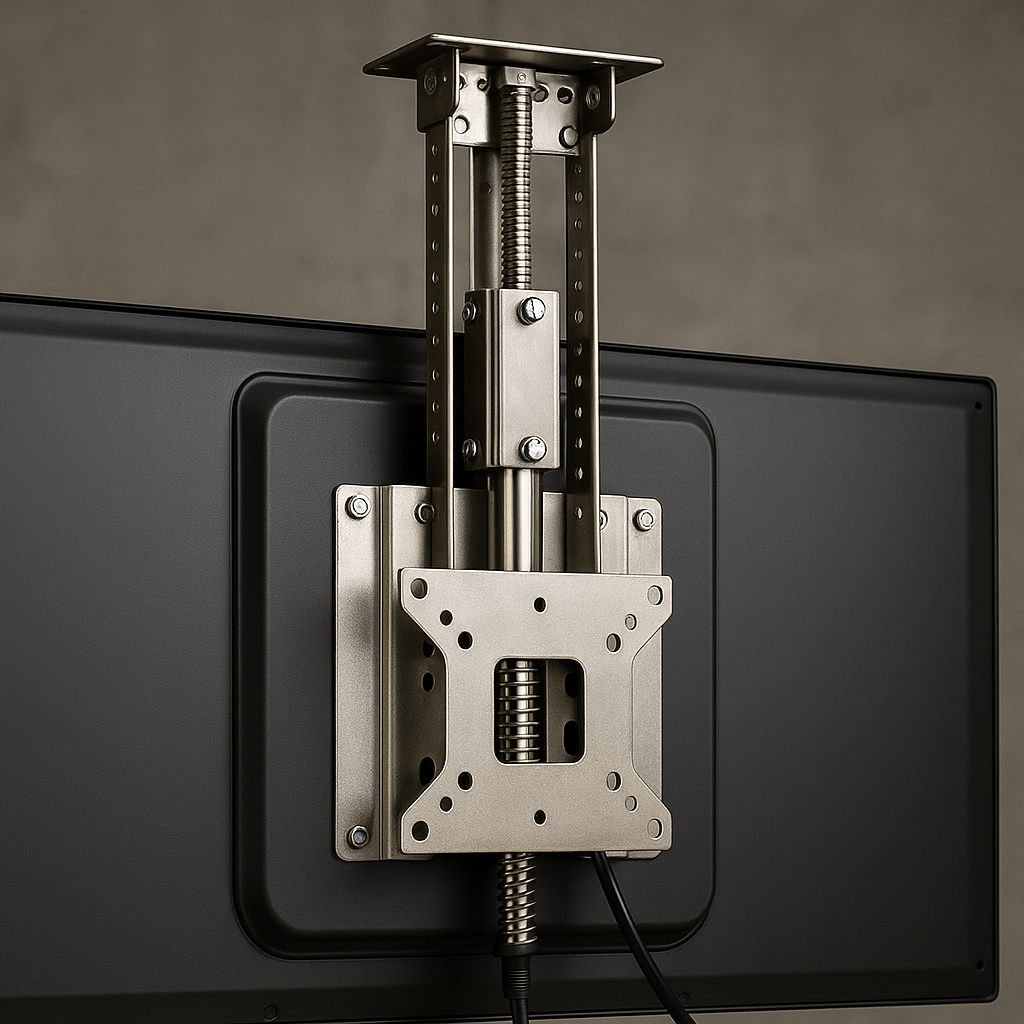
Interface Conflict: Mounting Realities vs. Concept Design
Many lift systems that look sleek in a brochure fail when mounted to real-world surfaces. Common issues include inconsistent surface contact, vibration transfer, and screw loosening over time. This is usually due to a failure to reconcile design geometry with on-site install conditions.
YISHANG addresses this with multi-slot mounting flanges, self-centering motor bases, and removable faceplates that allow fast vertical calibration post-installation. The outcome: fewer call-backs, tighter fits, and less client frustration.
When assessing a supplier, don’t just ask for a product spec sheet. Ask how the lift integrates into 16 mm MDF cabinetry or into a suspended ceiling with M8 bolts. Mounting is not cosmetic—it’s structural.
Kinematic Logic: Precision in Motion Path & Lift Geometry
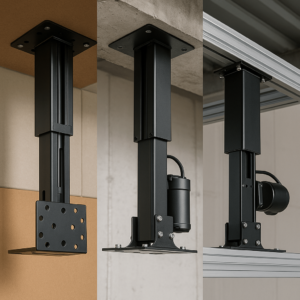
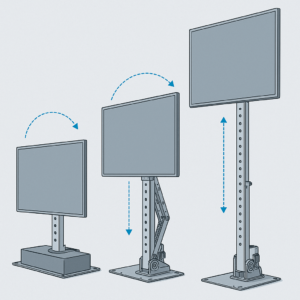
A TV lift isn’t simply up/down motion. It’s a three-phase mechanical transition: (1) idle tension equilibrium, (2) actuator vector engagement, and (3) synchronized vertical lift under load.
Procurement teams often underestimate the impact of small design variables—like pivot offset angle or torque lag—on final TV stability. In drop-down systems, incorrect linkages can cause asymmetric descent, warping the enclosure or cracking drywall anchors.
YISHANG’s systems follow constant-velocity actuation curves and use trapezoidal lead screws to stabilize load forces. With test loads ranging from 5 kg to 70 kg, the lifts are field-tested on simulated ceilings and cabinets with integrated damping systems. This ensures quiet, unshocked movement even under repeated cycles.
Material Fatigue and Failure Modes in TV Lift Systems
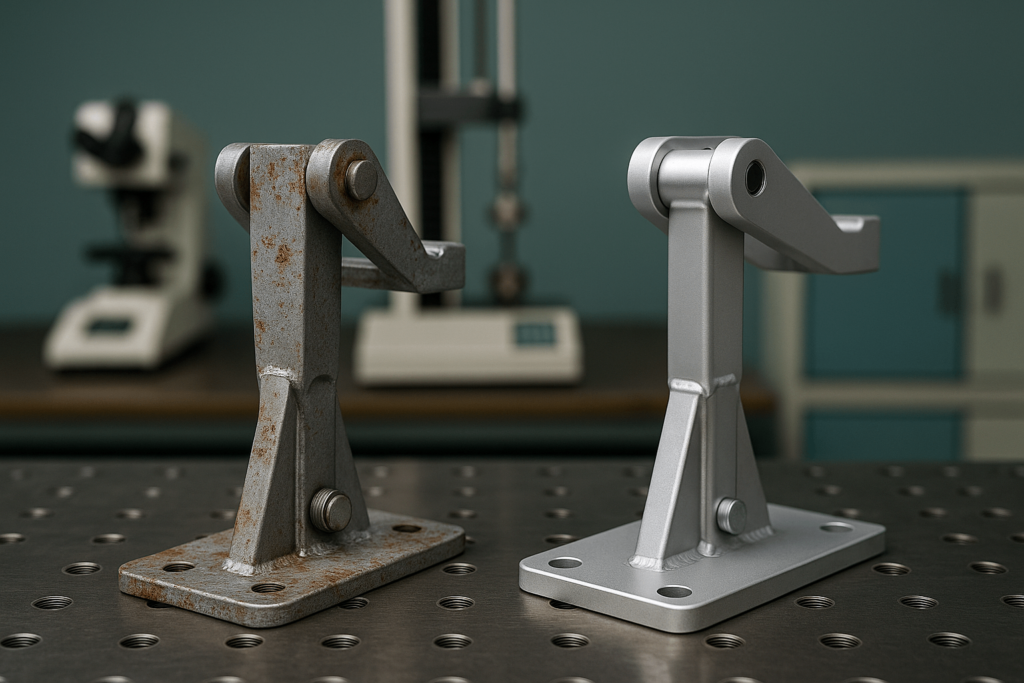
Not all TV lift failures are visible. Over 60% originate from fatigue stress in the actuator rod, gearbox, or anchor screws. These problems often emerge after 10,000+ cycles in hospitality or institutional environments.
YISHANG uses 304 stainless for exterior rails and hardened alloy steel for critical rotating components. More importantly, we apply galvanic isolation between dissimilar metals to prevent long-term corrosion. Every lift is fatigue-tested to a 15% duty cycle, simulating real-life AV use cases in hotels, schools, and retail kiosks.
Make sure the supplier provides fatigue cycle data, corrosion charts, and post-test deformation reports. This separates real OEMs from simple metal assembly vendors.
Control Systems and AV/Automation Integration
In modern AV environments, TV lifts must talk to more than just a wall switch. Buyers increasingly demand RS-485, IR, and app-based control systems. Integration with platforms like Crestron, Control4, or KNX is now a baseline expectation for high-end projects.
YISHANG supports multiple control protocols and offers dry-contact relays, RF remotes, and PLC interface options. More importantly, the firmware can be customized per project. We work with clients to test compatibility before final shipment.
When sourcing a TV lift, ask not just about the motor, but about the control logic. Can the system pause mid-cycle to accommodate AV timing? Will it reset seamlessly after a power outage without user intervention? Does it support synchronization with peripheral devices like projector screen lifts or ambient lighting presets?
Automation and ROI in Large-Scale Projects
Many procurement managers overlook the labor impact of TV lift systems. In high-scale projects—think 200 hotel rooms or 500 hospital beds—the time to install and calibrate lifts becomes a major cost driver.
YISHANG uses modular brackets, quick-connect wiring harnesses, and alignment jigs to reduce install time by over 30%. Our OEM clients report shorter project cycles and lower after-sales support due to reduced install variability.
TV lifts are also increasingly tied to energy-saving policies. Automatic shut-off, load-based standby modes, and integration with daylight sensors reduce the total cost of ownership. We’ve helped clients in the UK and Germany win LEED credits by integrating these features.
Common Procurement Mistakes and Avoidable Pitfalls
We’ve reviewed hundreds of RFQs across 30+ countries. Here are the top 3 recurring mistakes:
1. Buying by Load Capacity Alone
Many buyers specify a 50 kg TV load and assume any 100 kg-rated lift is fine. Wrong. You must consider torque curve under acceleration, not just static lift strength.
2. Ignoring Cable Management
Without integrated cable tracks or sleeves, power cords and HDMI lines can tangle and snag. This leads to premature failure and warranty disputes.
3. Missing Environmental Factors
In outdoor or semi-exposed locations (retail signage, poolside bars), humidity, salt spray, and UV exposure degrade cheap actuators. Always require a minimum IP54 rating for such use cases.
Engineering-Informed Procurement Guidelines
If you’re sourcing for a project above 50 units, procurement decisions should include not just price and lead time—but also: fatigue performance, smart control, maintenance logic, and vendor traceability.
✅ What to Include in Your RFQ:
- Required stroke length and travel speed
- TV weight + enclosure weight
- Mounting surface material and constraints
- Power requirements (AC/DC, voltage)
- Preferred control type (IR, switch, BMS, app)
- Certification needs: CE, UL, ISO9001, IP rating
YISHANG provides datasheets, CAD files, duty cycle graphs, and full integration specs at quotation stage. We don’t just sell hardware; we partner in solving deployment friction.
Case Study: 3,000 Units for UK Hospitality Chain
Client Need:
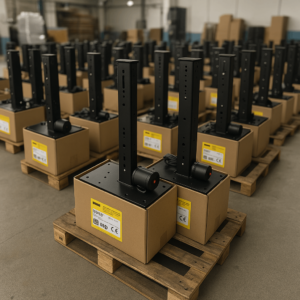
A European hotel group wanted 3,000 drop-down TV lifts installed across five countries with three types of ceiling architecture. Requirements included 220V support, BMS integration, and 10-year fatigue resilience.
Solution:
YISHANG designed a modular chassis with adjustable flange spacing, pre-set stroke limits, and RS485 control modules. All units shipped pre-tested with client’s AV panels and labeled by room series.
Result:
Saved 21% in install labor. Zero actuator failures after 18 months. Client reordered 1,200 more units for expansion.
Summary and Key Takeaways
TV lift systems seem simple but hide complex challenges—from motion logic to load dynamics to real-world integration.
If you’re a procurement officer, OEM buyer, or engineering manager, don’t just buy by weight rating and dimensions. Focus on fatigue data, kinematics, mounting logic, and automation flexibility.
YISHANG combines fabrication precision, design intelligence, and control integration into one export-ready product line. For projects that demand consistency across thousands of units, we deliver both form and function.
Frequently Asked Questions (FAQ)
Q1: Can TV lifts be customized for non-standard enclosures?
Yes. YISHANG offers OEM/ODM services including customized stroke lengths, voltage options, and cabinet fitment to suit non-standard or space-limited enclosures.
Q2: What is the typical duty cycle for hospitality-grade TV lifts?
Our lifts are rated for a 10–15% duty cycle under continuous use, ideal for hotel, conference, and educational environments.
Q3: Are YISHANG TV lift systems compatible with Crestron or KNX?
Yes. We support dry contact, RS-485, and Modbus TCP/IP protocols for seamless BMS/AV integration.
Q4: How do you ensure safety in child-accessible installations?
We offer anti-pinch sensors, soft-stop actuation, and obstacle detection features for enhanced safety.
Q5: What certifications are required for EU/US compliance?
CE, UL, and RoHS are mandatory in most applications. We support full documentation for customs and quality audits.
📩 Ready to discuss your project?
Get in touch with YISHANG’s technical team for CAD drawings, integration specs, or OEM RFQs. We’re here to help your next deployment go smoothly.