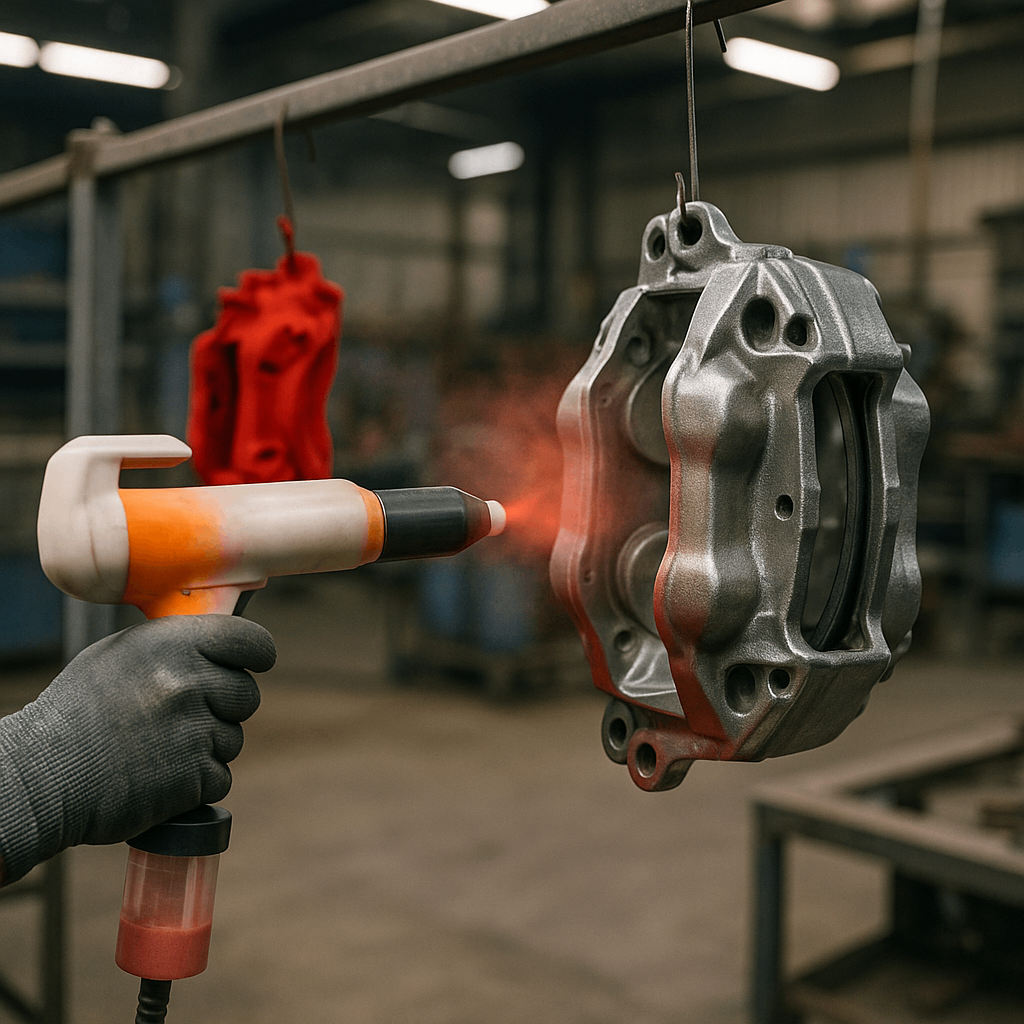
Quick Answer — What Most Buyers Expect to Know First
Professional powder coating for brake calipers typically falls into
$100–$300 per set for basic retail-level work, and
$350–$700+ for high‑performance, multi‑layer, or custom finishes. These references reflect the market average found in retail and shop‑service environments.
For
B2B and wholesale buyers, pricing per caliper is lower on a per‑unit basis, but driven by the same engineering variables: pretreatment, masking complexity, curing stability, coating system selection, and quality targets. The deeper cost analysis below explains how to interpret quotations and how to evaluate suppliers from a procurement perspective.
When international wholesale buyers search for how much to powder coat calipers or how much to powder coat brake calipers, they are not looking for DIY tips. They are comparing suppliers, validating quotations, and assessing the stability of a powder‑coating process applied to a functional brake component. In this context, powder coating is not a cosmetic upgrade—it is an engineered surface‑treatment step that influences durability, warranty exposure, and brand perception.
This article is structured for procurement teams managing OEM, aftermarket, or private‑label caliper programs. Instead of repeating generic cost lists, it connects price, engineering depth, and supplier capability so you can read quotations accurately and make supplier choices based on long‑term value, not just initial cost.
1. Why Powder Coating Calipers Has a Real Cost Structure — A Procurement‑Driven Understanding
Powder coating for brake calipers involves more operational risk, technical precision, and application sensitivity than powder coating ordinary metal parts. Understanding why helps procurement teams evaluate quotations with much greater accuracy.
Calipers Experience Thermal and Mechanical Stress Unmatched by Most Components
Brake calipers regularly reach temperatures above 300°C during repeated braking cycles. A coating system must retain adhesion, resist discoloration, and remain stable under these conditions. It must also avoid interfering with functional zones such as piston bores or slide surfaces. This explains why quotations for calipers are not comparable to quotes for brackets or enclosures—engineering risk is higher, and a supplier’s process discipline directly affects product performance.
Different Metal Substrates Require Precise Pretreatment Standards
Calipers may be cast iron, forged aluminum, or machined aluminum alloys. Each requires unique pretreatment parameters. Cast iron needs deeper blasting and descaling; aluminum requires oxide removal and conversion coating. Suppliers who use one generic pretreatment method often struggle with adhesion consistency. Mature factories apply dedicated blasting media, dwell times, rinse control, and conversion coatings—practices supported by standards like ISO 9001 and adhesion tests such as ASTM D3359 or ISO 2409.
Geometry Complexity Creates Real Labor and Process Variation
Multi‑piston calipers include deep pockets, tight edges, and critical surfaces requiring masking. A supplier must prevent powder ingress while delivering even coverage across difficult geometries. This is where labor, fixture quality, and masking engineering influence cost. For procurement teams, geometry complexity becomes one of the clearest indicators of whether a supplier truly understands caliper‑specific coating challenges.
This section establishes the engineering and operational fundamentals that shape the entire cost structure behind a powder‑coated caliper.
2. Understanding Real‑World Pricing Tiers — What Each Price Level Represents
Pricing variation is normal in global sourcing, but each price tier generally represents a predictable capability level. Below is a concise table to help you compare structures at a glance before reading the detailed segments.
Pricing Summary Table (Retail Reference + B2B Implications)
| Tier |
Typical Retail Price per Set |
Process Depth |
Suitable For |
| Level 1 |
$120–$200 |
Basic prep, single layer |
Entry‑level markets, simple calipers |
| Level 2 |
$200–$350 |
Structured workflow, improved masking |
Mid‑range aftermarket or private label |
| Level 3 |
$350–$600 |
Multi‑piston capability, multi‑layer system |
Performance lines, premium markets |
| Level 4 |
$500–$900+ |
Show‑grade custom, complex effects |
Limited editions, high‑margin branding |
Level 1 — Basic Clean Calipers ($120–$200 per Set)
This tier assumes minimal surface defects and minimal documentation. The focus is basic visual improvement, not long‑term durability. It is serviceable for low‑cost programs but not well‑suited for brand‑sensitive products.
Level 2 — Moderate Preparation and Structured Workflow ($200–$350 per Set)
Buyers begin to see consistent blasting, improved masking, and better coating control. Calipers with moderate contamination are processed more systematically. This tier supports mid‑volume aftermarket programs where predictability matters.
Level 3 — High‑Performance and Multi‑Piston Capability ($350–$600 per Set)
Here, suppliers handle demanding geometries and multi‑layer coating systems. Process control, oven accuracy, and QC are notably stronger. This tier is appropriate for performance‑oriented and premium aftermarket programs where finish consistency is critical.
Level 4 — Show‑Grade, Multi‑Layer, and Custom Systems ($500–$900 per Set)
This tier is designed for high‑end, visually demanding projects. Multiple layers, specialty powders, precise gloss control, and tight batch‑to‑batch color consistency justify the premium. For buyers, this tier is tied to branding and high customer expectations.
These tiers help procurement teams read quotations with context rather than comparing raw numbers without understanding underlying process differences.
3. Technical Factors That Determine Cost — A Practical Framework for Buyers
Each quotation reflects assumptions about preparation, coating system, curing stability, and geometry handling. This framework clarifies what contributes to cost and how to evaluate supplier maturity.
Surface Condition, Contamination, and Pretreatment Depth
Rust, casting scale, pitting, or old coating dramatically increase pretreatment workload. Mature suppliers specify blasting media, alkaline cleaning, rinse control, and conversion coatings. Asking for adhesion test data (ASTM D3359 or ISO 2409) helps buyers determine whether a supplier executes controlled pretreatment or merely performs basic cleaning.
Geometry, Masking Precision, and Fixture Engineering
Complex geometries demand responsible masking to protect functional zones. Suppliers with custom silicone caps, metal shielding tools, or precision fixtures achieve better repeatability. For buyers, this affects long‑term cost because improved masking reduces scrap and rework across large volumes.
Curing Stability, Oven Technology, and Batch Control
Curing quality dictates hardness, gloss retention, and long‑term adhesion. Basic shops rely on operator judgment. Mature factories capture temperature curves, calibrate ovens, and maintain batch logs. If a quotation for how much to powder coat calipers references controlled curing, buyers can expect more consistent long‑term performance.
Coating System Selection and Layer Structure
Powder systems vary widely. A functional single‑layer polyester differs entirely from a multi‑layer high‑temperature system involving primer and clear coat. Each layer adds oven time, labor, and material cost. Buyers should request clarity in RFQs regarding layer count, powder specification, and finish expectations.
Supplier Risk‑Management Practices
A supplier who invests in inspection, masking control, and documentation effectively assumes part of your downstream risk. Their prices reflect preventive cost rather than corrective cost. Procurement teams benefit from understanding how each quotation allocates this risk.
4. Paint vs Powder — A Short, Cost‑Focused Comparison for Buyers
Search engines frequently associate how much to powder coat brake calipers with comparisons to painting because many buyers evaluate both options before making sourcing decisions. For B2B buyers, this comparison is most meaningful when viewed through lifecycle cost and warranty exposure.
Cost and Durability Differences
Paint is cheaper upfront but less durable under thermal load. Powder coating costs more initially but provides longer service life and lower failure rates—important for brand reputation.
Lifetime Cost Perspective
For projects with longer warranty periods or premium positioning, powder coating often becomes more cost‑effective across the full lifecycle, even if its initial cost is higher. Buyers focused on resale impact, corrosion stability, or gloss retention typically choose powder.
When Painting May Still Be Acceptable
For highly cost‑sensitive, short‑term programs, painting can serve as a lower‑cost option. However, buyers should account for increased rework and higher variability.
This balanced comparison aligns your sourcing choices with the realities of end‑market expectations.
5. Why Market Quotes Differ — Practical Insights for Procurement
Quotations may vary widely even when calipers appear similar. Understanding the drivers helps procurement teams avoid incorrect assumptions.
What Each Quote Includes — or Excludes
Some quotes include only the coating step, excluding pretreatment, masking, or final inspection. Others include a complete workflow. Buyers should standardize RFQ structures to avoid comparing incomplete quotes.
Equipment, Automation, and Labor Structure
Labor‑driven operations offer lower prices but may struggle with batch consistency and scaling. Automated or semi‑automated lines provide repeatability and lower long‑term variability.
Supplier Quality Targets and Market Positioning
Suppliers optimized for budget markets price differently from those experienced in high‑end aftermarket or OEM programs. A supplier’s existing customer profile gives buyers insight into their real capability level.
6. Real Cost Scenarios — Connecting Price to Capability
Below are realistic pricing signals that help buyers interpret supplier quotations.
Around $180 per Set — Basic Capability
Manual masking, minimal documentation, and acceptable but inconsistent finish. Suitable for low‑cost markets but not premium programs.
Around $300 per Set — Structured Process and Stable Output
Repeatable blasting, better masking, documented curing, and reduced defect rates. Appropriate for mid‑range caliper lines.
Around $450 per Set — High Precision for Multi‑Piston Units
Dedicated masking fixtures, multi‑layer systems, and batch‑controlled curing. Intended for performance‑oriented products.
Around $700 per Set — Show‑Grade and Custom Finishes
Complex color systems, show‑grade gloss, multiple curing cycles, and extremely tight QC. Suitable for branding‑driven or limited‑edition products.
These scenarios help buyers connect price, process depth, and supplier capability.
7. How Wholesale Buyers Should Select a Powder Coating Partner
Rather than selecting the lowest number, buyers benefit from focusing on stability, documentation, and scalability.
Evaluate Process Consistency and Capacity
Color matching stability, defect rate control, and reliable lead times matter more than small price differences—especially for recurring orders.
Request QC Documentation and Traceability
Professional suppliers can provide curing logs, QC checklists, and work instructions that reflect operational maturity.
Match Supplier Experience with Your Caliper Type and Market
A supplier experienced with performance calipers will naturally price and execute differently than one focused on simple industrial parts.