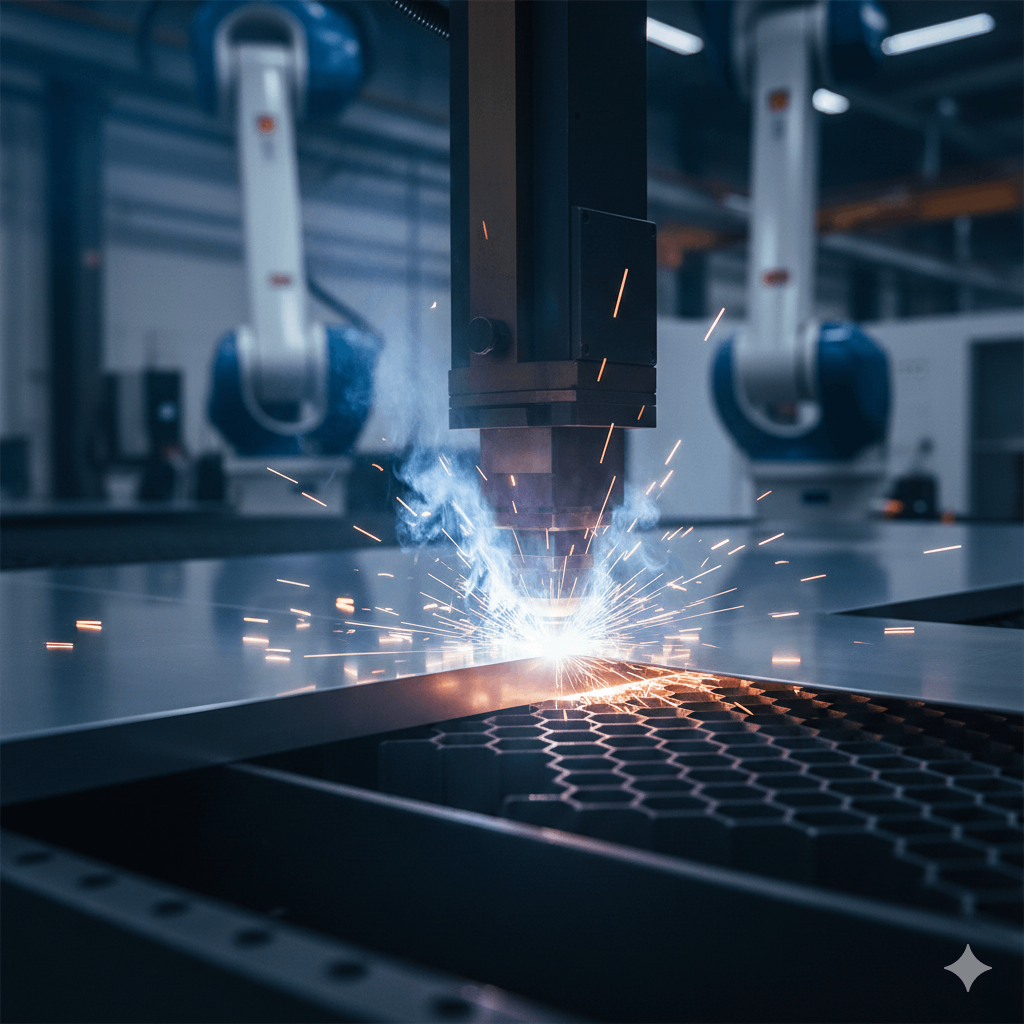
For procurement managers and supply chain engineers, sourcing high-performance metal components is less about finding a machine and more about validating a repeatable industrial process. In the high-stakes world of global manufacturing, aluminum remains one of the most versatile yet technically demanding materials to fabricate at scale. Consequently, selecting a partner who understands the underlying metallurgy is as important as the design itself.
At YISHANG, we recognize that for wholesale buyers, the stakes extend far beyond a single prototype. A minor deviation in edge quality or a slight compromise in material temper can lead to thousands of rejected units and catastrophic delays in a global supply chain. Therefore, this guide moves beyond the basics to explore the engineering nuances that drive successful, long-term procurement decisions in the aluminium laserschneiden (aluminum laser cutting) sector.
1. The Physics of Absorption: Why Tech Specs Dictate Your Unit Cost
In the specialized field of aluminium laserschneiden, the primary hurdle is not the metal’s hardness, but its optical physics. Aluminum naturally reflects infrared light, which historically posed a significant risk to older $CO_2$ laser resonators. In contrast, modern technology has developed specific wavelengths to combat this reflectivity. When you are auditing a potential supplier, the technology they employ is a direct indicator of their ability to handle large-scale orders without unplanned downtime.
Modern fiber laser technology, operating at a 1.06μm wavelength, has fundamentally shifted the ROI for laser cut aluminium sheet projects. Unlike older systems, fiber lasers are absorbed efficiently by non-ferrous metals. As a result, this ensures a stable “keyhole” melt pool, which is the foundation of consistent edge quality. For a wholesale buyer, this means faster feed rates—often 2x to 3x faster than $CO_2$ on thin gauges—which directly reduces the hourly machine rate factored into your quote.
However, power density is just as critical as raw wattage. High-wattage systems (12kW+) require sophisticated optical isolators to protect the machine from back-reflection. At YISHANG, we view these technical safeguards as the “insurance policy” for your project’s timeline. A shop without these protections is one “reflection event” away from a three-week machine breakdown, a risk no supply chain manager should accept when managing critical inventory levels across 50+ countries.
Furthermore, the stability of a high-end fiber laser ensures dimensional consistency across a 10,000-unit run. For procurement teams in the automotive or EV sectors, this repeatability is non-negotiable. It ensures that the first bracket cut in January fits into your automated assembly line exactly like the last one cut in December. Ultimately, this consistency minimizes the “tolerance stack-up” issues that often plague low-cost, low-tech fabrication.
2. Navigating Gas Dynamics: The “Hidden” Logic of Surface Integrity
When reviewing a quote for laser cut aluminum sheet, the assist gas is often overlooked as a mere consumable. Nonetheless, for an expert engineer, gas selection is a strategic decision that defines the “Landed Quality” of your product. For most demanding industrial applications, High-Pressure Nitrogen ($N_2$) is the only viable option for achieving a “Weld-Ready” or “Anodize-Ready” edge.
Nitrogen cutting creates an inert environment within the cut gap, effectively preventing the exothermic reaction that causes oxidation. In the context of aluminium laserschneiden, this results in a “Bright Cut”—a silver, smooth edge. If your project involves secondary welding, this is vital. This is because an oxidized edge can introduce porosity into the weld pool, compromising the structural integrity of a medical rack or an energy storage cabinet.
At YISHANG, we prioritize 99.999% purity Nitrogen. Although cheaper “shop air” cutting might look attractive on a quote, it creates a thin layer of aluminum oxide ($Al_2O_3$). For a wholesale buyer, this is a “hidden cost” trap. Specifically, if that oxide isn’t mechanically removed, subsequent powder coating may fail to adhere. Investing in high-purity Nitrogen at the source eliminates the manual labor costs of grinding thousands of parts later.
| Assist Gas Parameter | High-Purity Nitrogen (N2) | Oxygen (O2) | High-Pressure Air |
| Edge Chemistry | Zero Oxidation | Heavy Slag Layer | Slight Nitriding |
| Edge Color | Bright Silver | Dark Gray/Black | Dull Gray |
| Downstream Cost | Lowest (Weld-Ready) | High (Requires Grinding) | Medium (Coating Risk) |
In addition to chemistry, the fluid dynamics of the gas stream are equally important. As the laser melts the laser cut aluminum sheet, the gas must expel the molten metal instantly. Otherwise, if the pressure or nozzle standoff distance is inconsistent, “bottom dross” or sharp burrs will form. We utilize specialized double-layer nozzles to maintain laminar flow, ensuring the bottom edge is as clean as the top.
3. Structural Integrity: Managing the Heat-Affected Zone (HAZ)
Aluminum’s high thermal conductivity is a double-edged sword. While it’s great for heat sinks, it complicates the aluminium laserschneiden process. In particular, the intense heat of a laser can act as a localized “annealing” process. For heat-treatable alloys like 6061-T6, if the supplier does not manage the Heat-Affected Zone (HAZ), the edges of your structural parts could be up to 30% softer than the rest of the sheet.
A professional fabricator like YISHANG manages this through “Duty Cycle” modulation. By doing so, we pulse the laser beam at high frequencies rather than using a continuous wave. This allows the material a fraction of a second to cool between energy bursts. As a result, this keeps the HAZ narrow—often less than 0.1mm—preserving the original temper and yield strength. This is a critical factor for structural frames in the agricultural or aerospace sectors.
In addition, thermal management is vital to prevent warping in large-format laser cut aluminum sheet projects. Aluminum’s high thermal expansion coefficient means that if heat builds up in one area, the entire sheet can distort. To counter this, we use “Staggered Cutting” paths, jumping across the sheet to distribute the thermal load evenly. Thus, we ensure the parts match your CAD file’s flatness requirements perfectly.
Furthermore, we must address “Thermal Runaway” at sharp internal corners. When a laser slows down to negotiate a 90-degree turn, the heat dwells longer in one spot. Unless advanced power-ramping is used, the corner will “blow out” or melt. This level of control is what separates a specialized factory from a generalist shop. Essentially, it ensures that your complex geometries are as strong as they are accurate.
4. DfM Strategy: Optimizing Geometries for Mass Production
The most effective way to reduce the unit price of a laser cut aluminum sheet order is through Design for Manufacturing (DfM). Indeed, in a B2B relationship, your supplier should act as an engineering consultant. At YISHANG, we perform a DfM audit on every wholesale project. The goal is to bridge the gap between a “perfect” CAD drawing and the physical realities of the laser-metal interaction.
One of the most frequent issues we correct is the “Hole-to-Thickness” ratio. Because aluminum is a “soft” melt, the assist gas needs sufficient space to expel the molten material. As an industry rule, the smallest hole diameter should be at least 1:1 with the material thickness. Attempting to cut a 3mm hole in a 10mm plate with a laser will often result in a messy finish. Instead, we recommend secondary drilling for such features to maintain precision.
| Alloy Grade | Common Usage | Laser Cutability | Post-Processing |
| 5052-H32 | Marine & Outdoor Enclosures | Excellent | Great for Powder Coating |
| 6061-T6 | Structural Frames | High Precision | Excellent for Anodizing |
Similarly, the “Taper Effect” is another reality of industrial aluminium laserschneiden. Because a laser beam is an hourglass shape, the sidewalls can have a slight V-shape. To fix this, we adjust the “Focal Shift”—moving the waist of the beam to a negative position below the material surface. Consequently, this ensures that seams are tight and assembly is frictionless for custom metal cabinets.
5. Wholesale Economics: Material Utilization and Scaling
In international procurement, the price of a laser cut aluminum sheet is heavily influenced by material utilization. Aluminum is a high-value commodity. Thus, the ability of your partner to minimize waste is a primary driver of your final unit cost. At YISHANG, we have refined our wholesale model over 26 years to maximize “Sheet Yield” for our global clients.
We utilize AI-driven nesting software that analyzes thousands of part orientations to find the most efficient layout. Typically, our utilization rate is between 85% and 92%. In comparison, the industry average is often closer to 75%. This efficiency allows us to provide more competitive quotes for large-scale OEM/ODM projects. In a market where every cent counts, the difference in nesting logic is the difference between a profitable project and a loss.
Furthermore, scalability in an export-driven factory depends on “Cellular Manufacturing.” We don’t just have lasers; we have integrated cells that include automated loading and robotic bending. This automation ensures that we can handle a sudden surge in order volume without a spike in lead times. For our clients in the 50+ countries we serve, this stability is a cornerstone of their inventory management.
6. Beyond the Cut: Why Edge Quality Dictates Coating Success
A professional aluminium laserschneiden process is only successful if it supports the next 20 years of the product’s lifecycle. For many wholesale clients, the laser-cut part is merely the first step. Actually, the chemistry and geometry of the laser-cut edge play a decisive role in the durability of these final surface treatments.
As previously discussed, a Nitrogen-cut edge is essential for coating adhesion. However, we also manage “Edge Radius” at a microscopic level. Sharp 90-degree corners are often points of coating failure. To solve this, we can program a subtle corner-rounding pass into the laser cycle. This allows the paint to wrap around the edge evenly, preventing “Edge Creep” corrosion.
In conclusion, a successful wholesale laser cut aluminium sheet project is the result of thousands of small, expert decisions. From the purity of the gas to the logic of the nesting algorithm, every detail impacts your bottom line. At YISHANG, we bring 26 years of these technical details together to support your growth in a global, competitive market. We are dedicated to helping you solve your most complex metal fabrication challenges.
Ready to optimize your supply chain with precision aluminum components?