
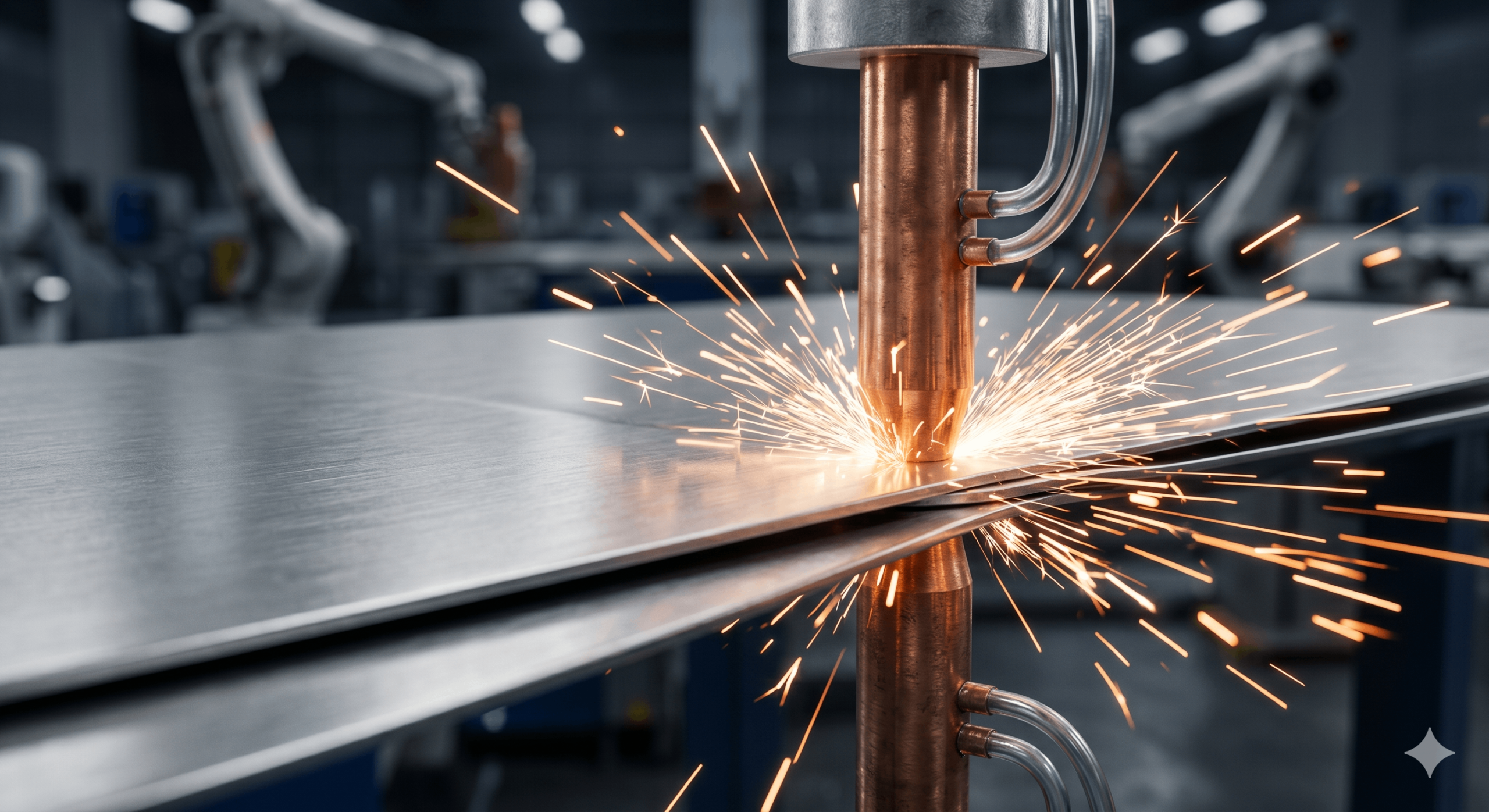
In the global industrial supply chain, the structural integrity of a finished product is rarely defined by its largest plates. Instead, it is defined by its smallest points of connection. For procurement managers and wholesale buyers, selecting a fabrication partner is a strategic decision. This choice directly impacts product liability and maintenance cycles. At YISHANG, we understand these high-volume production risks. Consequently, we know a single marginal weld can compromise an entire shipment of junction box NEMA units or complex control station enclosures.
This guide provides a technical resource for decision-makers overseeing high-durability projects. By understanding the intersection of physical principles and material resistance, your organization can improve. Specifically, you can move from simple component procurement to strategic engineering. Furthermore, our 26 years of experience indicate that spot welding is a controlled thermal event. Therefore, it must be optimized for production scalability and long-term reliability.
1. The Physics of the Nugget: Why Consistency Trumps Speed
At its core, spot welding is a localized metallurgical event governed by Joule’s Law. This can be expressed as Q = I^2Rt. In a high-volume factory, the goal is to generate sufficient thermal energy (Q). This heat creates a molten weld nugget at the interface of two metal sheets. However, this must occur without damaging the outer surfaces. For a wholesale buyer, the consistency of this nugget is the primary metric for risk mitigation. This is especially true across a 10,000-unit batch of electrical meter box components.
The electrical resistance (R) is the most dynamic variable in this equation. Professional fabricators know that contact resistance is inversely proportional to electrode pressure. Consequently, this is critical for high-end applications like a stainless steel enclosure or a steel enclosure aluminum. In these cases, joint strength and surface finish must coexist perfectly. If the electrode pressure is insufficient, contact resistance spikes. As a result, this leads to expulsion, which is a violent spray of molten metal that leaves the joint brittle.
Conversely, excessive pressure drops the resistance too far. This often results in an undersized nugget that may fail under environmental stress. For products like a solar battery enclosure, structural failure can lead to safety hazards. Therefore, mastering this physics is non-negotiable. Additionally, managing the Heat-Affected Zone (HAZ) is vital to maintain the parent metal’s properties. This ensures a push button enclosure remains resilient against mechanical impacts and industrial vibrations.
2. Process Comparison: Why Spot Welding Wins in B2B Scaling
For wholesale procurement, understanding when to deploy spot welding versus other methods is key to cost-optimization. Specifically, a strategic comparison can highlight mass production efficiency:
| Feature | Resistance Spot Welding (RSW) | MIG Welding | TIG Welding |
|---|---|---|---|
| Production Speed | Extremely High (Seconds) | Moderate | Low |
| Thermal Distortion | Minimal (Localized Heat) | Significant | Moderate |
| Consumables Cost | Lowest (No filler/gas) | Moderate (Wire/Gas) | Moderate (Gas/Rod) |
| Automation Potential | High (Robotic Ready) | Moderate | Low |
| Aesthetics | Clean (Minor Indentation) | Visible Bead | Premium Finish |
For products like a galvanized steel enclosure or carbon steel enclosure, RSW offers the highest ROI. This is because it eliminates secondary grinding and minimizes raw material waste. However, you should still evaluate a supplier’s range of welding technologies. For example, Laser Spot Welding is ideal for medical-grade precision. Ultimately, these options allow you to handle complex projects without sacrificing structural integrity.
3. Design for Manufacturing (DFM): Reducing Costs at the Source
Successful B2B partnerships often begin at the design table. Strategic buyers can reduce unit costs for an electrical meter box or enclosure push button significantly. To achieve this, you should optimize designs for the spot welding process. Key considerations include:
- Overlap Requirements: Ensure a minimum flange width. Typically, this should be four times the nugget diameter. This provides sufficient space for electrode contact.
- Surface Accessibility: Design for easy electrode access. This prevents the need for expensive, custom-angled electrode tips. Consequently, it avoids inflating the lead times of a stainless steel enclosure project.
- Weld Pitch Optimization: Maintain a consistent pitch between welds. This prevents the Shunting Effect and ensures uniform strength. As a result, the steel enclosure carbon or enclosures solar battery assembly remains robust.
At YISHANG, we collaborate with your engineering team to refine these DFM factors. Furthermore, we ensure that your enclosure aluminum enclosure is structurally sound. In addition, we optimize the part for rapid, automated mass production.
4. Metallurgy Challenges: Tailoring the Process to the Alloy
Each material reacts uniquely to the welding current. Therefore, a one-size-fits-all approach leads to high rejection rates. Instead, we tailor the process to the substrate’s specific metallurgical profile. This ensures long-term durability for every batch.
Stainless steel (304/316) is a common choice for its corrosion resistance. However, it possesses higher electrical resistance than mild steel. In addition, it has lower thermal conductivity. This means it heats up rapidly. Consequently, it requires shorter weld times and higher pressures. These adjustments prevent carbide precipitation, which could compromise the alloy’s performance over time.
Aluminum alloys present the opposite challenge. Specifically, as high-performance heat sinks, they dissipate thermal energy rapidly. Welding an enclosure aluminum enclosure requires a massive burst of current. This is necessary to break through the non-conductive oxide layer. Therefore, we use specialized Inverter-DC power supplies. In addition, we perform rigorous surface preparation to prevent the electrode from sticking.
For a galvanized steel enclosure, the zinc coating presents a unique hurdle. Zinc melts at a lower temperature than steel. Consequently, it can contaminate copper electrodes and lead to mushrooming of the tip. To maintain consistency, a factory must implement a strict electrode dressing protocol. Specifically, we reshape the tips every few hundred welds. This ensures the current density remains within the target Sweet Spot.
5. Technical Control and Quality Assurance (QA)
The reliability of an industrial weld is established in a timing sequence. This occurs in milliseconds. The cycle begins with Squeeze Time, which stabilizes contact resistance. Then, Weld Time creates the molten nugget. Finally, Hold Time allows solidification under pressure.
To guarantee the long-term lifecycle of a product, a multi-tiered quality control strategy is non-negotiable. At YISHANG, we employ destructive testing such as the Peel Test. This measures the nugget diameter accurately. Moreover, on the automated production line, we use Non-Destructive Testing (NDT). Ultrasonic sensors probe nugget density in real-time. Thus, we provide a digital pass/fail grade for every unit.
For an overseas purchaser, this transparency is the ultimate insurance policy. Furthermore, our standards align with AWS C1.1 or ISO 18278 standards. Whether for the automotive industry or the energy sector, the process must be repeatable. Selecting a partner with 26 years of experience allows you to leverage this mastery. Consequently, your brand can grow with confidence.
Please feel free to contact us or send your inquiry today. We are ready to discuss how our specialized spot welding process can enhance your next metal enclosure project.
FAQ: Professional Technical Insights for Procurement
What is the minimum pitch to avoid the Shunting Effect? Typically, the minimum distance should be three times the nugget diameter. For a 1.5 mm steel enclosure, this means a pitch of at least 15-20 mm. Therefore, current doesn’t bypass the intended joint.
How does YISHANG handle high-volume NEMA enclosure orders? We utilize robotic spot welding stations with adaptive control systems. Furthermore, these systems monitor every weld in real-time. Consequently, they automatically adjust parameters to compensate for material variations.
Why is electrode dressing critical for galvanized steel enclosure projects? Zinc contamination increases the electrode’s contact area. As a result, this dilutes the current density. Without a strict dressing schedule, the welds will lose penetration. Therefore, structural failures may occur in the field.