
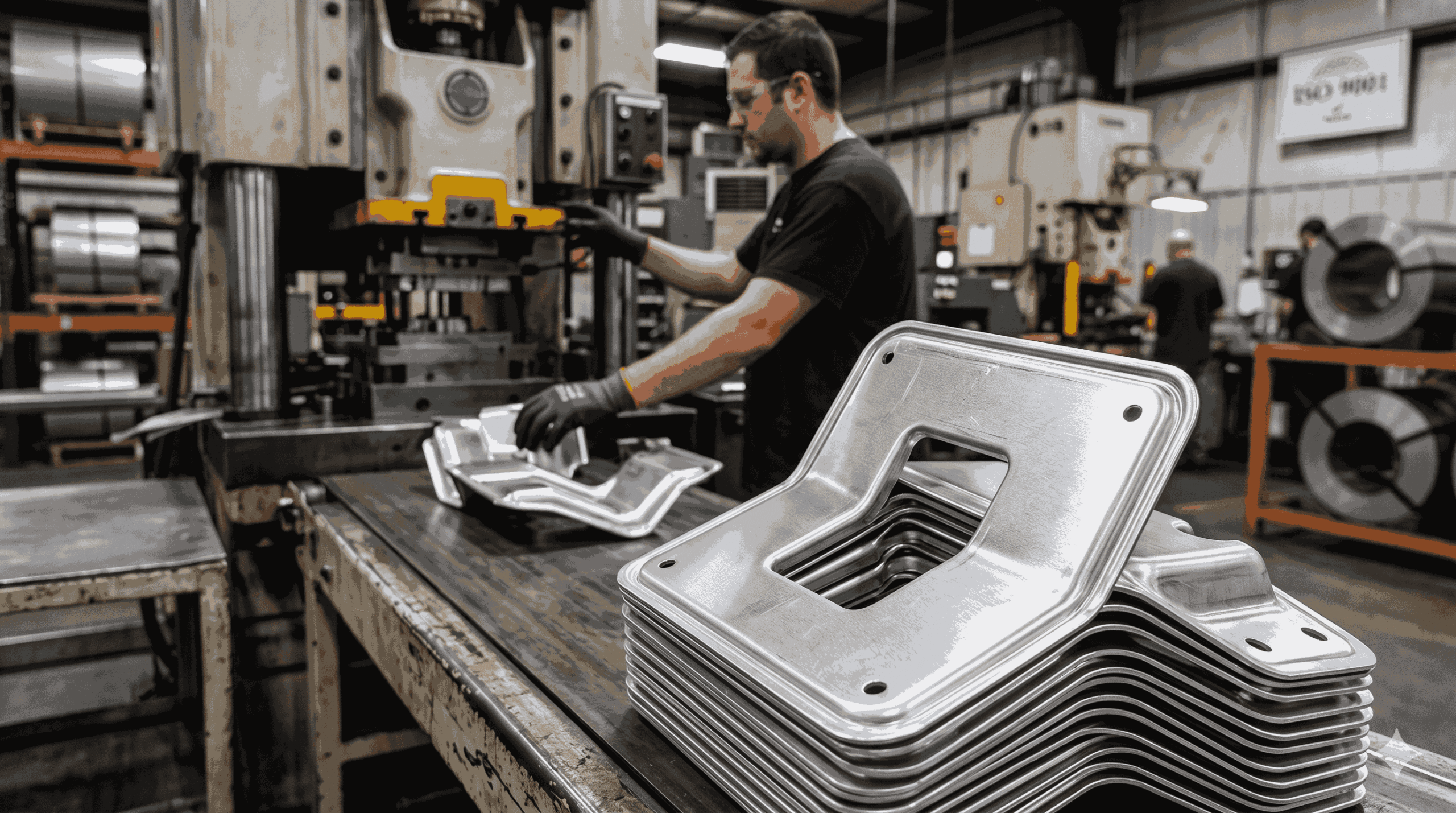
Sourcing high-performance industrial components requires a delicate balance of material science, mechanical optimization, and cost efficiency. For procurement teams, specifying custom aluminum stamping parts is a proven strategy to scale volume while reducing component weight. Translating a digital CAD model into a physical, defect-free component, however, involves complex physical and chemical realities.
Through this consultative guide, YISHANG shares insights from over two decades of manufacturing experience. We map out the critical lifecycle of a stamping project—from financial evaluation through metallurgical selection, die engineering, and surface chemistry—to help you optimize your supply chain and eliminate hidden defects.
I. The Threshold Phase: Evaluating the Economic & Physical Shift to Stamping
1. The ROI Break-Even Matrix
The financial pivot point. Before committing budget to a custom tooling program, evaluating the financial tipping point between CNC machining services and stamping is crucial. While CNC machining offers near-zero upfront tooling costs, the piece-part price remains fixed due to constant cycle times.
Unlocking long-term value. Precision metal stamping requires a significant initial investment in hard tooling. However, once commissioned, the marginal unit cost plummets. For most custom metal brackets and enclosures, the break-even threshold typically sits between 5,000 and 10,000 units.
Securing the TCO advantage. Beyond this volume, the speed of sheet metal stamping yields a significantly lower Total Cost of Ownership (TCO). Partnering with a reliable custom sheet metal manufacturer ensures that the initial tooling investment pays off rapidly through scalable, high-volume production.
2. The Thin-Wall Structural Advantage
Eliminating residual stress. From a mechanical perspective, aluminum alloy stamping provides structural benefits that other methods struggle to match. Machining thin walls from solid blocks often introduces residual stress, leading to warping. Traditional die casting services may introduce internal porosity that weakens the component.
Work-hardened strength. Through precision custom sheet metal fabrication, raw alloy sheets are cold-worked. This physical deformation actually increases yield strength through work hardening. Designers can comfortably specify ultra-thin walls (under 1.5 mm) while maintaining the tensile strength required for demanding automotive or energy storage applications.
3. Cycle-Time Dynamics for Global Supply Chains
High-speed throughput. When fulfilling global wholesale orders, output velocity is a primary metric. Advanced progressive die stamping presses operate at rapid speeds, frequently ranging from 80 to over 120 strokes per minute (SPM).
Responsive manufacturing. This rapid output drastically minimizes factory lead times, ensuring supply chains can pivot quickly to market demands. For simpler geometries, utilizing compound die stamping serves as a highly cost-effective alternative with lower initial tooling costs.
Material consistency matters. Achieving these speeds requires absolute precision. Any variation in the raw material coil can cause dimensional drift. Understanding how raw aluminum behaves under high-velocity pressure is the next step in engineering a flawless component.
II. The Metallurgy Phase: Mastering Material Behavior Under Compression
1. Navigating the Temper Grade Options (Beyond the “5052” Label)
The importance of thermal states. A frequent challenge in procurement is specifying a general material without defining its thermal temper. White-metal aluminum alloy 5052 is the industry standard for custom brackets due to its excellent fatigue and corrosion resistance, but its behavior varies drastically across temper states.
Matching temper to geometry. Using a highly strain-hardened state like 5052-H34 for tight bend radii often results in micro-cracking. Conversely, 5052-O (Annealed) provides the extreme ductility needed for deep drawing stamping services, while 5052-H32 offers the ideal balance for structural electronic enclosures.
Handling structural alloys. For heavy-duty applications requiring 6061-T6, special engineering protocols are necessary. Due to its low ductility, an experienced partner will stamp the material in its softer T4 state, followed by artificial aging to reach the final high-strength T6 condition without fracturing.
2. The Physics of Springback Compensation
Managing elastic recovery. Aluminum features a relatively low elastic modulus (E ≈ 69 GPa) compared to structural steel. This causes a pronounced springback effect; once the stamping punch retracts, the elastic recovery of the material forces the bent angle to open up slightly.
Predictive engineering. If left unaddressed, parts will fail tight assembly inspections. Professional tool designers employ finite element analysis (FEA) to calculate precise springback variables.
Over-bending die geometry. To hold strict dimensional tolerances of ±0.05 mm, the forming die is engineered with an over-bend. For example, achieving a 90-degree bend in 5052-H32 may require the tool to strike at 87 degrees, allowing natural recovery to settle perfectly on target.
3. Grain Direction Vectoring
The microstructure reality. Sheet metal possesses a distinct rolling grain direction created during the milling process. Bending a part parallel to this grain places localized tensile stress on the outer fibers, which is a leading cause of structural fracturing in custom aluminum stamping parts.
Strategic layout planning. To mitigate this, tooling engineers meticulously orient the part layout so that critical bend lines run perpendicular or at a 45-degree angle to the rolling grain.
Balancing yield and strength. This blank nesting optimization not only prevents part failure but also maximizes material utilization, frequently saving 15% to 25% in scrap costs for large wholesale runs.
III. The Tool Room Phase: Engineering Around Die Wear and Surface Defects
1. Combating Adhesive Wear (Aluminum Galling)
The friction challenge. Despite being a soft metal, aluminum poses a severe threat to tooling durability. Under intense pressure, aluminum atoms exhibit a chemical affinity for steel dies, causing adhesive wear known as aluminum galling.
Preventing surface scratches. This cold-welding phenomenon creates microscopic deposits on the tool, which act as abrasive files that ruin the surface of subsequent parts. To eliminate this without constantly halting the press, modern tool rooms apply advanced coatings.
High-performance tool protection. Utilizing Physical Vapor Deposition (PVD) coatings, such as Chromium Nitride (CrN), drastically lowers the friction coefficient. This ensures a clean sheet metal fabrication process and extends the life of the tool steel die inserts.
2. Kinematics of Part Formation: Progressive vs. Deep Drawing
Selecting the right architecture. Matching the tooling strategy to the part geometry is essential for a high-quality, cost-effective outcome. While CNC machining parts are great for prototyping, volume production relies on dedicated dies.
Continuous processing. Progressive die stamping feeds the raw coil through sequential stations (piercing, bending, blanking), making it ideal for complex, multi-feature custom sheet metal brackets.
Hollow part dynamics. Conversely, deep drawing stamping is required for deep, hollow shapes like battery enclosures. Engineers must carefully calibrate the blank-holder pressure; if it is too tight, the material tears, and if too loose, the walls will suffer from severe wrinkling.
3. Managing Abrasive Aluminum Oxide Skin
The invisible ceramic layer. Raw aluminum instantly reacts with oxygen to form a micro-thin layer of aluminum oxide (Al2O3). While it provides corrosion resistance, this oxide skin acts as an extremely hard, abrasive ceramic during manufacturing.
Protecting cutting edges. Over millions of strokes, this layer grinds down the cutting edges of the die. To counteract this, manufacturers must utilize premium tool steels (like D2 or powder-metallurgy steels) and maintain precision die clearances.
Burr-free outcomes. Running a tight clearance—typically 8% to 12% of the material thickness—ensures clean shear edges without burr formation, protecting both the workpiece and the tooling throughout the product lifecycle.
IV. The Finishing Phase: Preventing Post-Stamping Chemical Failures
1. The Press-Oil Contamination Trap
Hidden secondary failures. Once a part leaves the press, the journey continues. For many industrial components, finish services are critical. However, synthetic lubricants used to reduce friction during stamping can become trapped in the microscopic pores of soft aluminum.
Protecting chemical treatments. If not thoroughly removed, these oils prevent uniform chemical reactions. During anodic oxidation, trapped oils cause chemical streaks. In a powder coating bake cycle, they outgas, causing the finish to blister and peel.
Integrated cleaning systems. A reliable custom sheet metal partner integrates automated, multi-stage aqueous degreasing directly into the production line. This ensures a pristine base metal surface, guaranteeing flawless adhesion for any subsequent surface treatment of metal brackets.
2. Designing for the Coating Rack
DFM for surface treatments. An often-overlooked aspect of design is how parts are handled during chemical processing. In both anodizing and powder coating, components must be suspended to ensure electrical conductivity and even coverage.
Preventing contact marks. If natural suspension points do not exist, racking clips will leave raw, uncoated marks on visible surfaces. Forward-thinking engineering incorporates non-critical handling holes into the design early on.
Aesthetic perfection. These dedicated contact points allow racks to grip the part securely in areas that will be completely hidden after final assembly, ensuring a flawless exterior cosmetic appearance.
3. Dimensional Growth After Finishing
Accounting for coating thickness. Precision stamping holds tolerances in microns, but heavy protective coatings can disrupt a strict tolerance budget if ignored during the CAD phase.
Calculating the dimensional shift. A durable powder coat adds roughly 50 to 100 microns per surface, while anodizing adds 5 to 25 microns. If the part interacts with stainless steel parts or CNC sheet metal assemblies, the stamped dimensions must be engineered slightly over-sized or under-sized to accommodate this growth and ensure perfect mating.
V. The Sourcing Protocol: 4 Critical Engineering Questions for Supplier Verification
When evaluating China sheet metal fabricators for a high-volume stamping rollout, moving beyond basic sales brochures is vital. To verify true metallurgical and tooling competence, ask your potential partners these four technical questions:
- “How does your tool design compensate for the springback of our specified aluminum temper?” This validates their FEA capabilities and confirms they understand the behavioral differences between tempers like 5052-H32 and 5052-O.
- “What PVD coating and tool steel grade are specified to prevent aluminum galling?” This ensures they are not artificially lowering tooling quotes by using inferior steel, which inevitably leads to premature die wear and scratched parts.
- “Is an automated chemical degreasing process integrated before anodizing?” This confirms they have the necessary infrastructure to remove press-oil contamination, securing a defect-free surface finish.
- “Is your production fully backed by ISO 9001-2015 and RoHS compliance?” For seamless global logistics, strict quality management and chemical compliance are non-negotiable. This protects your supply chain from regulatory liabilities.
Conclusion
Sourcing custom aluminum stamping parts is a strategic endeavor that, when executed with precision, yields significant dividends in structural performance and piece-cost reduction. By prioritizing metallurgical control, proactive tool engineering, and integrated finishing, procurement teams can build highly resilient supply chains.
Looking for a reliable, engineering-focused manufacturing partner? Contact the technical team at YISHANG today to discuss your project, request a DFM review, or secure a competitive wholesale quote backed by strict NDA protection.