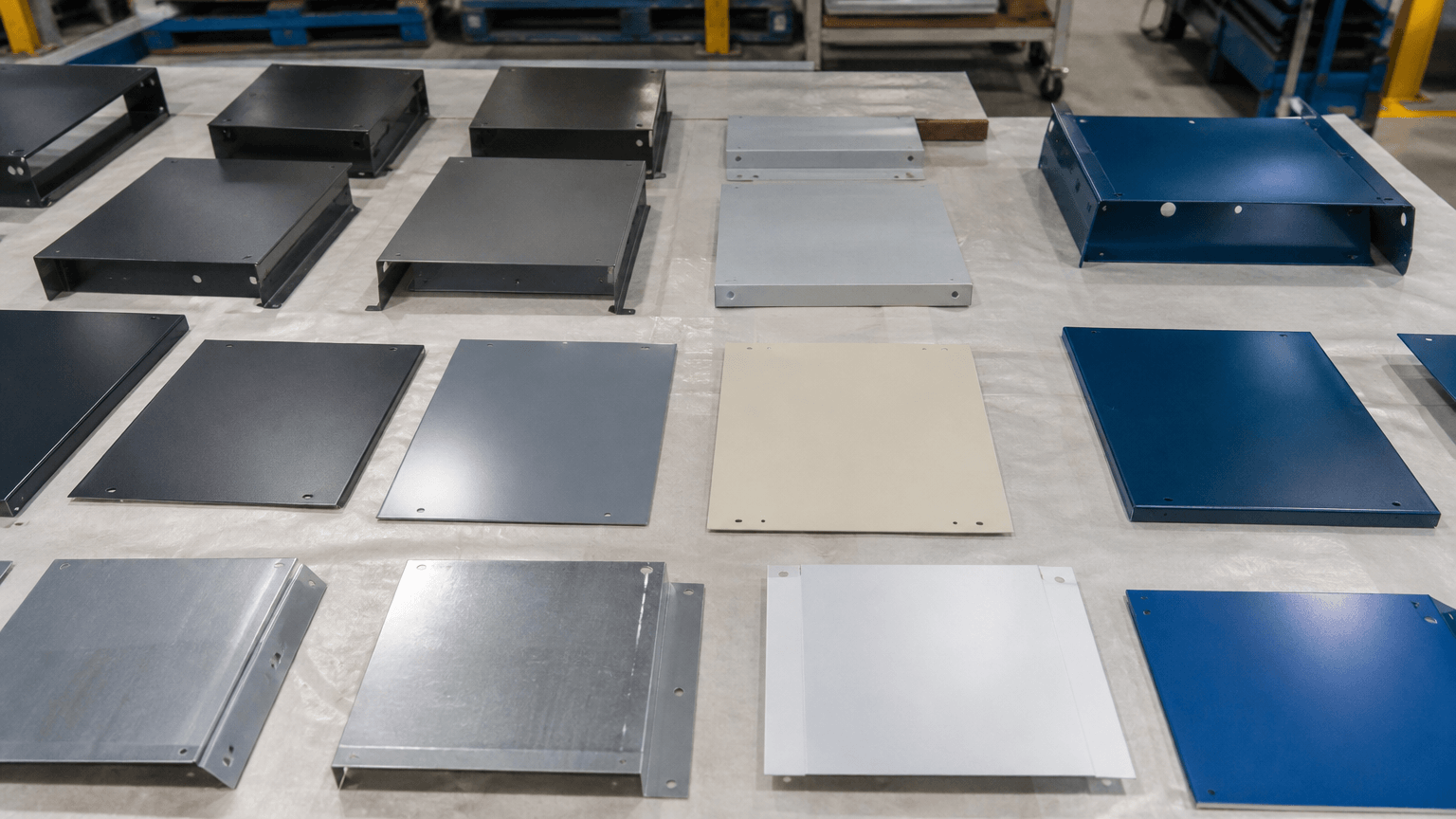
Coating metal means preparing a metal surface and applying a controlled organic or inorganic protective or decorative layer. The visible color is only one part of the system. A defensible choice depends on the substrate, cleaning and pretreatment, resin chemistry, application route, film build, cure, part geometry, and service exposure—not on a generic request for durable paint.
This guide focuses on liquid paint and powder systems used on fabricated sheet metal, while also explaining continuous coil coating and finishing applied to aluminum extrusions. Galvanizing and electroplating deposit metallic layers, anodizing creates a controlled oxide layer, passivation modifies surface chemistry, and thermal spray deposits a different class of material. These treatments may support or replace an organic coating in some designs, but they are not synonyms for painting or powder coating.
Performance Starts Beneath the Visible Finish
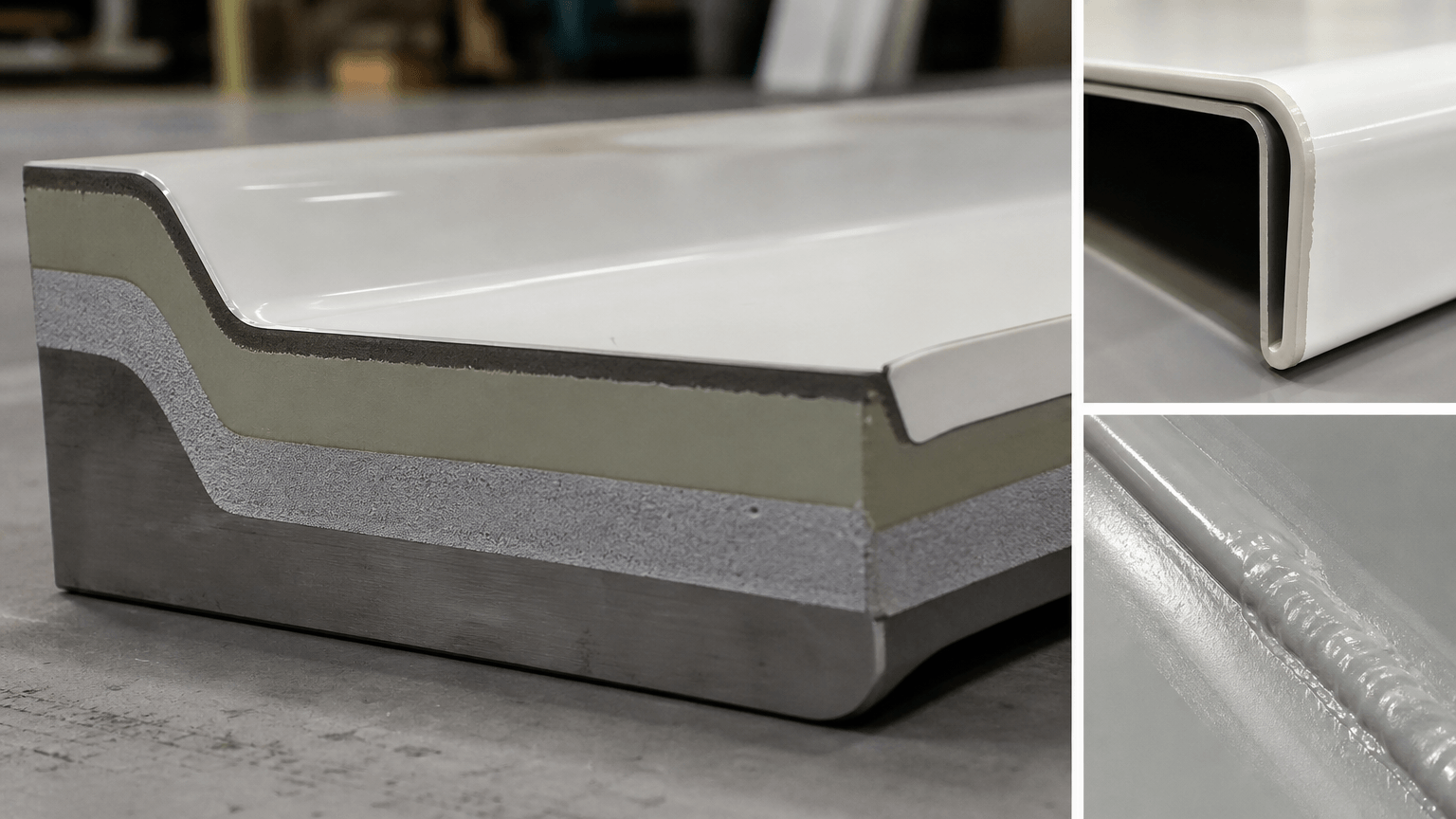
A functional coating sequence usually begins with removal of oil, dust, fingerprints, polishing compounds, welding residue, and other contamination. Degreasing is followed by the rinsing, surface conditioning, or conversion pretreatment required for the substrate and approved coating system. After drying, the process may include a primer, topcoat, and, for some pre-coated products, a back coat. Each applied layer must reach its specified film build and cure condition.
Typical coating stack: topcoat → optional primer → conversion-treated or conditioned surface → metal substrate. Coverage and preparation at cut edges, corners, recesses, and welded seams may differ from those on broad flat faces.
The layers do different jobs. A prepared surface profile can contribute mechanical keying, while compatible pretreatment and resin chemistry support adhesion. Primers and topcoats can provide barrier protection by limiting the movement of water and contaminants. Sacrificial protection is a separate mechanism associated with materials such as zinc and should not be assumed from an ordinary paint film.
Resin is the principal film-forming component. The complete formulation affects hardness, flexibility, adhesion, chemical resistance, color retention, gloss retention, and weatherability. Pigments provide color and hiding power and can influence ultraviolet stability and other performance characteristics. Additives control properties such as flow, leveling, texture, gloss, and application behavior. Pretreatment remains essential because resin, pigment, and additives cannot compensate for rust, oil, unsuitable surface conditioning, or incomplete cure.
Fabrication changes the surface that must be coated. Laser-cut edges, sharp corners, grinding marks, weld discoloration, seams, recesses, and trapped-solution areas can create local weakness or visible variation. Drainage, venting, hanging, masking, and electrical grounding should therefore be reviewed during part design. Target dry-film thickness and the applicable time-and-metal-temperature cure window must come from the approved coating data and project specification rather than a generalized rule. Yishang’s surface-finishing information provides related process context.
Four Coating Routes, Four Different Production Contexts
| Route | Part state and application | Important selection issues |
|---|---|---|
| Powder coating | Dry powder is electrostatically applied to fabricated components or assemblies and then thermally cured. | Review grounding, hanging points, recess coverage, heat tolerance, masking, color changes, reclaim control, and the effect of film build on fits. |
| Liquid spray coating | A water- or solvent-borne formulation is sprayed onto the part. Film formation involves liquid release and any specified curing or crosslinking. | Formulation, equipment, flash-off, VOC controls, overspray, runs, touch-up, and cure conditions all affect the result. |
| Coil coating | Flat metal strip is continuously cleaned, coated, and cured before downstream cutting and forming. | Forming limits, bend performance, cut edges, later welding, and damage during fabrication must be engineered around the pre-coated sheet. |
| Aluminum-extrusion finishing | Already-extruded profiles are finished with an appropriate powder or liquid system. | This identifies the product form and finishing stage, not a unique chemistry. Long profiles, recesses, drainage, racking, and any architectural requirements affect selection. |
These routes are not interchangeable. Coil coating takes place before fabrication, whereas powder and liquid spray processes generally finish an existing component or assembly. Extrusion finishing can use different coating chemistries, but the process must accommodate the profile length and cross-sectional geometry.
Powder does not rely on a liquid carrier, while liquid formulations may use water or solvents. However, actual emissions, transfer efficiency, scrap, line productivity, color-change loss, rework, and cost depend on the formulation, equipment, recovery system, environmental controls, geometry, and lot size. Touch-up can remain visible against an original cured film, particularly on metallic-effect, low-gloss, or textured finishes.
Substrate Condition Determines the Preparation Strategy
Cold-rolled steel: Mill and fabrication oils must be removed thoroughly, and cleaned bare steel can begin corroding before coating if it is left exposed. Cut edges and sharp corners may receive less effective coverage than flat faces. Pretreatment and any primer should be selected against the actual exposure and approved coating data.
Galvanized steel: The zinc layer should not automatically be removed. Compatibility must be established among the zinc surface condition, cleaning method, pretreatment, and coating formulation. Storage stain, contamination, exposed cut edges, and zinc damaged by welding require separate attention. The galvanized steel guide provides additional substrate context.
Aluminum: Alloy, oxide condition, handling contamination, and previous processing can affect adhesion. The surface may require oxide conditioning and a compatible conversion pretreatment. Crevices and poorly drained cavities can retain process solution or moisture. See the aluminum material overview for related fabrication considerations.
Stainless steel: A smooth surface may require a validated preparation method to develop adhesion, and contamination by carbon-steel particles must be controlled. If a directional cosmetic grain is specified, grinding and handling must preserve it. Coating should also be justified because bare stainless may already satisfy some corrosion and appearance requirements.
Selection Matrix: Exposure, Substrate, Geometry, and Route
How Resin Family Changes the Questions
Resin family matters, but it does not define a complete performance level. Polyester formulations are widely considered for general-purpose applications, although indoor and exterior grades can differ substantially. Silicone-modified polyester, or SMP, is a family intended to improve selected weathering characteristics rather than a universal upgrade. FEVE systems may be investigated where demanding color and gloss retention is required, subject to formulation data and route availability. PVDF systems also have formulation and process constraints and may not suit every part geometry or production route.
Use Exposure to Define the Validation Plan
| Exposure | Substrate and route | Pretreatment questions | Resin-system questions | Geometry risks | Sample requirements | Tests to define |
|---|---|---|---|---|---|---|
| Controlled indoor | Can the fabricated part be cleaned, grounded, hung, and cured without affecting its shape? | What preparation is compatible with the metal and expected handling? | Would an approved polyester powder or liquid system meet appearance and cleaning needs? | Threads, fits, rack contacts, recesses, and visible faces. | Color, gloss, texture, and masking sample. | Film thickness, adhesion, cure, appearance, and any relevant handling test. |
| General outdoor | Identify the metal, part state, and whether coating occurs before or after forming. | How will cut edges, weld areas, and wet-dry exposure be addressed? | Compare exterior-grade polyester, SMP, primer options, and other validated products. | Sharp edges, seams, crevices, and poor drainage. | Representative substrate and production geometry. | Weathering, corrosion, adhesion, edge condition, color, and gloss as specified. |
| High ultraviolet | Confirm whether the product is an extrusion, fabricated part, or pre-coated sheet. | Is the pretreatment approved for the substrate and exposure? | Review pigment stability and suitable polyester, SMP, FEVE, or PVDF products without assuming a universal winner. | Orientation, exposed faces, touch-up, and replacement-part matching. | Physical color and gloss master using the intended substrate. | Relevant accelerated or natural weathering with defined color and gloss evaluation. |
| Coastal or humid | Check for galvanized surfaces, dissimilar metals, exposed cuts, and damaged zinc. | Does the system address salt deposits, moisture retention, and crevices? | Evaluate pretreatment, primer, topcoat, film continuity, and maintenance together. | Edges, lap joints, drainage traps, and enclosed cavities. | Representative edges, seams, welds, and scribes where applicable. | Defined corrosion testing, edge evaluation, adhesion, and design review. |
| Chemical contact | Define the substrate and whether exposure is splash, cleaning, intermittent contact, or immersion. | Can preparation residues or trapped solution affect service? | Use formulation-specific resistance data; resin family alone is insufficient. | Joints, liquid traps, damaged areas, and inaccessible surfaces. | Coated samples made on the intended substrate. | Tests reproducing the chemical, concentration, temperature, contact time, and cleaning cycle. |
| High cosmetic demand | Confirm substrate uniformity and whether multiple batches or replacement orders will be viewed together. | Will preparation leave grain, grinding, or surface-profile variation? | Define color, gloss, texture, metallic effect, and touch-up expectations. | Visible welds, grinding transitions, rack marks, and pigment orientation. | Retained physical master under defined viewing conditions. | Visual inspection, instrumental color difference, gloss, film thickness, and batch records. |
The selection should account for ultraviolet exposure, humidity, coastal salt, industrial contaminants, abrasion, cleaning agents, operating temperature, and the intended maintenance interval. Solar-reflective pigments may be available in some products, but thermal or energy-performance claims require measured product data and evaluation of the complete assembly.
From Approved Sample to Production Acceptance
Begin appearance approval with a physical master sample. A recognized color code can support communication, but it does not define the resin, gloss, texture, substrate influence, or metallic-pigment orientation. Digital renderings should remain non-controlling references. Color, gloss, texture, metallic effect, acceptable surface variation, and visible faces should be approved separately.
| Acceptance category | Specification basis |
|---|---|
| Appearance | Define lighting, viewing distance, visible faces, allowable defects, rack marks, texture, and touch-up policy. |
| Color and gloss | Identify the physical master, instrument conditions, measurement locations, allowable difference, and method for matching replenishment orders. |
| Film and cure | State the approved product data, measurement method, locations, required thickness range, and cure-verification procedure. |
| Mechanical performance | Define adhesion and any impact or bend testing relevant to forming, handling, or service deformation. |
| Corrosion or weathering | Define substrate, pretreatment, specimen, scribe and edge condition, conditioning, duration, evaluation method, and pass-fail criteria. |
Potential test references include ASTM D3359 or ISO 2409 for adhesion, ASTM D523 for gloss, ASTM D2244 for instrumental color difference, and ASTM B117 or ISO 9227 for salt spray. Relevant AAMA specifications may apply to qualifying architectural products. Compliance should not be claimed until the applicable edition, coating system, test method, specimen preparation, and acceptance criteria are confirmed.
Accelerated salt-spray and weathering results provide comparative evidence under defined test conditions. They do not convert directly into guaranteed years of outdoor service. Actual performance also depends on substrate preparation, edge condition, film damage, design, local exposure, maintenance, and the complete coating system.
For samples and production, document masking, grounding contacts, threaded holes, hanging points, rack marks, packaging protection, and retained approval samples. Color setup, sample timing, lot size, minimum-order constraints, capacity, rework policy, warranty scope, packaging, and delivery schedule remain project-dependent commercial variables.
Request a Coating-System and Prototype Review
Send Yishang your RFQ and 2D drawings, plus 3D files when available, for a joint review of fabrication and powder-coating implications for custom sheet metal parts, enclosures, frames, cabinets, and welded assemblies.
To make the review specific, include:
- Base metal, grade, thickness, and current surface condition
- Product use environment and expected maintenance or service objective
- Required color, gloss, texture, visible faces, and any physical reference sample
- Masking, grounding, thread, hinge, fit, mating-surface, and assembly requirements
- The requested coating system or performance requirement without assuming an unverified chemistry
- Target inspection methods, specimen conditions, and pass-fail criteria
- Prototype quantity, estimated batch quantity, destination country, and packaging expectations
Yishang has more than 26 years of custom metal manufacturing experience, exports to more than 50 countries, serves B2B projects only, supports OEM and ODM manufacturing, and holds ISO and RoHS certifications. See the broader custom sheet metal fabrication route for the relationship between part production and finishing.
Failure Diagnosis by System Variable
- Peeling: investigate contamination, unsuitable pretreatment, inadequate cure, substrate incompatibility, or intercoat problems. Overbaking can also affect some multilayer systems.
- Blistering: check for trapped moisture, soluble contamination, corrosion beneath the film, outgassing, or retained process residue.
- Edge rust: examine sharp geometry, low edge coverage, exposed cuts, damaged galvanizing, and whether the complete system suits the environment.
- Chalking or fading: review resin and pigment weatherability, ultraviolet exposure, film degradation, and color-family sensitivity.
- Uneven gloss or texture: compare substrate finish, applied film thickness, cure history, powder reclaim ratio where applicable, and viewing conditions.
- Batch color variation: review formulation lots, application settings, film build, cure, substrate color, metallic-pigment orientation, and measurement method.
A photograph can identify areas for investigation, but it rarely proves root cause. Review pretreatment, material-lot, application, oven, inspection, handling, and exposure records before selecting suitable adhesion, cure, contamination, or corrosion tests. For a new product, prototype review can expose edge, weld, drainage, fit, masking, and appearance risks before batch production. Yishang can review these powder-coating interfaces as part of a custom fabricated sheet metal project without assuming an unverified coating chemistry.
Frequently Asked Questions
Is powder coating always better than liquid paint for sheet metal parts?
No. Powder is practical for many fabricated components, but liquid systems may better suit certain chemistries, film requirements, temperature limitations, appearance targets, or repair methods. Geometry, production route, cure capability, exposure, environmental controls, and acceptance criteria determine the appropriate process.
Can galvanized steel be powder coated without removing its zinc layer?
A compatible system can retain the protective zinc layer, but the actual surface must be evaluated. Contamination, storage stain, oxidation, welding damage, outgassing risk, and pretreatment compatibility can affect the result. Validation should use representative galvanized material and production geometry.
Does a thicker coating automatically provide better corrosion protection?
No. Insufficient film can leave weak coverage, but excessive thickness may affect cure, flexibility, appearance, fit, or intercoat behavior. Corrosion performance also depends on preparation, pretreatment, primer, resin, edge continuity, cure, damage, and exposure.
How should holes, threads, grounding points, hinges, and mating surfaces be handled?
Mark these features on the drawing and define whether they require masking, plugs, post-coating thread treatment, controlled film build, or bare electrical contact. Coating accumulation can change fits and hinge movement, while unplanned bare areas can create corrosion or electrical-performance problems.
Why can an approved sample differ from production using the same color code?
A color code does not control every formulation and process variable. Resin and pigment lots, substrate shade, film thickness, cure, gloss, texture, metallic orientation, application settings, and viewing light can alter appearance. Retain a physical master and define both visual and instrumental comparison conditions.