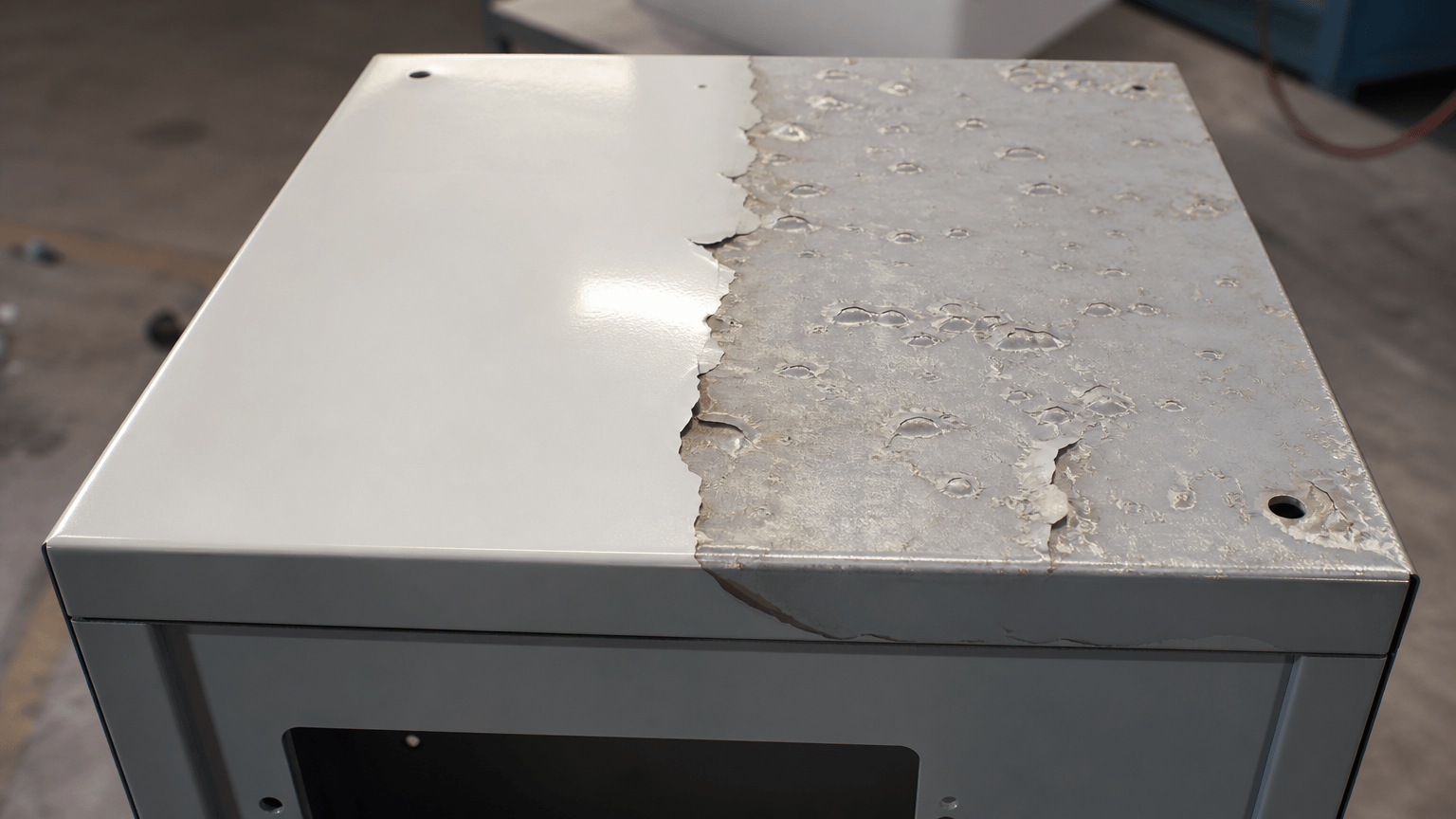
You can sometimes buff powder coat if the finish is known, smooth, fully cured, glossy, and affected only by superficial haze, transfer, or very fine marks. On a visible enclosure, frame, or production part, however, a small gloss or color change can turn a handling mark into a cosmetic rejection. Check the powder supplier’s guidance and test the complete hand-polishing method in a hidden area or on a spare panel first.
Do not treat matte, textured, metallic, chrome-effect, faded, chalked, blistered, cracked, peeling, corroded, or substrate-exposing damage as routine buffing work. Buffing modifies and removes a small amount of the cured surface. It cannot rebuild film thickness, restore corrosion protection, cover exposed metal, or correct failed adhesion or pretreatment.
Identify the Finish and Diagnose the Defect
When a mark appears during assembly, final inspection, or pre-shipment review, the immediate pressure may be to polish it away. First determine whether the problem is removable material on the coating, a shallow surface change, or damage through the coating. The wrong treatment can enlarge the affected area or create a mismatch across a customer-facing panel.
Record the powder manufacturer and product code if available, resin family, color, gloss, texture, metallic or other effect, clear topcoat, substrate, primer, cure history, coating age, and service environment. Check drawings, finish schedules, batch records, technical data, maintenance instructions, and warranty terms before applying chemicals or abrasives. A label such as polyester, epoxy, epoxy-polyester hybrid, or polyurethane does not establish polishability by itself. Formulation, pigments, additives, cure condition, film build, age, geometry, and exposure also affect the result. Remaining film thickness cannot be judged reliably from appearance alone.
Inspect the clean, dry surface under directional light from more than one angle:
- Material on the coating: Dust, oil residue, fingerprints, salt or mineral deposits, adhesive residue, and some transfer marks may respond to coating-approved cleaning without cutting the finish.
- Superficial surface change: Slight haze or very fine marks may be eligible for controlled hand polishing on certain smooth gloss coatings.
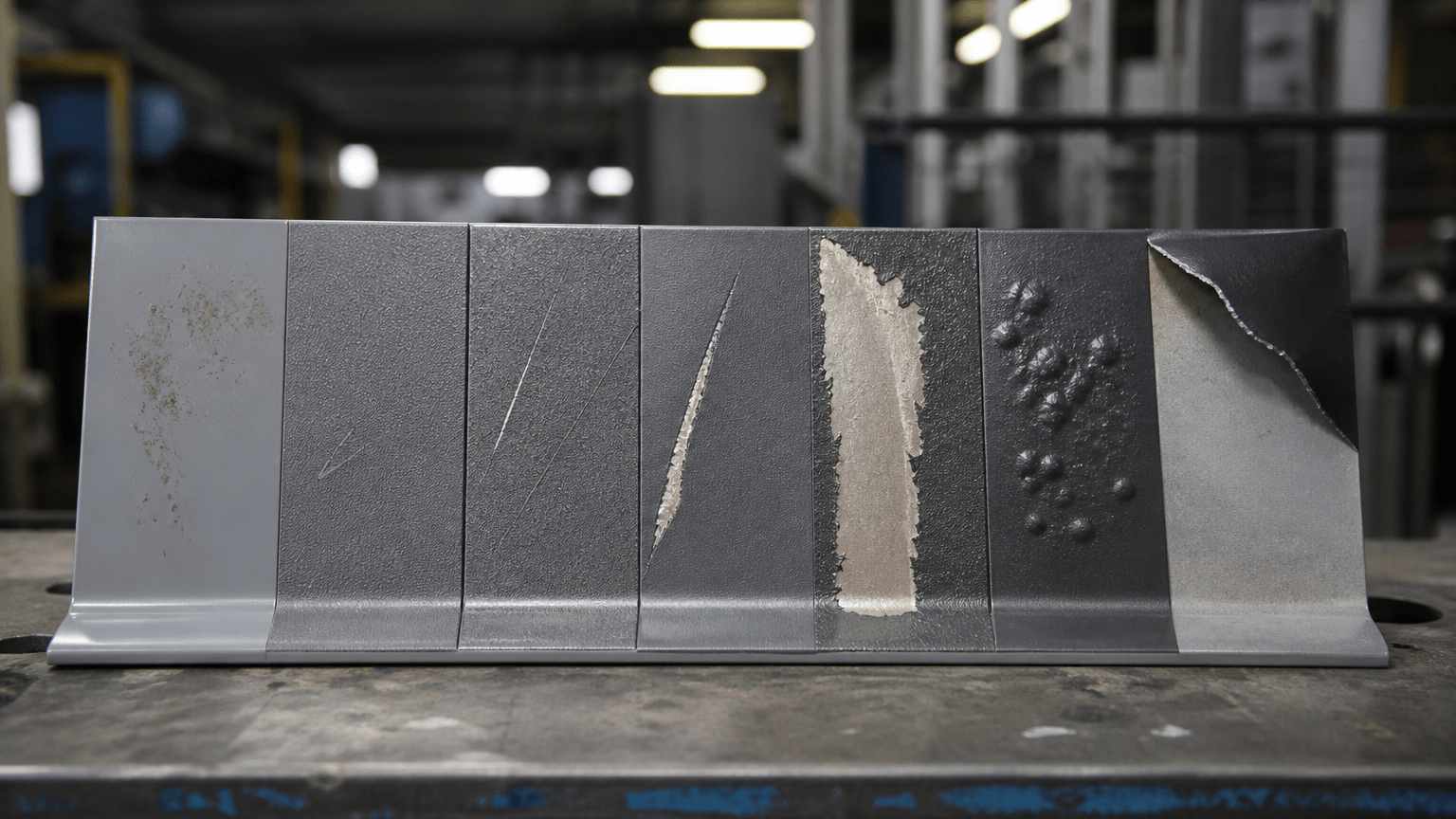
- Damage through or beneath the coating: Deep scratches, visible primer or substrate, corrosion, bubbles, cracks, peeling, edge lifting, or delamination require more than polishing.
Apparent fading may instead be contamination, gloss change, pigment degradation, chalking, chemical attack, or uneven abrasion from earlier cleaning. If powdery residue remains after approved cleaning or a broad area has lost color or gloss, localized buffing is unlikely to produce a uniform result.
Controlled Hand Buffing for an Eligible Smooth Finish
Eligibility and Stop Conditions
For a superficial mark on a known smooth gloss coating, test one small area before treating a visible face or releasing a rework method across a batch. The objective is not to make the area as glossy as possible; it is to reduce the mark without creating a detectable difference in color, gloss, haze, texture, or coating condition.
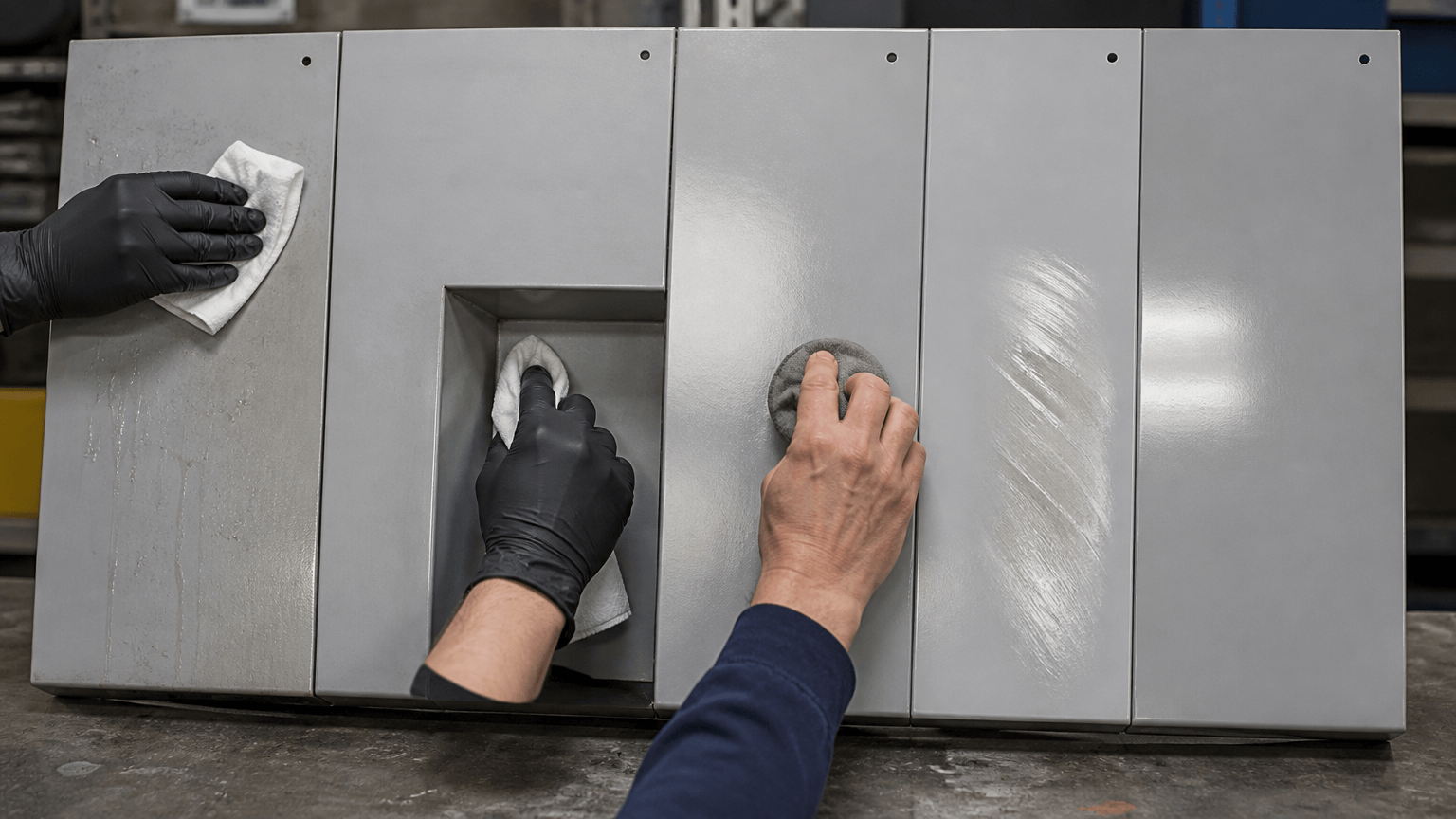
Cleaning, Testing, and Hand-Buffing Sequence
- Confirm the coating and restrictions. Review supplier care guidance and production records. Stop if the finish is unknown, soft, under-cured, special-effect, visibly failing, or suspected of having inadequate film build.
- Inspect the defect. Look for primer or metal exposure, rust staining, bubbles, cracks, peeling, edge lifting, or softness. A scratch that catches a clean fingernail should not automatically be considered polishable because leveling it may remove too much surrounding coating.
- Remove loose particles. Use clean water or another coating-approved method. Do not wipe a gritty panel because trapped particles can create additional scratches.
- Clean without cutting. Use a neutral, non-abrasive cleaner and a soft, lint-free cloth, following supplier instructions for dilution and contact time. Do not substitute an unverified automotive compound, abrasive cleaner, metal polish, acetone, thinner, or strong solvent.
- Remove residue and dry. Rinse or wipe as directed and dry with a separate cloth. Reinspect under directional light. If the defect disappears, stop; cleaning was sufficient.
- Test in a hidden area. Preferably use an approved spare panel. After drying, check color, gloss, haze, texture, softening, tackiness, pigment transfer, and coating pickup on the cloth.
- Use only a verified low-cut product. It must be considered suitable for the identified cured finish. Apply it to the cloth rather than flooding the panel. No product, quantity, or working time is universally appropriate.
- Buff by hand with control. Use light pressure and short, overlapping passes in a consistent direction. Work one small area at a time and avoid heat buildup. Keep away from edges, corners, holes, weld transitions, raised texture, decals, graphics, seals, and potentially thin areas.
- Inspect frequently. Stop if the cloth picks up coating color or the area becomes glossier, flatter, hazier, warmer, cooler, or otherwise different. Machine polishing adds cut, heat, pad, and speed variables; it is not simply a faster version of hand buffing.
- Remove residue and compare. Use the approved removal method and a separate cloth. Compare treated and untreated areas under the same lighting, distance, angle, and surface condition used for acceptance. Use wax, sealant, or protective film only when approved for the coating and end use.
This procedure applies only to minor correction of cured powder coat. Bare-metal polishing before coating is a separate manufacturing operation, and repair behavior established for liquid paint should not be assumed to apply to powder coating.
Appearance-Sensitive Coatings Need Extra Caution
A repair that is unobtrusive on one smooth gloss part may be obvious on a matte enclosure door, textured frame, or metallic control panel. Abrasion changes surface topography and can create a visible patch across a critical cosmetic face. Use this table only for screening; it does not establish compatibility.
| Finish or condition | Main buffing risk | Evaluation route |
|---|---|---|
| Smooth gloss, known product, fully cured | Localized gloss, haze, color, or film-build change | Review supplier guidance and conduct a hidden-area hand test |
| Matte or low-gloss | Rubbing can leave a permanent shiny patch | Clean only unless a finish-specific repair method is approved |
| Textured powder | Abrasion can flatten peaks while leaving recesses unchanged | Avoid routine polishing; assess touch-up or recoating |
| Metallic, bonded metallic, mica, or chrome-effect | Reflectivity, apparent particle orientation, depth, or color may shift | Obtain supplier guidance and test a representative spare panel |
| Transparent topcoat or multi-layer system | Polishing may reduce the upper layer or alter optical depth | Identify the complete layer system before treatment |
| Outdoor fading or chalking | Localized treatment may create patchy color and gloss | Investigate deterioration and evaluate recoating |
Resin family alone is insufficient. Exact formulation, pigment package, additives, cure, film build, age, and exposure must be considered together.
Buff, Clean, Touch Up, or Recoat?
Choose the route according to defect depth, affected area, finish appearance, substrate exposure, and failure signs. For production rework, also consider the cosmetic zone: a functional localized repair may still be unacceptable on a customer-facing cover or enclosure door.
| Observed condition | Initial action | Stop condition | Likely escalation |
|---|---|---|---|
| Dust, oil, salt, mineral deposit, or removable residue | Approved neutral cleaning | Softening, staining, gloss loss, or color transfer | Identify the contaminant and obtain coating-specific guidance |
| Transfer, slight haze, or very fine mark on eligible smooth gloss powder | Clean, then conduct a low-cut hand test | Any visible color, gloss, haze, or texture change | Accept, approve limited correction, assess touch-up, or recoat |
| Scratch that catches a fingernail | Do not assume it can be buffed out | Leveling would remove substantial surrounding coating | Evaluate localized repair or recoating |
| Deep scratch, chip, or exposed substrate | Protect from moisture and contamination | Buffing cannot replace the lost coating | Use an approved repair system or prepare, pretreat as required, and recoat |
| Small area proposed for touch-up | Check preparation and repair-material compatibility | Unacceptable color, gloss, texture, edge, protection, or weathering difference | Recoat the complete face or part when uniformity is required |
| Widespread fading or severe chalking | Investigate age, exposure, chemistry, and specification | Polishing creates an isolated patch | Evaluate stripping and recoating |
| Corrosion, bubbles, cracking, peeling, or delamination | Segregate affected parts and investigate the system | No buffing test is appropriate | Assess substrate, contamination, pretreatment, cure, primer compatibility, layer adhesion, and exposure before recoating |
Localized touch-up is not equivalent to factory powder recoating. Differences in color, gloss, texture, repair edges, protection, and weathering may remain. Complete recoating may involve disassembly, masking, hardware removal, stripping, corrosion removal, renewed pretreatment, and verification of the replacement system. See this guide to pretreatment, coating routes, and inspection criteria when the defect indicates coating-system failure.
Approve the Result Before Reworking a Batch
A polishing test can appear acceptable at a workbench and still fail inspection after assembly or under the customer’s lighting. Before reworking multiple OEM parts, use a retained approved finish sample or representative sacrificial panel. Define critical or Class A faces, secondary and hidden areas, edges, weld zones, and hardware locations.
Agree on viewing distance, lighting, angle, inspection duration, and whether magnification is permitted. Compare color, gloss, texture, haze, polish marks, exposed substrate, and repair boundaries. Allowable variation must come from the drawing, finish specification, powder supplier documentation, or approved sample—not a generic tolerance.
Pilot the method on one representative part. Record the cleaner, polishing product, cloth or pad, sequence, treatment area, operator method, and approval result. Confirm that the treatment does not conflict with supplier instructions or warranty terms. Yishang’s quality control approach provides related context for samples, cosmetic zones, and controlled inspection. Finish decisions are particularly important for visible custom sheet metal enclosures.
Request a finish and rework feasibility review for an RFQ, prototype, or production batch. Send Yishang full-part and close-up photos under consistent lighting, the drawing and finish specification, cosmetic-face designations, batch quantity, project stage, destination, and required timing. Include the substrate, application, indoor or outdoor exposure, approximate defect area, substrate exposure, and any corrosion, bubbles, cracking, or peeling.
Where known, also provide the powder manufacturer, product code, resin family, color, gloss, texture, primer, clear coat, cure history, and an approved sample or spare test panel. Yishang can review this information with the part design and production stage to discuss controlled sample evaluation, localized rework planning, or recoating for a custom sheet metal batch. This review does not imply that every existing coating can be restored. For new or replacement production finishes, review Yishang’s surface finishing service.
Questions About Buffing Powder Coat
These questions commonly arise when a marked RFQ sample, prototype, or production part must be assessed against a drawing, finish specification, or approved sample.
Can automotive rubbing compound be used on powder coat?
Compatibility cannot be assumed. Automotive compounds are made for particular paint systems and cutting levels. Verify the exact powder and supplier guidance, then test the complete method on a hidden area or spare panel.
Can a scratch be buffed out if a fingernail catches on it?
Not necessarily. Leveling it may remove too much surrounding coating. If primer or substrate is visible, buffing cannot restore film thickness or corrosion protection; assess an approved repair or recoating route.
Why does matte or textured powder coat become shiny after rubbing?
Rubbing can smooth a matte surface or flatten texture peaks, changing light reflection. The resulting glossy patch may be more visible than the original mark.
Can faded or chalky outdoor powder coating be restored by polishing?
Not reliably. Local polishing may create uneven color and gloss without reversing pigment degradation, binder erosion, chemical attack, or broader deterioration.
When is touch-up preferable to stripping and recoating?
Touch-up may suit small, defined damage when a compatible repair system provides the required protection and the repair boundary is acceptable. Stripping and recoating is more appropriate for widespread mismatch, exposed or corroded substrate, bubbles, cracking, peeling, adhesion failure, or critical faces requiring uniform appearance.