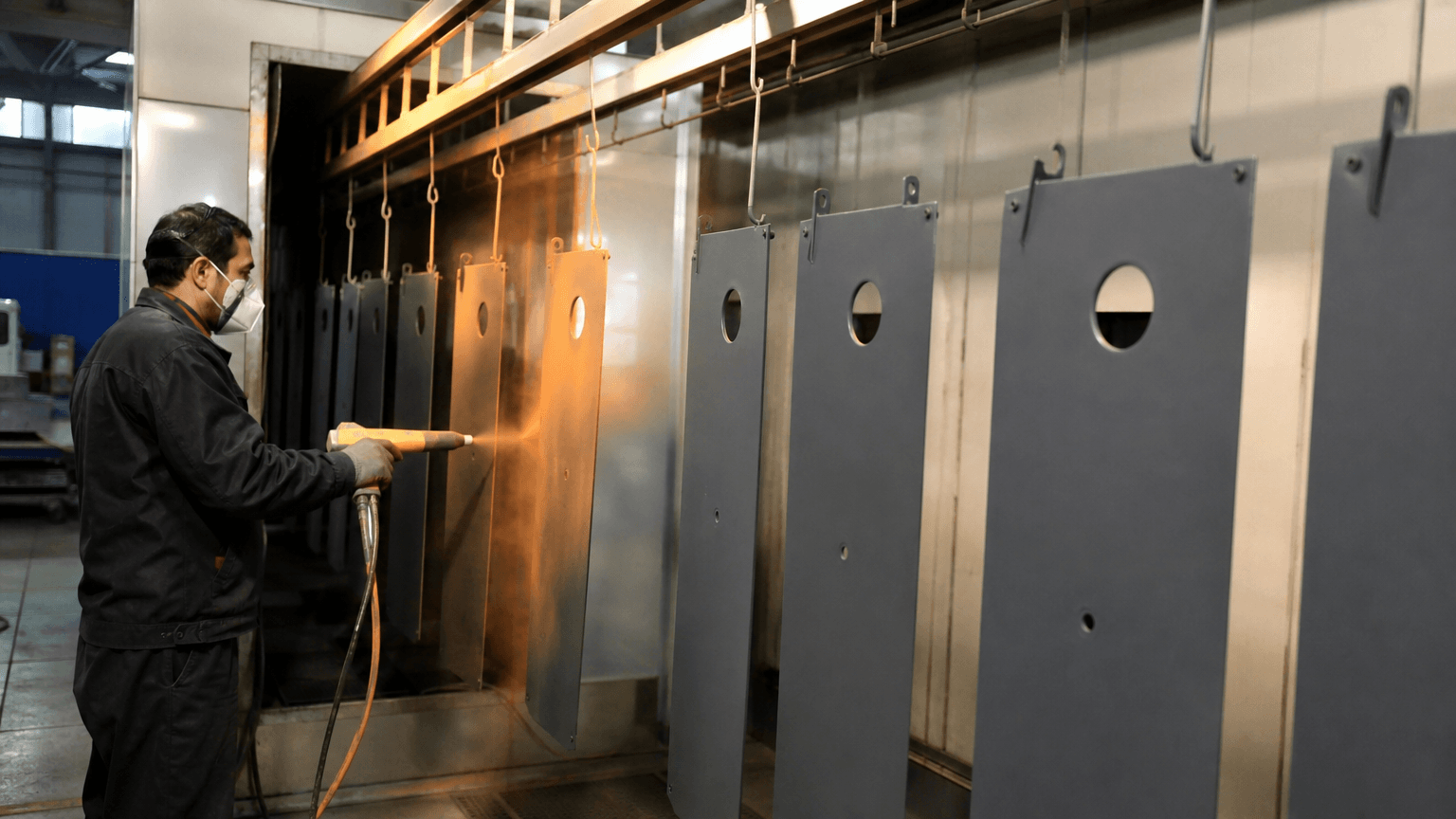
Can plastic be powder coated? Sometimes, but conventional oven-cured powder coating is not a default route for most plastics. Typical conventional powder-coating cure temperatures are approximately 150–232°C, but the exposure is process-dependent and many grades may soften, warp, shrink, discolor, outgas, or exceed dimensional limits. Feasibility depends on the exact grade, fillers, wall thickness, molded-in stress, moisture condition, service temperature, and required fit. This guide gives an OEM go-or-no-go method for comparing routes and validating production-equivalent parts.
When an OEM wants one finish across a sheet-metal enclosure and an injection-molded cover, the metal part may suit conventional powder while the plastic part changes shape or loses fit during the same cycle. Treat the two as separate process decisions: prove deposition, curing, preparation, masking, assembly, and inspection for each substrate.
Can plastic be powder coated? Start with two feasibility gates
On an RFQ or drawing, the phrase powder coated can hide two different questions: can the process deposit the powder consistently, and can the plastic survive the complete cycle? Passing the first gate does not prove that the part will retain its geometry or function after curing.
Conventional electrostatic powder spray deposits charged dry powder and then uses heat to melt, flow, and cure the coating. Plastic is usually nonconductive, so charge management, grounding, coverage, recesses, contact points, and complex geometry require separate review from a conductive metal part.
The approximate 150–232°C range represents a typical, process-dependent exposure for conventional powder coating, not a universal schedule, minimum, or maximum for every product. Ask the powder supplier to define the part-temperature profile, dwell time, chemistry, equipment conditions, and film-build window. Check the plastic datasheet for heat-deflection behavior, softening, shrinkage, moisture sensitivity, outgassing, chemical resistance, and dimensional stability.
Compare the exact plastic grade, not just the polymer family
A drawing that says ABS, PC, PA, PP, PVC, or thermoset is not enough to approve a coating route. Fillers, flame retardants, impact modifiers, pigments, plasticizers, recycled content, molding history, and moisture condition can change heat response, surface energy, outgassing, and preparation compatibility.
| Plastic family | Primary screening concerns | Evidence to collect |
|---|---|---|
| ABS | Heat response, molded-in stress, cleaner or etchant compatibility | Grade data, representative heat and preparation trial, dimensions |
| PC | Residual stress, stress cracking, color change, chemical sensitivity | Production-equivalent geometry and chemical-compatibility review |
| PA or nylon | Moisture absorption, conditioning, fillers, outgassing, dimensional movement | Defined moisture state, filler data, before-and-after dimensions |
| PP | Low surface energy, thermal movement, preparation compatibility | Validated activation and adhesion after conditioning |
| PVC | Formulation differences, plasticizers, heat sensitivity, discoloration | Compound review and controlled molded-part trial |
| Thermoset plastics | Compound-specific response, porosity, brittleness, fillers, outgassing | Compound data plus exposure, appearance, adhesion, and dimensional checks |
Wall thickness, ribs, bosses, inserts, uneven sections, and unsupported spans can make a suitable grade unsuitable for a particular shape. Use production-equivalent resin, additives, molding condition, moisture state, and geometry rather than a generic plaque or a different grade from the same family.
Polyester, epoxy, and fluoropolymer describe coating resin-system categories, not plastic substrate types. Confirm whether the selected product forms a thermoset film or a thermoplastic powder layer, and verify its intended substrate, deposition method, cure or melt profile, and environmental requirements.
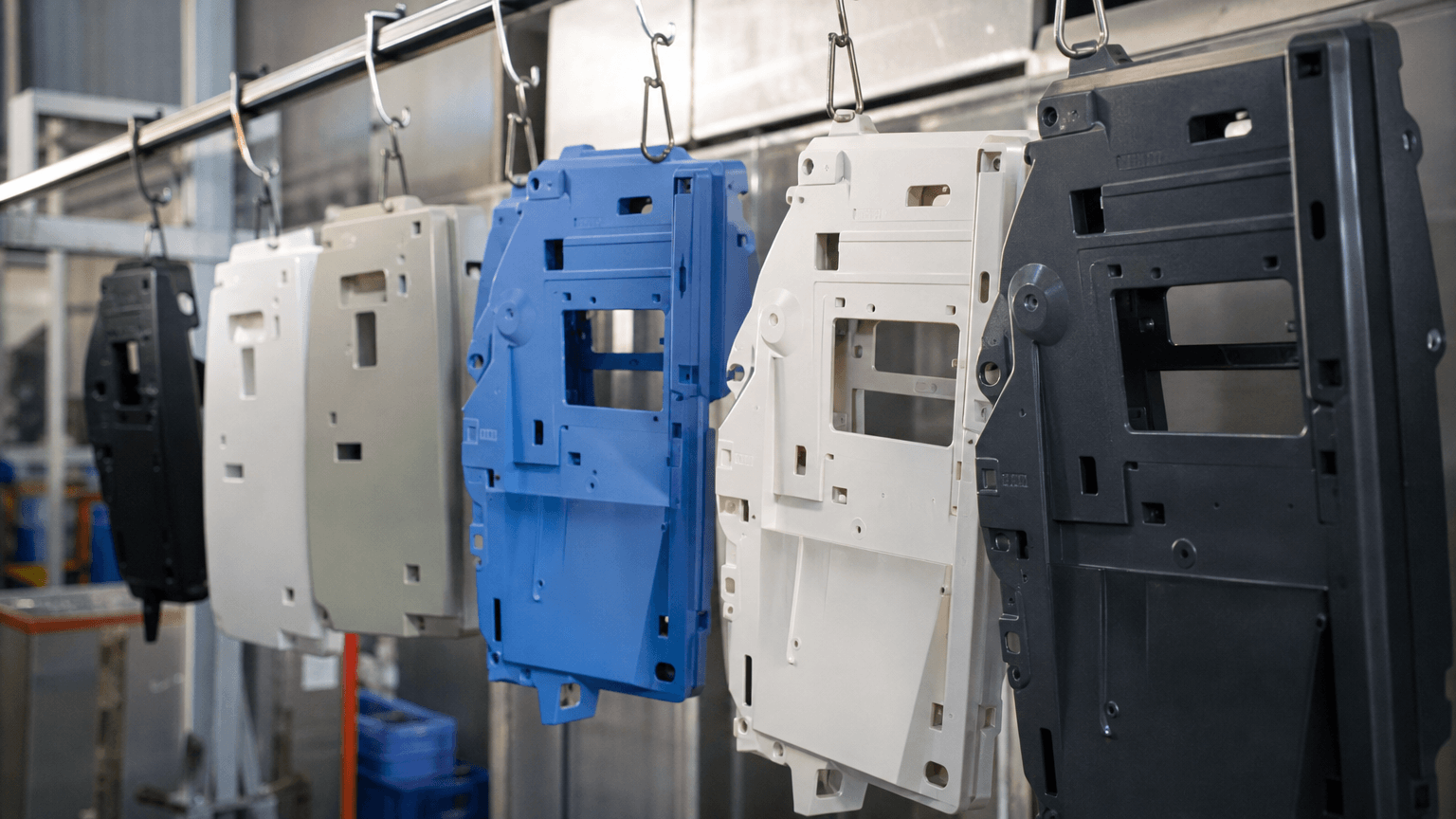
Separate powder, wet, and molded-color routes
When a project needs a coated appearance but the plastic cannot tolerate a conventional cycle, a lower nominal temperature or a different process name does not prove compatibility. Each route changes the deposition, heat, drying, masking, and inspection questions.
| Route | Process distinction | Part-level question |
|---|---|---|
| Conventional electrostatic powder spray | Spray equipment deposits charged dry powder, and an oven cures it | Can the process control charge and coverage while keeping the complete thermal cycle within the part’s limits? |
| Low-temperature powder | A specified formulation uses a lower thermal profile than a selected conventional product | Does the full time-temperature profile fit the exact grade and geometry? |
| UV-curable powder | Powder melts or flows before UV energy initiates curing | Can the part tolerate the melt stage, and can UV reach recessed surfaces? |
| Fluidized-bed powder coating | The part contacts suspended powder through route-specific preheating or preparation | How will the process control preheating, build, edges, recesses, inserts, and fits? |
| Wet spray coating | A liquid coating dries or cures through a substrate-compatible route | Are solvent, primer, flash-off, drying, and handling conditions compatible? |
| Molded-in color | The molding process creates color in the plastic rather than applying a film | Can molded color meet the appearance and service requirements? |
For low-temperature, UV, fluidized-bed, or fluoropolymer options, obtain supplier data for the substrate, deposition method, part exposure, cure or melt conditions, film-build window, equipment, ventilation, and handling. Do not assume that a route validated on one grade applies to another. For parts still in development, OEMs can compare custom injection molding and molded-in-color options before fixing a secondary finish.
Use a go-or-no-go route screen
| Project condition | Routes or changes to evaluate | Decision evidence |
|---|---|---|
| Thermal exposure changes shape, color, or critical dimensions | Wet spray, molded-in color, a different grade, redesigned geometry, or metal substrate; consider low-temperature or UV powder only with validation | Actual part exposure, service needs, and dimensional results |
| Color is the main requirement | Molded-in color or a compatible wet route | Appearance, chemical exposure, environment, quantity, and rework implications |
| Nonconductive geometry produces uneven coverage | Controlled electrostatic trial, wet spray, or design change | Charge management, fixture, orientation, recess coverage, and film build |
| Tight fits cannot absorb coating build or movement | Masking, revised allowances, redesign, or a coating-free interface | Threads, mating faces, bearing seats, snap features, and assembly checks |
| Plastic is combined with a metal frame, cabinet, enclosure, or bracket | Approve separate finishes for each substrate | Interface dimensions, contact areas, masking, and finish compatibility |
For a mixed-material technical review: Yishang can review the metal fabrication and finishing scope, identify interface and dimensional questions, and flag plastic-coating items that require specialist validation. Keep sheet-metal fabrication, machining, welding, finishing, assembly, and inspection as separate scope and acceptance-criteria lines; success on the metal portion does not validate the plastic. Share the exact plastic grade and filler content, datasheet, drawing or assembly layout, wall thickness, inserts, mating features, critical dimensions, appearance target, service temperature, chemical and wear conditions, expected quantity, proposed route, prototype needs, and trial results. This review does not replace part-level approval by the selected plastic-coating specialist.
Design and surface preparation controls
After a route appears possible, preparation and part design determine whether the coating can adhere without damaging fit or function. Do not transfer metal pretreatment chemicals, metal powder-coating equipment settings, or metal inspection criteria directly to plastic.
- Confirm material condition: Record the exact grade, fillers, molding history, storage condition, and any drying or preconditioning the material requires.
- Clean compatibly: Use a cleaner validated for the grade and additives; check for swelling, whitening, cracking, and residue.
- Activate the surface: Low-surface-energy materials may require validated abrasion, compatible chemical etching, activation, or primer. Do not transfer the method from another grade.
- Manage charge and coverage: Define the fixture, grounding, conductive aid, preheating, or other route-specific controls needed for a nonconductive part.
- Mask functional features: Protect threads, inserts, mating faces, electrical contacts, bearing seats, snap features, and grounding points.
- Review geometry and fixturing: Check ribs, bosses, recesses, edges, orientation, hanging points, contact marks, and powder accumulation.
- Control dimensions: Allow for film build, thermal movement, shrinkage, and post-coating assembly fit.
Run trial parts with the intended preparation, masking, fixture, orientation, deposition, curing or drying, and handling conditions. A similar polymer plaque cannot substitute for representative geometry.
Validation gates before production release
Before a buyer releases a drawing or batch process, validate the complete route on production-equivalent parts. The buyer and coating supplier should set the visual, dimensional, adhesion, and service criteria before the trial.
- Record the baseline: Exact resin grade, fillers, moisture state, molding history, critical dimensions, weight where useful, color, and visible condition.
- Screen preparation and heat exposure: Check for swelling, cracking, gloss change, discoloration, warpage, shrinkage, insert movement, and outgassing.
- Coat representative samples: Use production-equivalent geometry, preparation, deposition, cure or drying, masking, fixtures, and handling.
- Approve appearance and film build: Define color, gloss, texture, coverage, edge appearance, contact marks, and allowable defects. Measure film thickness with a buyer-approved method suitable for the substrate.
- Test adhesion and mechanical use: Apply agreed adhesion criteria and add impact, abrasion, friction, flexing, or wear checks where service requires them.
- Condition for actual service: Use relevant cleaners, oils, fuels, disinfectants, humidity, or other media. Add thermal cycling when operating, shipping, or assembly temperatures matter.
- Reinspect fit and dimensions: Compare critical features before and after coating, conditioning, and assembly. Hold release until the sample meets the defined criteria.
A production-equivalent prototype review can reveal interface and fit problems before the team finalizes fixtures and finish requirements.
Plastic powder-coating troubleshooting: check grade, moisture, preparation, deposition, cure, and inspection
When a trial shows warpage, shrinkage, blistering, poor adhesion, color change, cracking, outgassing, or dimensional drift, change one process stage at a time. Stop and retest after each correction.
- Verify the material: Reconcile resin grade, filler content, molding condition, and datasheet with the approved sample before interpreting the defect.
- Check moisture and contamination: Blisters, craters, outgassing, and weak adhesion may originate below the film. Correct storage, drying, cleaning, or handling, then retest.
- Inspect preparation: Peeling can reflect low surface energy, additive bloom, incompatible cleaners, insufficient activation, or excessive abrasion. Correct the surface and retest.
- Review deposition and geometry: Bare recesses, heavy edges, and uneven coverage can indicate charge, fixture, orientation, gun-setting, masking, or accumulation problems.
- Audit the complete thermal profile: Compare actual part exposure with the plastic and powder data when warpage, shrinkage, insert movement, cracking, color change, or dimensional drift occurs.
- Repeat conditioned inspection: A visually acceptable part may fail after chemical exposure, impact, wear, or thermal cycling. Hold the process until the team understands the result and can reproduce it.
Start with the exact grade, representative geometry, critical tolerances, and required finish. Approve preparation, route, acceptance criteria, and prototype results in sequence. For mixed metal-and-plastic assemblies, validate the metal finish and plastic coating separately before production release.
Frequently asked questions
These questions commonly appear when teams add plastic coating to an RFQ, drawing, prototype plan, or mixed-material assembly.
Will powder coat stick to plastic without special surface preparation?
Not reliably in every case. Adhesion depends on surface energy, contamination, additives, preparation, chemistry, and curing. The exact grade may need cleaning, compatible abrasion, activation, etching, or primer, followed by part-level validation.
Is there a practical way to powder coat plastic at a lower thermal load?
Low-temperature and UV-curable powders may reduce exposure compared with a selected conventional product, but their melt, flow, cure, coverage, and dimensional requirements still need part-level validation.
Can ABS, PC, PA, PP, PVC, and thermoset plastics use the same process?
No. Their heat response, moisture behavior, surface energy, chemical sensitivity, and dimensional stability differ. Evidence from one grade does not approve the same process for another.
What causes warping, blistering, peeling, cracking, or color change?
Possible contributors include heat exposure, molded-in stress, moisture, outgassing, contamination, incompatible preparation, poor activation, uneven build, and coating-substrate mismatch. Diagnose the stages in sequence.
When is wet spray or molded-in color a better choice?
Consider them when powder curing threatens dimensions, a compatible wet coating can meet service needs, or molding can create the required color. Compare appearance, chemicals, wear, quantity, rework, trials, and tolerances.