
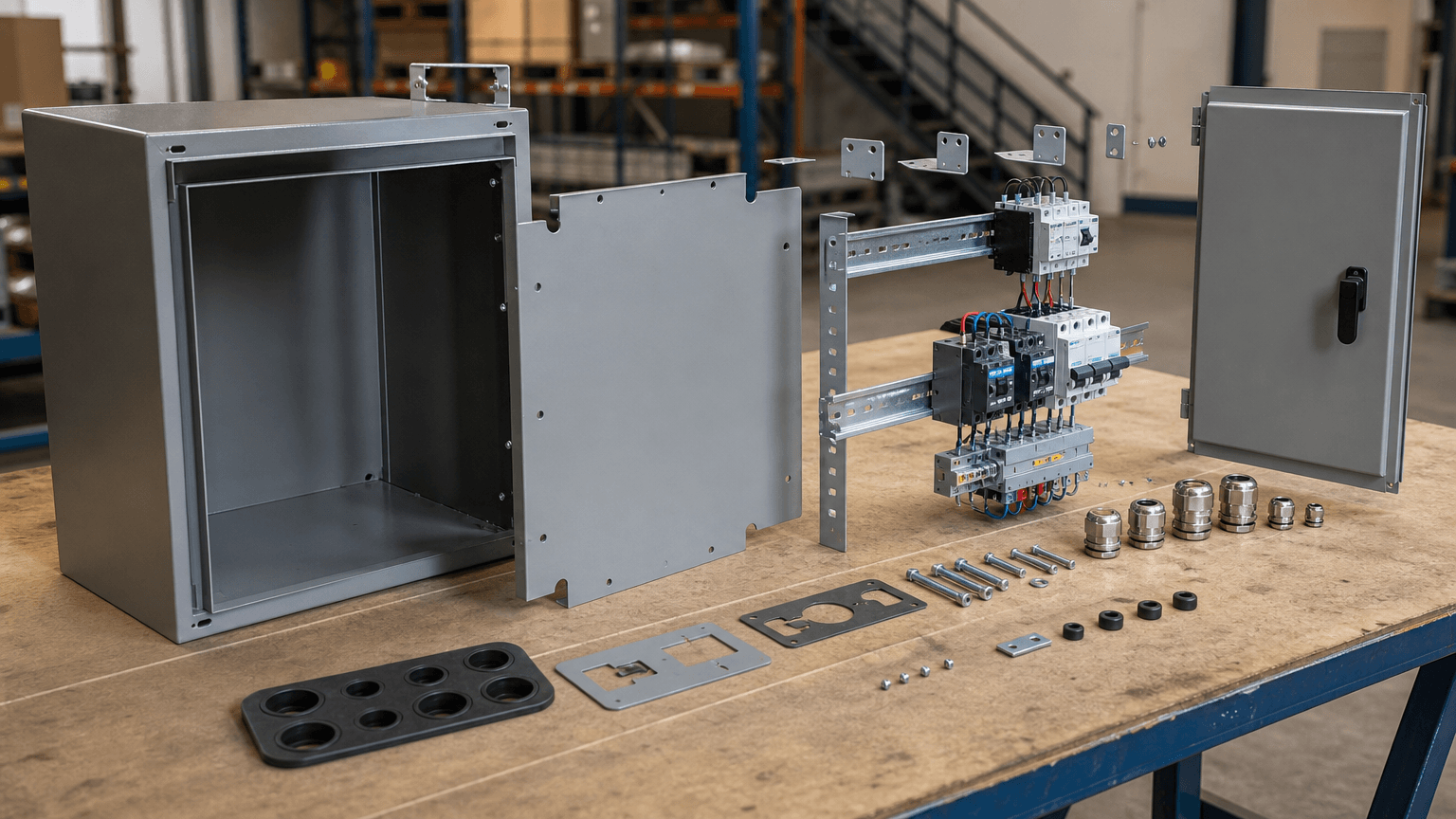
Electrical assy normally means electrical assembly, but the phrase does not specify whether the deliverable is an empty enclosure, a mechanically populated chassis, a wired subassembly, or a tested finished electrical product. The controlling drawings, BOM, purchase order, quotation, and agreed statement of work determine the actual scope.
Direct answer: Assy is common shorthand for assembly. Treat electrical assy as a broad commercial or engineering label until the documents identify the parts, installation operations, testing, records, and delivery condition included.
For an OEM buyer, this distinction affects both the quotation and the production handoff. One supplier may deliver a fabricated sheet metal enclosure for a later integration step, while another quotation may include hinges, rails, brackets, or other mechanical hardware. Wiring, PCB installation, connector termination, and electrical testing should not be inferred from the word assembly.
What Electrical Assy Means in Project Documents
Buyers often encounter the abbreviation in several documents, and each document serves a different purpose. A BOM may define the assembly hierarchy, an assembly drawing may show the physical arrangement, and a work instruction may describe one assigned operation. The quotation and purchase order then need to make the commercial delivery state clear rather than allowing a general label to expand the supplier’s responsibility.
- BOM: Identifies parent and child items, quantities, part numbers, and revisions. It may not state who purchases, installs, or tests each item.
- Assembly drawing: Shows locations, orientation, interfaces, and notes. It does not automatically include wiring or functional work.
- Quotation: Records inclusions, exclusions, assumptions, substitutions, and the proposed delivery condition.
- Purchase order: Confirms the agreed commercial scope and should reference the controlling revisions and acceptance documents.
- Work instruction: Explains an assigned build or inspection operation but does not replace the controlled product definition.
Illustrative BOM descriptions
The following descriptions show why the parent label needs supporting detail. They are examples, not universal definitions:
- ENCLOSURE ASSY: Formed and finished metal body with hinges, mounting studs, and a removable cover; supplied empty with no electrical installation.
- CONTROL BOX ASSY: Enclosure plus buyer-specified rails and electrical items installed to an approved layout; wiring and electrical testing excluded unless separately listed.
The second description suggests a wider delivery state, but it still requires referenced drawings, component information, revision status, and acceptance criteria. If those details are missing, the supplier should request clarification before quoting or releasing the work.
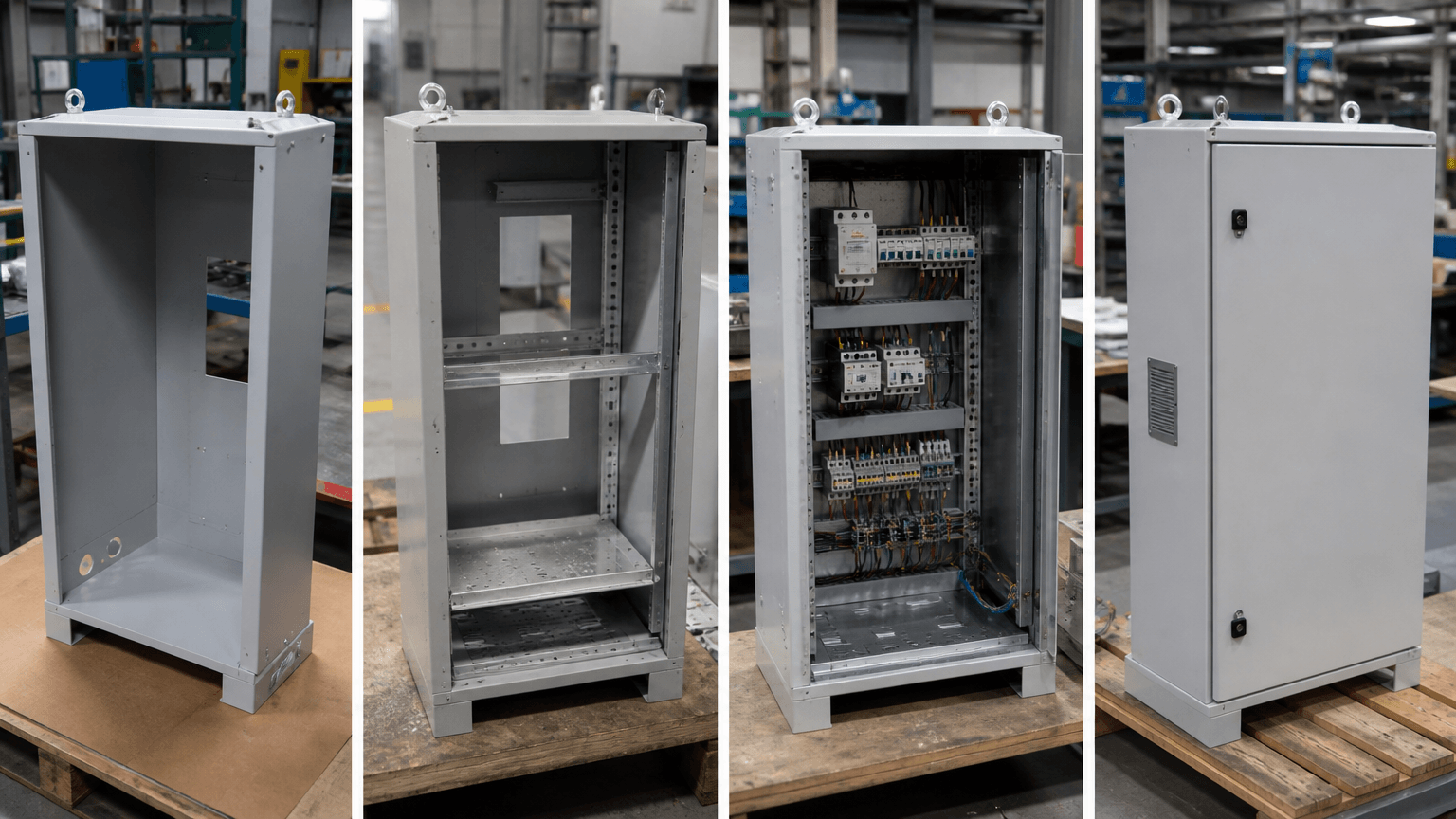
Four Delivery States Behind the Same Name
Separate the physical delivery state from the product name. The following scopes are often grouped under electrical assy, but they require different inputs, responsibilities, and acceptance bases.
| Scope | Representative deliverable | Required inputs | Typical acceptance basis |
|---|---|---|---|
| Fabricated sheet metal enclosure | Cut and formed panels with defined joining and finish operations; only named hardware is included. | Part drawings, 3D model if needed, material, finish, and feature notes. | Dimensions, openings, hole locations, finish, visual condition, and listed hardware. |
| Mechanically assembled enclosure | Enclosure fitted with hinges, latches, panels, rails, brackets, studs, fasteners, or other specified mechanical items. | Assembly drawing, hardware BOM, fit notes, and torque requirements where applicable. | Hardware presence, orientation, alignment, access, and mechanical function. |
| Electrical subassembly | Enclosure with specified electrical components installed; wiring and terminations are included only when listed. | Controlled electrical BOM, component layout, wiring documents, and approved parts list. | Component presence, orientation, routing, labels, terminations, inspection records, and other named criteria. |
| Tested finished electrical product | Populated unit released after defined electrical, safety, or functional checks. | Test procedure, acceptance limits, applicable project requirements, and record format. | Completed test records, release approval, and defined product documentation. |
These categories can overlap, but they are not interchangeable. Installing a component does not demonstrate that the product operates correctly, and a finished metal enclosure does not prove that wire processing, crimping, soldering, PCB work, battery-pack assembly, motor assembly, or energized testing is included. Each operation needs an identified owner.
Mechanical Interfaces That Set Up Electrical Installation
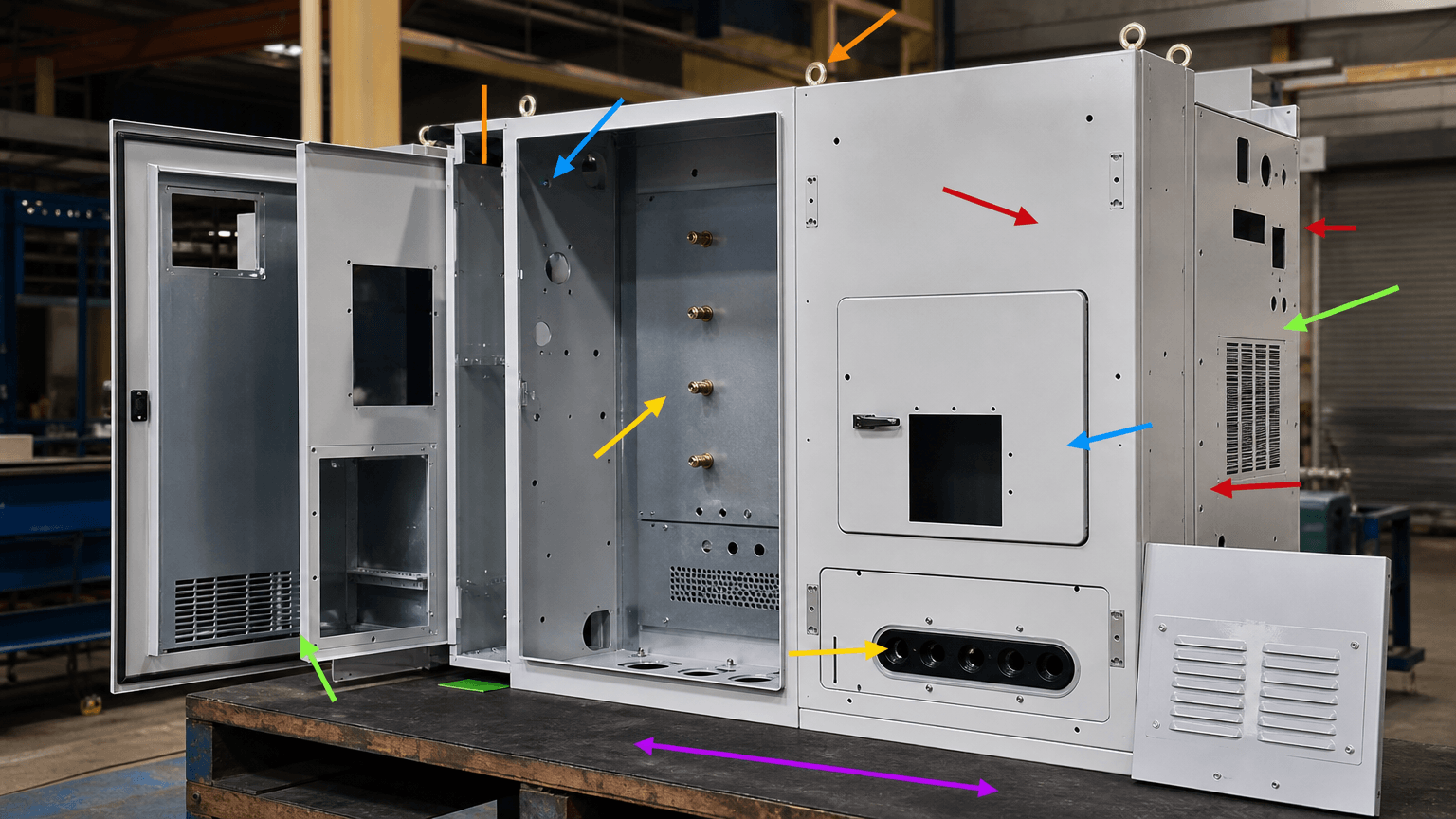
An enclosure dimensioned only by its outside length, width, and height may still fail to support the intended electrical installation. The metal structure must accommodate the component layout, installation sequence, service access, cable path, and later inspection. A custom sheet metal enclosure should therefore be defined around its interfaces, not only its external dimensions.
- Mounting geometry: Holes, slots, studs, threaded hardware, rails, and formed brackets establish the component pattern. Reference locations, revisions, and inspection requirements should appear on the controlled drawing.
- Structural supports: Bends, returns, ribs, welded supports, and joined panels affect stiffness, alignment, and usable space. A small bracket may be a critical electrical-installation interface.
- Cable entry: Cutouts, gland openings, grommet openings, and removable entry plates should match the intended cable path and service direction. Sealing or environmental requirements must be stated separately.
- Ventilation: Louvres, fan openings, filters, and other airflow features need review against component placement, covers, and maintenance access. Their location should follow the product layout rather than a generic enclosure pattern.
- Access and labeling: Doors, hinges, latches, removable panels, labels, and service covers require clearance for opening, tools, inspection, replacement, and identification. A panel that closes correctly may still obstruct installation or maintenance.
- Grounding and bonding: If the design requires a bonding location or coating-free contact area, the OEM must define its position, hardware, surface treatment, and acceptance method. A coated metal surface should not be assumed to provide the required electrical path.
- Material and finish: Steel, stainless steel, aluminum, copper, and galvanized steel differ in structure, corrosion resistance, weight, conductivity, forming behavior, and joining considerations. Powder coating, polishing, or another finish can affect mating surfaces, threaded features, masking areas, and dimensional fit.
Where Metal Fabrication Ends and Electrical Integration Begins
Sheet metal fabrication produces the enclosure or chassis from sheet or plate. Laser cutting and CNC punching create profiles, openings, and mounting features, while bending forms the three-dimensional geometry. Welding may join selected panels, brackets, or supports and has its own design and inspection requirements. Powder coating, polishing, and other finishing processes protect or alter the surface; mechanical assembly then installs specified hardware such as hinges, rails, fasteners, or covers. These steps support an electrical product, but none alone constitutes electrical integration.
A design may also contain a CNC-machined spacer, adapter, mounting block, or plate. CNC milling and turning should be identified as separate child parts and processes rather than merged with sheet metal fabrication. The interface between a machined part and the enclosure should define the part number, reference surfaces, hole or thread pattern, fasteners, fit requirements, surface condition, and installation responsibility. If the sheet metal supplier is not responsible for the machined item, state whether it is buyer-supplied, separately purchased, or excluded.
Document the Handoff Before Production Release
A line that says electrical assy is not enough for a multi-supplier product. The handoff package should show the assembly hierarchy and the boundary between the metal supplier, electrical integrator, inspector, and OEM before the work is released.
- Control the BOM: Separate sheet metal parts, machined parts, mechanical hardware, and electrical items into identifiable levels. Include part numbers, revisions, quantities, approved component information where required, finish requirements, and whether each item is buyer-supplied or supplier-purchased.
- Control the geometry: Provide 2D drawings for dimensions, interfaces, finish notes, and critical features. Add a 3D model when it helps review component placement, cable paths, access, or interference. State which document controls acceptance.
- Assign every operation: Confirm responsibility for purchasing, receiving inspection, component installation, torque requirements, labeling, wire routing, mechanical inspection, electrical testing, documentation, packaging, and final release. The supplier’s assembly scope should be confirmed rather than assumed.
- Separate acceptance criteria: Mechanical acceptance may cover dimensions, fit, finish, hardware, and visual condition. Electrical or functional acceptance may require separate procedures, limits, records, equipment, and an assigned owner.
Buyer-supplied components need rules for packaging condition, incoming inspection, shortages, damage, traceability, and approved substitutions. Supplier-purchased components need an agreed source, revision control, and a change-approval process. Reference geometry should be marked clearly; otherwise, a supplier may interpret it as part of the required delivery.
Destination-market product, safety, labeling, documentation, and environmental requirements are project inputs that the OEM must supply or confirm. Populated and unpopulated enclosures may also need different packaging controls for cosmetic damage, movement, moisture, and component impact during international shipping. The quality control plan should match the dimensional, finish, and assembly criteria assigned to the metal portion.
What to Send for a Custom Enclosure or Chassis
When an enclosure or chassis will receive electrical components later, send enough information to define the mechanical interface without implying unverified electrical capability. The review package should make the required delivery state, installation responsibility, and acceptance method visible from the start.
- Current 2D enclosure, chassis, panel, or frame drawings with revision status and applicable tolerance requirements.
- A 3D model or component layout showing mounting patterns, access zones, cable entries, and interference risks.
- Material and finish requirements, including coating-mask, bonding, polished, or corrosion-related notes.
- Prototype and batch quantities together with the required delivery condition.
- A clear distinction between components shown as reference geometry and components that must be installed.
- A list of expected mechanical operations, such as fitting hinges, rails, studs, brackets, covers, fasteners, or labels.
- Mechanical inspection criteria, packaging expectations, and destination-market information supplied by the OEM.
For products used in electronics applications, the application context helps explain the intended interface but does not expand the agreed manufacturing scope. Yishang supports OEM and ODM custom manufacturing, prototype review, batch production, and sheet metal assembly. Any requested wiring, PCB installation, component termination, or electrical testing remains subject to explicit project review.
Decision Matrix: Confirm the Delivery State
Use this matrix when drafting a statement of work or comparing quotations. If a project moves through more than one state, list the states as separate line items instead of relying on one parent label.
| Delivery state | Order wording to confirm | Responsibility boundary | Release basis |
|---|---|---|---|
| Empty fabricated enclosure | Fabricated sheet metal enclosure, empty, to drawing revision, material, and finish. | No electrical components, wiring, or testing unless separately listed. | Mechanical geometry, openings, finish, and specified hardware. |
| Enclosure with mechanical hardware | Enclosure with named brackets, rails, doors, panels, studs, or fasteners installed. | Mechanical installation and fit; electrical work remains outside scope unless stated. | Hardware, alignment, access, and mechanical fit. |
| Specified electrical items installed | Named buyer-supplied or supplier-purchased electrical items installed to the controlled layout and instructions. | Identify purchasing, receiving, installation, labeling, routing, inspection, and substitution owners. Testing is separate unless named. | Component presence, installation condition, labels, routing, and required records. |
| Electrically tested finished unit | Populated unit plus named electrical or functional tests and release documentation. | Assign the test method, limits, equipment, records, and final approval before work begins. | Completed test evidence and defined product-release criteria. |
FAQ: Electrical Assy Scope
The abbreviation is useful for organizing a product structure, but it is not a substitute for a controlled scope. These questions address the most common interpretation gaps during drawing review and quotation.
What does ASSY mean on an electrical BOM?
ASSY is a common abbreviation for assembly. On an electrical BOM, it usually identifies a parent item made from multiple parts, but it does not establish whether the item is an empty enclosure, a mechanically populated chassis, a wired subassembly, or a tested product. Review the child BOM, drawings, notes, and purchase scope.
Does an electrical assy automatically include wiring and connectors?
No. Wiring, connectors, terminals, crimping, soldering, PCB installation, and testing must be listed in the controlled BOM, assembly drawing, work instruction, quotation, or purchase order. If the operation and acceptance criteria are not identified, request written scope clarification.
Can a sheet metal fabricator supply an enclosure ready for electrical installation?
Yes. A supplier can produce a fabricated or mechanically assembled enclosure with defined mounting holes, studs, rails, brackets, cable entries, access features, finish, and inspection criteria. Ready for electrical installation does not automatically mean that components are installed or that electrical testing is performed.
Which drawing controls if the BOM, assembly drawing, and purchase order describe different scopes?
Do not assume that one document has universal priority. The contract or agreed document-precedence clause should control. Until the buyer and supplier issue a clarification or revised document, the conflicting descriptions should remain an open scope issue rather than being interpreted informally.
Need a project scope and drawing review? Share the latest 2D drawings with applicable tolerances, a 3D model if available, the BOM or component layout, material and finish requirements, prototype and batch quantities, required delivery state, expected mechanical assembly operations, inspection criteria, and destination-market inputs. Yishang can review the sheet metal fabrication and mechanical assembly boundary before quotation and identify unclear interfaces; any electrical work or testing will be confirmed separately if requested.