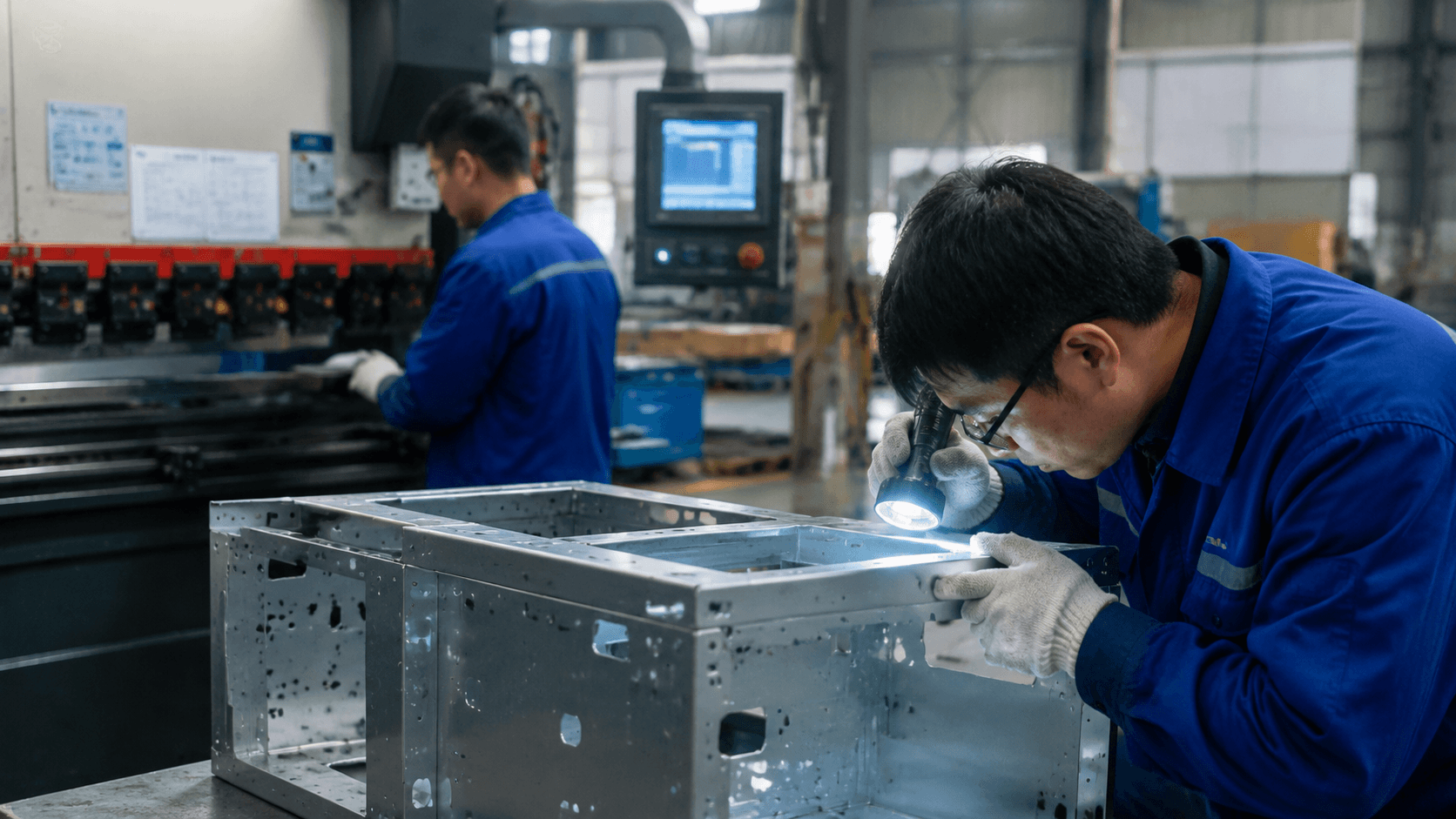
When an overseas OEM needs a repeatable enclosure, cabinet, frame, or formed part, the difficult question is not whether a company says it does metalwork. It is whether that supplier can turn specified sheet stock into the required product and control each critical handoff. Sheet metal manufacturing companies are suppliers that transform specified sheet material into custom parts, enclosures, cabinets, frames, welded assemblies, or other finished products through a controlled production route.
For an overseas OEM, a credible candidate should explain the product route, identify which operations are performed in-house or outsourced, show how quality and drawing revisions are controlled, and accept clear responsibility for the delivered part or assembly. A business that only sells metal, performs one process, or installs products at a construction site may not control the complete OEM manufacturing requirement.
Directories, revenue figures, company size, and online rankings can help you find candidates, but they do not prove factory capability or production fit. Before sending an RFQ, compare verifiable evidence against the product, quality, commercial, and delivery requirements you actually need.
Definition and boundaries in OEM sourcing
The useful boundary is not the label on a website; it is controlled transformation into a specified OEM deliverable. If a cabinet, bracket, or welded frame arrives with the wrong revision, uncontrolled finish variation, or unclear inspection ownership, the buyer has a supplier-responsibility problem even when individual metalworking operations were available.
A supplier may use an outside specialist for coating, machining, or another step without being unsuitable. The buyer must know who performs the work, who inspects it, how changes are controlled, and who releases the final product.
| Supplier type | Typical responsibility | What an OEM buyer should verify |
|---|---|---|
| Factory manufacturing supplier | Converts sheet stock into custom parts or assemblies and may coordinate specialist processes. | Drawing control, complete process route, inspection, and repeat-production responsibility. |
| Sheet metal contractor | May fabricate or coordinate project-specific metal work, ductwork, or site packages. | OEM production experience, revision control, and responsibility after delivery. |
| Construction or architectural installer | Fits architectural or construction metal at a project site. | Which company actually manufactures the parts and owns product quality. |
| Raw-material distributor | Sells sheet, cut blanks, or standard metal products. | Material grade, thickness, documentation, and whether further processing is available. |
| Machining-only provider | Produces milled or turned components through CNC machining. | Whether a separate sheet-metal supplier is needed for formed parts and assembly. |
These categories can overlap, but they are not interchangeable. A mechanical contractor may install a system while another company makes its enclosure. A distributor may provide suitable material without offering bending or welding, while a machining-only provider may be unable to produce the formed sheet-metal body.
Factory ownership can be useful evidence, but it is not the only test. Map every operation and quality responsibility to the purchase order, including any work performed by subcontractors.
Map the supplier’s process route to the OEM product
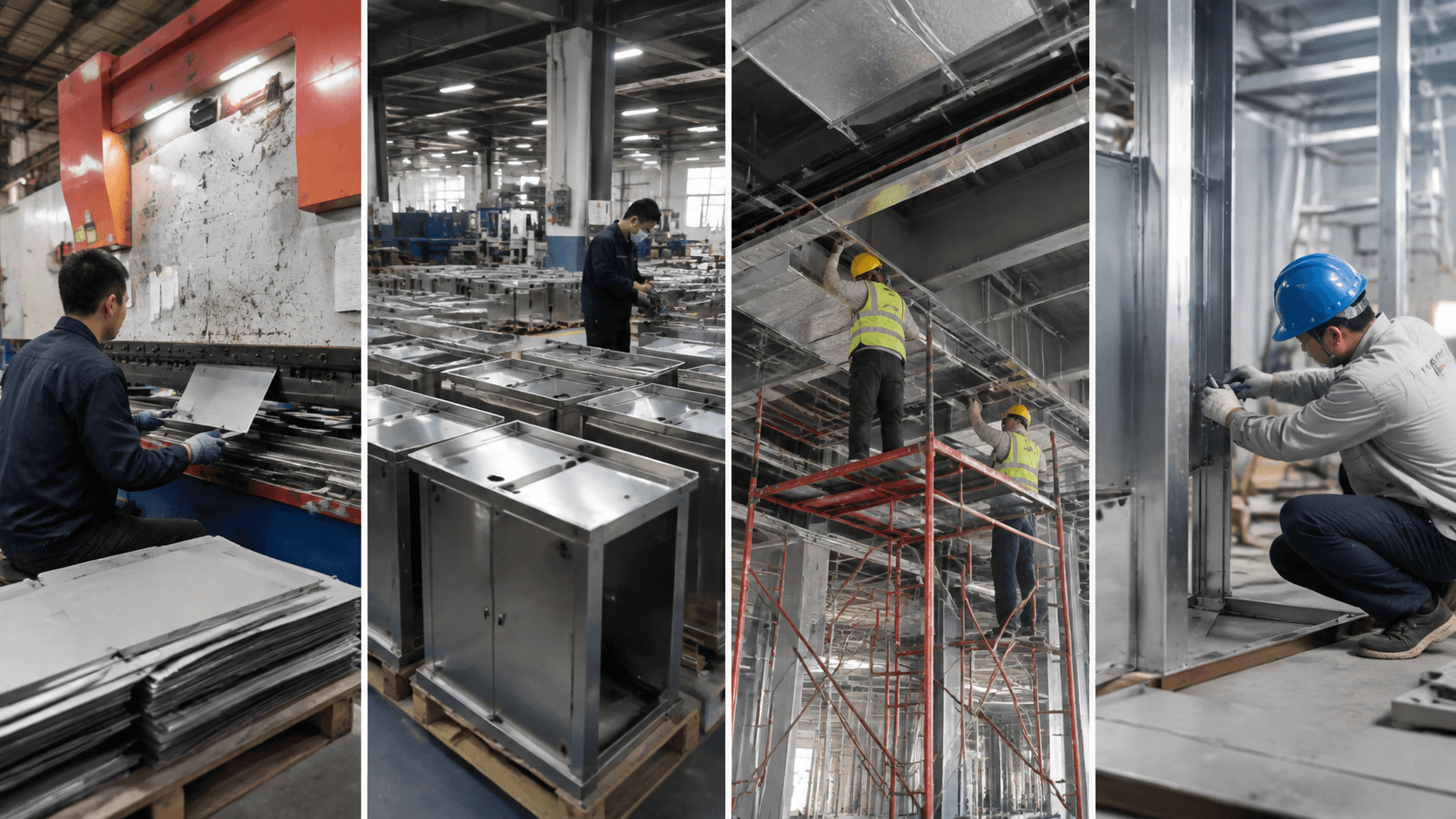
A part can look simple at the flat-pattern stage and still require several controlled operations before it is ready for use. For example, an enclosure may need cutting, forming, hardware insertion, joining, finishing, inspection, and packing; a supplier is a manufacturing fit only when it can complete or transparently control the route required by the drawing and BOM.
Start with the product geometry and delivered condition rather than an equipment list. Then match the required operations to the product you will receive.
- Flat sheet parts: Laser cutting or CNC punching may produce profiles, holes, slots, and blanks. Confirm edge condition, burr removal, hole requirements, and the material assumptions used for the quote.
- Formed components: Cutting or punching is followed by bending. Review bend allowances, springback, flange dimensions, bend sequence, and the critical angles or interfaces.
- Enclosures and cabinets: The route may include cutting, punching, bending, hardware insertion, welding or mechanical joining, surface finishing, and final assembly. Define door fit, access panels, labels, and purchased hardware.
- Frames and display racks: Confirm how members, brackets, shelves, and connection points are made and checked. Interfaces must align with the larger product or installation.
- Welded assemblies: Welding joins previously cut or formed pieces. Discuss joint details, fit-up, welding sequence, distortion control, cosmetic expectations, post-weld finishing, and inspection.
Cutting and forming create sheet-metal geometry; welding joins components; powder coating or polishing changes the surface; and assembly combines parts and hardware. These are linked but separate operations, so each should have its own acceptance criteria.
If an assembly includes a CNC-milled or turned insert, shaft, bracket, or other machined component, identify it as a machining operation. Confirm the machined part’s interface dimensions, material, inspection, and supply responsibility separately rather than presenting CNC machining as sheet-metal fabrication.
Do not assume that laser cutting, CNC punching, bending, welding, finishing, or assembly is performed in-house. Ask who manages outsourced purchase orders, incoming inspection, rework decisions, traceability, and final release. Yishang’s listed capabilities include laser cutting, CNC punching, bending, welding, powder coating, polishing, assembly, prototype review, and batch production. Buyers can review its custom sheet metal structures and assemblies, then confirm the internal and outsourced boundaries for the specific project.
Evidence of engineering and quality readiness
Once the process route appears suitable, the next question is whether the supplier can repeat it reliably. A company may describe itself as precise or high quality, but OEM buyers need evidence of how drawings, materials, prototypes, inspections, changes, and nonconforming parts are controlled.
Request evidence that matches the risk and maturity of the project. The following table separates a claimed capability from the proof that helps reduce buyer uncertainty.
| Area or claim to test | Evidence to request | Buyer risk if unclear |
|---|---|---|
| Process ownership | A route map showing internal and outsourced cutting, forming, joining, finishing, assembly, and inspection. | No clear owner for a defect or delayed subcontracted operation. |
| Engineering readiness | Drawing review, DFM comments, revision history, and approval points. | Parts may be made from an obsolete or misunderstood revision. |
| Prototype and batch control | Prototype or first-piece approval method and controls for moving into batch production. | An approved sample may not represent later production. |
| Material and traceability | Material grade, thickness, supplier documentation, and batch traceability where required. | Unapproved substitutions may affect forming, corrosion, or appearance. |
| Dimensions and interfaces | Inspection plans and records for critical dimensions, interfaces, and stated tolerances. | Parts may look acceptable but fail assembly. |
| Joining, finish, and assembly | Weld, cosmetic, surface-finish, hardware, and assembly acceptance criteria. | Distortion, scratches, finish variation, or fit disputes may arise. |
| Nonconformance and change control | Segregation, disposition, corrective-action, and customer-change procedures. | Rejected parts or design changes may enter production without approval. |
| Certifications | Certificate names, validity, issuing information, and scope relevant to the product. | A certificate may not cover the site, process, or product being purchased. |
Ask how revisions reach production and subcontractors, how rejected parts are identified, and when customer approval is required for a process or material change. For regulated or safety-sensitive products, define the documents required before shipment. A supplier’s quality-control information can support this review, but it should not replace project-specific confirmation of inspection responsibilities and records.
Online reviews, payment scores, awards, and generic quality statements do not substitute for product-quality evidence. They may provide background, but they do not show whether the quoted part will meet its drawing, finish, or assembly requirements.
Commercial terms, lead-time assumptions, and overseas delivery
Two suppliers can quote the same drawing while making different assumptions about material yield, finishing, assembly, inspection, or freight. Compare the quote as a delivery system rather than as a unit price, because an apparently low offer may exclude work needed for a usable product.
Ask each supplier to state assumptions and exclusions in the same format. This makes differences visible before they become change orders or schedule disputes.
| Quote variable | Questions for comparable offers |
|---|---|
| Material and yield | Which grade, thickness, surface condition, and material-utilization assumptions are included? |
| Quantity bands | What changes between prototype, initial order, and forecast or batch quantities? |
| Tooling and fixtures | Are special tools, welding fixtures, programming, or setup charges included or separate? |
| Process scope | Are deburring, bending, welding, hardware, coating, polishing, and assembly included? |
| Inspection and release | Which inspection records, samples, labels, and approval steps are included? |
| Schedule and changes | What drawing status, approval cycle, production start point, and change assumptions support the lead-time statement? |
| Packaging and freight | What export packaging, destination, shipping responsibility, documentation, and damage process apply? |
Lead-time statements should be tied to the actual drawing status, material availability, quantity, process route, prototype approval, and production schedule. Ask how a design change is logged, repriced, and rescheduled after approval rather than accepting an unqualified delivery promise.
For overseas supply, define the destination before comparing freight. Clarify who arranges shipping, which documents accompany the goods, how packaging protects coated or cosmetic surfaces, and who handles delivery exceptions or transit damage. Yishang provides separate shipping information for buyers assessing international delivery arrangements. Exact cost and delivery benchmarks should remain project-specific.
Prepare an RFQ package for comparable replies
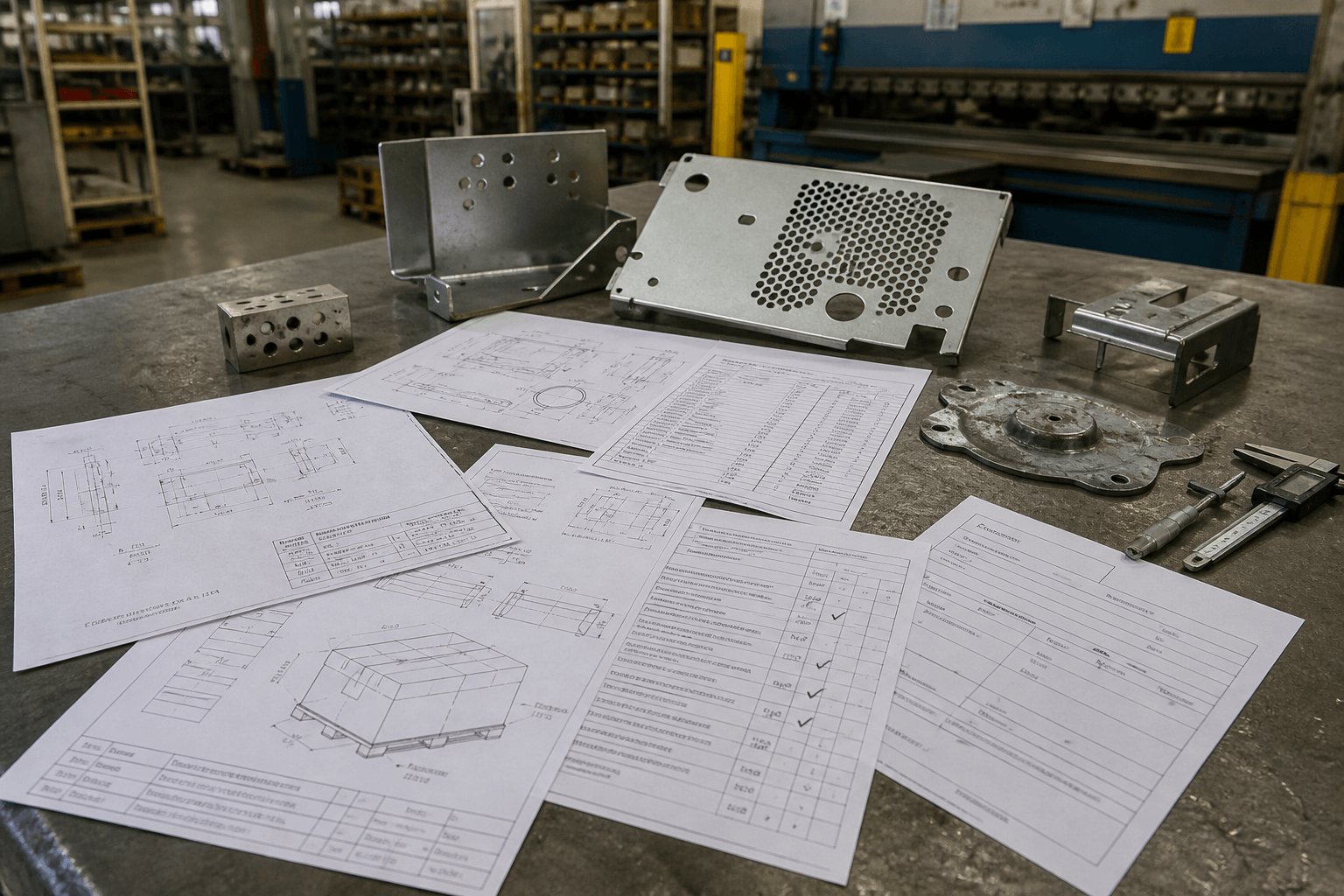
Comparable replies start with comparable information. Send enough data for each supplier to price the same product, identify the same risks, and explain any proposed design changes; at a minimum, provide a 2D drawing and, where available, a 3D CAD file, assembly drawing, and BOM.
Keep the revision and quantity information consistent across all files. If the design is still developing, identify which dimensions or finishes are fixed and which items are open for supplier DFM feedback.
| Data group | Information to include |
|---|---|
| Product | Part number, revision, 2D dimensions, 3D model, assembly relationships, and BOM. |
| Material and process | Material grade, thickness, required forming, joining method, hardware, assembly scope, and DFM expectations. |
| Finish and quality | Surface finish, critical dimensions, tolerances, weld requirements, cosmetic criteria, inspection records, and compliance documents. |
| Volume and timing | Prototype need, initial quantity, forecast quantity, target production date, and tooling or fixture expectations. |
| Logistics | Destination country, packaging, labeling, pallet or carton requirements, shipping responsibility, and delivery documentation. |
Mark every requirement as mandatory, preferred, or open to supplier DFM suggestion. This allows a supplier to propose a different bend, joining method, or packaging approach without silently changing a critical requirement. Ask suppliers to list assumptions and exclusions separately from the price.
Before sending the inquiry: make sure the requested quantity, drawing revision, finish, inspection level, packaging, destination, and schedule are stated consistently for every candidate. If the route is still uncertain, invite DFM comments rather than asking suppliers to quote different interpretations of the design.
Shortlist suppliers with an evidence-weighted rule
After the first technical and commercial review, compare suppliers by verified fit rather than by company size. A specialist with clear process ownership may be more suitable than a large contractor whose factory route, inspection scope, or export responsibility remains unclear.
Use mandatory gates first, then apply a weighted score to the candidates that pass. This prevents a strong commercial response from compensating for a missing process, quality, or delivery requirement.
Sheet Metal Manufacturing Company Evaluation Matrix: Factory Fit, Quality, Cost, and Delivery
Score each candidate from 0 to 5 for the factors below and multiply the score by the weight divided by five. Mark missing information as unverified; do not award a neutral score simply because a supplier has not provided evidence.
| Factor | Weight | Evidence to score |
|---|---|---|
| Process fit | 25% | Complete route for cutting, forming, joining, finishing, and assembly. |
| Quality evidence | 20% | Inspection plan, records, material control, nonconformance handling, and certification scope. |
| Engineering support | 15% | Drawing review, DFM feedback, revision control, prototype approval, and change management. |
| Production continuity | 15% | Batch-production readiness, schedule assumptions, and clear subcontracting boundaries. |
| Commercial clarity | 10% | Material, quantity bands, tooling, finish, inspection, and exclusions stated in the quote. |
| Export logistics | 10% | Packaging, destination responsibility, documentation, and delivery-exception handling. |
| Communication | 5% | Clear technical answers and disciplined handling of project changes. |
Apply mandatory gates before using the total score. The supplier must accept the specified material, thickness, and finish; explain who performs each critical process; agree to the required inspection and release method; and state packaging and delivery responsibilities.
Red flags include unsupported equipment claims, unexplained outsourcing, incomplete quotes, refusal to clarify tolerances, substitutions without approval, or an inability to state who inspects outsourced work. These gaps should remain visible in the comparison rather than being filled with assumptions.
When product risk justifies it, use a prototype review or controlled first order before releasing a larger batch. Compare the approved sample with the drawing, finish requirements, assembly interfaces, packaging, and inspection records rather than judging only the quoted price.
Yishang can be included as one candidate in this evidence-based process, not as an unsupported market ranking. Its stated scope is B2B wholesale and custom manufacturing only, with OEM and ODM support, more than 26 years of custom sheet metal and metal-product manufacturing experience, exports to more than 50 countries, and ISO and RoHS certifications. These facts should still be checked against the specific drawing, current certificate scope, and process ownership.
To compare Yishang against the same matrix, send your 2D drawings, 3D CAD files where available, BOM, material grade and thickness, finish, critical tolerances, quantities, assembly, inspection, labeling and packaging requirements, destination, schedule, and compliance needs through CONTACT US. This gives the supplier a basis for a project-specific fit review rather than a generic capability response.
Frequently Asked Questions
These questions address common gaps in supplier descriptions before an OEM sends drawings or approves a first order. Use the answers as prompts for evidence, not as substitutes for reviewing the project documents.
What is the difference between a sheet metal manufacturing company, a sheet metal contractor, and a construction installer?
A manufacturing company takes responsibility for producing specified parts or assemblies through a controlled route. A contractor may coordinate fabrication for a project, while a construction installer primarily fits metal at a site. Confirm who makes the OEM part and who owns its quality.
How can an overseas OEM verify which processes a company controls in-house?
Request a process map naming the location responsible for cutting, bending, welding, finishing, assembly, and inspection. For outsourced steps, ask for the control method, documentation flow, incoming inspection, and final-release responsibility.
What drawings, BOM data, quantities, and finish requirements should be sent for a comparable sheet metal quote?
Send 2D drawings, 3D CAD files where available, an assembly drawing, BOM, revision, material grade, thickness, finish, critical tolerances, quantities, schedule, destination, packaging, and inspection requirements. Separate mandatory requirements from open DFM items.
Which quality and certification documents should buyers request before approving a supplier?
Request the drawing-review method, revision records, material documentation, inspection plan and records, prototype or first-piece approval method, weld and cosmetic checks, nonconformance process, traceability details where required, and certification names, validity, and scope.
Is the largest sheet metal manufacturing company necessarily the best fit for an OEM project?
No. Size, revenue, payment ratings, and online rankings do not prove process fit or repeatability. Choose the supplier that provides evidence for your product, gives a complete quote, communicates clearly, and accepts appropriate validation steps.