
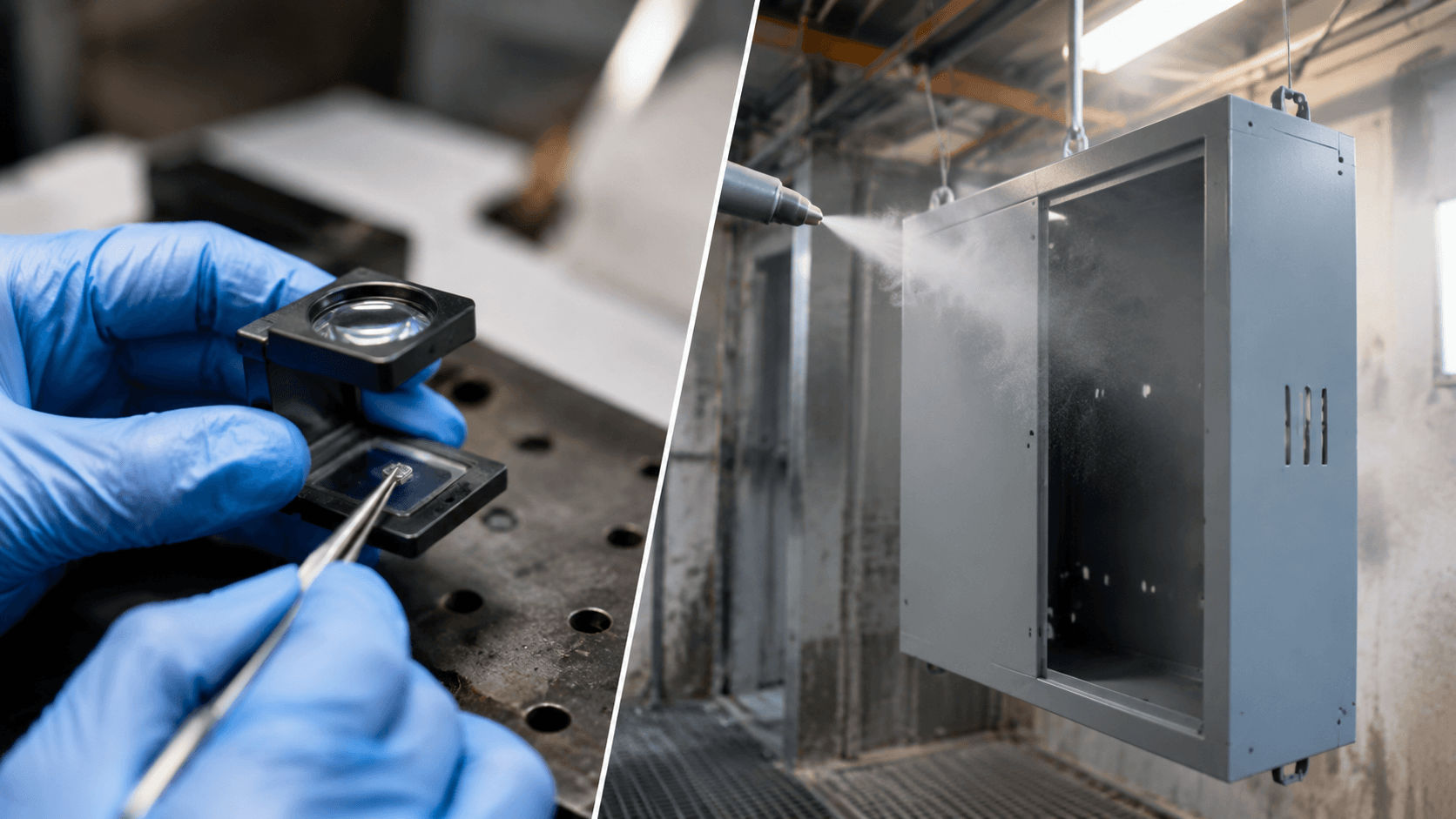
“The Powder Touch” may be a business or brand name, but some buyers use the phrase when searching for ways to repair a powder-coated surface. This article does not profile, represent, or claim affiliation with any company of that name. For an existing damaged finish, the practical routes are localized touch-up, complete recoating, or part replacement. For a new OEM product, powder coating should be coordinated with—but remain technically distinct from—sheet-metal fabrication, welding, masking, inspection, and assembly.
What Does “The Powder Touch” Mean?
The right interpretation depends on the buyer’s immediate need. A purchasing team may be searching for a named provider, while an engineer or maintenance team may need to address a chip, scratch, or coating failure before a part returns to service. No information about a similarly named business should be inferred from this page; the guidance below focuses on coating repair decisions and new OEM manufacturing.
Powder coating normally involves applying dry coating material to a prepared part and curing it to form a continuous finish. Localized powder-coating touch-up is a different process. It usually uses a compatible liquid coating, touch-up pen, aerosol, or another repair system approved for the application. Loose powder is not ordinarily pressed or sprayed onto a small damaged spot as a field repair.
This distinction affects how the result should be accepted. A liquid repair may conceal a scratch or cover exposed substrate, but it does not reproduce the complete pretreatment, electrostatic application, and curing sequence used for the original finish. Visual similarity and protective performance must therefore be evaluated separately.
Localized Repair Versus Complete Recoating
Before approving a quick repair, the buyer or maintenance team needs to determine whether the issue is a superficial mark or evidence of a broader coating problem. A localized repair begins with an assessment of the damage and surrounding finish. Dirt, oil, loose coating, oxidation, or corrosion products may need to be removed using a method compatible with both the substrate and the coating that remains. The edges around a chip may also require preparation before the specified repair coating is applied.
The substrate, original coating, repair-product instructions, and use environment determine whether this approach is suitable. Touch-up is most plausible when the damage is limited and the surrounding coating remains firmly attached. For example, a small mark on a low-visibility indoor component may justify a cosmetic repair if the applicable product requirements permit it.
Touch-up should not automatically be treated as restoring the original coating’s adhesion, corrosion resistance, gloss, texture, or service life. Even a close nominal color may remain visible because the original finish and repair differ in application method, surface profile, aging, or response to directional lighting.
Complete recoating addresses a larger area or the entire part. Depending on the condition and compatibility of the existing finish, the work may require stripping or preparing a sound original coating before another coating is applied. Widespread peeling, rust, contamination, an unknown coating history, or heat and chemical damage can make direct overcoating unreliable.
The complete assembly must also be assessed before another cure cycle. Inserts, seals, adhesives, hardware, and other components may not tolerate stripping, surface preparation, or reheating. If the sheet metal is cracked, distorted, or badly dented, finishing is not the first remedy; the geometry must be repaired or the component replaced.
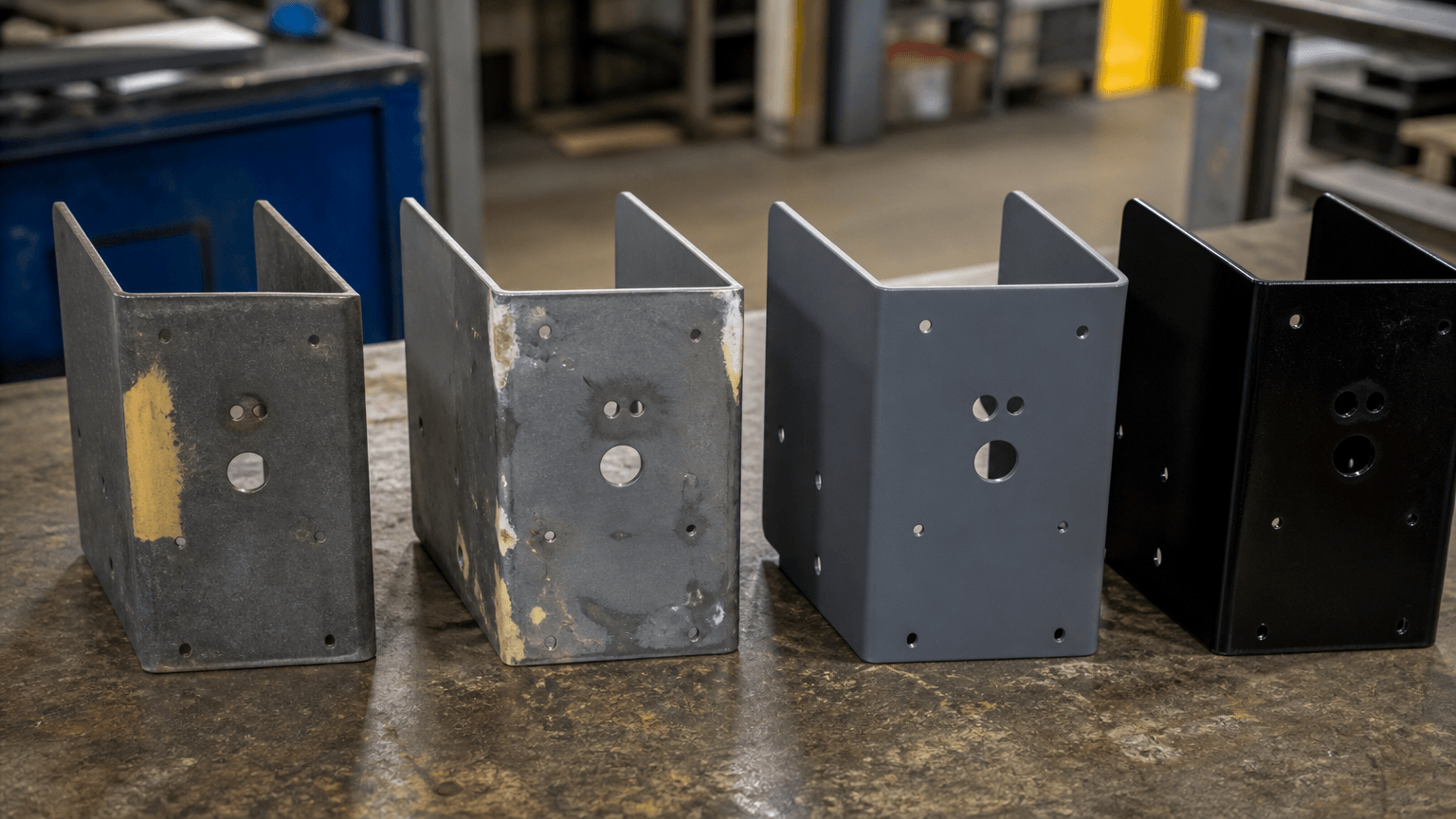
Touch Up, Recoat, Replace, or Manufacture New Parts?
A production delay can encourage teams to choose the fastest visible fix, but damage size alone does not determine the correct route. The review should also consider substrate exposure, corrosion, failure distribution, service environment, appearance expectations, assembly fit, and whether the product can be disassembled or reheated. The following matrix helps separate cosmetic repair needs from coating-system failure, physical part damage, and new production requirements.
| Condition or project | Likely route | Principal limitation | Information to verify | Fabrication drawing needed? |
|---|---|---|---|---|
| Minor cosmetic scratch with no visible substrate | Consider a compatible localized touch-up | The repair may differ in color, gloss, or texture | Original finish, repair-product approval, and appearance criteria | Usually not for a field repair |
| Small chip exposing bare metal | Prepare and repair the area, or recoat when protection is critical | A local repair may not provide performance equivalent to the original system | Substrate, environment, corrosion risk, and product instructions | Useful when fit surfaces are close to the damage |
| Rust at the damaged area | Remove and assess the corrosion before selecting repair or recoating | Covering rust does not address the underlying condition | Corrosion extent, remaining material, and access to edges or seams | Useful for critical geometry |
| Widespread peeling, blistering, or adhesion loss | Investigate the cause and consider stripping and recoating | Overcoating a failing layer leaves an unstable foundation | Substrate condition, contamination, coating history, and compatibility | Recommended for controlled rework |
| Heat or chemical damage | Assess the part, then choose between recoating and replacement | The substrate, remaining finish, or assembly components may also be affected | Exposure conditions, material condition, and affected components | Recommended |
| Distorted, cracked, or badly dented sheet metal | Repair the geometry or replace the part before finishing | Coating cannot correct dimensional or structural damage | Critical dimensions, joint condition, and assembly fit | Yes for replacement production |
| New enclosure, cabinet, frame, or welded assembly | Plan fabrication and powder-coated production as a coordinated workflow | Finish requirements must be reconciled with masking, fit, and assembly | Model, drawing, material, quantity, environment, and acceptance criteria | Yes |
Outdoor, humid, corrosive, or high-wear service warrants more scrutiny than a dry indoor cosmetic application. If damage affects an electrical contact, sealing face, safety-related feature, or close-fitting interface, the product specification should govern the decision rather than appearance alone.
Integrating Powder Coating with Sheet-Metal Design
For a new OEM part, finish decisions made after fabrication can create avoidable fit and assembly problems. Powder coating is a finishing process—not another name for sheet-metal fabrication. Laser cutting and bending form the sheet components, welding joins them, surface preparation and coating create the finish, and assembly installs hardware or combines parts. These operations remain distinct even when one manufacturer coordinates them within a single production workflow.
Machined inserts or other CNC-machined components may also be used in a sheet-metal assembly, but machining remains a separate manufacturing process. The drawing must define how each machined component locates, fastens, grounds, or mates with the coated sheet-metal part so that coating buildup does not compromise the interface.
Laser-cut edges, bends, welds, grinding transitions, seams, and enclosed areas can affect surface preparation and finished appearance. Pretreatment and coating selection also need to account for the substrate and service environment, including whether the fabricated part is mild steel, aluminum, or galvanized steel.
Instead of relying only on a general coating note, drawings should identify features where the finish could change function or assembly:
- Threads and hardware locations: Coating buildup can obstruct threads or change how fasteners, inserts, and studs seat.
- Holes, tabs, slots, and hinges: Coating can affect movement or reduce clearance at close-fitting interfaces.
- Grounding and electrical contacts: Required conductive contact areas should be identified as masking zones.
- Mating and sealing surfaces: Coating on locating faces, flanges, or gasket seats can alter fit or sealing conditions.
- Label and adhesive zones: These areas may require a defined surface condition compatible with the downstream application.
- Visible surfaces: Color, gloss, texture, weld cleanup, and acceptable appearance limits should be agreed before production.
Dimensional inspection and finish-specific inspection answer different questions. A component may satisfy its dimensional requirements but fail its appearance criteria. Conversely, a visually acceptable finish may obstruct a hole, thread, hinge, or mating surface and prevent assembly. Drawing-based checks and agreed finish references help keep these acceptance categories separate.
Further context is available in Yishang’s information about custom sheet metal enclosures, surface-finishing options, and quality control for newly manufactured parts.
Preparing a New OEM Project for Review
A useful project review starts by separating a field-repair request from a repeat-production requirement. A repair assessment may rely on photographs, substrate information, coating history, and service conditions. A new or repeat-production sheet-metal project requires controlled design information so that tolerances, masking, finish expectations, and assembly interfaces can be reviewed together.
Provide the 2D drawing or 3D model, material and sheet thickness, prototype or batch quantity, and intended use environment. If an existing item is the visual reference, include photographs, but do not rely on photographs alone to establish an exact color, gloss, or texture standard.
Define the required color reference, gloss and texture expectations, visible surfaces, masking zones, grounding points, threads, tolerances, and critical assembly interfaces. Packaging expectations should also be stated when finished faces require protection or separation during handling and transport. If the project requires a particular inspection method or performance test, identify it in the specification rather than assuming that a general powder-coating note includes it.
Need to determine the appropriate route for an OEM project? Send Yishang the 2D drawing or 3D model, material and sheet thickness, required tolerances, prototype or batch quantity, use environment, finish reference, masking details, and assembly requirements. Include photos when an existing part or finish is being referenced. A project-specific review can clarify whether the requirement falls within custom sheet-metal fabrication, powder-coated production, assembly, or a repair service outside the intended manufacturing scope; it does not assume that every damaged coating can be repaired.
Frequently Asked Questions
These questions address common points that affect repair approval, drawing preparation, and finish acceptance. The answers are general guidance; the substrate, existing coating, service environment, tolerances, and project specification still need to be reviewed.
Is powder-coating touch-up performed with powder or liquid repair paint?
Localized touch-up usually uses a compatible liquid repair paint, touch-up pen, aerosol, or another approved repair system. It is not the same as electrostatically applying dry powder and curing the complete part. Compatibility should be checked against the substrate, original coating, use environment, and repair-product instructions.
Can a touch-up pen exactly match the original powder-coated finish?
An exact match should not be assumed. Color may appear different because of gloss, texture, coating condition, aging, application method, and lighting. If a uniform appearance is critical, define the viewing and acceptance conditions and consider whether complete recoating is more appropriate.
Does WD-40 damage powder coating?
There is no universal compatibility answer because coating formulations, finish condition, exposure time, and product variants differ. Check the guidance for both the coating and chemical product, then test an inconspicuous area before broader use. The same caution applies to cleaners, solvents, and lubricants generally.
Can an existing powder-coated part be coated again without stripping?
A sound and compatible existing finish may sometimes be prepared for overcoating, but the decision requires project-specific evaluation. Peeling, corrosion, contamination, an unknown coating history, incompatible layers, or strict appearance requirements may make stripping necessary. The part and any assembled components must also be suitable for the preparation process and another cure cycle.