
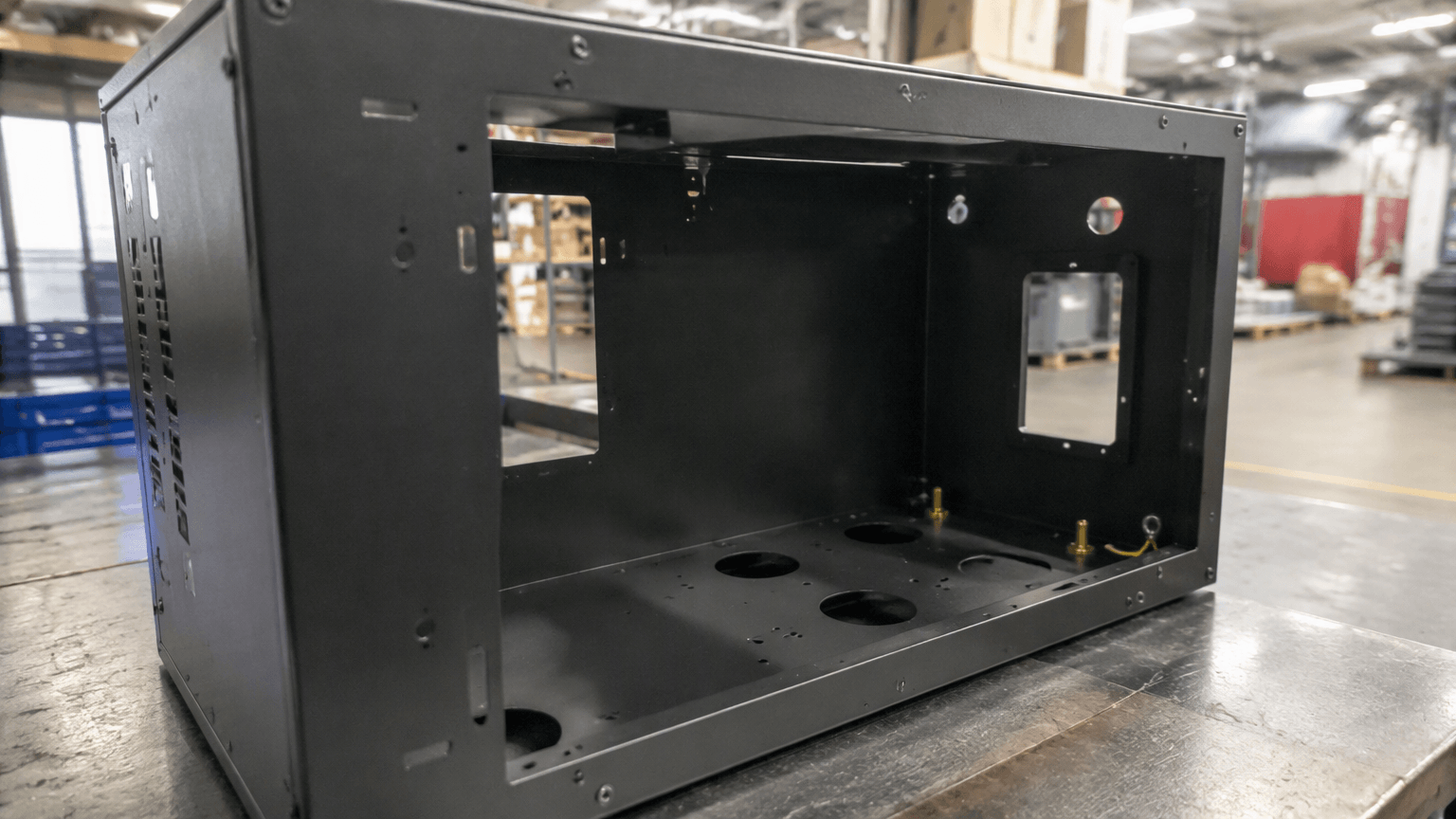
The main advantages of a CNC machine are repeatable programmed movement, consistent feature location, CAD/CAM-assisted revision control, repeatable complex features, reduced manual variation, and scalable production. The result depends on machine type, material, tooling, fixturing, tolerances, geometry, quantity, and process conditions. For a powder-coated part, CNC controls upstream cutting, punching, bending, or machining; it does not apply or cure the coating.
Metal powder coated means a fabricated metal substrate has been prepared, covered with electrostatically applied powder, and heated so the powder forms a cured coating. That phrase describes a finish state, not a complete OEM specification: substrate, preparation, color, gloss, texture, film thickness, masking, and acceptance still need definition.
Where CNC fits in the metal route
CNC is a control method used by different equipment, not a synonym for every metal operation. CNC laser cutting and CNC punching make sheet-metal blanks; a CNC press brake may form bends; milling and turning remove material from separate components. Welding, preparation, powder application, curing, and inspection remain distinct operations.
- Define: CAD files and drawings establish profiles, holes, bends, interfaces, and revisions.
- Fabricate: CNC cutting, punching, or machining creates the programmed features.
- Complete: Bending, welding, deburring, and other required fabrication follow.
- Finish: The part is prepared, powder is applied, and the coating is cured.
- Release: Inspection and assembly follow unless an approved process plan defines another sequence.
In most custom sheet-metal fabrication routes, cutting, punching, bending, welding, deburring, and required machining are completed before final finishing. Post-coating cutting, bending, welding, or machining can damage the film and expose the substrate.
Powder metallurgy compacts and sinters metal powder to form a component; it is not powder coating. Powder coating plastic involves another substrate and process review. Liquid paint uses a liquid system, electroplating deposits metal electrochemically, anodizing modifies a suitable metal surface, and galvanized sheet has a zinc-based layer. Powder over galvanized sheet requires compatible preparation.
What the CNC advantages mean in practice
CNC is valuable when the part has repeatable features, controlled interfaces, or a production quantity that supports programming and setup. It is not automatically faster, cheaper, or suitable for every geometry.
| Advantage | Practical value and limitation |
|---|---|
| Repeatability | Programmed paths can repeat profiles, hole locations, and other features. Material, tooling, fixturing, and inspection still affect results. |
| Dimensional consistency | Controlled movements support drawing-defined dimensions and fit, but the machine type and process must match the tolerance. |
| Automation and productivity | Programmed cycles can reduce repeated layout, positioning, and manual handling after setup. Throughput depends on setup, tooling, part mix, and inspection. |
| CAD/CAM workflow | Digital geometry can support toolpath creation and controlled revisions. File release, programming, and setup checks remain necessary. |
| Complex features | A suitable machine can produce programmed contours, hole patterns, slots, pockets, or formed features. Axis access, tooling, material thickness, and geometry set the limits. |
| Reduced manual variation | Standardized programs and setups reduce dependence on repeated hand layout. Tool wear, deburring, material variation, and operator setup still matter. |
| Scalability and revision control | An approved program can support repeat batches and controlled changes from prototype to production. Quantity and setup economics determine whether the route fits. |
How CNC features interact with powder-coated metal
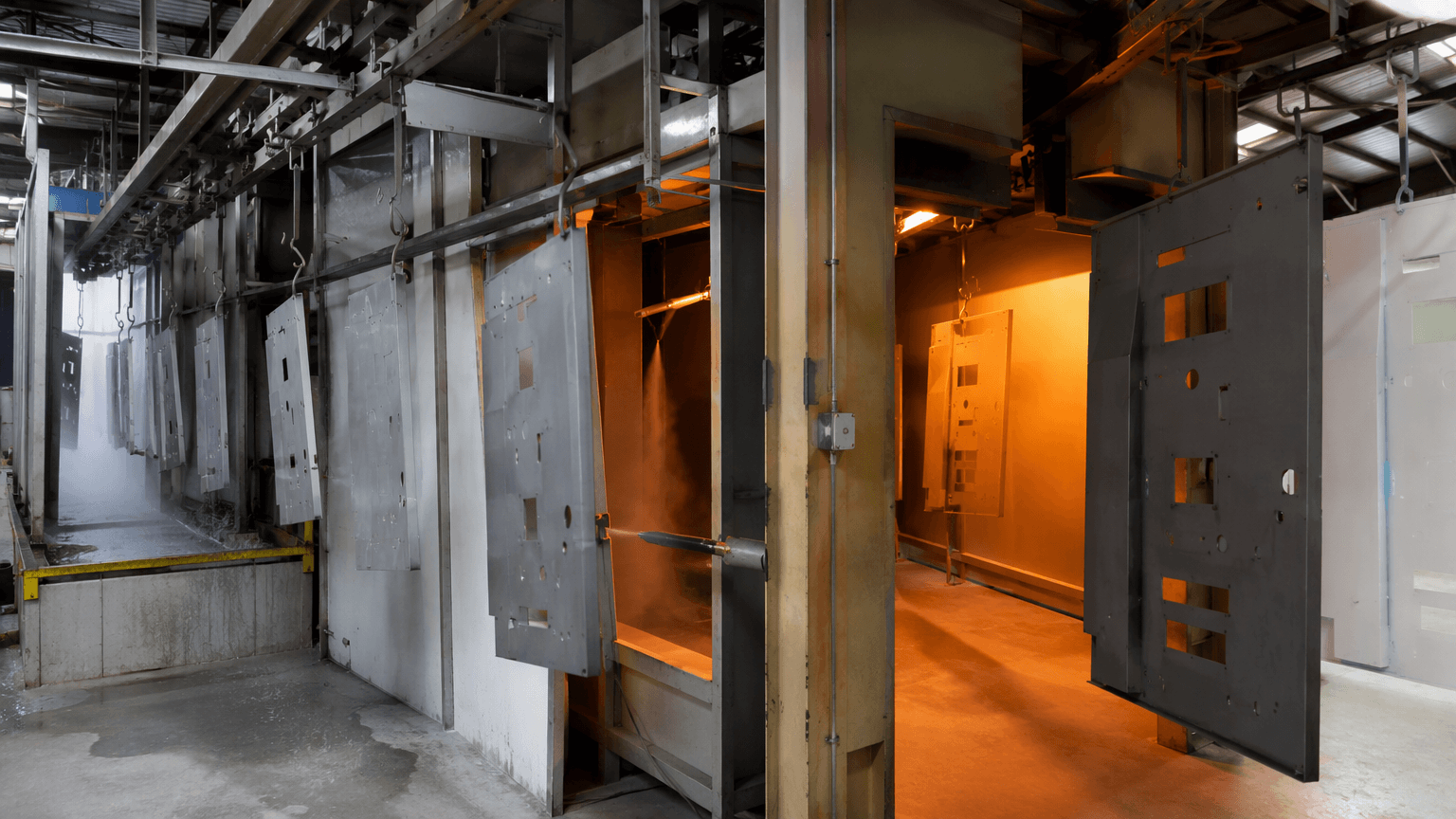
Powder coating normally follows fabrication. The coating can improve the specified appearance and surface performance, but its film build and coverage must be considered alongside CNC-created features.
| Part feature or condition | Design and process point |
|---|---|
| Substrate and surface | Mild steel, aluminum, galvanized steel, and stainless steel may be candidates when the powder system and preparation are compatible. Oil, oxidation, rust, fingerprints, and weld residue can affect adhesion. |
| Preparation | Cleaning, degreasing, rust removal, phosphating, or blasting may be appropriate; no single route suits every substrate or service condition. |
| Welds and edges | Spatter, rough transitions, contamination, sharp edges, and edge coverage should be reviewed before finishing. |
| Recesses and closed areas | Deep recesses, folded returns, perforations, and enclosed sections can restrict preparation or powder access. Complete coverage should not be assumed. |
| Holes and threads | Film build may affect threads, close-fit holes, press fits, or bearing seats. Define masking, allowance, and post-finish checks. |
| Mating and grounding areas | Sealing faces, metal-to-metal interfaces, electrical contacts, and grounding pads may need defined no-coat zones. |
| Heat and service | Curing must suit inserts, seals, adhesives, hardware, and the substrate. Moisture, chemicals, ultraviolet exposure, abrasion, and temperature conditions should be stated. |
Surface cleanliness, cure conditions, film thickness, and edge coverage affect adhesion, appearance, and corrosion performance. Powder coating does not make metal permanently rustproof or suitable for every environment.
Specify CNC features and the finish together
Replace a general note such as metal powder coated with a brief that connects the drawing, sample, process, and inspection plan.
| Field | Record |
|---|---|
| Part and substrate | Material grade, thickness, fabricated condition, critical dimensions, tolerances, and weld details. |
| Powder and preparation | Powder system or finish family when required, plus the agreed or supplier-proposed preparation route. |
| Appearance | Color reference or sample, gloss, texture, visible zones, lighting method, and acceptable variation. |
| Film thickness | Project-defined target range or another agreed acceptance basis; do not insert an unsupported universal value. |
| Masking and function | No-coat areas for threads, holes, labels, seals, grounding points, mating faces, and assembly interfaces. |
| Acceptance | Visual comparison, coverage, measurement locations, dimensional fit, and adhesion, cure, or corrosion checks when required. |
| Production | Prototype and production quantities, batch grouping, sample approval, change control, packaging, and shipping conditions. |
Illustrative drawing note: Powder coat accessible coated surfaces to the approved color, gloss, texture, and appearance specification; mask the threads, grounding pads, and mating faces shown in detail views; verify film thickness and acceptance per the agreed inspection plan.
Compare finishes by application conditions
Compare powder coating with liquid paint, anodizing, plating, or galvanizing by substrate, geometry, environment, appearance, dimensional risk, repair needs, and production conditions. No finish is universally superior.
| Route | Conditions to compare |
|---|---|
| Powder coating | Suitable when a cured colored or textured film fits the substrate, heat exposure, geometry, masking plan, and service requirement. |
| Liquid paint | May fit a liquid application, drying or curing route, appearance, or repair method; review preparation, handling, and performance. |
| Anodizing | Applies to suitable aluminum requirements; review alloy response, color variation, dimensional effect, and electrical contacts. |
| Electroplating | May fit a defined metallic deposit need; review substrate compatibility, deposit distribution, threads, and post-treatment. |
| Galvanizing or galvanized sheet | May fit a zinc-based exposure strategy; review forming, welding, dimensional build, appearance, and any subsequent powder route. |
Preparation, masking, color changes, batch grouping, fixtures, oven constraints, inspection, rework risk, and packaging can change cost and lead time. Evaluate the actual part and quantity rather than relying on a generic advantage list.
Inspect CNC features, coating, and fit separately
- Identify: Confirm part number, drawing revision, finish brief, batch, and approved appearance reference.
- Check dimensions: Inspect critical CNC features before finishing where useful, then verify holes, threads, interfaces, and clearances after coating when film build may affect function.
- Inspect appearance: Under agreed lighting, compare color, gloss, texture, contamination, runs, pinholes, scratches, exposed metal, and visible coverage by appearance zone.
- Check masking: Examine recesses, edges, welds, holes, grounding points, mating faces, and coated-to-uncoated boundaries.
- Verify coating: Measure film thickness at defined locations when specified. Check adhesion, cure, or corrosion-related performance only under the agreed inspection plan.
- Record release: Document measurements, batch identity, masking results, rework disposition, and packaging condition as required.
These records can be aligned with the supplier’s quality control process so engineering, procurement, and production teams use the same baseline.
Prepare a CNC and powder-coating RFQ
For an OEM project, send the information needed to separate fixed requirements from items requiring manufacturability review:
- Current 2D drawings, 3D files, revision level, critical tolerances, and bill of materials where applicable.
- Material grade, thickness, dimensions, weld details, and known surface condition.
- The required CNC operation or separate machined components, plus holes, threads, mating, grounding, and no-coat details.
- Color sample or reference, gloss, texture, appearance zones, film basis, inspection method, and service environment.
- Prototype and production quantities, batch structure, target schedule, packaging, shipping, and compliance needs.
Ask the supplier to flag unclear interfaces, inaccessible areas, thermal risks, setup or batch constraints, and cost or lead-time drivers before release. Yishang supports B2B OEM and ODM custom manufacturing, has more than 26 years of custom metal-product experience, exports to more than 50 countries, and holds ISO and RoHS certifications. You can send drawings for a manufacturability review covering CNC operations, sheet-metal fabrication, powder-coating interfaces, inspection, and assembly.
Frequently Asked Questions
Is metal powder coated the same as painted metal?
Powder coating is an applied finish, but it uses dry powder followed by heat curing rather than a conventional liquid coating. The phrase alone does not define preparation, color, texture, film requirement, masking, or acceptance.
Can powder-coated parts retain usable holes, threads, and grounding points?
They can when the drawing identifies these features and the process includes suitable masking or coating allowance. Threads, close-fit holes, grounding points, and mating faces should receive dimensional and functional checks after finishing.
Should cutting, bending, welding, or machining happen after powder coating?
Final fabrication normally happens first because post-coating work can damage the film and expose the substrate. Any exception needs a defined location, protection, and touch-up acceptance. CNC machining remains distinct from sheet-metal cutting and forming.
Can aluminum, galvanized steel, and stainless steel be powder coated?
They may be suitable, but each needs compatible preparation, powder selection, and process confirmation. Alloy condition, existing zinc, weld areas, contamination, attached components, and environment can change the route.
How can an OEM control color and gloss across samples and batches?
Define the color reference, gloss, texture, appearance zones, lighting, acceptable variation, and batch boundaries. Approve a physical sample when visual matching matters and require change approval for powder or process changes.