
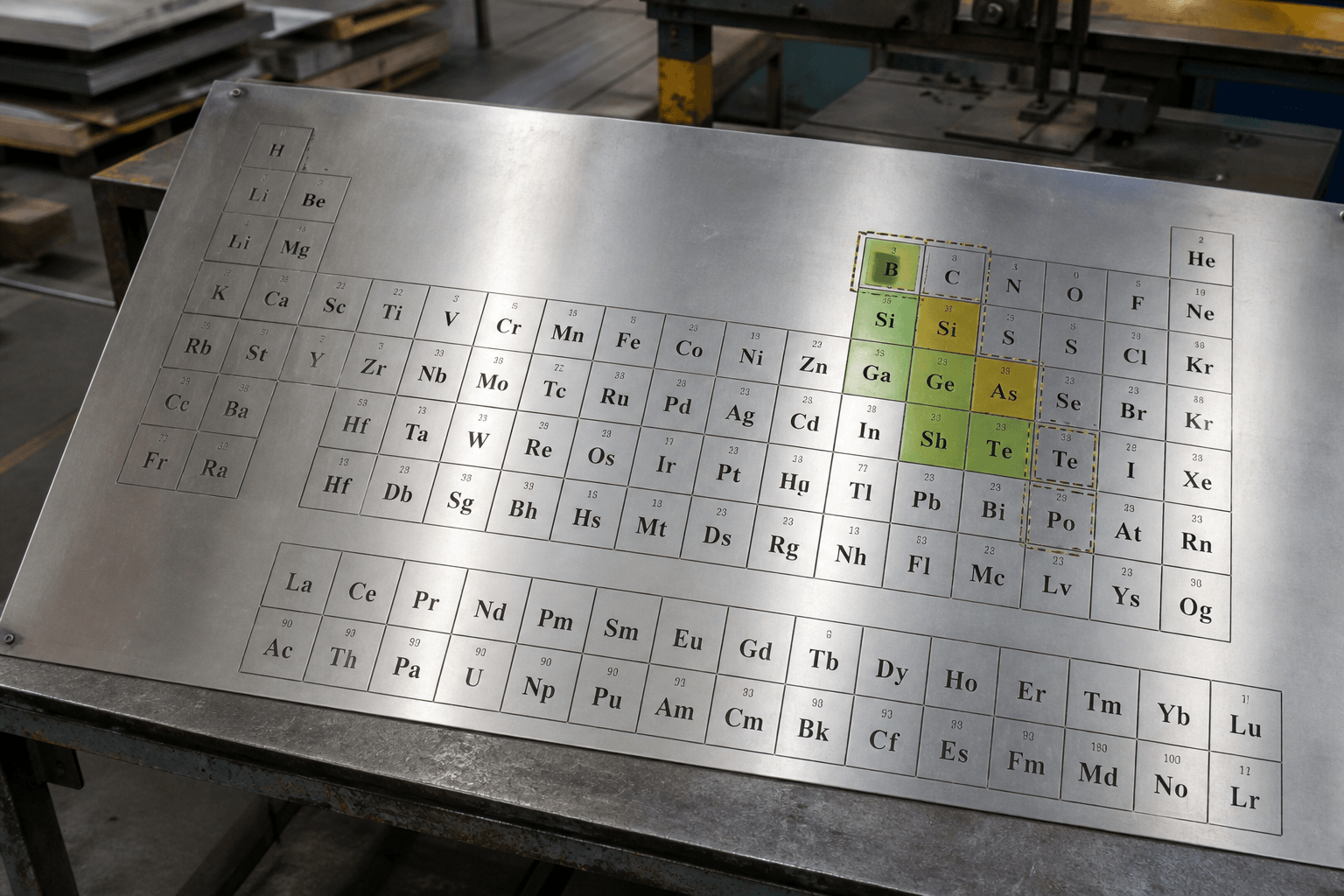
A metalloid is a chemical element that combines some metallic and nonmetallic characteristics. When an engineer sees the term in a research note, datasheet, or early OEM material discussion, it narrows the chemistry question but does not identify what should be purchased or fabricated. The classification has no universally fixed boundary, and sources may treat edge cases such as polonium and astatine differently. It is an element classification, not a grade, alloy designation, product form, or complete material specification.
The staircase boundary shown on many periodic tables is a useful visual guide to the transition between metals and nonmetals, not an absolute scientific rule. That distinction matters when a broad chemistry term appears in an industrial material discussion or an early component concept.
The commonly listed elements and the disputed edge cases
A common procurement problem begins when a project document names silicon, boron, or another element without stating whether the requirement concerns a pure element, an alloy addition, a compound, or a finished product. The usual core list helps identify the chemistry under discussion, but the periodic-table location alone cannot complete a material specification.
| Element | Symbol | Typical reference treatment |
|---|---|---|
| Boron | B | Commonly included; its bonding and physical behavior are not simply those of a typical ductile metal. |
| Silicon | Si | Commonly included; it is also frequently described as a semiconductor in electronic contexts. |
| Germanium | Ge | Commonly included; its elemental electronic behavior can receive both metalloid and semiconductor descriptions. |
| Arsenic | As | Commonly included; its observed properties depend strongly on form and evaluation context. |
| Antimony | Sb | Commonly included; it has both metal-like and nonmetal-like characteristics. |
| Tellurium | Te | Commonly included; its practical properties also depend on form and conditions. |
Borderline cases: Polonium and astatine appear on some metalloid lists but are classified differently, or omitted, by other references. The disagreement exists because metalloid is defined by a collection of chemical and physical tendencies rather than one decisive test. The staircase communicates the general pattern, but periodic-table position does not settle every case.
Related terms answer different technical questions
A search for silicon or germanium may return results about metalloids, semiconductors, and semimetals as though the terms were interchangeable. They are not: metal, nonmetal, and metalloid are broad chemistry classifications, while semiconductor and semimetal primarily describe electronic behavior.
| Term | Primary basis | What it generally indicates |
|---|---|---|
| Metalloid | A mixture of metallic and nonmetallic characteristics | An element shows mixed or intermediate behavior; the category has no fixed universal boundary. |
| Metal | A broad chemical and physical category | Metal-like behavior is dominant, often including electrical conductivity, luster, and ductility, although exceptions exist. |
| Nonmetal | A broad chemical and physical category | Nonmetallic behavior is dominant; low electrical conductivity is common, but properties vary across the category. |
| Semiconductor | Electrical properties and their response to conditions | Conductivity can fall between that of a good conductor and an insulator and may respond strongly to temperature or impurities. |
| Semimetal | Electronic band structure and carrier behavior | Electronic bands may overlap slightly or meet in a way that produces limited carrier populations. |
These labels can overlap because they answer different questions. Silicon, for example, can be called a metalloid for its mixed element-level characteristics and a semiconductor for its electrical behavior in a specified form or application. Many semiconductor materials are compounds rather than metalloid elements. Likewise, semimetal is a band-structure description, so it should not be assigned solely from an element’s position on the periodic table.
Property patterns behind the classification
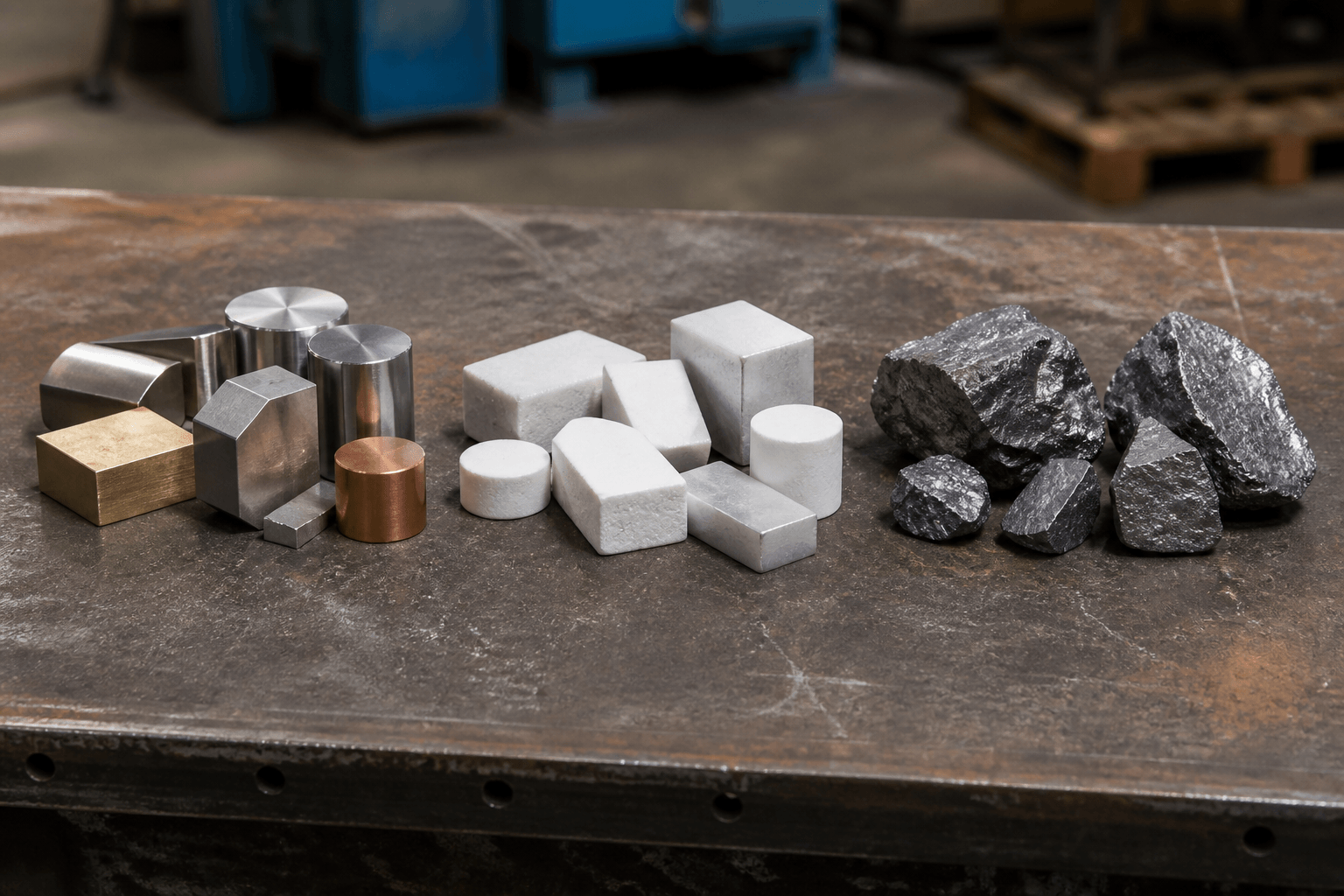
At the evaluation stage, a buyer may be tempted to infer conductivity, appearance, or fabrication behavior from the word metalloid. In practice, the classification reflects a pattern of behavior, and the relevant result can change with the element’s form, purity, structure, processing history, and service conditions.
Electrical behavior can be intermediate or variable
Some commonly listed metalloids, particularly in specific elemental forms, show semiconducting tendencies. Their conductivity can change with temperature, impurities, crystal structure, or processing history, so the term metalloid does not establish a usable electrical-performance value by itself.
Appearance and mechanical behavior do not always agree
Several metalloids can have a metallic-looking luster while tending toward brittleness rather than ductility. Luster, hardness, strength, ductility, and fracture behavior are tendencies or measured properties, not universal classification requirements, and they should not be assumed for an unspecified material.
Form and structure influence the result
Electronic structure helps explain the unusual combination of bonding, energy levels, and responses to heat or light. Purity, crystal structure, allotrope, compound formation, processing history, and service conditions can all affect practical behavior. A property observed in a pure elemental form should not automatically be assigned to an alloy, compound, or finished product that contains the same element.
In industrial documents, define the material behind the label
Once a project moves from chemistry research toward procurement, the important question is what exactly is being specified. A reference to a metalloid may describe several materially different targets, and each requires its own composition, form, performance, and documentation requirements.
- Pure element: an elemental material with a defined purity requirement.
- Alloying addition: a smaller amount of the element incorporated into a metal alloy.
- Compound: a chemical material whose composition and properties differ from those of the free element.
- Finished product: a wafer, part, or other product that contains the element without being made from a pure metalloid element.
For example, a project document that mentions silicon could refer to elemental silicon for an electronic application, a silicon-containing alloy, or a compound containing silicon. These are different purchasing targets. The word silicon alone does not identify purity, grade, form, dimensions, mechanical behavior, electrical performance, or acceptable contaminants.
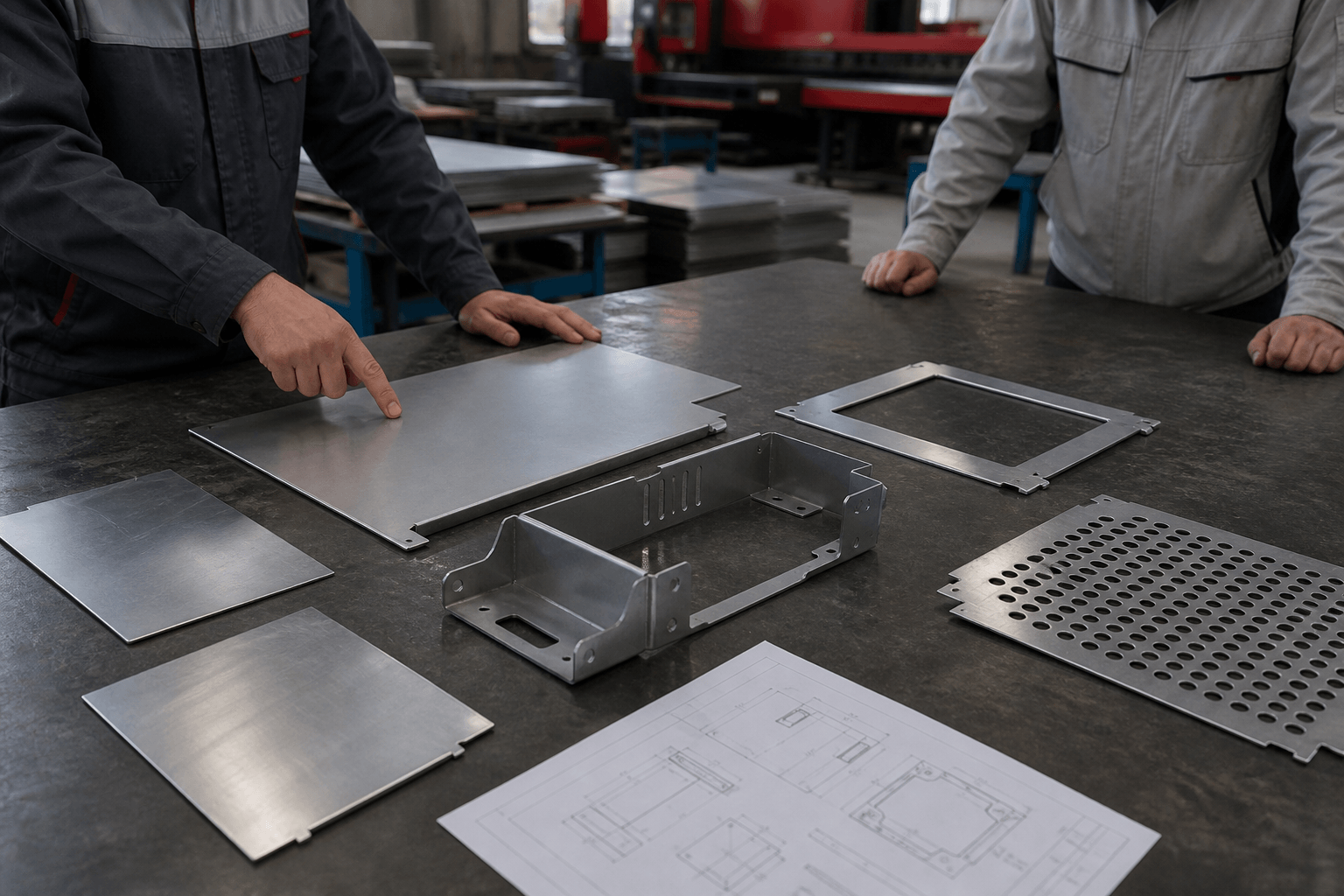
If the requirement has progressed from element research to a specified enclosure or another custom sheet-metal component, custom sheet metal fabrication built to your drawings is the relevant manufacturing discussion. The drawing and material specification still need to identify the actual product requirement rather than only its broad chemical category.
Turn the broad term into a usable requirement
Before an RFQ or material request is issued, replace the general label with information that a design team, supplier, and inspector can interpret consistently. The following checklist is useful whether the target is a raw material, an electronic material, or a custom component.
For a custom part, any proposed cutting, forming, machining, joining, finishing, or assembly route must be checked against the specified material and geometry. A related quality control process also depends on agreed composition, product characteristics, inspection criteria, and records, not on the chemistry label alone.
In short, a metalloid is an element with a blend of metallic and nonmetallic characteristics, but it is not a complete material specification. Use the classification to guide research, then use exact composition, form, properties, drawings, and documentation to support a sound purchasing or manufacturing decision.
Frequently Asked Questions
These questions address the distinctions most likely to affect an early material search or OEM RFQ. The same principle applies throughout: classification can guide research, but the project still needs a defined material and product requirement.
Which elements are most commonly called metalloids?
The core list most often includes boron, silicon, germanium, arsenic, antimony, and tellurium. Polonium and astatine are sometimes included as borderline cases, depending on the reference.
Is silicon a metalloid, a semiconductor, or both?
It can be both because the terms describe different attributes. Metalloid refers to silicon’s mixed element-level characteristics, while semiconductor describes electrical behavior in a specified form or application.
Are metalloids considered metals?
They are generally treated as a separate intermediate category rather than ordinary metals. Some share traits with metals, such as luster or electrical activity, but they may also be brittle or show nonmetal-like chemistry.
Why do references disagree about polonium and astatine?
The category has no universally fixed boundary. References may weigh periodic-table position, chemical behavior, electronic structure, and available property data differently, so these elements can be classified as borderline or placed elsewhere.
Can metalloid be used by itself as the material specification on an OEM RFQ?
No. An RFQ needs the exact element, alloy, compound, grade or purity, product form, dimensions and tolerances, required properties, quantity, surface requirements where relevant, and documentation or inspection expectations. The word metalloid alone cannot support a reliable material, manufacturability, or prototype assessment.