
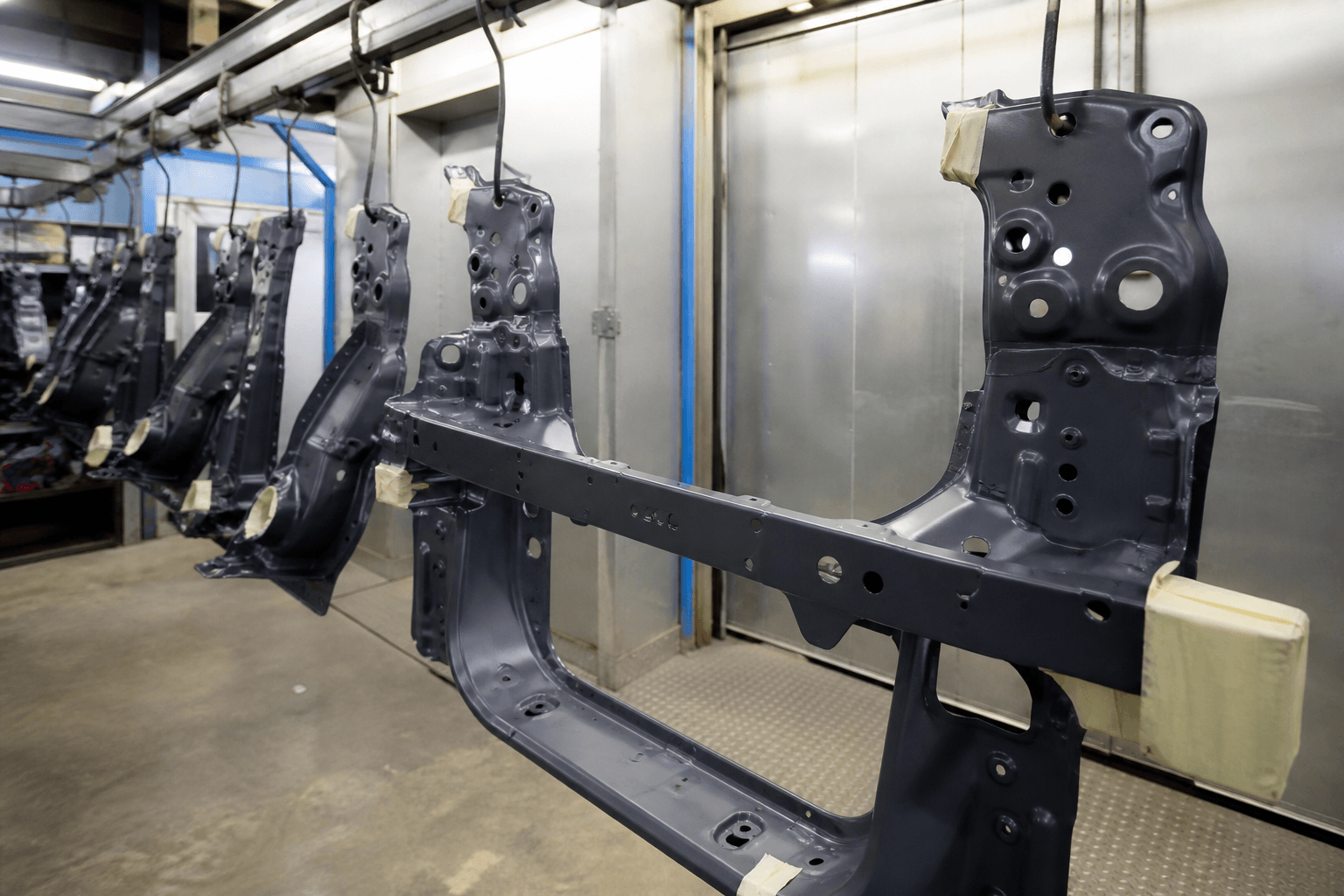
Can you powder coat a car? Usually, the practical answer is to powder coat a removed, compatible metal component—not a fully assembled vehicle. The phrase powder coat car often refers to brackets, frames, covers, guards, mounts, or housings that can be disassembled, prepared, sprayed, cured, and inspected separately. A complete car contains glass, rubber, plastics, wiring, seals, bearings, trim, mixed substrates, and size constraints that make it a different refinishing project.
For an OEM buyer, the useful question is whether a specific metal component can accept the selected powder system while meeting its appearance, dimensional, environmental, and assembly requirements. A removable bracket may be a good candidate, while an exterior body-refinishing job, heat-sensitive assembly, or close-fit component may require a different treatment or a defined uncoated area.
Can You Powder Coat a Car, or Is It a Parts-Only Job?
When an OEM drawing or restoration plan calls for a finish on a bracket, frame, cover, or housing, the first question is not the color. It is whether the part can be removed, prepared, masked, heated, and inspected without affecting its function. That distinction determines whether powder coating is a practical component process or whether the project needs a different refinishing workflow.
Powder coating is normally considered after a metal car component has been removed from the vehicle. The part can then be cleaned, pretreated, masked, grounded, sprayed, cured in a controlled oven, and inspected before reassembly. This is fundamentally different from processing a complete vehicle with its assembled systems still in place.
A fully assembled car creates practical problems with oven access, cure heat, overspray control, disassembly, and coating exclusion. It may also contain materials that cannot follow the same preparation or cure cycle. Large exterior body panels are a separate application, with priorities such as panel appearance, color matching, blending, collision repair, and localized touch-up rather than repeat-batch coating of removable industrial components. Some panels or restoration projects may be evaluated separately, but they should not be assumed to follow the same workflow as a bracket, frame, or housing.
Which Car Parts Are Good Candidates for Powder Coating?
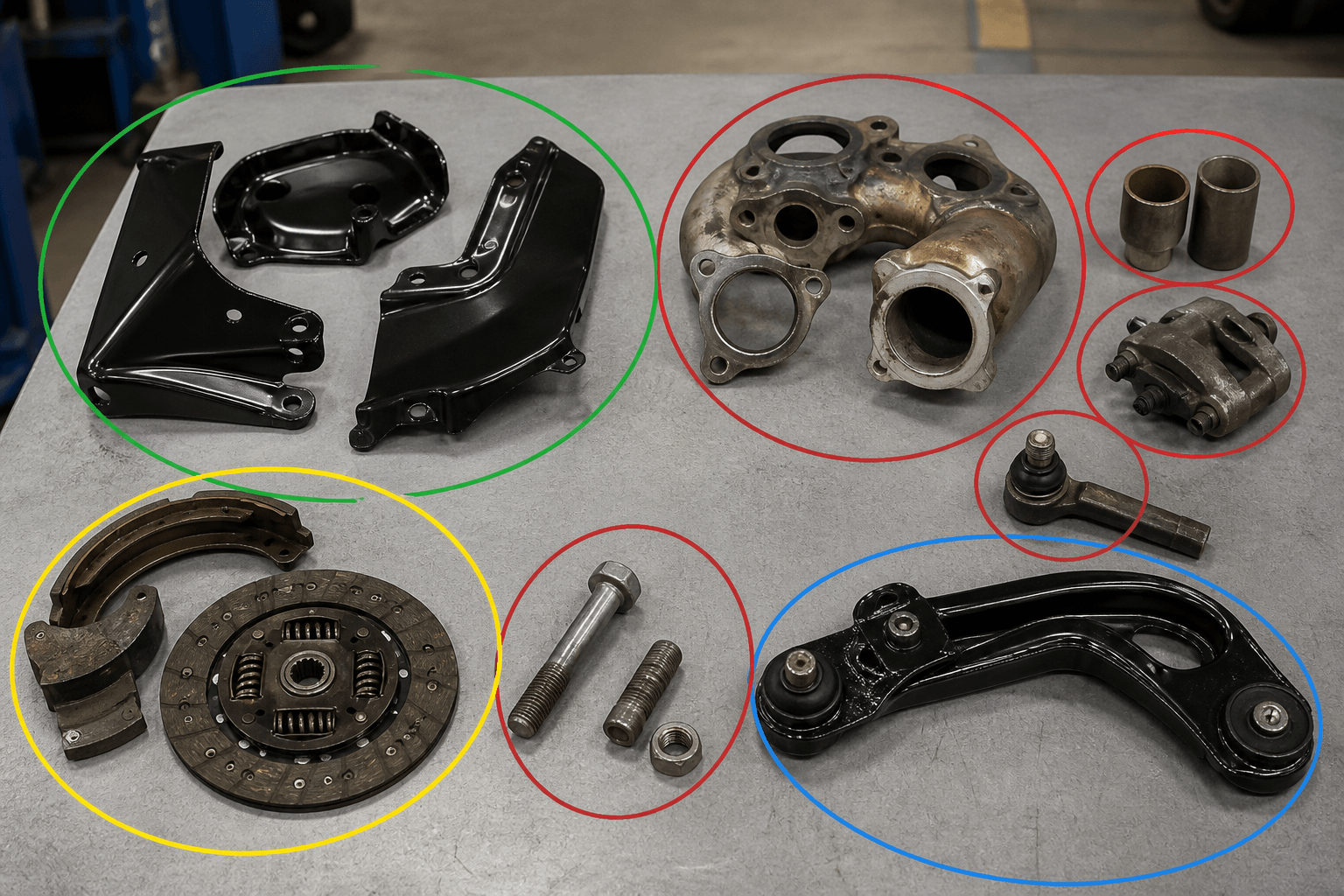
Before an RFQ is priced, screen the part against its material, operating temperature, service environment, geometry, and functional interfaces. This early review can prevent a finish request from overlooking an obstructed thread, unacceptable dimensional change, inaccessible cavity, or component that cannot tolerate the cure cycle.
| Part situation | Initial indication | What must be verified |
|---|---|---|
| Removable steel brackets, frames, mounts, guards, and non-friction supports | Often suitable | Surface preparation, service environment, oven access, geometry, and protected interfaces. |
| Aluminum covers and housings | Potentially suitable | Alloy, geometry, compatible pretreatment, cure exposure, and appearance requirements. |
| Galvanized or previously treated components | Conditional | Existing-layer compatibility and the required cleaning or pretreatment sequence. |
| Large exterior body panels | Application-dependent | Panel size, color matching, repair method, appearance criteria, and oven access. |
| Engine- or exhaust-adjacent metal components | Use caution | Actual operating temperature and a coating system intended for that service duty. |
| Threads, bearing seats, brake or friction interfaces, and grounding points | Mask or exclude | Coating can affect fit, contact, torque, braking, sealing, or electrical continuity. |
| Sealed assemblies, plastics, rubber, glass, and heat-sensitive parts | Not standard candidates | Disassembly and separate assessment of each material and component. |
Suitable does not mean that every surface should be coated. Steel, aluminum, galvanized surfaces, and other substrates are not interchangeable; each may require a different cleaning and pretreatment decision. The service environment also matters, including UV, moisture, salt, chemicals, abrasion, impact, cleaning agents, and operating temperature.
Geometry affects spray access as well as functional fit. Deep cavities, narrow returns, sharp edges, recesses, and close-fitting surfaces can produce shadowed or thin areas if they are not planned. Threads, bearing seats, brake and friction surfaces, electrical contact areas, grounding points, sealing surfaces, and other close-fit interfaces may need plugs, caps, tape, or a defined uncoated zone. For a component example, custom metal brackets built to your drawings can be specified with these coating exclusions from the beginning.
How Is a Powder-Coated Car Component Processed?
Once the component passes the initial suitability review, the coating line is controlled around its substrate, geometry, exclusions, and selected powder system. Each stage affects adhesion, coverage, appearance, dimensional fit, or repeat-order consistency.
- Confirm the part and exclusions. Review the material, existing surface treatment, contamination risk, critical dimensions, and areas that must remain uncoated. Remove attached components wherever practical.
- Clean the metal. Oils, dirt, oxidation, rust, and other contamination must be removed using a method appropriate to the substrate and existing finish. Residue left on the surface can interfere with adhesion and appearance.
- Apply substrate-specific pretreatment. Preparation may include cleaning, removal of unsuitable layers, or a compatible conversion treatment. Steel, aluminum, and galvanized surfaces need different considerations. Poor preparation can lead to adhesion loss and allow corrosion to develop or spread beneath damaged areas.
- Mask, hang, and ground the part. Threads, seats, contact points, sealing lands, and assembly faces are protected before spraying. The hanger must provide a reliable grounding path so charged powder is attracted to the metal surface.
- Apply the powder. Electrostatic spraying builds coverage on the grounded workpiece. Spray access, edge coverage, cavity depth, recesses, and part orientation influence the result, so difficult geometry must be planned in advance.
- Cure according to the powder system. The powder melts, flows, and crosslinks when the workpiece reaches the required metal temperature for the required time under controlled oven conditions. A generic oven-air setting is not a universal cure specification, and under-curing or over-curing can affect the finished result.
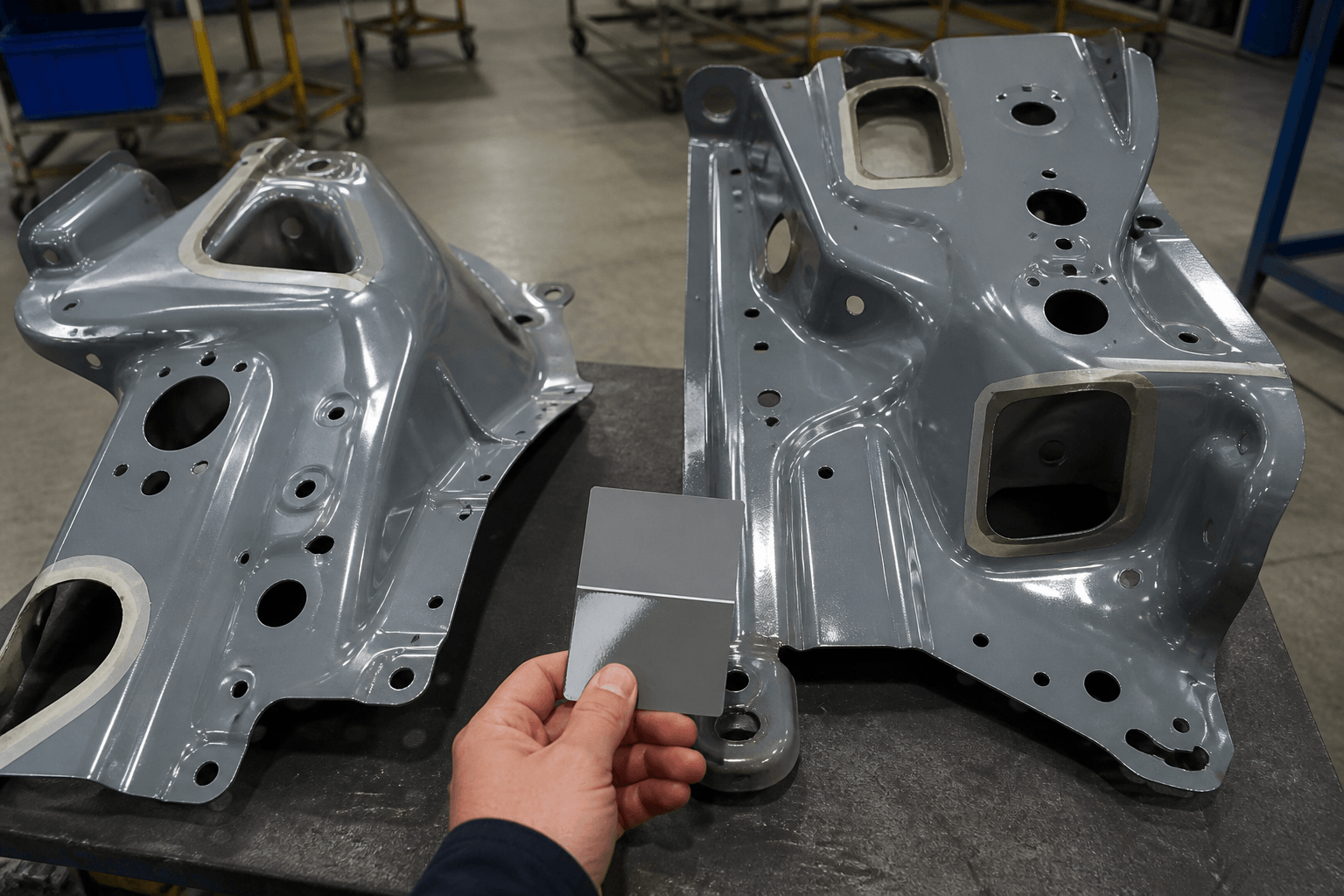
- Inspect after curing. Review color, gloss, texture, coverage, edge condition, masking lines, visible defects, and critical dimensions. Film-thickness, adhesion, or other validation checks should be agreed with the buyer according to the application.
Inspection must cover function as well as appearance. A visually acceptable finish is not sufficient if a bearing seat is tight, a thread is obstructed, a grounding point is insulated, or a sealing surface no longer assembles correctly.
Powder Coating vs. Automotive Paint: Which Fits the Part?
The choice between powder coating and liquid automotive paint often arises when an OEM is defining a visible or service-exposed metal component. Neither finish is automatically the right answer; the decision depends on removal, heating, repair method, finish control, and the part’s environment.
| Decision factor | Powder coating may fit when | Liquid automotive paint may fit when |
|---|---|---|
| Application fit | The metal component can be removed, hung, masked, and placed in a suitable cure oven. | The job involves large surfaces, staged refinishing, or localized work where oven access is limited. |
| Repairability | The production part can be recoated or replaced; a small repair may be difficult to blend into the original texture or gloss. | Localized touch-up or blending is important, subject to the selected paint system and shop controls. |
| Finish control | Color, gloss, texture, and coverage can be defined against an approved sample or reference. | Layering and blending may offer more flexibility for visible bodywork and color transitions. |
| Curing | The component and its interfaces tolerate the powder system’s controlled heat cycle. | The selected wet coating can follow its flash, drying, and cure requirements without exposing the assembly to unsuitable heat. |
| Environment and service | The substrate preparation and powder system suit UV, moisture, salt, chemicals, abrasion, and temperature. | The liquid system is selected for the same exposure factors and the required ventilation, solvent, and overspray controls. |
Powder coating can provide a durable dry-film finish when preparation, system selection, application, and cure are compatible. That does not make it universally better than paint. For a batch of removable metal components, powder may be practical; for a large visible panel requiring frequent blending or repair, liquid automotive paint may be more adaptable. Exposure, chemical contact, abrasion, temperature, and the desired repair method should be stated before either finish is chosen.
What Should an OEM Specify Before Ordering?
A request that says black powder coat does not fully define a production requirement. For an OEM or ODM project, the drawing package or project brief should connect the finish to the part material, vehicle location, functional interfaces, appearance reference, inspection plan, and expected production pattern.
- Part identity and volume: drawing, 3D file, or clear photos; part number; base material; vehicle location; prototype or production status; annual volume; and expected batch size.
- Existing surface condition: bare, galvanized, previously coated, oxidized, or otherwise treated metal. State whether an existing layer must remain, be removed, or be evaluated for compatibility.
- Service environment: indoor or outdoor exposure, UV, moisture, salt, chemicals, abrasion, cleaning agents, and operating or nearby temperatures.
- Appearance requirement: color reference, gloss level, texture, coating system or performance target, and any approved sample or master panel. A color name alone may not define gloss or texture sufficiently.
- Functional exclusions: masked areas, threads, bearing seats, brake or friction interfaces, electrical contact and grounding points, sealing surfaces, dimensional tolerances, and post-coating assembly requirements.
- Acceptance requirements: agreed film-thickness target, appearance criteria, adhesion or other validation tests, inspection records, and the treatment of nonconforming or repaired parts.
- Handling and delivery: protection of coated surfaces during handling, packaging requirements, and any assembly or identification needs after coating.
Cost is shaped by the part and the control plan rather than by the word powder alone. Surface area, preparation effort, masking, color changes, batch size, testing, handling, packaging, and rework can all affect the price. A prototype with extensive masking may have a different cost structure from a repeat production batch of the same component.
Service life is likewise a variable outcome. Substrate condition, preparation, coating selection, exposure, impact damage, operating temperature, and maintenance all influence how long the finish remains acceptable. Repeat-order consistency requires controlled assumptions, including the material and pretreatment approach, approved appearance references, defined masking, suitable cure control, and inspection records. Buyers can review related inspection planning through quality-control requirements for coated metal products.
Frequently Asked Questions
If you are preparing an RFQ for powder-coated car parts, these questions help separate a general refinishing request from a defined component application. The final answer still depends on the part drawing, substrate, service conditions, and required finish.
Can an entire car be powder coated, or must the vehicle be disassembled?
A standard powder-coating workflow is normally applied to removed components. A complete vehicle would require extensive disassembly and a separate feasibility review covering part size, substrates, masking, cure heat, and refinishing requirements.
What are the main disadvantages or limitations of powder coating car parts?
The main limitations are the need for oven access, substrate-specific preparation, careful masking, and heat compatibility. Local repairs may be difficult to blend in texture or gloss, while friction, sealing, electrical, and close-fit areas may need to remain uncoated.
Is powder coating better than automotive paint for car components?
Neither finish is universally better. Powder coating often suits removable metal parts that can be cured under controlled heat, while liquid automotive paint may be more adaptable for visible bodywork, staged refinishing, or localized blending.
How much does it cost to powder coat a car or a batch of its metal parts?
There is no reliable universal price. Cost varies with part size and surface area, preparation, masking, color changes, batch size, testing, handling, packaging, rework, and whether the request covers separate components or a larger refinishing project.
How long does powder coating last on a car part?
No fixed service life applies to every part. Preparation, coating selection, UV and moisture exposure, chemicals, abrasion, operating temperature, impact damage, and maintenance all influence how long the finish remains acceptable.