
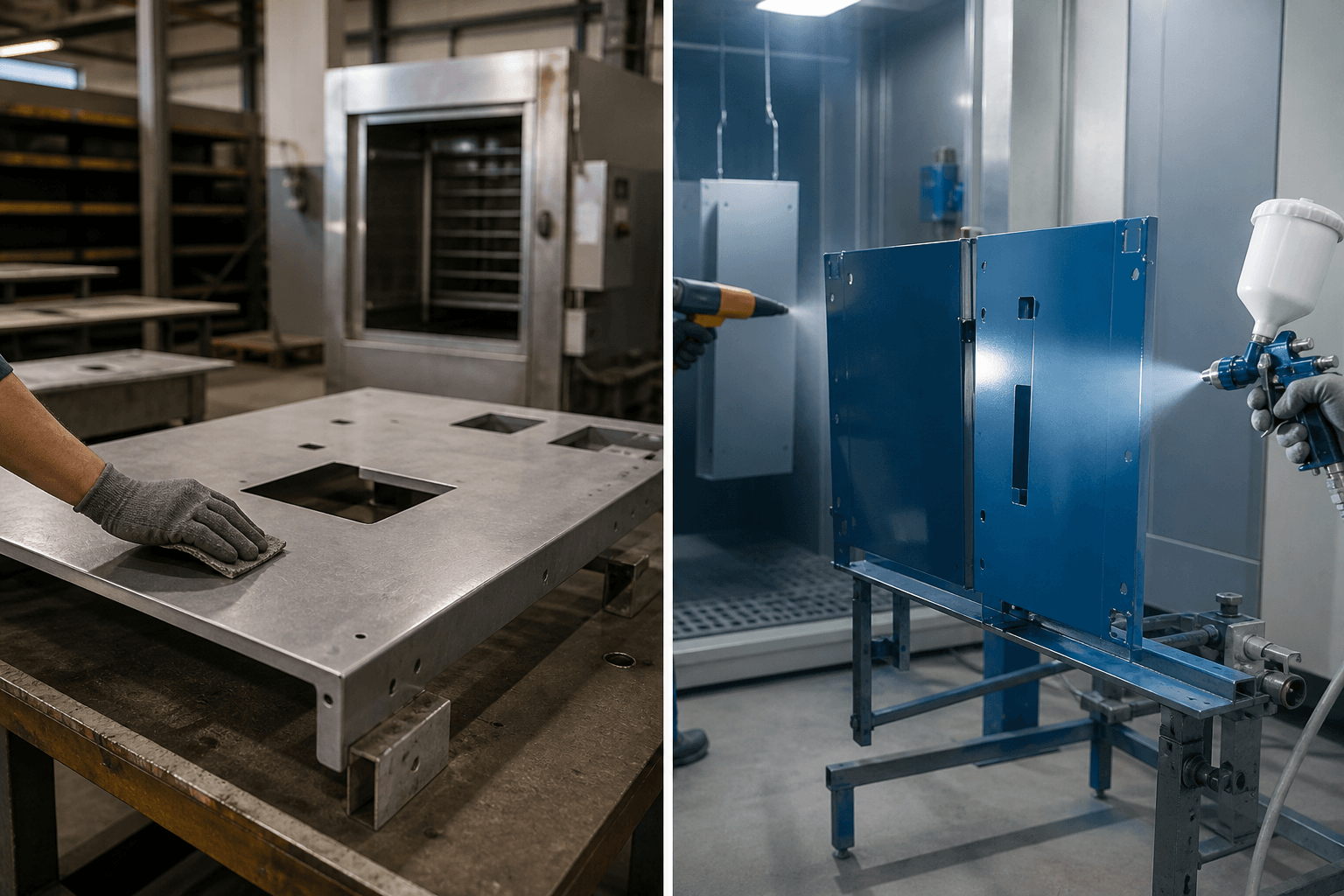
When an OEM part is moving from design review to quotation, the finish callout has to do more than name a color. Paint and powder coating are different process routes: liquid paint forms a wet film, while powder coating deposits dry particles that are melted and cured. The right choice depends on the substrate, service environment, geometry, thermal limits, appearance, repair needs, and production conditions.
For an OEM metal part, the finish is part of the product design rather than simply a cosmetic step at the end. Coating thickness, masking, cure, handling, and surface preparation can affect corrosion protection, dimensions, fit, and assembly.
Paint and powder coating in one minute
If a drawing says only painted or coated, production still has to resolve the material, layers, preparation, application method, and acceptance criteria. That missing detail can affect both the quotation and whether visible or functional surfaces can be finished as intended.
Liquid paint is a formulation in which resin, pigment, additives, and a solvent or water carrier are applied as a wet film. The system may use a primer and topcoat, with flash-off, drying, or chemical curing between and after applications. Resin type, solids content, application method, and layer structure all influence the finished result.
Powder coating uses dry resin-based particles containing pigments and additives. For common industrial thermoset powders, the particles are electrostatically deposited on a grounded metal part and then heated so they melt, flow, and cure. A typical powder route includes preparation, application, heat curing, cooling, and inspection; a liquid route may include cleaning, primer application, flash-off or drying, topcoat application, final drying or curing, and inspection.
Neither process automatically solves difficult access conditions. Both may require masking, defined cure controls, and inspection of functional surfaces. This comparison is intended for industrial metal parts and products rather than decorative household painting. Because fabrication sequence affects seams, access, and mating surfaces, coating decisions should be reviewed alongside the custom sheet metal fabrication requirements.
Start with the substrate and service conditions
At the early specification stage, describe what the part will experience instead of selecting a finish from color or appearance alone. Consider indoor or outdoor exposure, UV radiation, humidity, standing moisture, salt contact, chemicals, abrasion, impact, operating temperature, expected service life, appearance, repairability, and the production mix.
Powder chemistry families are useful screening categories, not universal performance classes. Epoxy powders are often investigated for indoor applications where adhesion or chemical resistance is important, although UV exposure may limit their suitability. Polyester powders are commonly screened for exterior appearance and weathering. Epoxy-polyester hybrids are frequently considered for general indoor applications, while polyurethane powders may be evaluated when the required appearance, weathering, chemical, or abrasion profile supports that choice. The selected product’s technical data and application evidence must confirm actual suitability.
Liquid paint also covers many different systems. A specified primer and topcoat combination, a project-specific repair method, or a drying and curing route that fits the product may justify evaluating liquid paint. Those conditions do not make liquid paint an automatic answer, just as the availability of a powder route does not make powder coating suitable for every design.
Surface preparation must be compatible with both the substrate and the selected coating. Cleaning may remove oil, dust, oxides, and loose contamination, while a conversion treatment may be used when required by the material and coating system. Carbon steel, aluminum, galvanized material, and other substrates can need different controls, so one pretreatment sequence should not be transferred between materials without checking the coating supplier’s data and validating adhesion and corrosion performance for the application.
| Project condition | Question to resolve | Route to investigate |
|---|---|---|
| Carbon steel | What moisture, salt, chemical, and corrosion-barrier requirements apply? | Compare compatible powder and liquid primer/topcoat systems with validated preparation. |
| Aluminum or galvanized steel | Will the surface condition, cleaning, and conversion treatment support adhesion? | Require substrate-specific pretreatment and coating data. |
| Outdoor or high-UV service | What weathering evidence matches the intended exposure? | Review a suitable polyester powder or liquid topcoat system without assuming either route wins. |
| Wet or chemical service | Which chemicals, concentrations, contact periods, and temperatures are present? | Compare the complete system with application-specific data or testing. |
| High abrasion or impact | Which surfaces will rub, slide, or receive handling impact? | Evaluate the coating, substrate, film range, edge condition, and relevant wear or impact checks. |
| Heat-sensitive parts | Can the part and any attached components tolerate the selected drying or cure route? | Compare the thermal requirements of a powder system with a suitable liquid or alternative system. |
| Appearance-sensitive parts | What color, gloss, texture, variation, and touch-up limits must be controlled? | Compare both routes using an approved reference and defined visual criteria. |
| Repair or field touch-up | Will local repair be needed, and how much visual difference is acceptable? | Define an approved repair approach rather than assuming the original application can be reproduced. |
| Complex geometry | Can the application method reach every visible and functional surface? | Review geometry, rack access, grounding, masking, and a production-intent trial. |
| Frequent color changes or mixed batches | How important are short runs, color sequencing, touch-up, and changeover control? | Compare the practical application, repair, batch, and scheduling requirements of each route. |
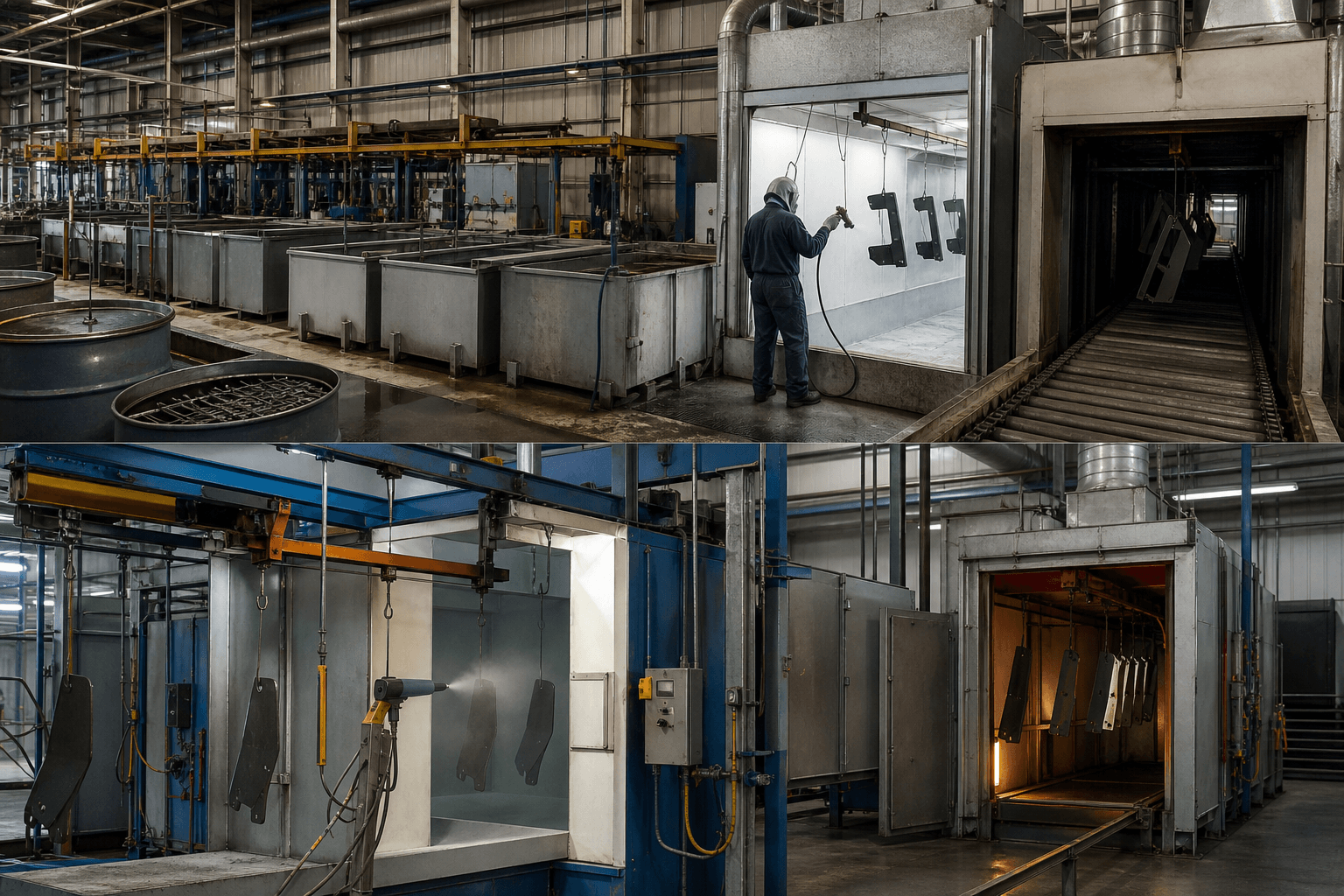
Part geometry sets the coating constraints
When a sheet-metal part contains deep recesses or enclosed features, the coating route must be reviewed with the design rather than after fabrication. Electrostatic powder application depends on charged particles reaching and adhering to a grounded part, so recesses, narrow channels, internal corners, box sections, and enclosed features can create a Faraday-cage effect.
The electric field can make it difficult for powder to enter or build evenly in those areas. Powder coating therefore does not automatically cover every recess. Manual application, a design adjustment, different part orientation, or a process trial may be needed; liquid application also requires a deliberate access review and does not automatically solve complex-geometry coverage.
Hanging points provide rack access and an electrical path to ground. Where practical, place them on hidden areas or non-functional edges. Rack contact can leave marks, thin spots, or small uncoated areas, so contact locations and the acceptable appearance should be defined before production. Grounding must remain reliable during application; a concealed hanging point is not useful if it prevents adequate electrical contact.
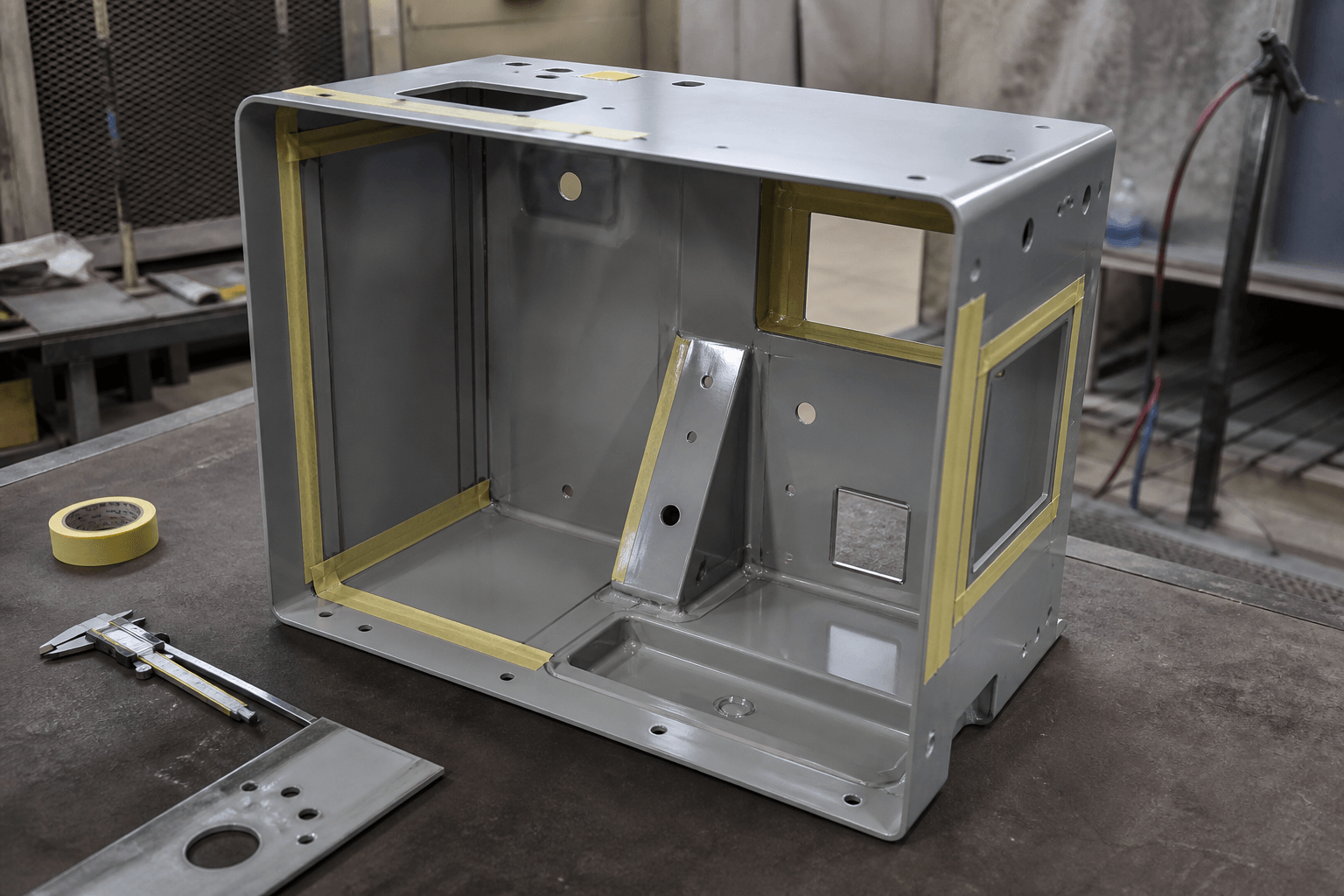
Threads, gasket lands, electrical contact points, tight mating faces, bearing seats, and precision interfaces may require masking or plugging. Identify these zones on the drawing or finish specification instead of relying on a broad instruction such as no coating on assembly surfaces. The required keep-out area should be clear enough for production and inspection to interpret consistently.
Bent seams, welded overlaps, and enclosed corners can retain oil, cleaning solution, or other contamination. They can also complicate drainage, pretreatment, coverage, and cure. Review access, vents, drains, and joint condition where the design creates an enclosed area. Decide whether individual components should be coated before assembly or whether the assembled product would block access and leave important interfaces uncoated.
Before approving the route, confirm rack access, oven clearance, part thermal behavior, and the effect of thermal mass. These issues are particularly relevant to custom sheet metal enclosures with internal corners, gasket lands, electrical interfaces, and post-coating assembly requirements.
Build a finish specification that can be inspected
A finish callout that says only black powder coat or painted is difficult to quote, produce, and inspect consistently. Give production and inspection the same interpretation by recording the coating route, substrate, finish appearance, functional keep-out areas, and the evidence required for approval.
- Liquid or powder route, plus the resin, coating family, or approved product when known.
- Base metal, material thickness, and required cleaning or pretreatment.
- Color reference, gloss target, texture, and permitted variation.
- Target dry-film-thickness range and the surfaces or zones to which it applies.
- Masked areas, plugged holes, grounding marks, and functional keep-out surfaces.
- Visual acceptance conditions for visible faces, hidden faces, edges, and assembly-critical areas.
Cure should be verified against the coating manufacturer’s technical data and the actual part-metal temperature, not oven air temperature alone. Part thickness, thermal mass, rack position, and configuration can change the result. A liquid system likewise needs its specified drying or curing conditions controlled rather than judged only by elapsed time.
| Requirement | Inspection approach | Record or decision |
|---|---|---|
| Color, gloss, and texture | Compare with the specified reference under agreed viewing conditions and, where required, with an agreed measurement approach. | Accept the approved appearance range or document the variation. |
| Film thickness | Measure representative visible, functional, edge, and difficult-to-coat areas against the specified range. | Record readings and investigate thin recesses or heavy edges. |
| Cure | Verify the selected cure condition using product data and the part-metal temperature. | Retain the cure record or place the batch under review. |
| Adhesion and impact | Use checks when they relate to handling, assembly, or service risk and define the method in advance. | Apply the agreed acceptance rule. |
| Corrosion, chemical, or abrasion resistance | Select tests that represent the actual service environment rather than ordering generic tests by default. | Relate the result to the application and agreed evidence. |
| Visual and dimensional condition | Check runs, orange peel, pinholes, contamination, exposed metal, thin coverage, hanging marks, fit, clearances, and threads. | Use the agreed repair, acceptance, or rejection process. |
For appearance-sensitive products, retain an approved reference panel or sample, identify the coating batch, and define how defects are repaired or rejected. The manufacturer’s quality-control information can provide context for discussing inspection records and defect control, but it does not replace the project-specific acceptance plan.
Production details behind cost and schedule variation
Two parts with the same color can still require different production plans. Coated surface area, part size, geometry, rack density, loading efficiency, and the number of parts in a batch all affect handling and scheduling. A compact part may use more rack positions than its mass suggests, while a large flat part may load efficiently.
- Color changes, multi-color work, and low-volume batches add setup, cleaning, and scheduling activity.
- Masking, plugging, manual application, and mask removal can be significant around threads and mating surfaces.
- Pretreatment, drying or curing, cooling, rework, and additional inspection affect elapsed production time.
- Powder or paint availability, protective packaging, and extra handling can change the planned sequence.
- Complex parts may need manual application, more inspection points, or a separate handling plan.
Rework can consume a planned production slot, particularly when appearance variation or inaccessible surfaces is discovered late. Agreeing on the coating system, masked zones, appearance criteria, and test scope early can reduce clarification and rework risk, but it does not guarantee a particular price or delivery date.
Validate the route on production-intent geometry
Before batch release, validate the finish on geometry that represents the planned product rather than relying only on a flat test coupon. The sample should expose the same access, fit, masking, and thermal questions that could affect the production part.
- Review the design: Confirm the substrate, service environment, tolerances, thermal limits, masking, and assembly interfaces from the drawing or model.
- Select representative geometry: Use a production-intent part or sample that includes relevant recesses, edges, holes, seams, welded areas, hanging locations, and critical mating surfaces.
- Approve the appearance: Define viewing conditions and record the accepted color, gloss, texture, visible coverage, and permissible marks.
- Check post-coating fit: Inspect clearances, threads, gasket contact, electrical interfaces, mating faces, and other dimensions after finishing.
- Choose relevant tests: Use corrosion, adhesion, impact, abrasion, chemical, or cure checks only when they reflect the service environment and have an agreed method.
- Document release criteria: Record the coating system, pretreatment, cure requirements, inspection results, repair limits, and rejection rules before batch production.
This sequence separates a finish that looks acceptable on a sample from one that is practical across the complete fabricated product. It also gives the buyer and manufacturer a shared basis for resolving defects or design changes before they affect a full batch.
Frequently Asked Questions
These questions often arise when an RFQ includes drawings but leaves the substrate, finish, tolerances, or repair expectations open. The answers are conditional because coating suitability depends on the complete part and service requirement.
Is powder coating always better than liquid paint for outdoor metal parts?
No. Outdoor suitability depends on the resin or paint system, substrate, pretreatment, UV exposure, moisture, chemical contact, geometry, and supporting technical data. A qualified powder system may be appropriate, but a multi-layer liquid system may also fit a particular product.
Can powder coating be applied to galvanized steel or aluminum?
It can be, but an assumed steel pretreatment sequence should not be used. Cleaning, conversion treatment, surface condition, cure compatibility, and adhesion need to be checked for the specific galvanized or aluminum substrate and selected powder.
Can a damaged powder-coated surface be touched up without a visible finish difference?
Touch-up is possible, but an exact visual match is not automatic. Color, gloss, texture, application method, and the age of the original finish can make the repaired area visible. Define the approved repair material and appearance limit before production, especially when the drawing identifies visible faces or tight assembly tolerances.
Can powder coating cover deep recesses, narrow channels, and enclosed corners reliably?
Not automatically. Faraday-cage effects, access, grounding, and part orientation can cause thin or uneven coverage. Review the geometry, provide practical rack access, and validate the result on a representative part before releasing the finish specification.
Review powder-coating feasibility before quotation
When a project points to powder coating, Yishang can review the part geometry, substrate, finish callout, masking needs, and batch-production requirements to identify missing inputs and determine whether the route is practical for the custom metal product. This review is intended to clarify feasibility before quotation, not to assume that powder coating is suitable for every part.
Share the information relevant to the application:
- 2D drawings, 3D files, or clear part photographs.
- Base metal, material thickness, and whether the item is an individual component or a welded assembly.
- Indoor or outdoor service conditions, chemical or abrasion exposure, and operating-temperature requirements.
- Known coating route, color reference, gloss or texture requirement, and masked or functional surfaces.
- Prototype or batch quantity, target schedule, packaging expectations, and assembly requirements.
- Required inspection tests, approved reference samples, and customer-specific acceptance criteria.