
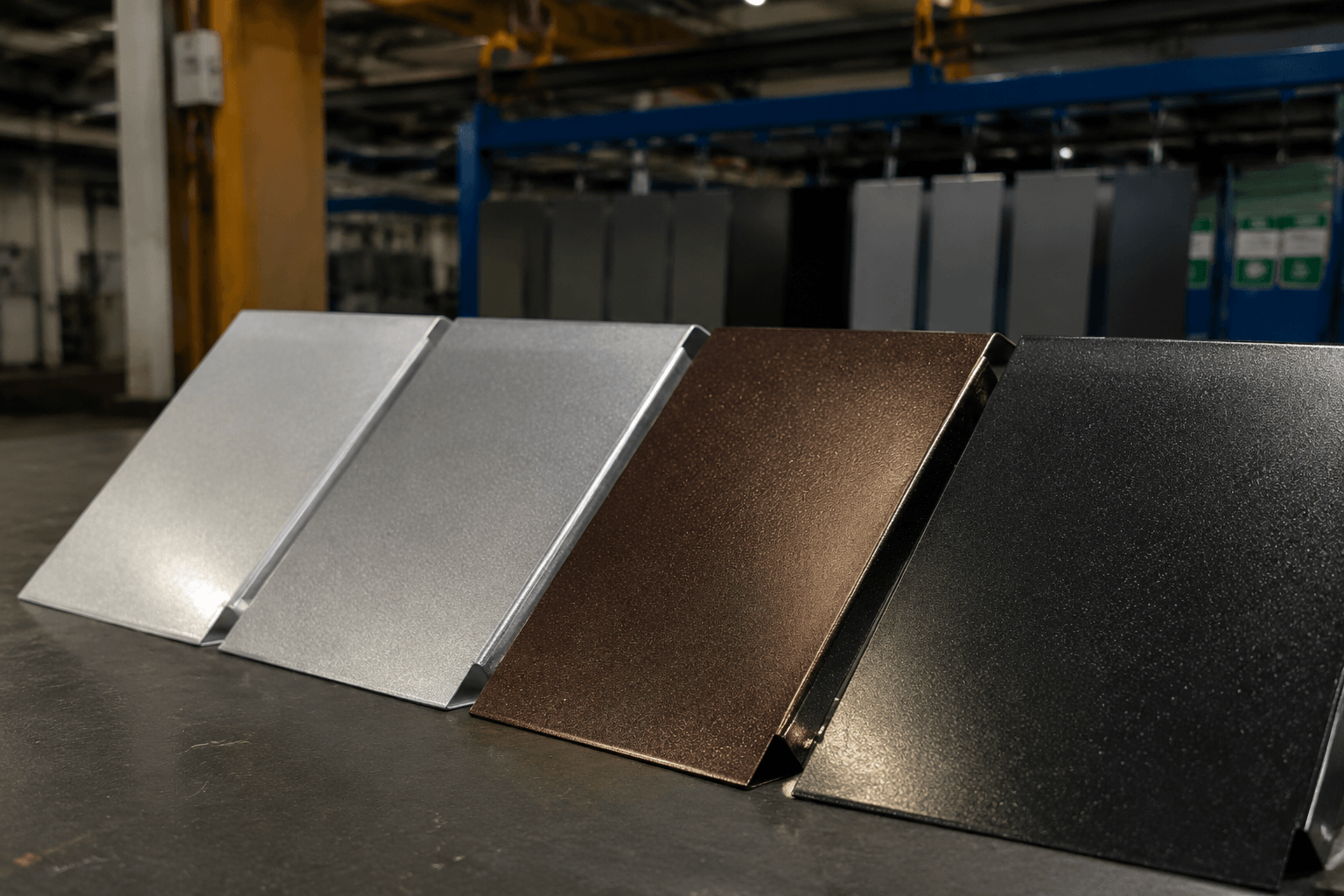
Metallic powder coat is a dry-applied, heat-cured coating formulated with metallic or effect pigments to create a metal-like appearance. It is not the same as bare metal, plating, anodizing, or PVD, and it does not make the substrate perform like the simulated metal. For repeat production, visual consistency depends on both the selected powder and the way the coating team applies it.
For repeat production, specify metallic powder coat as a complete coating system with an approved visual target. The powder product, substrate, pretreatment, fabricated geometry, application route, film build, cure, inspection method, and future powder lots can all affect the result.
Metallic powder coat is an effect finish, not a metal surface
When a buyer writes metallic silver or bronze on an RFQ, the important question is whether the requirement concerns appearance or the properties of a metal surface. Powder coating uses dry particles containing a resin, colorants, additives, and, in a metallic product, flakes or other effect pigments. Electrostatic spraying deposits the particles on a grounded part, and heat then melts and cures the film.
The resin forms the binder and protective layer while the pigments create reflected highlights within the coating. A metallic powder-coated steel cabinet remains coated steel. A copper-like or silver-like finish does not prove that the part contains enough copper, silver, nickel, or another metal to provide the electrical, thermal, wear, or corrosion behavior of solid or plated metal.
Powder manufacturers may offer different levels of sparkle, depth, light-dark travel, gloss, and texture. These are product-specific appearance options, not universal performance categories. A screen image, printed reference, familiar color-system reference, or small powder chip can show the general direction, but a coated sample gives a more meaningful reference for a customer-facing assembly.
Appearance depends on formulation and application
Compared with a conventional solid-color powder, a metallic effect can respond more visibly to process changes. Two parts with the same named metallic color may look lighter, darker, more sparkly, streaked, or uneven when the team changes the application conditions. Broad panels, adjacent components, and assemblies viewed under changing light reveal these differences readily.
Effect pigments reflect light according to their distribution and orientation in the cured film. Depending on the viewing angle, some flakes send light toward the observer while others do not. That interaction creates sparkle, depth, color travel, or directional variation sometimes called flop.
In a bonded metallic powder, the manufacturer attaches effect pigments to base-powder particles. In a dry-blended system, the supplier mixes the effect pigments with the base powder without the same bonding step. Both approaches exist, but they can behave differently during transport, spraying, recovery, and film formation. The exact product instructions determine the required handling and application controls.
Charging behavior, part grounding, spray distance, gun movement, pass direction, overlap, booth conditions, part orientation, film build, and cure consistency can influence the visible pattern. A broad face sprayed in one direction may show a different highlight pattern from a neighboring face or a component coated in another orientation. Possible symptoms include clouding, striping, picture framing, uneven sparkle, thin edge coverage, pinholes, and craters.
Contamination, substrate condition, outgassing, or cure problems can also create these symptoms, so operators should investigate the full process rather than attribute every defect to pigment orientation. Control reclaim with equal discipline: some metallic formulations can change appearance when virgin and recovered powder combine at an uncontrolled ratio. Do not assume that recovered overspray will always match fresh powder.
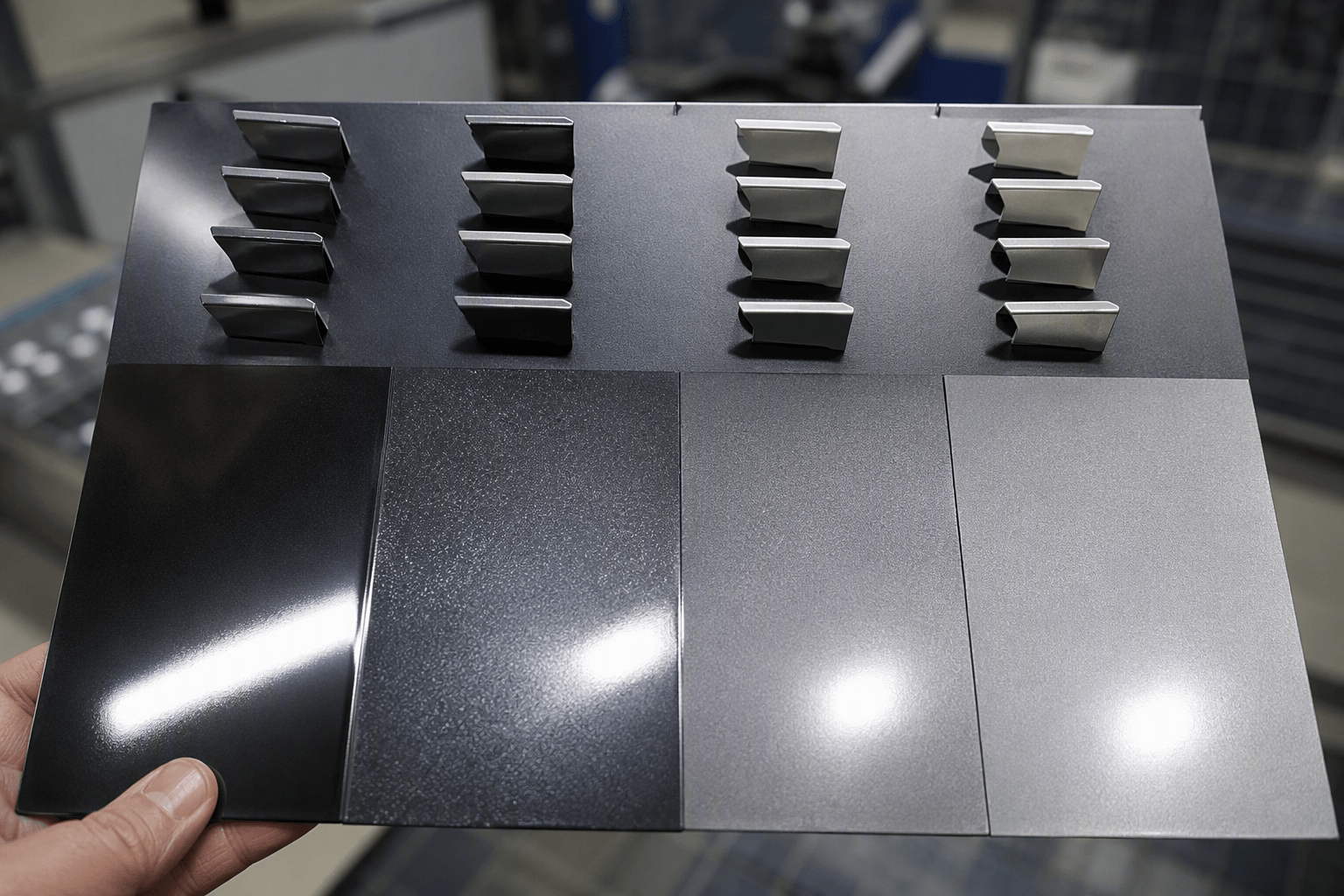
Substrate, pretreatment, and geometry set the baseline
On a fabricated enclosure or welded frame, the surface beneath the decorative finish can remain visible through changes in texture, edges, seams, or reflection. Sheet-metal fabrication establishes bends, cutouts, corners, and broad faces. Welding changes seams and heat-affected areas, while cleaning, pretreatment, application, and cure determine how the finish covers those conditions. Assembly can later mark or contaminate the cured surface, and inspection verifies the agreed requirements.
Steel and aluminum need cleaning and pretreatment appropriate to the material, contamination, surface condition, and intended exposure. Steel may carry oil, scale, rust, or weld residue. Aluminum has different oxide and cleaning behavior and may react differently to handling contamination or alloy surface condition. Confirm the coating system instructions on the actual material grade and fabricated condition.
Corrosion resistance belongs to the complete system of substrate, preparation, pretreatment, coating continuity, edge coverage, and cure. The metallic color alone is not weatherproof or corrosion-proof and does not establish exterior suitability. Exposure, UV, humidity, salt or industrial atmosphere, cleaning chemicals, and handling requirements should follow the selected product documentation and agreed tests.
Sharp edges may receive less powder than broad faces. Deep recesses and Faraday-cage regions can limit electrostatic access, while overlapping joints can retain contamination or restrict access. Weld seams, grinding transitions, heat marks, and inconsistent weld cleanup can remain visible beneath a smooth or reflective metallic effect. Review masking for threads, grounding points, labels, contact surfaces, and assembly interfaces before coating. On custom sheet metal enclosures, judge cutouts, corners, adjacent panels, and broad visible faces together rather than as isolated coupons.
From Color Idea to Approved Metallic Production Sample
Before an OEM releases a customer-facing finish for repeat production, make the sample represent the material, geometry, application conditions, and viewing conditions that matter in service. This workflow turns a color preference into a controlled approval record.
- Define the visual target. Record hue, metallic character, flake scale or sparkle preference, gloss, texture, any intended directional effect, and acceptable variation. Mark broad faces, edges, recesses, weld areas, and adjacent parts that must match.
- Select the exact product. Identify the powder manufacturer, product code, finish designation, and product-specific application information. Record resin chemistry separately from metallic effect, gloss, and texture.
- Use a substrate-matched panel. Coat the intended steel or aluminum grade with the agreed cleaning and pretreatment system. Record the powder lot, application route, and cure information when the project uses those as process controls.
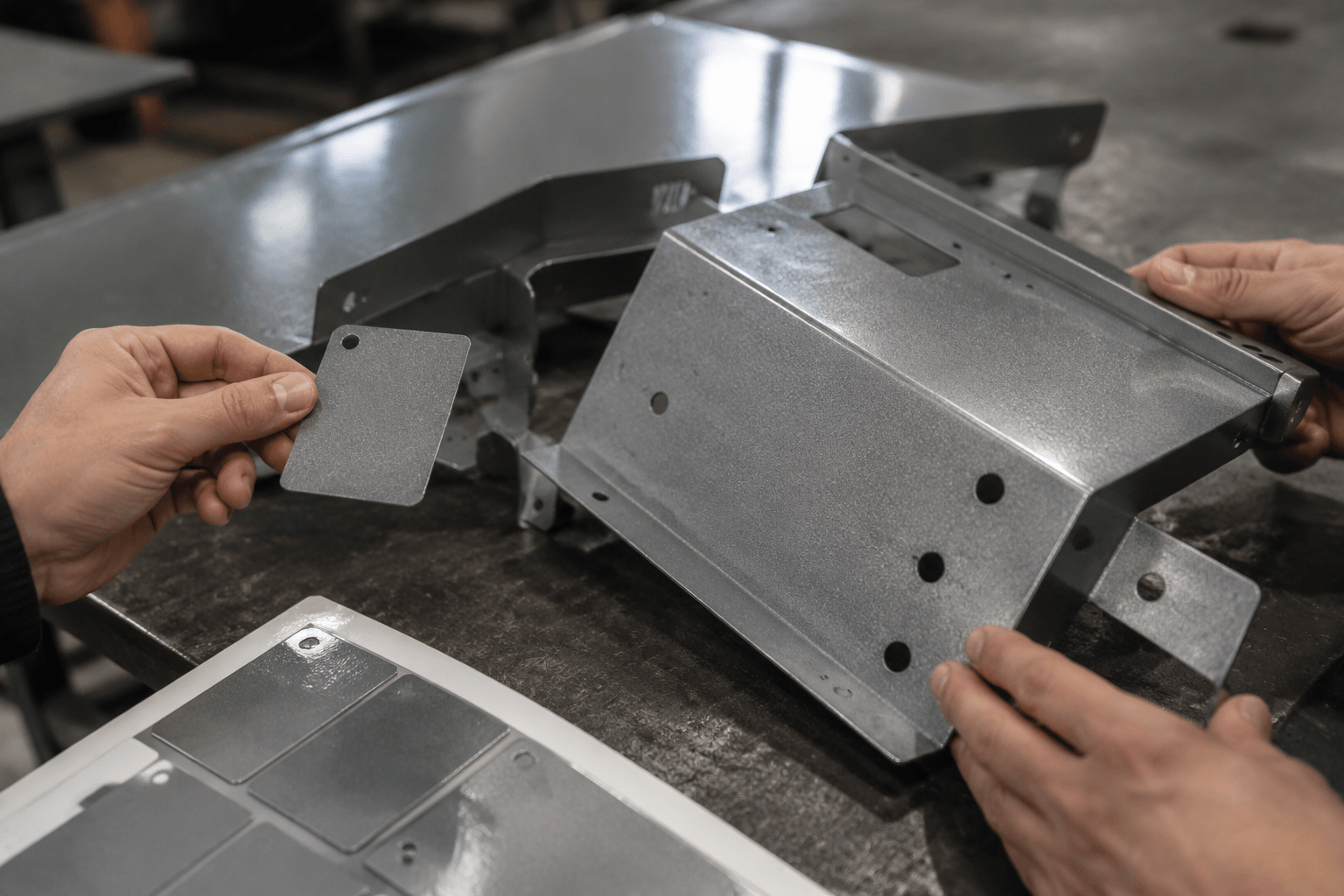
- Check representative geometry. Review a broad face with corners, edges, recesses, holes, masking areas, weld zones, and an orientation arrow. A small flat chip cannot reveal every production risk.
- Set viewing conditions. Compare the panel and sample under agreed illumination, distance, angle, and orientation. Instrumental color readings can support control but may not fully describe sparkle, flop, texture, or directional appearance.
- Retain the decision. Sign and date a physical master panel, photograph the panel and its identification, and document gloss, texture, viewing conditions, and acceptable variation. Keep the master for first-article inspection and replenishment review.
Digital images, printed references, and powder chips remain useful at the concept stage, but they should not serve as the sole release standard for a customer-facing assembly. Compare adjacent parts together and in a consistent orientation when they must read as one product.
Where metallic powder coating fits among decorative finishes
A product team choosing between metal-like finishes should compare process boundaries as well as visual character. Metallic powder coating, anodizing, wet metallic paint, PVD, and electroplating use distinct processes and create different substrate, geometry, exposure, repair, and production considerations. Some powder products have grades intended for outdoor exposure, but the exact product documentation must establish that suitability.
| Finish | Visual and process character | Key boundary |
|---|---|---|
| Metallic powder coat | Polymer film containing metallic or effect pigments; smooth, textured, fine-sparkle, and coarse-sparkle effects may be available. | Requires compatible heat curing, grounding, preparation, geometry control, and disciplined application and reclaim handling. Touch-up may remain visible. |
| Anodizing | Electrochemical oxide finish associated primarily with aluminum; it changes the surface rather than adding a polymer film. | It is not a general substitute for coating steel. Alloy, surface condition, geometry, and color process affect the result. |
| Wet metallic paint | Liquid coating with different flow, film-build, drying, and touch-up behavior. | May suit different heat or substrate constraints but brings product-specific solvent, VOC, drying, and application controls. |
| PVD | Vacuum deposition creates a surface layer capable of highly reflective or specialized metallic appearances. | It has separate substrate, pretreatment, geometry, and production requirements; it is not powder coating under another name. |
| Electroplating | Electrochemical deposition adds an actual metal layer onto a conductive or suitably prepared surface. | Conductivity, bath access, masking, recesses, edges, and the complete corrosion system require review. |
Metallic powder coating can suit enclosures, cabinets, frames, furniture, display fixtures, and lighting housings. Appearance risk rises when broad customer-facing faces or adjacent components meet changing light. For display fixtures and commercial equipment, see custom metal fabrication for retail and commercial equipment. For decorative housings where lighting angle may emphasize sparkle and direction, see custom metal fabrication for lighting fixtures and equipment.
Cost and production timing can change with custom-color development, sample cycles, powder availability, pretreatment, masking, part complexity, special handling, inspection, and material purchase requirements. A supplier may require a minimum powder purchase or set conditions for future availability, so base lead-time and replenishment assumptions on the exact product and geometry rather than the color name.
Plan service performance and repeat production as one system
After a customer-facing sample gains approval, connect its appearance to the part’s actual service environment. Indoor use, outdoor UV, humidity, salt exposure, abrasion, handling, detergents, and other cleaning chemicals create different requirements.
Obtain and review the technical data sheet and application data for the exact powder, substrate, pretreatment, and intended use. If testing will support the decision, define the specimen, substrate, pretreatment, coating product, preparation, test method, exposure condition, acceptance criterion, and responsible party. A test name without those details is not a complete requirement.
Inspect color and effect against the approved master, along with gloss or texture where the project specifies them. Check visible defects, coverage, adhesion, cure verification, and coating thickness when the project or coating supplier requires those checks. Record the comparison conditions and acceptance criteria so the team can revisit a visual decision consistently.
For repeat production, record the powder product and lot, production date, substrate and pretreatment route, application records, cure records, and retained reference panels. Separate factories, lines, orientations, and future lots can produce visible differences in color or sparkle, so do not assume perfect continuity. Where commercially practical, reserve powder for replenishment; otherwise, plan a new-lot sample and reapproval when continuity matters.
Custom colors may require formulation development, sampling, a minimum powder purchase, or other supplier conditions. Confirm how unused material, future availability, and approval records will be handled before design release. During assembly and service, protect the cured finish from avoidable contact damage.
Follow the coating supplier’s maintenance instructions. Use compatible cleaning methods and avoid unapproved abrasives or chemicals. An approved touch-up may restore protection or reduce the visible size of damage, but it should not promise an invisible repair; differences in flake, gloss, texture, application, and aging can reveal the work. For documented inspection and traceability, review the quality control process alongside the coating requirement.
Request a metallic powder coat sample and RFQ review
If you want a feasibility review tied to an RFQ or drawing, send the information needed to assess the finish on representative material and geometry. The review should establish what the drawing calls out, what the sample must prove, and which production conditions require control.
- Part drawing or 3D file with the substrate and material grade if known. Identify cosmetic faces, viewing orientation, fit-critical interfaces, masked or no-coat zones, threaded features, grounding points, and assembly contact areas.
- Finish callout or photo and physical reference showing the intended metallic effect, including sparkle, texture, gloss, and directional preferences.
- Preferred powder manufacturer, product code, finish designation, or technical data if you have already selected them.
- Required gloss, texture, approved color reference, and acceptable variation, including the adjacent parts or broad faces that must match.
- Indoor or outdoor environment and relevant corrosion, UV, cleaning, handling, or abrasion conditions.
- First-batch quantity, annual quantity, and expected replenishment pattern, including whether future lots require reapproval.
- Photos or notes identifying recesses, welds, edges, orientation-sensitive surfaces, masking areas, and other appearance-critical features that a flat chip cannot represent.
Yishang supports B2B OEM and ODM custom manufacturing and has more than 26 years of custom metal-product manufacturing experience. The feasibility question is whether the requested effect can be sampled and controlled on the actual material and geometry before repeat production is released.
Where RFQ Assumptions Create Cost and Production Risk
Many sheet metal fabrication problems begin before production starts. If drawings, tolerances, finish expectations, material grades, or assembly requirements are unclear, suppliers may quote based on different assumptions. That can make prices difficult to compare and may lead to rework, cosmetic rejection, assembly misalignment, or production delays later.
For OEM buyers, the goal is not simply to request the lowest price. The goal is to make sure each supplier is quoting the same manufacturing reality. Before confirming an order, clarify which dimensions are fit-critical, which surfaces are cosmetic, whether prototypes must match batch-production conditions, and how finished parts will be inspected.
Frequently Asked Questions
For OEM teams, the questions below separate metallic appearance from substrate, process, and production-control requirements.
Is metallic powder coat made with real metal, or does it only imitate a metallic appearance?
It uses metallic or other effect pigments to create a metallic appearance. The exact composition depends on the product, but a copper-like or silver-like finish does not turn the substrate into solid metal or provide that metal’s properties.
What are the main downsides of metallic powder coating compared with a solid-color powder finish?
Metallic effects can respond more visibly to spray direction, orientation, grounding, film build, reclaim ratios, cure consistency, and lot changes. Large faces may reveal variation more readily, and repairs may show more clearly. A representative sample and retained master help manage these issues.
Can the same metallic powder be applied to both aluminum and steel, and why might preparation differ?
The same product may work on both materials, but the exact product and application data must confirm the combination. Steel and aluminum have different preparation needs, so validate both the substrate and pretreatment before approval. Include the material grade and exposure in the review.
Can scratches or chips in a metallic powder finish be touched up without a visible repair?
Not reliably. An approved touch-up may restore protection or reduce the visible size of damage, but differences in flake, gloss, texture, application, and aging can reveal the repair. Validate cosmetic matching on a representative sample if appearance matters.
Are there six standard types of powder coating, and why is resin chemistry different from metallic color or effect classification?
There is no universal six-type classification that answers every specification question. Resin chemistry identifies one dimension of the powder, while metallic describes a color or effect. A complete requirement should also state gloss, texture, substrate, and service environment.