
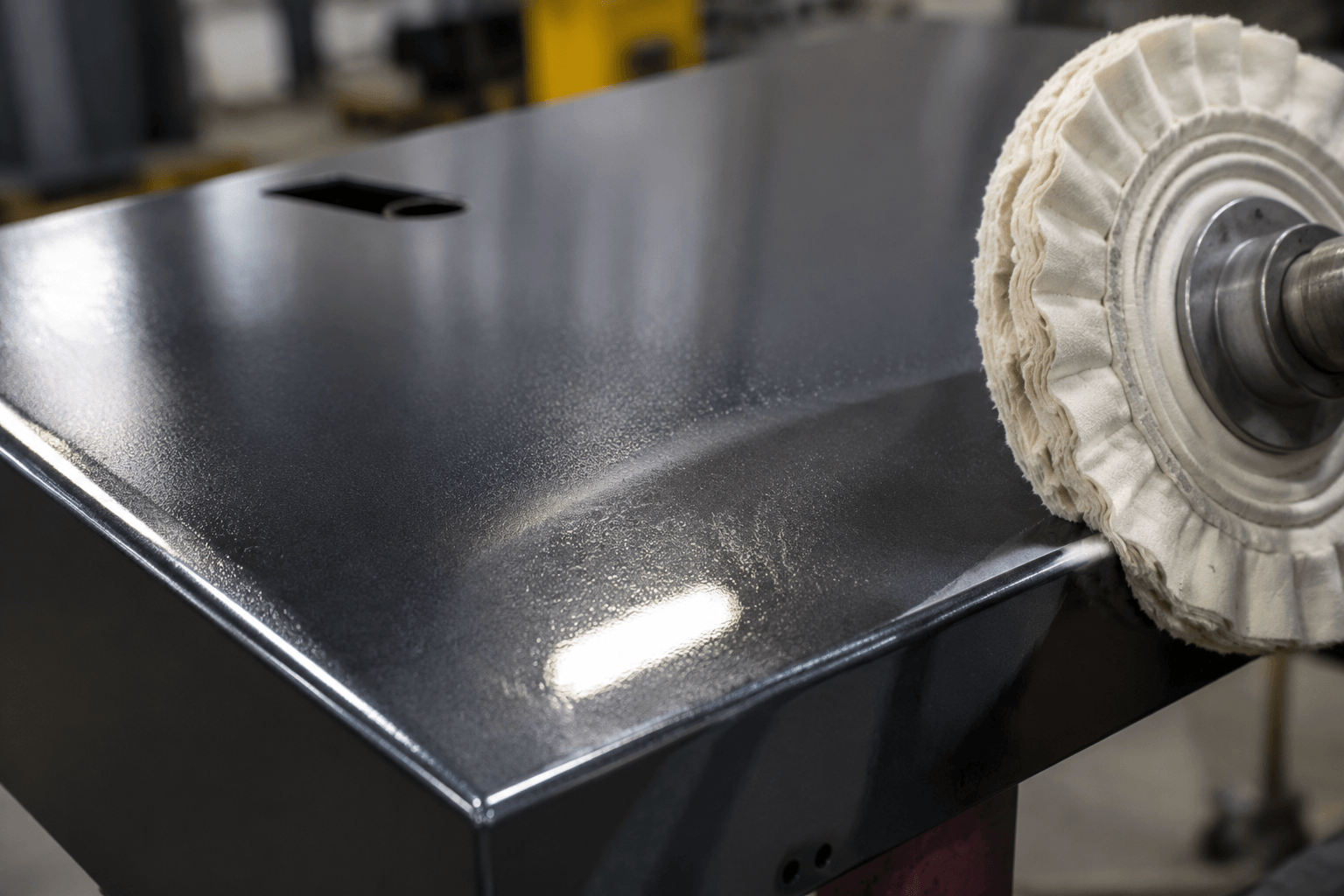
When an OEM panel, bracket, or enclosure shows a light haze after coating, buffing may improve its appearance—but only in limited cases. It treats the cured powder-coat film, not the exposed steel, aluminum, or stainless-steel substrate, so it is not equivalent to metal polishing. Before a supplier applies it to production parts, confirm the coating and finish, trial the method on representative geometry, and define how the result will be inspected.
Can You Buff a Cured Powder-Coat Finish?
For a buyer reviewing a first article or a finished batch, the key question is whether the visible issue is limited to the surface or indicates a damaged coating system. Buffing a cured powder-coat film is a post-coating treatment that may alter the upper surface enough to reduce shallow haze or a light cosmetic mark while the film remains intact.
That process differs from polishing bare metal. Abrasive metal polishing works directly on exposed steel, aluminum, or stainless steel to level the substrate and develop a bright, directional, or mirror appearance. When powder coat remains in place, the coating is still the visible layer; cutting through it does not restore protection or produce a uniform bare-metal finish.
The outcome depends on the coating chemistry, cure condition, gloss level, texture, color, metallic effect, film condition, and part geometry. Buffing powder coat should therefore be treated as a finish-specific repair trial, not as a universal post-cure operation.
Classify the Mark Before Choosing a Repair Route
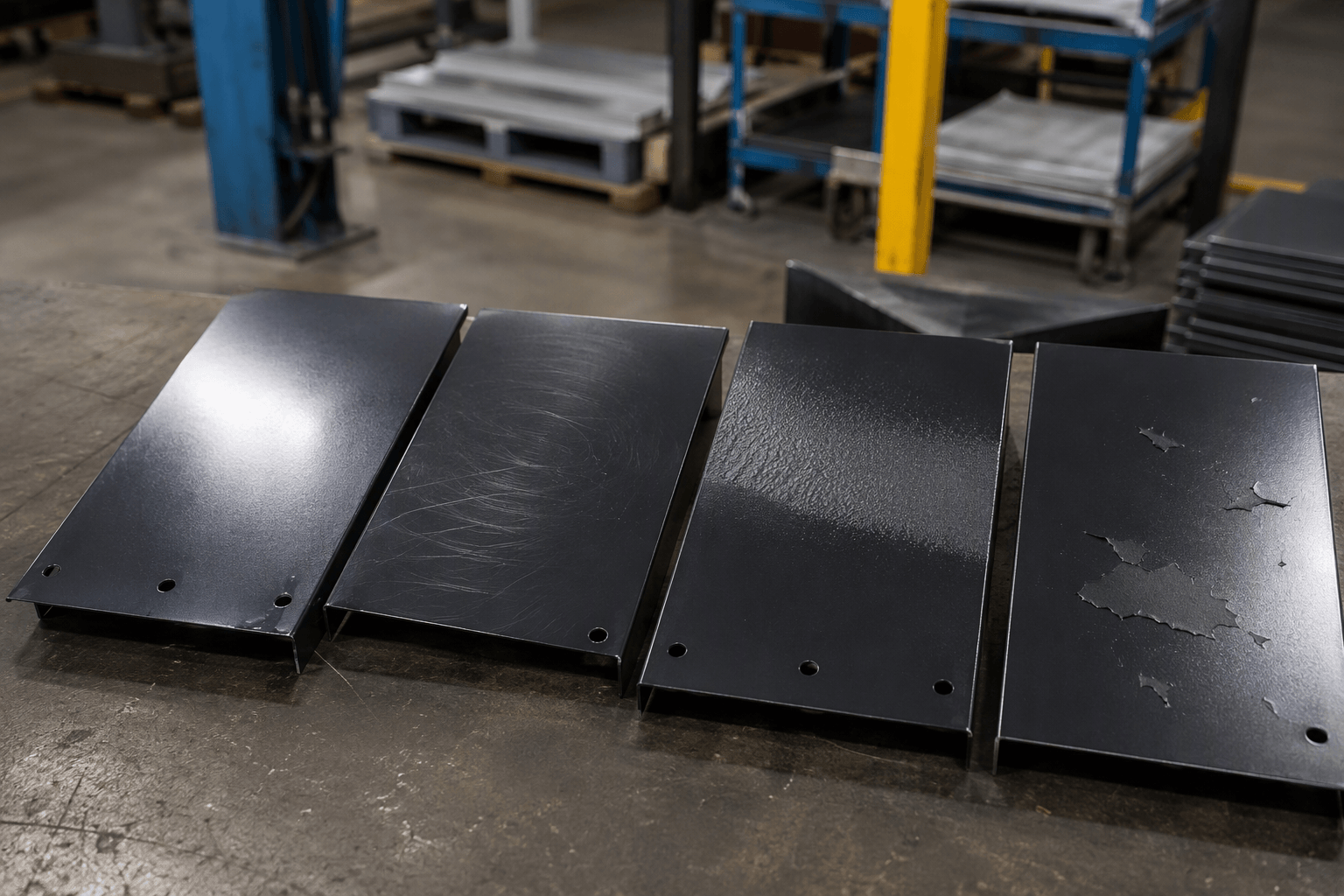
When a finished enclosure or fabricated panel fails a visual check, first determine where the problem exists: at the top of the appearance, within the coating film, or in the substrate. A dull area may be contamination that needs cleaning, while a mark that has penetrated the film requires a different response. This distinction helps prevent a cosmetic treatment from being used on a coating or substrate failure.
| Observed condition | Likely location or cause | Practical route |
|---|---|---|
| Light haze or superficial cosmetic mark | Disturbance near the top of an otherwise intact film | A controlled buffing trial may be appropriate; compare the treated area with the surrounding finish. |
| Transfer mark or light handling scuff | Residue or a shallow visual change rather than missing coating | Clean first with an approved method, then decide whether buffing is needed. |
| Deep scratch, chip, or exposed substrate | The coating film has been penetrated or removed | Review localized repair or recoating. Buffing alone cannot rebuild the missing film. |
| Orange peel or broad texture variation | The coating profile or application result is uneven over an area | Review the coating process or a recoat route instead of selectively leveling one spot. |
| Fisheye or pinhole | A local coating or contamination defect extends into the film | Use a repair or recoat review; buffing may leave the defect or make the area less uniform. |
| Poor adhesion, blistering, corrosion, or under-film damage | Film integrity, pretreatment, or substrate condition is compromised | Do not treat this as a cosmetic buffing issue. Define rework, rejection, or a different finishing process. |
Inspect the part under agreed lighting and viewing conditions, not only under a polishing light or from one favorable angle. A treated area can look better locally while showing a gloss patch, color shift, texture difference, or uneven reflection from normal viewing positions. If the defect affects a visible interface or a protective function, the decision should include more than visual improvement.
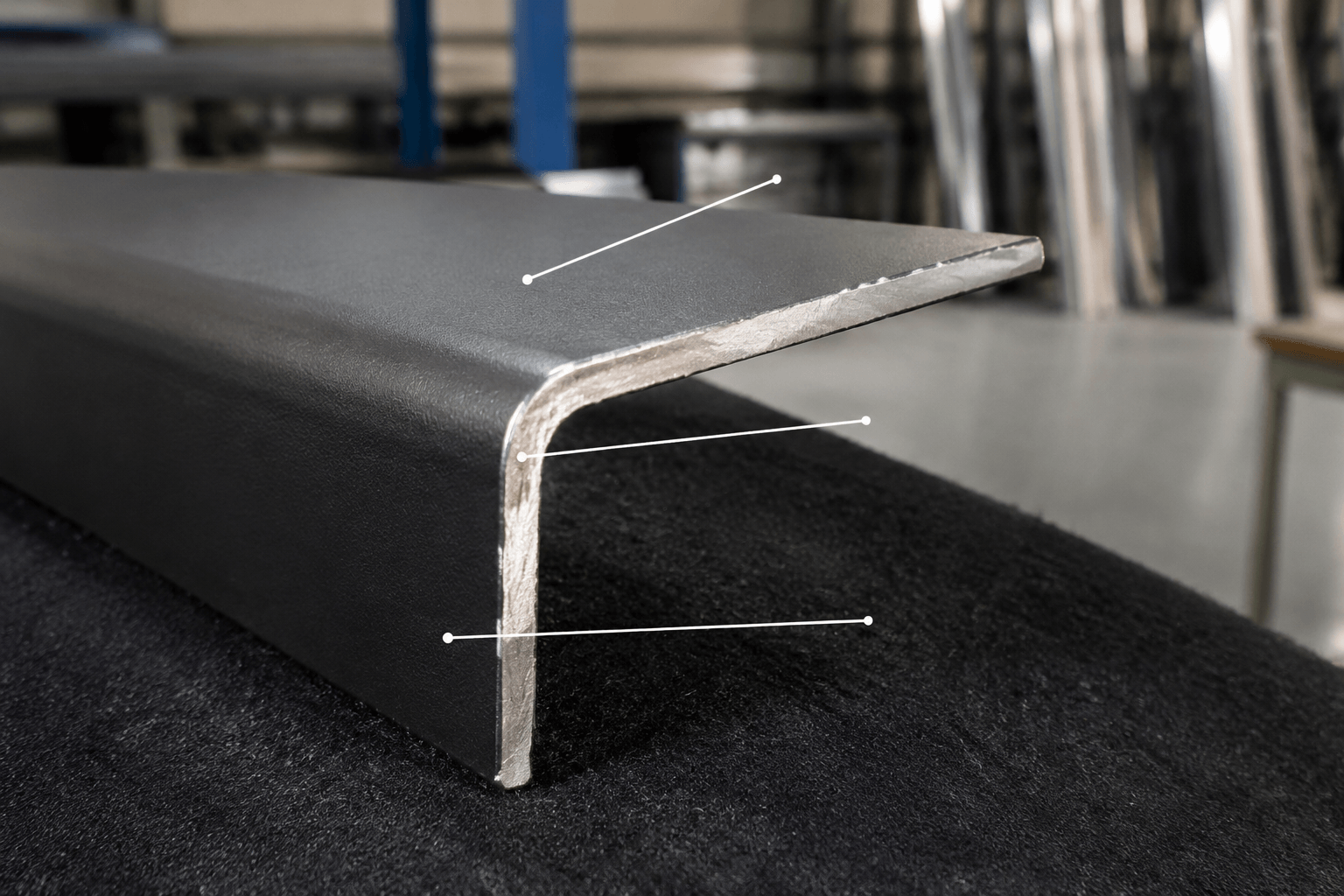
Finish Type and Geometry Set the Risk
A treatment that looks acceptable on a smooth, high-gloss flat panel may be unsuitable on another powder-coated part. For an OEM finish, the color callout is only one part of the definition; gloss, texture, metallic effect, and consistency across the assembly also matter.
- Smooth gloss: A superficial mark may be reduced, but the treated zone can become more reflective than the surrounding coating.
- Low-gloss or matte: Local action can create a shiny patch or change the light-diffusing appearance required by the specification.
- Textured finishes: Buffing can flatten texture peaks and leave an irregular transition that is difficult to blend into the untouched surface.
- Metallic or sparkle finishes: A local surface change can alter reflection, color perception, or sparkle consistency. The repaired area should not be assumed to match the surrounding film.
Edges, corners, bend lines, weld transitions, holes, recesses, internal faces, and masking boundaries increase the risk of an uneven result. High points may receive more contact while tight features remain untreated, producing edge exposure, a halo around the repaired area, or inconsistent appearance across an assembly.
Where steel, aluminum, and stainless steel are all used in the product, evaluate the relevant substrate and geometry rather than transferring approval from one part to another. Edge condition, weld preparation, pretreatment, and the coating system can affect how the finished surface responds. Review the coating supplier’s technical information alongside an approved finish sample or visual master; a color name alone is not a complete appearance definition.
A Controlled Trial for Production Approval
Before asking a supplier to buff an entire lot, use a sample, sacrificial part, or hidden-area trial to establish whether the route is suitable. The test should reproduce the features that create the greatest risk, rather than relying only on a convenient flat area.
- Identify the defect. Photograph and describe the mark, its location, apparent depth, and size. Note whether the film appears intact, and do not assume that every visible defect is buffable.
- Confirm the finish. Record the base material, coating identification, color, gloss or texture target, metallic effect, and cure status when available. Check the supplier’s guidance for the specific coating system.
- Clean and document the starting condition. Remove suitable contamination with an approved cleaning method. Record the appearance under the planned inspection lighting before treatment.
- Select representative geometry. Use a sample or hidden area with the same substrate and coating. Include a flat face and, where relevant, an edge, corner, weld transition, hole, recess, or masking boundary.
- Apply a limited, documented trial. Agree the approach with the responsible finishing specialist. Record the pad, compound, operating approach, number of passes, and treated area. No universal speed, pressure, compound, or pad guarantees the same result for every powder coating.
- Compare treated and untreated areas. Check visible marks, gloss, color, texture, sparkle, reflection, blend boundaries, edge exposure, and coating integrity from normal viewing angles. Check masking-sensitive interfaces and critical dimensions where coating removal or edge condition could matter.
- Use additional checks when required. If film thickness, adhesion, corrosion protection, or wear performance is important, use the agreed verification method. Visual improvement alone does not prove that coating performance has been preserved.
Record the outcome as approved, conditionally approved, or rejected. Production buffing should not begin until the OEM and supplier agree on the finishing route, affected zones, inspection method, and response to variation. If the trial improves one area but leaves an unacceptable blend boundary, recoating or a different specified finish may be more appropriate than expanding the buffing area.
Define the Finish in the OEM Specification
At the RFQ or drawing-review stage, a powder-coat requirement should be tied to the part geometry and assembly interfaces rather than added as a general note at the end of a drawing. For custom sheet metal fabrication, the specification should state what the supplier must produce, where appearance matters, and how the result will be judged.
- State the base material, relevant thickness, welded features, exposed and hidden faces, holes, recesses, internal faces, and masking zones.
- Identify the powder color, coating system when specified, gloss or texture target, and any metallic or sparkle effect.
- State whether buffing is required, optional, prohibited, or limited to named appearance zones and defect types.
- Provide an approved reference panel, first-article sample, or visual master when appearance matching is important.
- Define acceptable variation for color, gloss, texture, sparkle, visible marks, edge condition, and repair transitions.
- Describe inspection lighting, viewing distance, viewing angles, cleanliness, and whether instrument checks are required. Link the plan to suitable quality-control planning.
- Define the disposition for nonconforming areas: controlled trial rework, localized repair, recoating, first-article review, or rejection.
If corrosion, wear, adhesion, or coating thickness matters in service, specify the agreed verification method separately. Buffing does not automatically preserve those characteristics, and a visually improved surface is not necessarily an acceptable production surface.
Buff, Recoat, or Change the Finish?
During first-article review or production troubleshooting, the right route depends on defect depth, appearance target, service environment, geometry, and the need for repeatability across a batch. Use the matrix below to frame the technical review; it does not replace sample approval for a finish-sensitive part.
| Condition or requirement | Preferred decision | Confirm before release |
|---|---|---|
| Intact smooth coating with limited haze | Run a controlled buffing trial | Uniform gloss, color, reflection, film integrity, and no visible blend boundary |
| Transfer mark or light handling scuff | Clean and reassess before selecting buffing | Removal of the mark without a new gloss or texture variation |
| Deep scratch, chip, corrosion, or exposed substrate | Review localized repair or recoating | Repair coverage, adhesion, edge condition, appearance, and protective requirements |
| Orange peel, fisheyes, pinholes, or poor adhesion | Review coating-process rework or rejection | Root condition and complete-film acceptance, not just increased surface brightness |
| Matte, textured, or metallic appearance must remain uniform | Consider recoating or a different finish route | Texture, gloss, color, and sparkle match against the visual master |
| Mirror or directional bare-metal appearance is required | Define a metal-polishing route instead of buffing cured powder coat | Exposed-metal finish, surface direction, protection, and assembly compatibility |
| A visible production surface must be repeatable across a batch | Approve a documented route through a sample or first-article review | Repeatability across relevant faces, edges, transitions, and inspection conditions |
For a limited cosmetic correction, a trial may be worthwhile. For production quantities, a route that can be described, inspected, and repeated is more useful than one attractive repaired spot. If the surface is customer-visible or contributes to protection in service, approve the sample or first article before releasing the batch.
Frequently Asked Questions
These questions commonly arise when an RFQ, drawing, or prototype review includes a cured powder-coat finish. The exact coating, geometry, acceptance criteria, and production quantity should still be confirmed before choosing a route.
Can cured powder coat be buffed or polished?
Sometimes. A cured film with superficial haze or a light cosmetic mark may respond to a carefully controlled trial. The result depends on the coating system, gloss, texture, geometry, and film condition, so buffing should not be approved as a universal process.
Will buffing remove scratches, orange peel, fisheyes, or pinholes from powder coat?
It is not a reliable repair for these conditions. Deep scratches and chips may require localized repair or recoating, while orange peel, fisheyes, pinholes, poor adhesion, and corrosion require a coating-process or substrate review.
Can matte, textured, or metallic powder coat be buffed without changing its appearance?
There is no general guarantee. Buffing can create gloss variation, flatten texture, or change the way metallic and sparkle effects reflect. Test the exact coating and geometry against an approved visual reference.
Can buffing powder coat create a mirror finish?
No. Buffing the coating does not create the same appearance as polishing exposed bare metal. If a mirror or directional metal finish is required, define that surface-finishing route separately before production.
When evaluating buffing powder coat for an OEM part, start with defect classification and a representative sample rather than a generic polishing instruction. For a prototype or production RFQ, drawings, finish requirements, critical tolerances, defect photos, quantity, and acceptance criteria give Yishang the information needed to review buffing, recoating, or another finish route before batch production.