
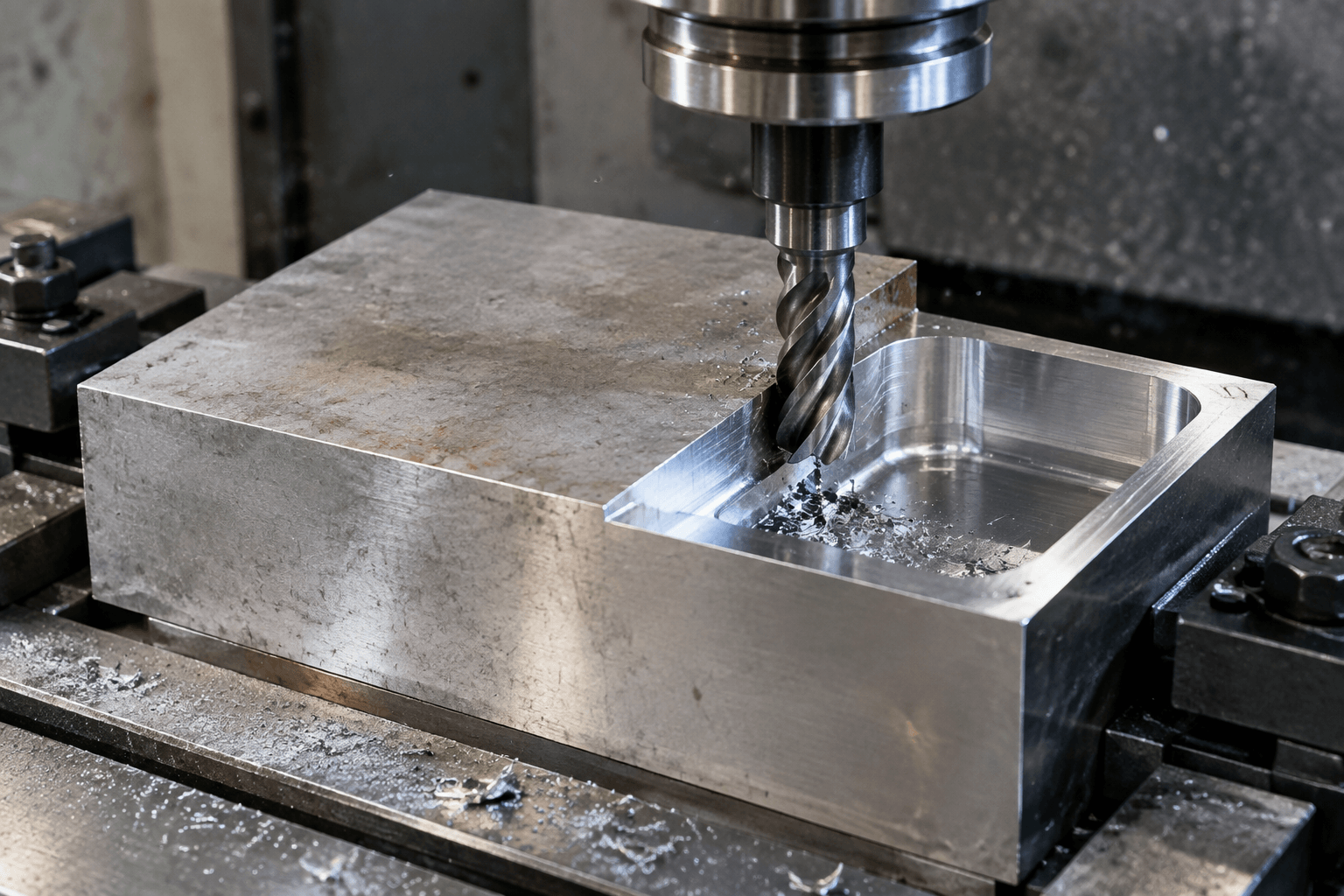
Machining of metal parts is a subtractive manufacturing process: cutting tools remove material from bar, plate, block, tube, or another solid workpiece to make controlled shapes and functional features. The appropriate route depends on geometry, material and stock form, tolerance strategy, quantity, and inspection needs.
Machining is distinct from sheet-metal fabrication, where flat stock is cut and then formed or joined. The sections below show where material removal is justified, when a cut-and-formed or hybrid route deserves comparison, and what to define before requesting a quotation.
What machining of metal parts means
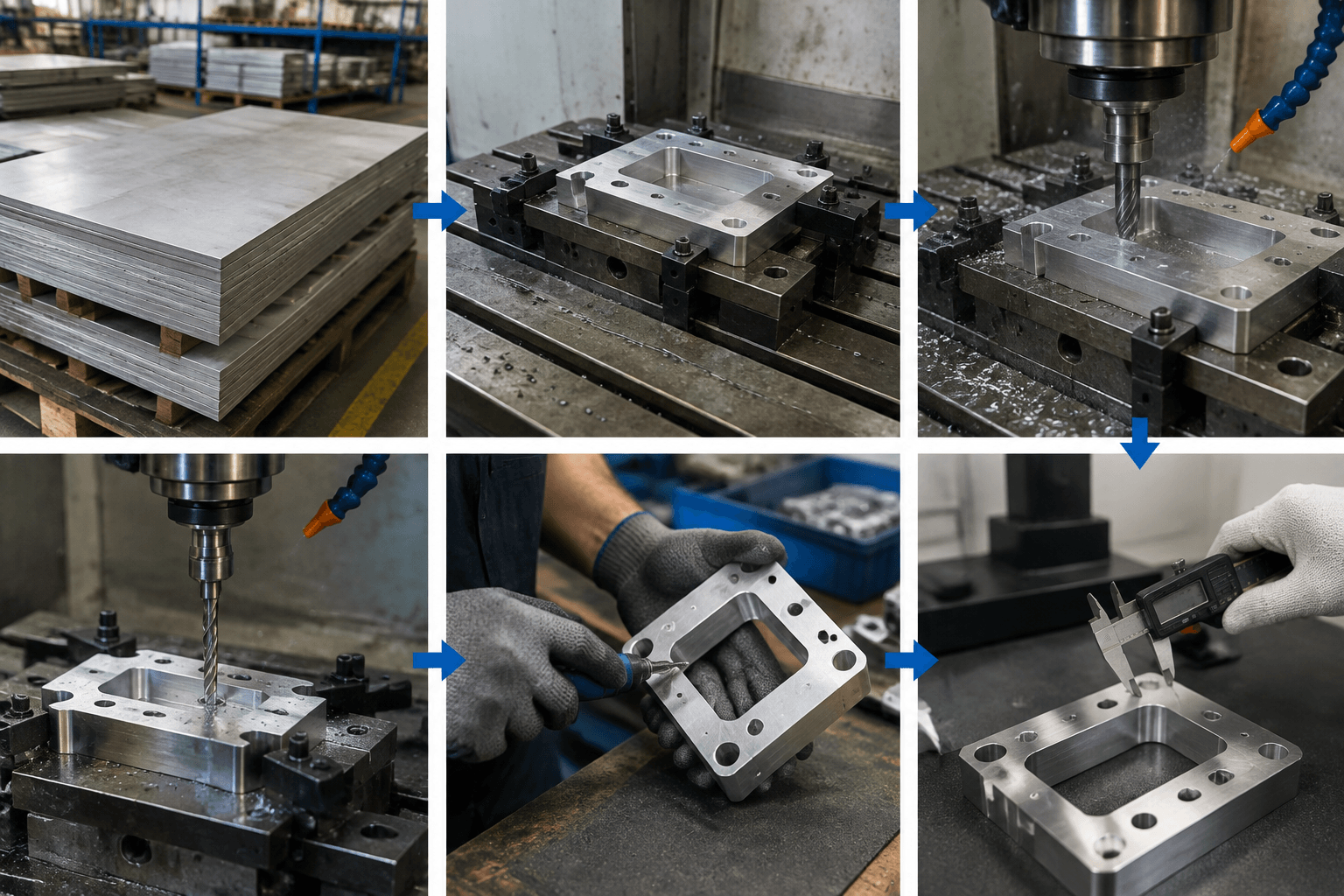
For a buyer reviewing a new component, machining begins with stock that contains more material than the finished part. A supplier removes the excess according to the released drawing, model, and process plan. This can suit mounting blocks, shafts, housings, and parts with pockets, bores, threads, slots, or three-dimensional contours. The selected stock form and removal strategy affect material use, workholding, setup count, and inspection.
- Stock selection: Select the specified grade, condition, and stock form, such as bar, plate, block, tube, or a suitable blank.
- Workholding and datums: Secure the workpiece and establish the reference surfaces used to locate features through subsequent operations.
- Toolpath planning and cutting: Plan cutter approach, access, and operation order, then remove material in roughing and finishing stages as required.
- Deburring and inspection: Remove unwanted burrs and verify critical features, threads, surfaces, and required records against released requirements.
Milling uses a rotating cutter for faces, pockets, slots, and contours. Turning rotates the workpiece to create cylindrical or other rotational features. Drilling creates holes, while boring enlarges or corrects an existing hole where its size, alignment, or surface condition needs control. Grinding uses an abrasive wheel when a particular dimensional or surface condition is required.
Machining itself does not bend flat sheet, weld separate pieces, or apply a coating. Those are separate operations, although they may be part of the same project.
Features that can justify material removal
A part should be evaluated feature by feature rather than labeled as simply a CNC part. Machining may be appropriate for pockets, located bores, threaded holes, mounting faces, slots, stepped surfaces, contours, and interfaces for bearings, dowels, seals, or mating components. In some assemblies, only these functional interfaces need machining while the surrounding structure is better produced by another route.
Design points to review:
- Tool access and internal corners: Rotating cutters leave an internal radius. Deep, narrow cavities or restrictive corners can increase tool reach, deflection, vibration, chip-removal difficulty, and inspection effort.
- Thin walls: Slender sections can move under cutting forces or after internal stress is released. Their support, machining sequence, and measurement method need review.
- Holes and threads: Define the applicable thread standard and class, size, required depth, bottom condition, and whether a hole is blind or through. Distinguish usable thread depth from drilled depth where needed.
- Datums and inspection access: Identify the surfaces that control fit and location, then confirm that critical features can be produced and measured from the intended datum system.
A feature can be technically machinable without being economical or repeatable for the required batch. Tool access, workholding, datum transfer, burr formation, setup changes, and verification all influence the production decision. Apply tighter tolerances to characteristics that control assembly, sealing, movement, alignment, or load transfer rather than to every dimension.
When fabrication or a hybrid route fits better
Broad planar surfaces, repeated bends, and joined sections are signals to compare machining with sheet-metal fabrication before committing to a route. Sheet-metal fabrication generally cuts flat stock and then bends, forms, fastens, or welds it into shape. It is commonly considered for panels, covers, brackets, cabinets, enclosures, frames, and similar structures.
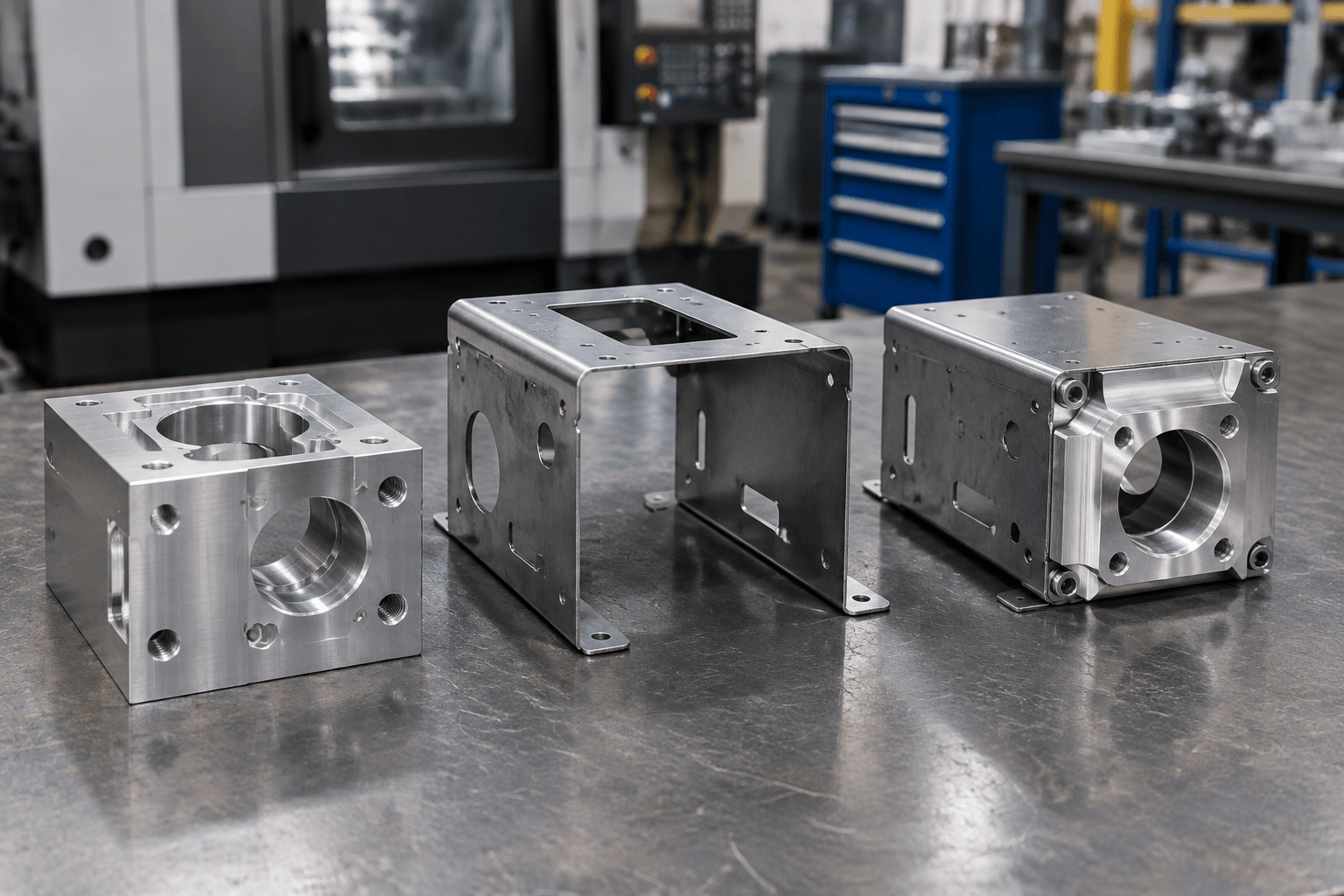
Machining a large enclosure from solid stock may require extensive material removal where cut-and-formed sheet creates the shape more directly. Conversely, a fabricated body can receive post-fabrication machining on a mounting face, bore, or locating interface. A hybrid decision should consider the finished assembly and datum relationships, rather than outside dimensions alone.
Fabricated parts introduce their own route-specific conditions, including bend allowance, springback, bend relief, hole position relative to bends, flatness, weld distortion, assembly fit, and handling. These are not reasons to reject fabrication; they are requirements to address in the drawing, process sequence, and inspection plan.
Machined, fabricated, or hybrid? Route-selection matrix
| Part characteristic | Route to evaluate | Main point to verify | Information needed |
|---|---|---|---|
| Solid component with substantial material removal | Machining from plate, block, bar, or a suitable blank | Material utilization, cycle time, workholding, and stock movement | 3D model, material condition, critical surfaces, tolerances, quantity, and annual demand |
| Pockets, bores, threads, or controlled mounting interfaces | Machining, potentially with a fabricated body | Tool access, datum transfer, burrs, and measurement access | Datum scheme, feature tolerances, thread details, mating information, and inspection requirements |
| Flat profile with repeated bends | Sheet cutting and bending | Springback, bend allowance, bend access, and hole location | Formed model or flat-pattern information, material, thickness, bend requirements, appearance needs, and quantity |
| Large enclosure, frame, or welded structure | Fabrication with appropriate joining, potentially followed by local machining | Distortion, flatness, squareness, fit, and machining allowance | Assembly drawings, joining details, critical faces, load requirements, and inspection points |
| Fabricated body with a controlled interface | Hybrid fabrication and machining | Transfer of references from the structure to the machined feature | Interface datums, joining sequence, mating requirements, batch size, and annual demand |
Illustrative route-review examples
These examples are not customer cases or fixed process recommendations. They show how functional features can change the route that a buyer should evaluate.
- Pocketed housing: A compact housing with internal pockets, a controlled bore, threaded holes, and a sealing face may justify machining from solid stock. The review should focus on cutter access, internal radii, datum relationships, wall movement, deburring, and how the bore and sealing face will be inspected.
- Bent enclosure: An enclosure dominated by flat panels and repeated bends may be better evaluated as sheet-metal fabrication than as a pocket machined from a block. Hole position near bends, springback, hardware installation, cosmetic surfaces, assembly fit, and production quantity remain important quotation inputs.
- Frame with locating interfaces: A large joined frame may use fabrication for the main structure and machining for bearing seats, mounting faces, or locating holes. The drawing should define post-joining datums, machining allowance, critical interface relationships, distortion controls, and the inspection stage used to verify final alignment.
Compare routes against the same functional requirements: avoidable stock waste, machining setups, forming or joining operations, and the features that actually require material removal. Review the custom CNC machining service information and custom sheet-metal fabrication overview while preparing part data; final feasibility depends on the released design.
Material, stock condition, and machinability
Material selection connects end-use performance to the production route. A material-family name alone is not enough to finalize a machining or fabrication decision because grade, temper, hardness, stock condition, geometry, and service environment can change cutting, forming, and joining behavior.
| Material family | Route considerations | Questions to resolve |
|---|---|---|
| Aluminum | Weight, corrosion behavior, thermal performance, and machinability can be relevant; properties vary by alloy and temper. | Does the specified condition meet load, wear, forming, joining, appearance, and service requirements? |
| Carbon steel | Grades and conditions differ in strength, hardness, cutting behavior, formability, and weldability. | Is corrosion protection needed, and will the specified condition affect machining or later fabrication? |
| Stainless steel | Grade and work-hardening behavior can affect machining and forming alongside corrosion requirements. | Which grade suits the environment, and are surface condition and joining requirements defined? |
| Brass or copper | Electrical, thermal, corrosion, or wear-related functions may guide selection, depending on grade. | Which functional property is required, and how will surface condition, joining, and handling be controlled? |
A material that machines readily is not automatically the best product material. It may be unsuitable for the required forming, welding, wear, temperature, corrosion exposure, or service environment. Assess loads, weight, thermal behavior, surface requirements, available stock forms, and downstream assembly together.
Cost, lead time, and inspection planning
Two parts with similar outside dimensions can have different prices and schedules because their removal volume, feature access, setup count, and verification requirements differ. The useful comparison is not overall size alone, but the combined effect of stock, operations, and the requirements needed to prove the part conforms.
- Raw stock and removal: Grade, condition, stock form, purchasing quantity, and the difference between starting and finished volume affect material use.
- Planning and setup: Programming, workholding, datum changes, special supports, and revision status affect one-time effort.
- Cutting and finishing: Tool reach, accessibility, tool wear, finishing passes, deburring, and separate specified operations affect recurring effort.
- Quantity and verification: Prototype quantity, batch size, annual demand, first-piece review, inspection records, and drawing maturity affect how setup and quality work are distributed.
For a sheet-metal alternative, compare nesting, cutting, bend setups, joining, fastening, inspection, and assembly. Fabrication may reduce stock removal while adding components and joints; machining may reduce interfaces while consuming more raw material or machine time. There is no universal size or volume threshold that determines the lower-cost route.
Lead time normally includes drawing and feasibility review, material sourcing, programming, fixture preparation, initial setup, production, deburring, any specified secondary operations, inspection, documentation, and packing. Drawing revisions, material availability, approval holds, or unresolved inspection criteria can affect the sequence, so a supplier should confirm the schedule for the released part rather than rely on a universal estimate.
Before production, provide the current 2D drawing and 3D model, revision control, material and stock condition, functional datums, critical dimensions, tolerances, threads, surface and edge requirements, and any marking, inserts, treatment, or assembly requirements. Identify inspection records that are justified by the part, such as first-piece or first-article confirmation, dimensional reports, material documentation, or CMM reporting. State RoHS or other applicable finished-product documentation requirements and packaging or identification needs. The quality control information provides additional context for inspection planning.
Prepare a route-review request
For an early route review, submit the current 2D drawing and 3D model, material grade or family and stock condition, prototype quantity, production batch size, and estimated annual demand. Include critical dimensions, datums, tolerance requirements, threads, surface specifications, inspection reports, material documentation, compliance needs, packaging, and delivery requirements.
Yishang can review machining, sheet-metal fabrication, and hybrid alternatives against the same functional requirements and identify missing or conflicting specifications before a quotation is prepared.
Where RFQ Assumptions Create Cost and Production Risk
Many sheet metal fabrication problems begin before production starts. If drawings, tolerances, finish expectations, material grades, or assembly requirements are unclear, suppliers may quote based on different assumptions. That can make prices difficult to compare and may lead to rework, cosmetic rejection, assembly misalignment, or production delays later.
For OEM buyers, the goal is not simply to request the lowest price. The goal is to make sure each supplier is quoting the same manufacturing reality. Before confirming an order, clarify which dimensions are fit-critical, which surfaces are cosmetic, whether prototypes must match batch-production conditions, and how finished parts will be inspected.
Frequently asked questions
These questions help buyers prepare drawings, prototype requirements, tolerance strategy, finish information, and quantities for a metal-part RFQ.
Is machining of metal parts the same as CNC machining?
Not exactly. Machining is the broader subtractive-process category. CNC machining uses computer-controlled equipment for operations such as milling, turning, drilling, boring, or grinding. The term CNC alone does not define the operation, workholding strategy, tolerance, finish, or inspection plan for a specific drawing.
How is machining different from sheet-metal fabrication?
Machining removes material from a solid workpiece. Sheet-metal fabrication generally cuts flat stock and then forms or joins it. Suitability depends on geometry, stock form, material, quantity, functional requirements, and inspection needs.
Does every dimension on a machined part need a tight tolerance?
No. Tight tolerances should be assigned to features that control function, fit, sealing, movement, alignment, or load transfer. Clearly identify those features and their datums in the RFQ package.
What usually makes a machined metal part more expensive or slower to produce?
Common drivers include difficult-to-source stock, substantial material removal, limited tool access, deep features, thin walls, multiple setups, fixturing, deburring, demanding functional tolerances, inspection, drawing revisions, and separate secondary operations. Quantity and drawing maturity also affect scheduling and quotation.
Can sheet-metal fabrication be combined with machined features?
Yes. A cut-and-bent or welded body may receive a machined mounting face, bore, or locating feature. Define the interface datum, machining allowance, process sequence, inspection method, finish requirements, and mating conditions so variation is managed between operations.