
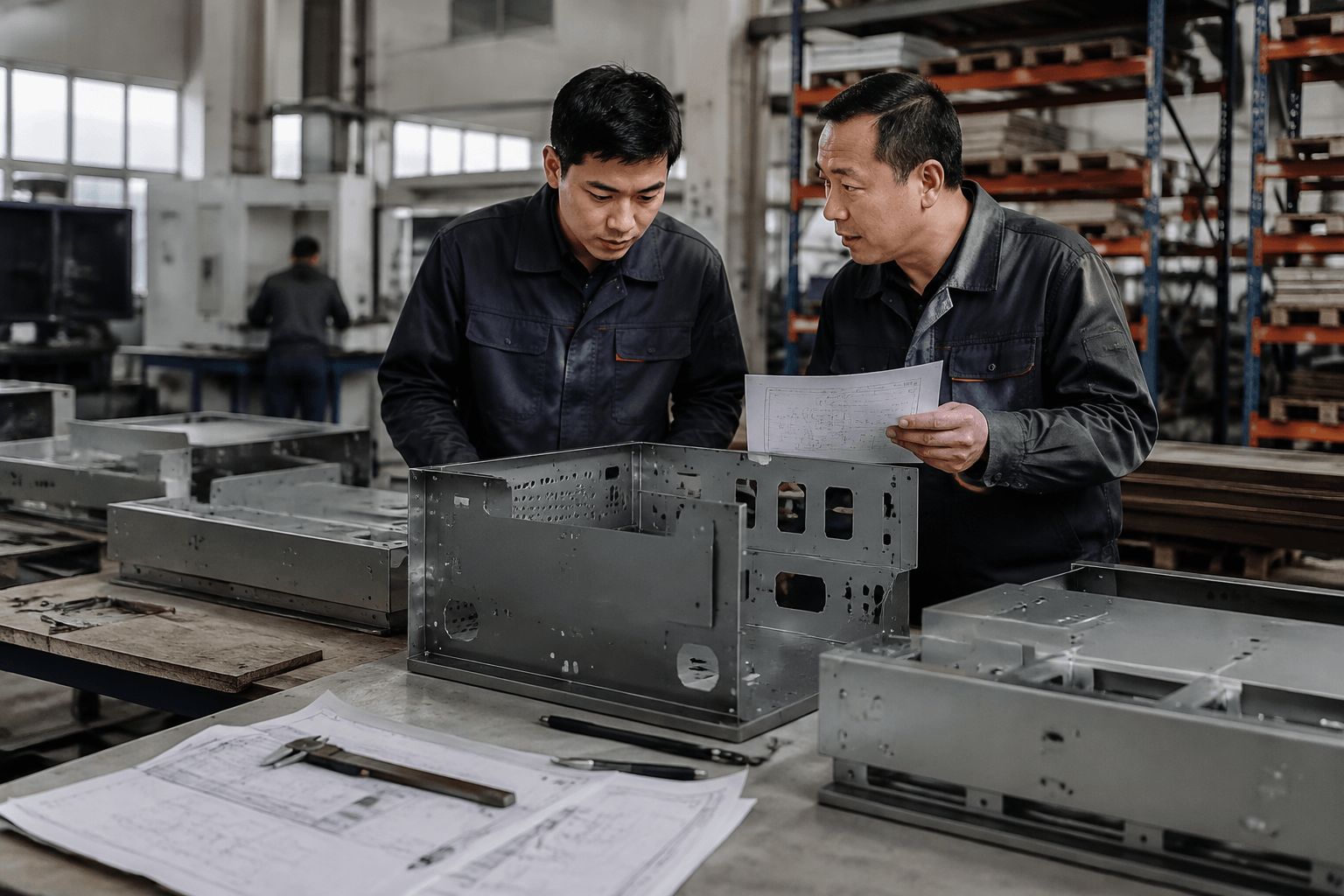
Contract metal fabrication is an outsourced manufacturing arrangement in which a supplier produces specified metal parts, products, or assemblies for an OEM or other buyer. For a buyer preparing an RFQ or moving a design toward production, the relationship may span prototype review, batch production, and repeat orders, with the supplier responsible for the agreed engineering, fabrication, inspection, packaging, and delivery activities.
This distinction becomes especially important when sourcing from an overseas manufacturer. A supplier may produce a laser-cut bracket as a single job, but an ongoing contract project usually requires clearer ownership of revisions, approvals, documentation, packaging, and future production releases. The actual scope still depends on the product specification and the fabricator’s documented capabilities.
How the contract fabrication relationship works
In an OEM supply chain, contract metal fabrication assigns an external manufacturer responsibility for producing custom metal parts or assemblies to the buyer’s drawings, specifications, purchase orders, and quality requirements. The arrangement may be project-based, ongoing, or divided into development and production stages, depending on how the buyer plans to validate and release the product.
A product family might include metal enclosures, electrical cabinets, frames, brackets, welded assemblies, or laser-cut and bent components. These are examples of possible applications, not a standard package that every contract fabricator supplies.
The word contract describes the manufacturing relationship rather than a particular machine operation. Custom sheet metal fabrication covers production work such as cutting, forming, and joining sheet metal, whether that work is purchased once or repeatedly. Contract fabrication adds a broader agreement covering how the supplier will support design review, approvals, production changes, inspection, and delivery.
- One-off job-shop order: The buyer submits a defined part and receives a quoted quantity. The transaction may end after delivery, with limited responsibility for future revisions or production planning.
- Contract metal fabrication: The buyer and supplier establish a repeatable route for drawings, materials, approvals, batch releases, inspection, changes, packaging, and shipment. Prototypes or samples may be included before regular production.
- In-house manufacturing: The OEM owns the equipment, workforce, process control, and daily production decisions. This provides direct control but also requires investment in machinery, facilities, maintenance, engineering time, and skilled labor.
Both OEM and ODM projects can use contract fabrication. In a typical OEM arrangement, the buyer owns the design and asks the supplier to manufacture it. In an ODM collaboration, the supplier may contribute design refinement or a manufacturable product concept, subject to the buyer’s review and approval. Some projects combine both approaches: the OEM defines the product’s function and requirements, while the fabricator recommends changes that improve manufacturability without altering the intended use.
Matching the production route to the product
A contract route may connect several operations, but buyers should not assume that every supplier provides every process, material, finish, tolerance, assembly service, or production volume. Before comparing quotations, the proposed route must be matched to the part geometry, material, thickness, quantity, joining method, appearance requirements, and final installation or use.
- Engineering and material confirmation: The supplier reviews drawings, 3D data, bills of materials, material requirements, tolerances, finishes, and assembly interfaces. Missing or conflicting information should be resolved before production is released.
- Cutting or punching: Laser cutting may be suitable for varied contours, prototypes, or changing designs. CNC punching may suit repeated holes, forms, or production patterns when the available equipment and tooling support the design.
- Bending and forming: Flat blanks may be formed into panels, covers, brackets, cabinets, channels, or frames. Bend direction, inside radius, hole position, and tool access can affect manufacturability and final fit.
- Joining: Welding, fasteners, inserts, riveting, or another specified method may be selected according to load, appearance, service access, and assembly requirements. A welded frame is not interchangeable with a bolted frame unless the product specification has been reviewed accordingly.
- Finishing and assembly: Deburring, painting, powder coating, plating, hardware installation, or subassembly may be included when the product requires these operations and the supplier accepts them within the scope. Finishing and assembly are not automatic features of every fabrication order.
- Inspection, packaging, and shipment: The supply route concludes with the agreed inspection records, protective packaging, labels, shipping documents, and delivery handoff.
CNC machining belongs to a different process family. A fabricated enclosure may require a machined interface or separately machined component, but CNC milling, CNC turning, die casting, injection molding, extrusion, and metal turning should be evaluated as separate or hybrid supply requirements rather than treated as sheet metal fabrication. If one of these processes is central to the product, the sourcing plan may require more than one specialist supplier.
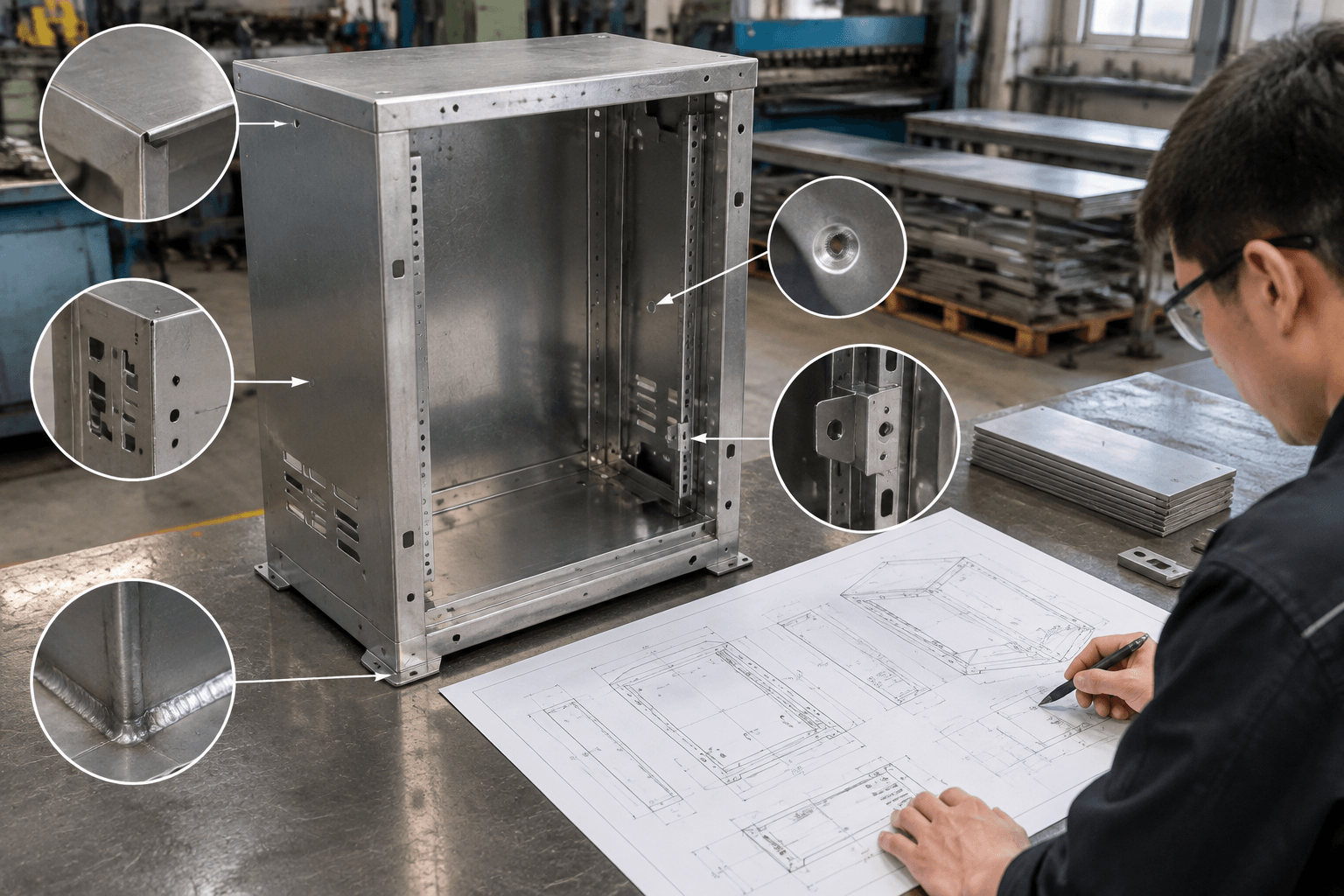
Moving from drawing review to repeat production
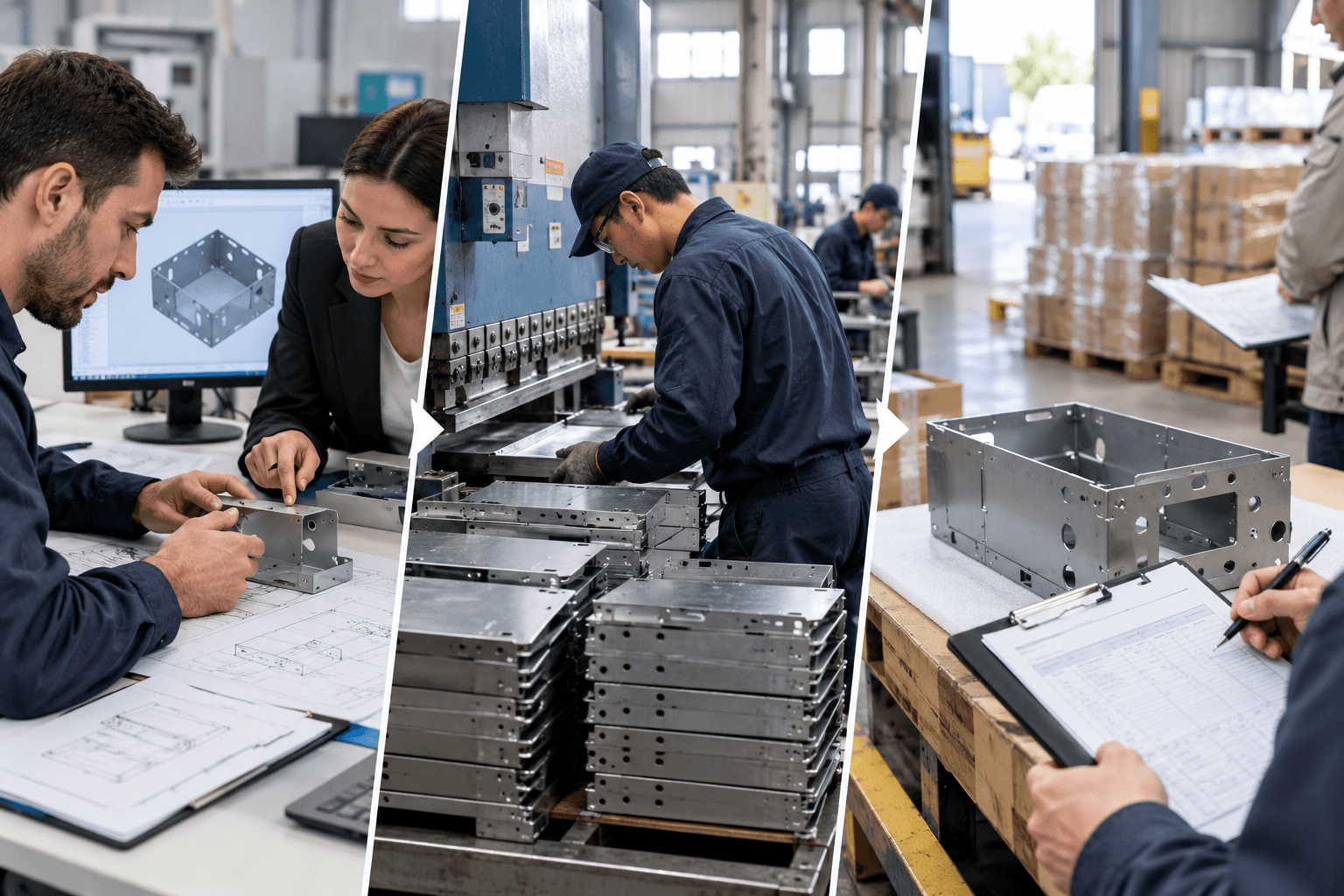
Once drawings are submitted, a contract project is easier to control when each stage has a defined decision point and approval owner. The sequence below provides a practical model for moving from design review to production, although the precise steps will vary with product complexity and the agreed quality plan.
- Review the drawing and BOM: The buyer provides the current drawing revision, parts list, relevant 3D files, material and finish information, tolerance requirements, joining details, and assembly expectations. The supplier identifies missing or conflicting information before pricing or production release.
- Discuss manufacturability: Engineering review may raise questions about bend access, hole-to-edge distance, weld access, distortion, hardware installation, or finish coverage. A supplier recommendation must remain separate from a buyer-approved design change. A suggested alteration is not authorized until the applicable revision or deviation has been documented.
- Review a prototype or sample when needed: A sample can help confirm fit, appearance, installation, or assembly sequence before batch production. This can be particularly useful for cabinets, enclosures, and assemblies, where a small change to a mounting hole, bend, gasket interface, or installed component may affect downstream assembly.
- Define first-piece approval: The buyer and supplier can agree on how the first produced piece or initial batch will be checked and which records are required. First-piece or first-article confirmation is a project activity to define, not an automatic feature of every quotation.
- Release production: After design approval, the parties establish the applicable revision, release quantity, material purchasing plan, operation sequence, inspection points, and expected handoffs. Prototype, short-batch, and repeat orders may each require different planning.
- Control changes and complete delivery: Later changes should identify the affected revision, remaining inventory, open orders, approval owner, and implementation date. Before shipment, the supplier completes the agreed inspection and prepares the required packaging, labeling, documentation, and freight handoff.
This lifecycle also clarifies communication responsibilities. The supplier can raise engineering concerns and recommend a production adjustment, but the buyer or designated engineering authority must approve changes affecting product definition, fit, function, appearance, or acceptance criteria.
Evaluating capability beyond the equipment list
Equipment is relevant, but a list of laser cutters, press brakes, or welding equipment does not show whether a supplier can control the complete manufacturing route. OEM buyers should compare the proposed process with the actual product requirements, request project-relevant evidence, and confirm what the quotation includes.
| Evaluation area | What to verify |
|---|---|
| Technical scope | Relevant materials, geometry, forming, joining, finishing, assembly, tolerance interpretation, and ability to support the expected order pattern. |
| Engineering support | How drawings and BOMs are reviewed, how DFM questions are raised, who approves changes, and how revision status is controlled. |
| Quality evidence | Applicable inspection records, first-piece confirmation arrangements, process documentation, final inspection responsibilities, and the method for handling nonconforming parts. The supplier’s quality-control approach can provide additional context. |
| Production planning | How prototypes, short batches, and repeat releases are scheduled, including material purchasing, fixtures, work instructions, and production-status communication. |
| Commercial transparency | Part pricing, setup or fixture charges when applicable, packaging, freight, documentation, approved substitutions, and other project-specific costs. |
| Delivery coordination | Packaging protection, labels, destination requirements, export documents, shipment ownership, and the process for communicating dispatch information. |
Quality evidence should reflect the product’s actual risks. A visible enclosure may require defined appearance criteria, while a welded frame may need particular attention to alignment, distortion, and assembly interfaces. Buyers should also clarify material purchasing, traceability expectations, approved substitutions, and which records must accompany each shipment.
Company background is relevant, but it does not replace a project-specific review. Yishang states that it has more than 26 years of experience in custom metal manufacturing, exports to more than 50 countries, focuses on B2B custom manufacturing, supports OEM and ODM work, and has ISO and RoHS certifications. These facts should be considered alongside the supplier’s confirmed fit with the buyer’s drawings, materials, quality requirements, and delivery model.
Responsibilities to agree before production
Many outsourcing problems arise from gaps in responsibility rather than from the fabrication operation itself. Before material is purchased or production begins, the contract, purchase order, quality agreement, or project record should identify who owns each decision, which document controls production, and how changes will be authorized.
| Topic | Points to agree |
|---|---|
| Product definition | Approved drawing and BOM revision, material, thickness, finish, tolerances, joining method, acceptance criteria, and required documentation. |
| Development assets | Ownership and maintenance of tooling, fixtures, nests, gauges, inspection aids, design files, and intellectual property. |
| Approvals and deviations | Prototype approval, production release, deviation requests, rework, replacement, corrective action, and authority to approve changes. |
| Orders and delivery | Forecast versus firm quantities, release timing, packaging protection, labels, destination rules, freight responsibility, and shipping documents. |
A forecast can support material and production planning, while a firm release authorizes a defined quantity and revision. The agreement should explain what happens if the buyer changes the design after material has been purchased or parts have entered production. It should also state who evaluates the effect on open orders, existing inventory, tooling, and delivery plans.
Packaging deserves the same attention as fabrication. A powder-coated panel, stainless steel enclosure, or assembled cabinet may need protection against abrasion, moisture, impact, or movement of loose hardware. The packaging method should suit the destination, handling route, and required arrival condition. Buyers planning international delivery can review the supplier’s shipping information as part of that discussion.
Is contract metal fabrication the right sourcing model?
Contract fabrication is often appropriate when an OEM needs recurring custom parts, metal enclosures, cabinets, frames, welded assemblies, or staged production but does not want to maintain all the required equipment and labor internally. It may also suit projects that need prototype feedback before repeat orders, provided the supplier’s technical scope and production model match the requirements.
| Project condition | Likely sourcing direction | What to review |
|---|---|---|
| Recurring custom sheet metal parts or assemblies | Contract fabrication is often suitable. | Revision control, repeat-order planning, material consistency, inspection records, and packaging. |
| Prototype followed by short-batch production | Potentially suitable if the supplier supports design review and controlled release. | Sample approval, DFM communication, fixture needs, and the transition from prototype to production. |
| Product requires cutting, bending, joining, finishing, and assembly | Suitable only if the proposed supplier covers or manages the required route. | Which operations are performed internally, which are outsourced, and who owns final quality. |
| Highly machined, cast, molded, or extruded geometry | Consider a specialized or hybrid supply chain. | Whether the fabricated portion should be sourced separately from CNC machining or another process. |
| In-house equipment and skilled labor are already available | Compare internal production with external contracting. | Total equipment and labor requirements, engineering ownership, flexibility, quality control, and management effort. |
| Unusual materials or specialized certifications | Proceed only after capability and documentation are verified. | Material availability, traceability, certification scope, inspection requirements, and customer acceptance criteria. |
The right answer depends on the complete product specification and commercial model. A contract fabricator may be a strong fit for an enclosure program but not for a component whose main value lies in precision machining or molding. Conversely, keeping every operation in-house may be impractical when demand is variable or the necessary equipment cannot be justified. Comparing technical scope, quality ownership, engineering workload, change control, and delivery coordination usually provides a more reliable decision than comparing piece prices alone.
For a relevant application involving formed panels, hardware, finishing, and assembly readiness, see custom sheet metal enclosures.
Frequently Asked Questions
These questions address common points OEM buyers should clarify before submitting drawings or approving a contract fabrication supplier.
Is contract metal fabrication the same as custom sheet metal fabrication?
No. Custom sheet metal fabrication describes the production of sheet metal parts or products, while contract metal fabrication describes the outsourced manufacturing relationship and the responsibilities it includes. A contract may cover sheet metal fabrication together with inspection, assembly, packaging, change control, and repeat-order management.
Can a contract metal fabricator support prototype review and repeat batch production?
Some suppliers can support both stages, but buyers should confirm this before approving the project. Ask how the supplier handles DFM questions, prototype quantities, sample review, first-piece confirmation, production release, revision control, and the transition from an approved sample to repeat batches.
Does contract metal fabrication include finishing and assembly?
It may, when the drawings or product specification require these services and the supplier includes them in the agreed scope. Painting, powder coating, hardware installation, welding, and final assembly should be defined clearly enough to establish responsibility, acceptance criteria, and the required condition at shipment.
What should an OEM provide for a contract fabrication review?
Provide current drawings or 3D files, the applicable revision, BOM, material and finish requirements, tolerances, joining details, and quantities for the prototype or production stage. Also identify assembly interfaces, packaging and labeling needs, destination, inspection documentation, and change-control expectations. This information allows the supplier to review the process route, commercial scope, and delivery responsibilities together.