
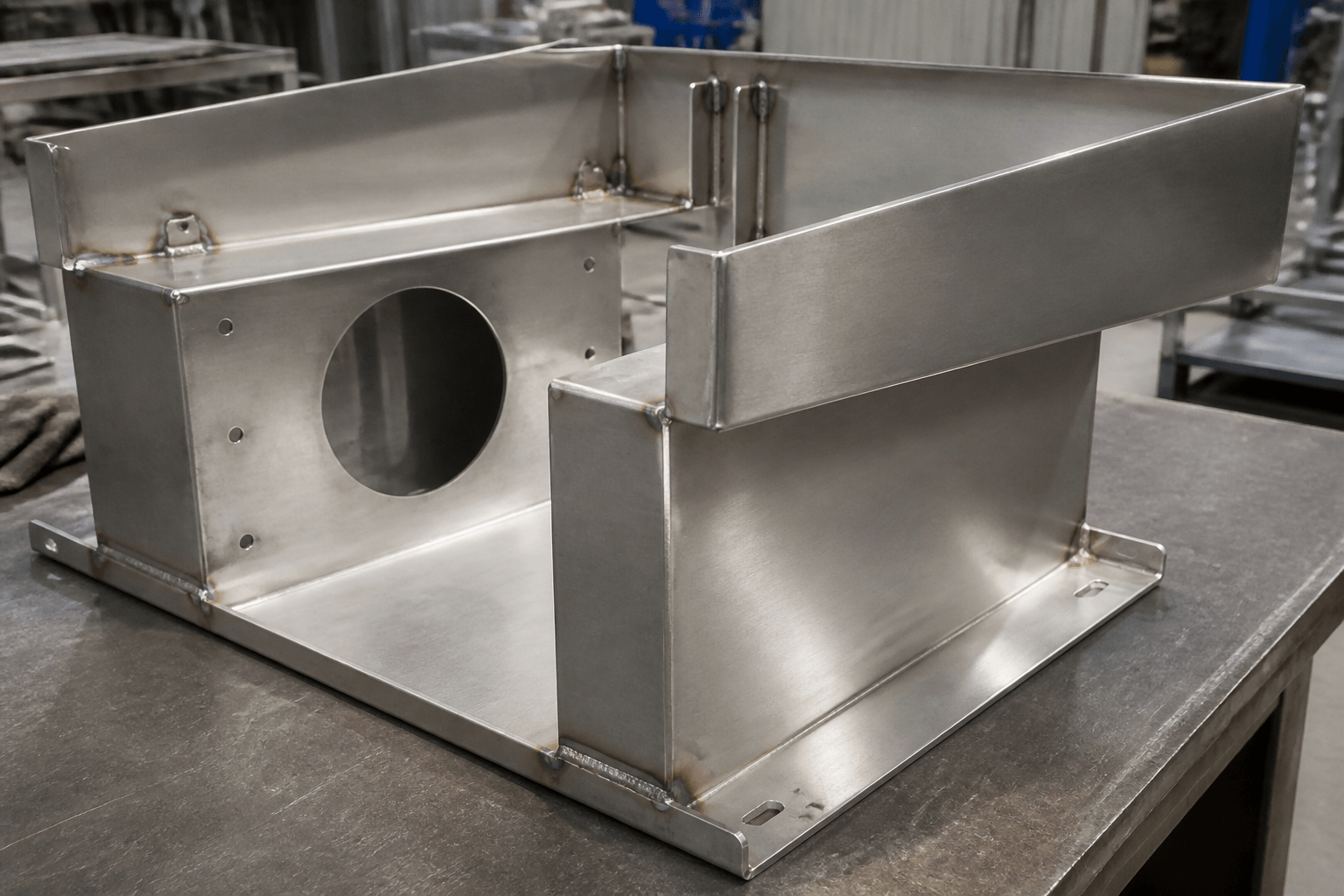
304 grade stainless steel is a widely used austenitic chromium-nickel stainless steel, commonly identified as UNS S30400. It combines useful corrosion resistance, formability, weldability, and surface-finish options, but suitability depends on the product form, material condition, exposure, fabrication method, and drawing requirements.
For a custom metal product, specifying only “304 stainless” is often incomplete. Engineers should also define the governing material specification, sheet or bar form, thickness, temper or condition, surface finish, weld treatment, critical dimensions, and inspection expectations.
What the 304 Designation Means
Type 304 belongs to the 300-series austenitic stainless steels. Its corrosion resistance comes primarily from chromium, which supports formation of a passive oxide layer on the surface. Nickel helps stabilize the austenitic structure and contributes to ductility and fabrication behavior.
304 is also identified as UNS S30400. EN 1.4301, often designated X5CrNi18-10, is a closely related European grade, but these identifiers should not be treated as automatically interchangeable. The required chemistry, mechanical properties, dimensions, testing, and documentation are controlled by the applicable product standard.
| Element | Typical specified range for Type 304 | Material significance |
|---|---|---|
| Chromium | 18.0–20.0% | Supports passivation and general corrosion resistance. |
| Nickel | 8.0–10.5% | Helps maintain the austenitic structure and good formability. |
| Carbon | 0.08% maximum | Higher carbon can increase sensitization concerns after certain thermal cycles. |
| Manganese | 2.00% maximum | Used in steelmaking and influences material behavior. |
| Silicon | 0.75% maximum | Acts mainly as a deoxidizer. |
| Phosphorus | 0.045% maximum | Controlled as a residual element. |
| Sulfur | 0.030% maximum | Controlled because it can affect corrosion and fabrication behavior. |
| Nitrogen | 0.10% maximum | Contributes to austenite stability and strength. |
| Iron | Balance | Base metal. |
These limits are commonly associated with ASTM Type 304, but purchasers should verify the current standard and product specification. Examples include ASTM A240 for chromium and chromium-nickel stainless plate, sheet, and strip; ASTM A276 for bars and shapes; ASTM A269 for certain tubing; and ASTM A312 for pipe. A sheet certificate issued to one specification does not establish compliance with an unrelated bar, tube, or pipe specification.
Properties and Their Design Implications
Property values vary with thickness, cold work, heat treatment, product form, test direction, and governing specification. The following figures are representative reference values rather than universal acceptance criteria.
| Property | Representative context or value | Design implication |
|---|---|---|
| Density | Approximately 8.0 g/cm³ | Useful for estimating component weight from finished volume. |
| Tensile strength | About 515 MPa minimum for annealed flat product under commonly referenced ASTM A240 requirements | Cold-worked material may be stronger, but it will not have the same forming behavior. |
| Yield strength | About 205 MPa minimum in the same general annealed flat-product context | Actual springback and forming load depend on condition, thickness, and bend geometry. |
| Elongation | Often specified around 40% minimum for relevant annealed products, subject to specimen and thickness rules | Supports drawing and forming, although local work hardening must still be managed. |
| Thermal conductivity | Approximately 16 W/m·K near room temperature | Heat is conducted less efficiently than in carbon steel, affecting welding and machining heat control. |
| Thermal expansion | Approximately 17 µm/m·K over a near-ambient temperature range | Welded assemblies and temperature-exposed parts may distort or change fit. |
| Corrosion behavior | Good resistance in many atmospheric, freshwater, and mildly corrosive environments | It is not corrosion-proof. Chlorides, crevices, contamination, chemicals, and temperature can change performance. |
304 is frequently selected for housings, panels, brackets, guards, counters, tanks, and equipment components. It can also be used in stainless food and beverage equipment, but grade selection alone does not establish food-contact suitability. Surface design, cleanability, weld quality, contamination control, regulations, and the actual process media must also be reviewed.
Where chloride exposure, coastal spray, cleaning chemicals, or persistent crevices are important, 316 may deserve evaluation because its molybdenum content generally improves resistance to chloride-related pitting. That is an environment-specific comparison, not a rule that one grade is always better.
Product Forms, Conditions, and Surface Finishes
304 is produced as sheet, strip, coil, plate, bar, tube, pipe, wire, and other forms. A fabricated enclosure may begin with sheet or coil, while shafts, spacers, or threaded inserts may require bar. Tubular frames require a tube specification that also defines dimensions, wall thickness, manufacture, and testing.
| Form or finish | What the buyer should consider |
|---|---|
| Sheet, strip, or coil | Specify thickness, tolerance basis, condition, flatness where critical, and rolling or polish direction. |
| Plate | Define thickness, surface condition, edge preparation, and any flatness or machining requirements. |
| Bar | State cross-section, dimensional tolerance, condition, and whether machining or polishing follows. |
| Tube or pipe | Do not use the terms interchangeably. Specify the applicable standard, outside diameter or nominal size, wall, seam condition, and finish. |
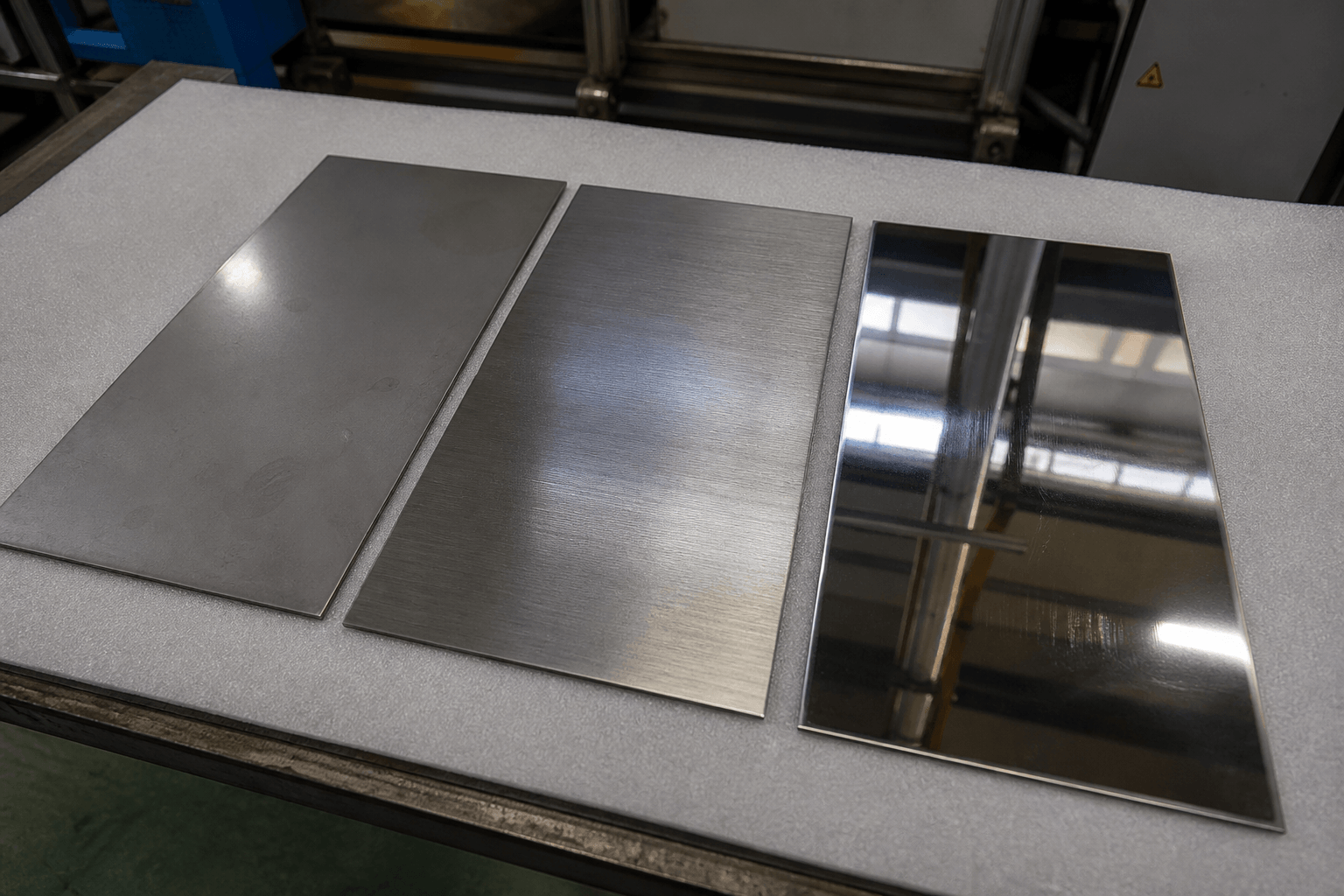
| No. 1 | A hot-rolled, heat-treated, and descaled surface. It is generally less reflective and not selected for a refined cosmetic appearance. |
| 2B | A smooth cold-rolled mill finish produced through finishing operations that include a light final roll. Appearance varies by mill and lot. |
| No. 4 | A directional mechanically polished finish commonly used for visible equipment surfaces. The abrasive specification and acceptable appearance may need clarification. |
| Bright annealed | A smooth, reflective mill-produced surface. It is not identical to a mechanically mirror-polished finish. |
| Custom brushed or polished | Define direction, abrasive sequence or target roughness where functional, protected areas, and an approved visual reference if appearance is critical. |
Finish names alone may not control visual consistency. Grain direction becomes obvious when adjacent panels are assembled under the same lighting. For visible 304 stainless sheet metal enclosures, drawings should show the directional grain and identify Class A cosmetic surfaces. Protective film type and the production stage at which it is removed can also affect handling and appearance.
304 vs. 304L: Differences That Affect Specification and Fabrication
| Decision point | 304 | 304L |
|---|---|---|
| UNS designation | S30400 | S30403 |
| Carbon limit | 0.08% maximum | 0.030% maximum |
| Welded construction | Suitable for many welded parts, but section size, heat input, exposure, and post-weld condition require review. | Lower carbon reduces susceptibility to sensitization associated with welding and certain thermal exposure. |
| Mechanical requirements | Controlled by product form, condition, and specification. | May have different specified strength requirements; do not assume identical values. |
| Selection approach | Often appropriate for formed or lightly welded general-purpose components in compatible environments. | Often considered for welded assemblies where resistance to weld-related sensitization is important. |
Dual-certified 304/304L material is available in parts of the supply chain when its chemistry and properties satisfy both designations, but availability should be confirmed for the required form and specification. A drawing should not replace 304 with 304L—or the reverse—without reviewing strength, welding, corrosion exposure, and contractual requirements.
How 304 Behaves During Fabrication
Cutting
Laser cutting, punching, shearing, sawing, waterjet cutting, and machining can all be applicable, depending on form and geometry. Heat-affected edges, burr direction, protective film, narrow webs, and cut-edge discoloration should be considered. Stainless tooling and handling practices should limit embedded carbon-steel contamination.
Bending and forming
Annealed 304 has useful ductility but work-hardens as it is deformed. Bend force and springback therefore depend on thickness, condition, bend radius, tooling, and rolling direction. Tight bends, repeated forming, and deep-drawn shapes require process-specific review rather than a single universal radius rule.
Directional finishes add another constraint: tooling contact can mark the surface, while an unsuitable grain orientation may make bends look inconsistent. Drawings should distinguish functional bend requirements from cosmetic restrictions.
Welding
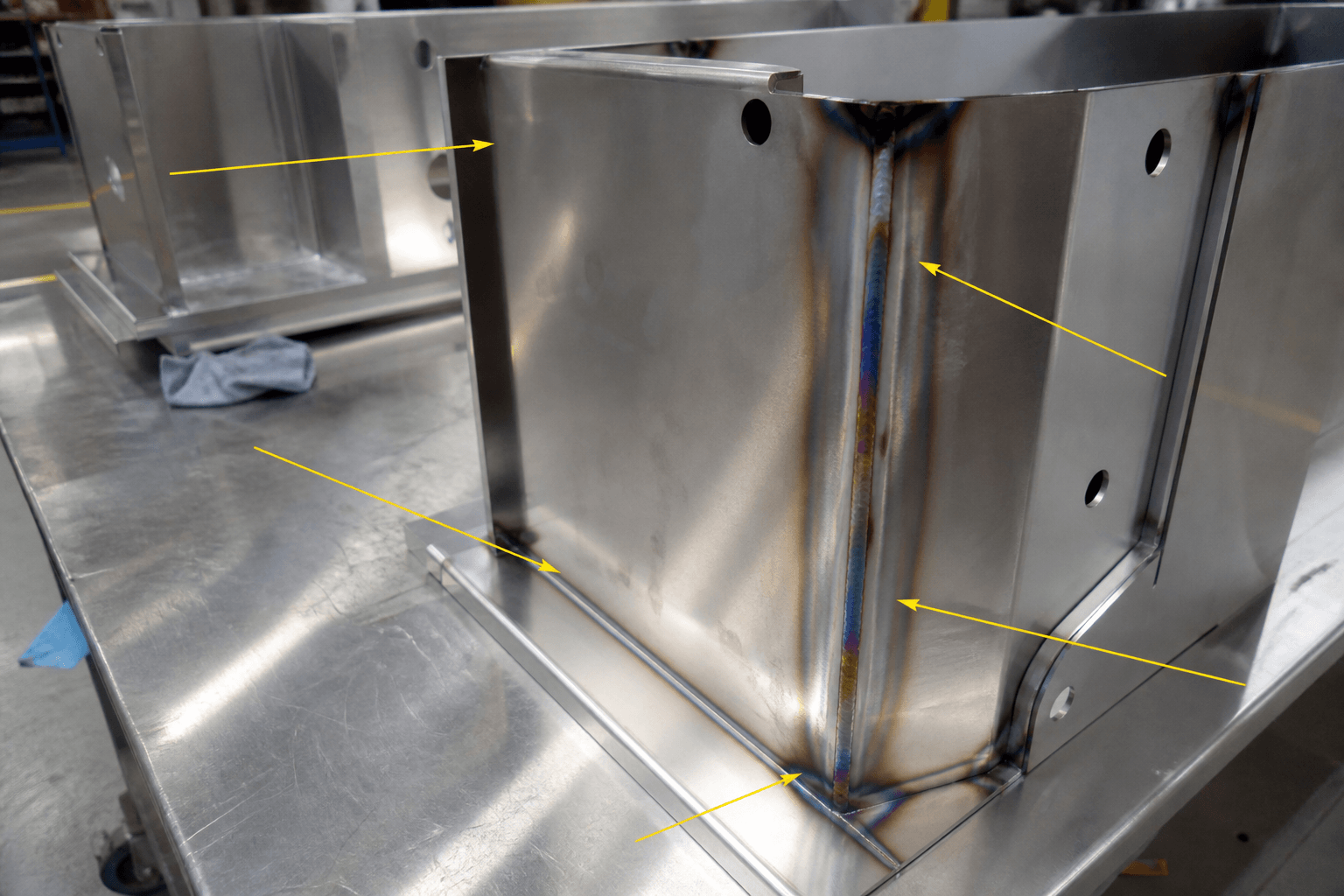
304 can be welded using common stainless welding processes when procedures, filler selection, joint access, and heat input are appropriate. The main design concerns include distortion, shrinkage, heat tint, crevices, burn-through on thin material, and the appearance of dressed welds.
Heat tint indicates oxide formation and can reduce local corrosion resistance if inappropriate for the service environment. Mechanical cleaning, pickling, or passivation may be specified where needed, but these treatments perform different functions and should not be described simply as “clean welds.” Sealed or continuous welds must be shown explicitly rather than inferred from a rendering.
Machining
Machining is separate from sheet metal fabrication, although machined 304 parts often interface with fabricated assemblies. The material work-hardens, retains heat near the cutting zone, and can produce difficult chips. Stable setups, positive cutting action, suitable tooling, coolant strategy, and continuous engagement help avoid rubbing and premature tool wear. Buyers needing discrete bosses, spacers, shafts, or threaded parts can review CNC machining for 304 stainless components as a related process.
Define the Part Clearly on Drawings and Inspection Documents
A useful material callout might read: ASTM A240 Type 304, annealed sheet, 2.0 mm, 2B mill finish, grain direction as shown. This is only an example. The standard, thickness, finish, and condition must match the actual design.
Add the following information where it affects function or acceptance:
- Dimensions and tolerances: Identify critical features rather than applying unnecessarily tight tolerances everywhere. Include datums, formed dimensions, hole positions, and inspection condition.
- Assembly interfaces: Define inserts, fasteners, hinges, seals, machined parts, mating gaps, grounding points, and allowance for weld or forming distortion.
- Grain and cosmetics: Mark polish direction, visible faces, areas protected from weld spatter, and permitted scratches or color variation. An approved physical sample can supplement words when appearance is subjective.
- Weld requirements: Show weld location, length, continuity, profile, dressing, and post-weld cleaning. Avoid ambiguous instructions such as “weld all around” where access or sealing intent is unclear.
- Surface treatment: State whether the requirement is mill finish, mechanical brushing, polishing, passivation, electropolishing, or another defined operation.
- Inspection and records: List critical measurements, finish or roughness checks, weld acceptance criteria, and any requested material certificates, heat traceability, or positive material identification. These records are options, not automatic requirements for every part.
For a drawing and material-callout review, provide the part drawing or 3D model, required grade and product form, service environment, finish expectations, critical dimensions, and assembly interfaces. Yishang supports B2B OEM and ODM custom manufacturing and has more than 26 years of experience producing custom sheet metal parts and metal products. A review can identify missing material, fabrication, finish, or inspection details before production planning.
Frequently Asked Questions
Is 304 stainless steel magnetic?
Annealed 304 is generally considered nonmagnetic or only weakly magnetic. Cold forming, bending, drawing, or machining can transform part of its structure and produce a measurable magnetic response. Magnetism alone is therefore not a reliable grade-verification method.
What is the practical difference between 304 and 304L?
304L has a lower maximum carbon content, which reduces susceptibility to sensitization during welding and some thermal exposures. Selection still depends on the product specification, required mechanical properties, weld condition, and service environment; the grades should not be substituted automatically.
Can 304 stainless steel rust or stain?
Yes. Chlorides, deposits, crevices, aggressive chemicals, heat tint, or contamination by carbon-steel particles can cause staining or localized corrosion. Correct grade selection, drainage, cleaning, fabrication control, and appropriate surface treatment all influence performance.
Which finish should be specified for a visible 304 sheet metal part?
No. 4 or another controlled directional brushed finish is common for visible panels, while 2B may suit less cosmetic surfaces. Specify grain direction, acceptable variation, protected faces, weld blending, and, when appearance is critical, an approved finish sample or measurable roughness requirement.