
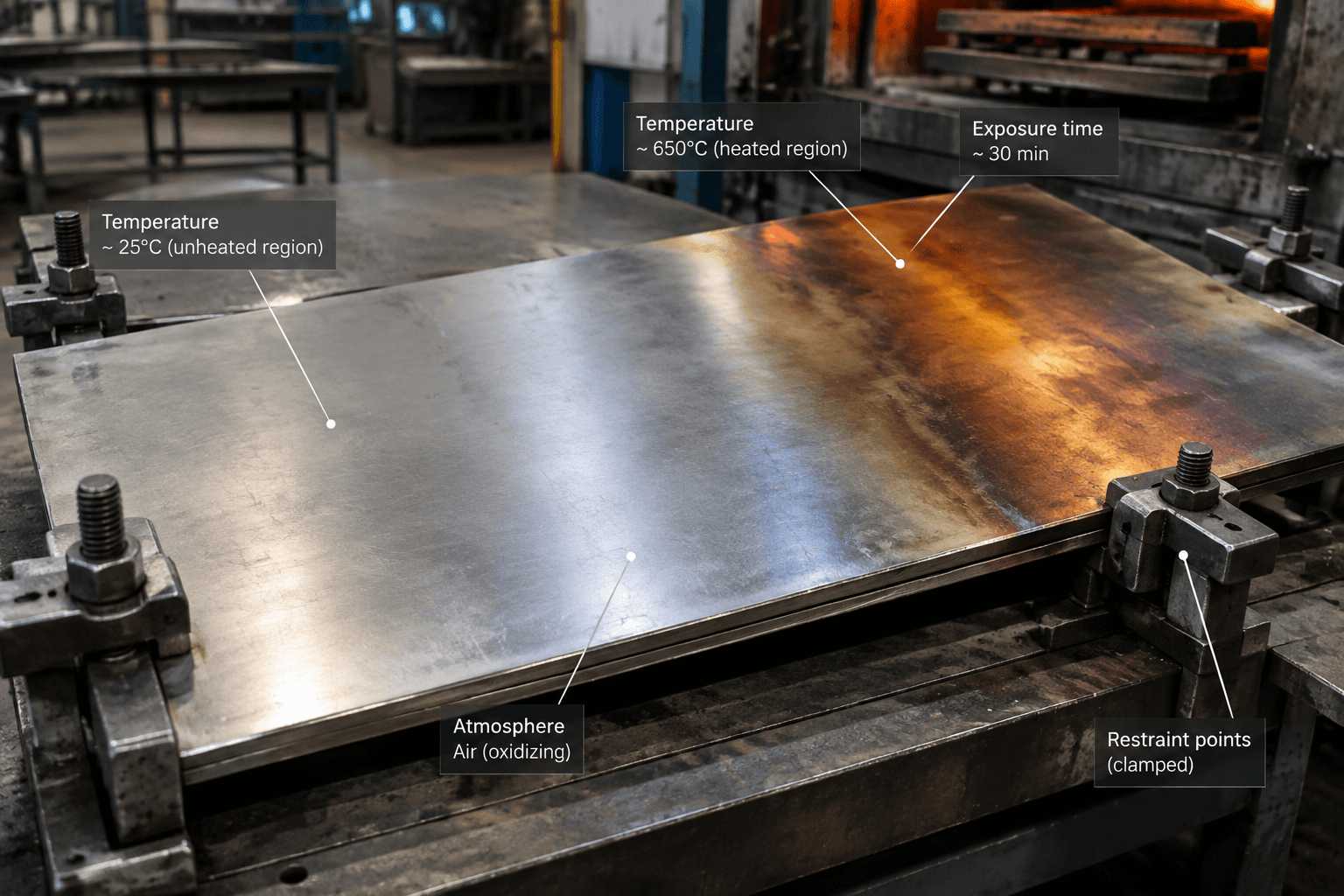
304 stainless steel has useful heat resistance, but no single temperature defines whether it is suitable for an application. Peak, intermittent, and continuous material temperatures must be evaluated separately, together with exposure time, atmosphere, applied load, thermal cycling, geometry, restraint, and required appearance.
A published temperature value is meaningful only when its source states the relevant material condition and service conditions. Oxidation resistance, retained strength, dimensional stability, corrosion behavior, and melting range describe different limits and should not be treated as interchangeable.
What Heat Resistance Means for 304 Stainless Steel
When engineers ask about 304 stainless steel heat resistance, they may be asking several different questions. Will the surface resist oxidation? Will the part retain enough strength under load? Will a panel remain flat? Will weld discoloration be acceptable? Could prolonged heating alter corrosion behavior? Each question requires different evidence.
| Term | What it evaluates | What it does not establish |
|---|---|---|
| Oxidation resistance | Resistance to oxide growth, scaling, and surface degradation in a defined atmosphere | Load capacity, dimensional accuracy, or corrosion resistance after exposure |
| Mechanical-property retention | Strength, stiffness, or ductility available at the operating temperature | Freedom from scaling or distortion |
| Dimensional stability | Expansion, movement, warping, and permanent shape change | Whether the alloy remains chemically resistant |
| Creep resistance | Resistance to gradual deformation under sustained load and temperature | Suitability for short unloaded temperature peaks |
| Melting range | The range in which the alloy changes from solid toward liquid | A permissible design or service temperature |
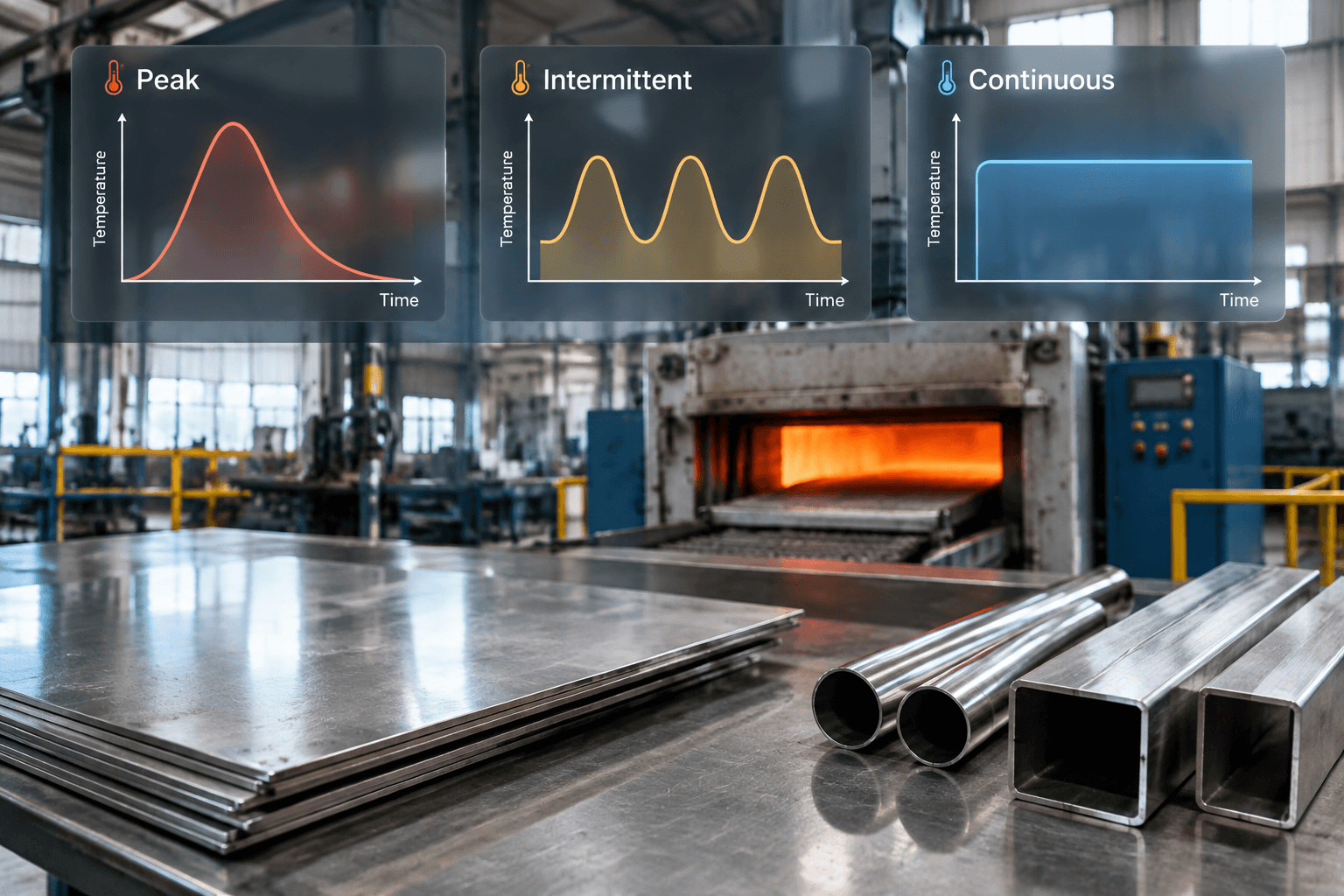
Continuous exposure means the component remains hot for long operating periods. Intermittent exposure includes repeated heating and cooling with enough time at temperature to affect oxidation, dimensions, or properties. A peak may be a brief upset, cleaning event, startup condition, or localized hot spot. These profiles cannot be compared by temperature alone because time and cycle count change the damage mechanism.
Service temperature must also be separated from fabrication heat. Welding can raise a narrow area to a very high temperature for a short time, while an oven panel may experience a lower but prolonged temperature across a much larger area. Neither should be confused with the melting range.
The Same Temperature Can Produce Different Results
Consider three hypothetical parts made from the same grade and thickness. An unloaded shield experiences occasional radiant heating. A welded enclosure cycles between ambient and operating temperature every day. A bracket carries a constant load while remaining hot. Even if all three reach the same measured peak, their likely concerns differ: surface oxidation for the shield, fatigue and distortion around joints for the enclosure, and strength loss or creep for the bracket.
The following conditions determine which interpretation is relevant:
- Actual material temperature: Air, furnace, flame, heater, and material temperatures can differ substantially. Measurement location and hot spots matter.
- Duration and cycles: A brief peak does not represent continuous service. Repeated expansion and contraction can loosen joints or accumulate deformation even when each cycle appears acceptable.
- Atmosphere: Clean air, combustion gases, reducing conditions, moisture, salts, sulfur-bearing gases, and process chemicals can produce different oxidation and corrosion behavior.
- Load: Elevated temperature reduces mechanical properties. A loaded support therefore requires a different assessment from a nonstructural cover.
- Geometry and thickness: Thin sheet responds quickly to heat and can distort around cutouts, bends, seams, or uneven temperature zones. Heavy sections usually develop different temperature gradients.
- Restraint: A free panel can expand. A bolted, welded, or tightly located panel may instead develop thermal stress, buckle, or transfer force into adjacent parts.
This distinction is important in custom sheet metal enclosures, where doors, rails, fasteners, electronics, seals, and mating panels may each have a different temperature and expansion response. The enclosure can remain intact while still failing its fit, alignment, or clearance requirement.
What Can Happen When 304 Is Heated?
Elevated-temperature behavior is best reviewed by failure mode rather than by searching for one universal limit.
| Failure mode | What to examine | Typical engineering concern |
|---|---|---|
| Oxidation and scaling | Atmosphere, material temperature, exposure time, and cycle frequency | Oxide growth, flaking, contamination, or loss of surface quality |
| Strength or stiffness loss | Temperature-dependent properties and applied load | Deflection, reduced load margin, or joint overload while hot |
| Thermal expansion | Temperature difference, part length, clearances, and restraint | Temporary movement, interference, stress, or fastener loading |
| Permanent distortion | Temperature gradients, thin sections, residual stress, joints, and cooling sequence | Warping, loss of flatness, door misalignment, or assembly mismatch |
| Creep | Sustained temperature, stress, duration, and material condition | Progressive deformation during long-term loaded service |
| Sensitization | Time-temperature history, carbon level, welding history, and later corrosive exposure | Chromium carbide precipitation and increased susceptibility to intergranular corrosion under relevant conditions |
| Other microstructural change | Composition, temperature, duration, prior processing, and authoritative metallurgical data | Property changes that cannot be dismissed through a general claim of immunity, including possible sigma-phase concerns under applicable conditions |
| Appearance change | Finish, atmosphere, fingerprints or residues, heat distribution, and cleaning method | Heat tint, uneven color, staining, or a mismatch between welded and unwelded areas |
Some effects are reversible and others are not. Thermal expansion normally reduces as the part cools, but yielding, creep, severe oxidation, metallurgical change, or stress-driven warping may leave permanent consequences. An inspection plan should therefore distinguish dimensions measured hot from dimensions measured after a defined cooling period.
Appearance may be a functional requirement rather than a cosmetic preference. For example, a hypothetical lighting trim could remain structurally serviceable but become unacceptable because repeated localized heating changes its visible finish. For fabricated lighting components, temperature mapping and post-cycle appearance criteria can be as relevant as the nominal grade.
Base Metal, Welds, and Formed Features Need Separate Review
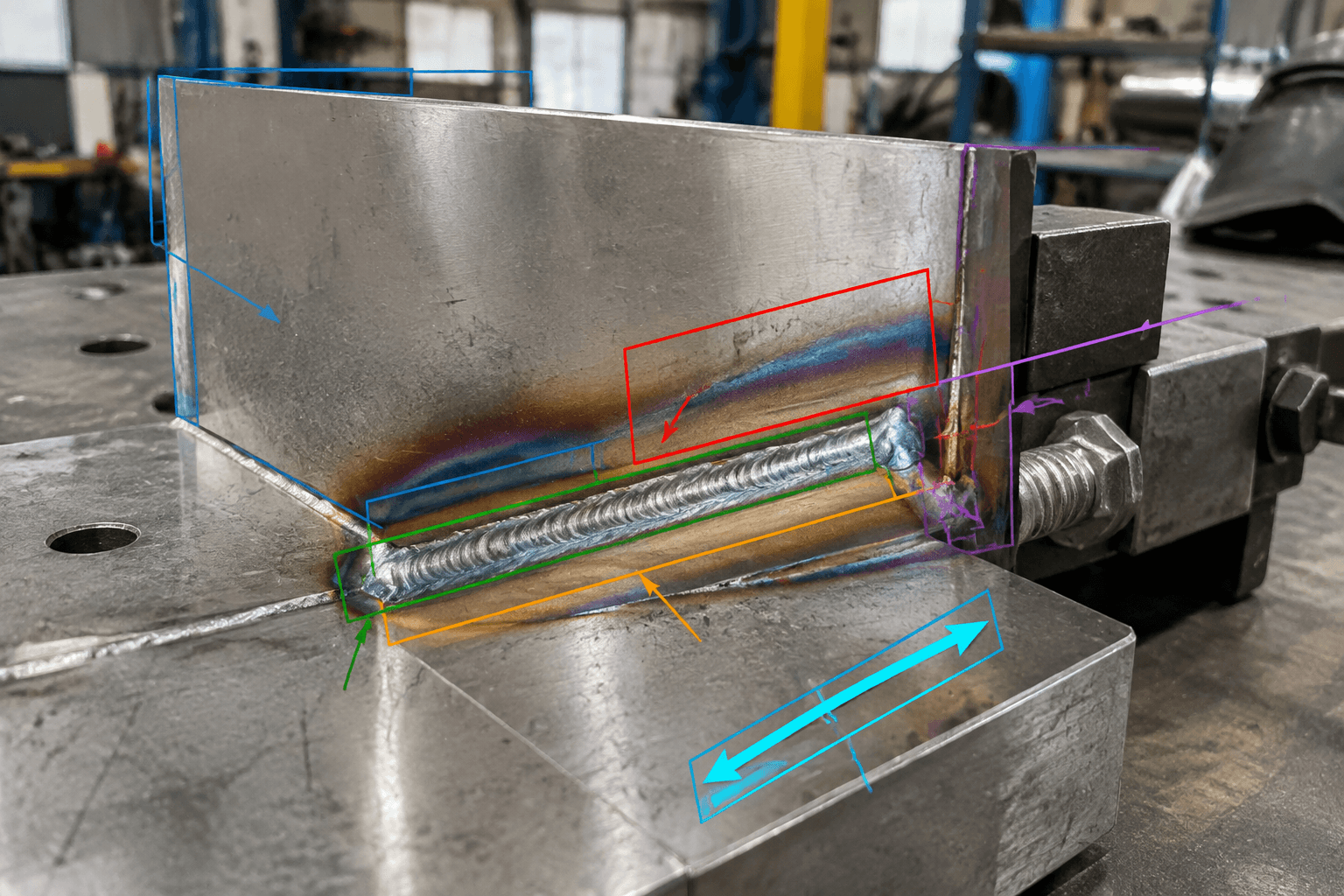
A fabricated 304 component is not thermally uniform. The drawing may specify one alloy, but the finished assembly contains regions with different processing histories and constraints.
- Base sheet: Confirm the specified grade, product form, thickness, temper or condition where relevant, and surface finish. Published data must correspond to the supplied material condition.
- Cut edges and formed areas: Tight bends, louvers, embossed features, and narrow webs can carry forming strain or residual stress. Their stiffness and heating rate may differ from broad flat areas.
- Weld metal: Filler selection, joint design, weld size, and service atmosphere influence performance. The weld should not automatically be assumed to behave exactly like the parent sheet.
- Heat-affected zone: Welding changes the thermal history beside the weld without melting the base material. Heat tint, residual stress, local distortion, and sensitization risk must be assessed according to the actual process and later environment.
- Constrained interfaces: Bolts, studs, frames, hinges, seals, and dissimilar materials can restrict expansion. Slot direction, clearance, fastening sequence, and joint flexibility may determine whether movement is accommodated.
Weld heat input is fabrication exposure, not proof of continuous service capability. Likewise, successful forming at room temperature does not guarantee that a long panel will remain flat through repeated heating. Designers should identify datum features, critical gaps, allowable flatness after exposure, and whether inspection occurs before heating, while hot, or after cooling.
Post-weld cleaning can remove visible contamination or heat tint when an appropriate process is specified, but it does not reverse distortion or erase the component’s thermal history. Where later corrosion matters, surface treatment and acceptance criteria need to be coordinated with the service medium.
304, 316, or 430: Choose for the Dominant Risk
There is no universal winner in a 304 versus 316 versus 430 comparison. Grade selection should start with the failure mechanism that controls the application, using comparable data for the same exposure profile and product condition.
| Grade | Potential reason to consider it | Important qualification |
|---|---|---|
| 304 | Common austenitic stainless choice for formed and welded sheet products where its overall fabrication and service characteristics fit the design | Its suitability still depends on atmosphere, loading, time, cycling, geometry, finish, and post-heating corrosion requirements |
| 316 | Often considered where the contact environment requires greater resistance to certain forms of corrosion than 304 | Better corrosion resistance in a particular medium does not automatically mean better oxidation resistance, strength retention, or dimensional stability at temperature |
| 430 | A ferritic, magnetic stainless grade that may suit selected formed components, environments, and cost targets | Its forming, welding, thermal expansion, corrosion, and elevated-temperature behavior differ from austenitic 304 and 316; equivalent service data and joint requirements must be reviewed |
For heated food or beverage equipment, thermal behavior is only one part of the decision. Contact media, cleaning chemicals, hygienic design, surface condition, applicable food-contact rules, and product compliance require separate verification. The same separation applies when reviewing metal fabrication for food and beverage equipment. Heat resistance alone does not establish oven safety or food-contact suitability.
If oxidation is the controlling risk, compare oxidation data under equivalent atmospheres and durations. If a bracket remains loaded while hot, compare temperature-dependent mechanical and creep data. If chloride-bearing condensate contacts the part after heating, corrosion behavior may dominate. If visual consistency is essential, prototype the specified finish and heating cycle rather than relying only on a grade designation.
Define the Thermal Exposure Before Evaluating 304
A useful application exposure profile records what the part actually experiences. It should include:
- Normal operating, startup, shutdown, upset, and peak material temperatures, including measurement locations
- Time at each condition, heating and cooling rates where relevant, expected cycle count, and required service life
- Atmosphere, ventilation, combustion products, humidity, cleaning agents, salts, and other contact media
- Applied loads while hot, orientation, vibration, and whether loads are constant or cyclic
- Material specification, thickness, finish, bends, cutouts, weld locations, filler requirements, and dissimilar-material interfaces
- Expansion clearances, restrained edges, fastener arrangement, seals, mating parts, and critical assembly dimensions
- Allowable scaling, color change, heat tint, roughness change, distortion, flatness loss, and post-heating fit
- Required material traceability, inspection records, thermal testing, and acceptance criteria
For a hypothetical welded cabinet, the profile might reveal that the highest local temperature occurs beside a heater rather than at the air-temperature sensor. The design review could then focus on local panel expansion, weld restraint, rail alignment, and finish discoloration. That is more actionable than placing a generic maximum temperature in the drawing notes.
Frequently Asked Questions
What temperature can 304 stainless steel withstand continuously versus intermittently?
There is no universal continuous or intermittent limit for every 304 component. Use an authoritative material or product reference that states the material condition, atmosphere, exposure duration, loading assumptions, and acceptance criterion. Then check whether oxidation, retained strength, creep, distortion, corrosion after exposure, or appearance controls the design. A short unloaded peak and continuous loaded service require different evaluations.
Is 304 stainless steel suitable for oven use?
It may be suitable for some oven components, but the word “oven” is not a complete service condition. Confirm actual material temperatures, duration, cycle frequency, atmosphere, direct flame or heating-element exposure, load, food or chemical contact, cleaning method, joint design, dimensional clearances, and finish requirements. Heat resistance alone does not establish appliance safety, food-contact suitability, or regulatory compliance.
Is 304 or 316 better for heat?
Neither is automatically better in every heated application. 316 may be preferred when its corrosion behavior suits the contact environment, but that advantage should not be presented as proof of superior oxidation resistance or structural performance at temperature. Compare both grades using equivalent data for the controlling failure mode, atmosphere, duration, load, and material condition.
Why is the melting range not an acceptable operating-temperature limit?
A component can oxidize, lose strength, creep, distort, discolor, damage adjoining materials, or undergo harmful microstructural changes far below its melting range. Melting data describes a phase transition, not a design allowance. A service limit must instead reflect the required function, load, environment, exposure profile, geometry, safety factors, and applicable engineering rules.