
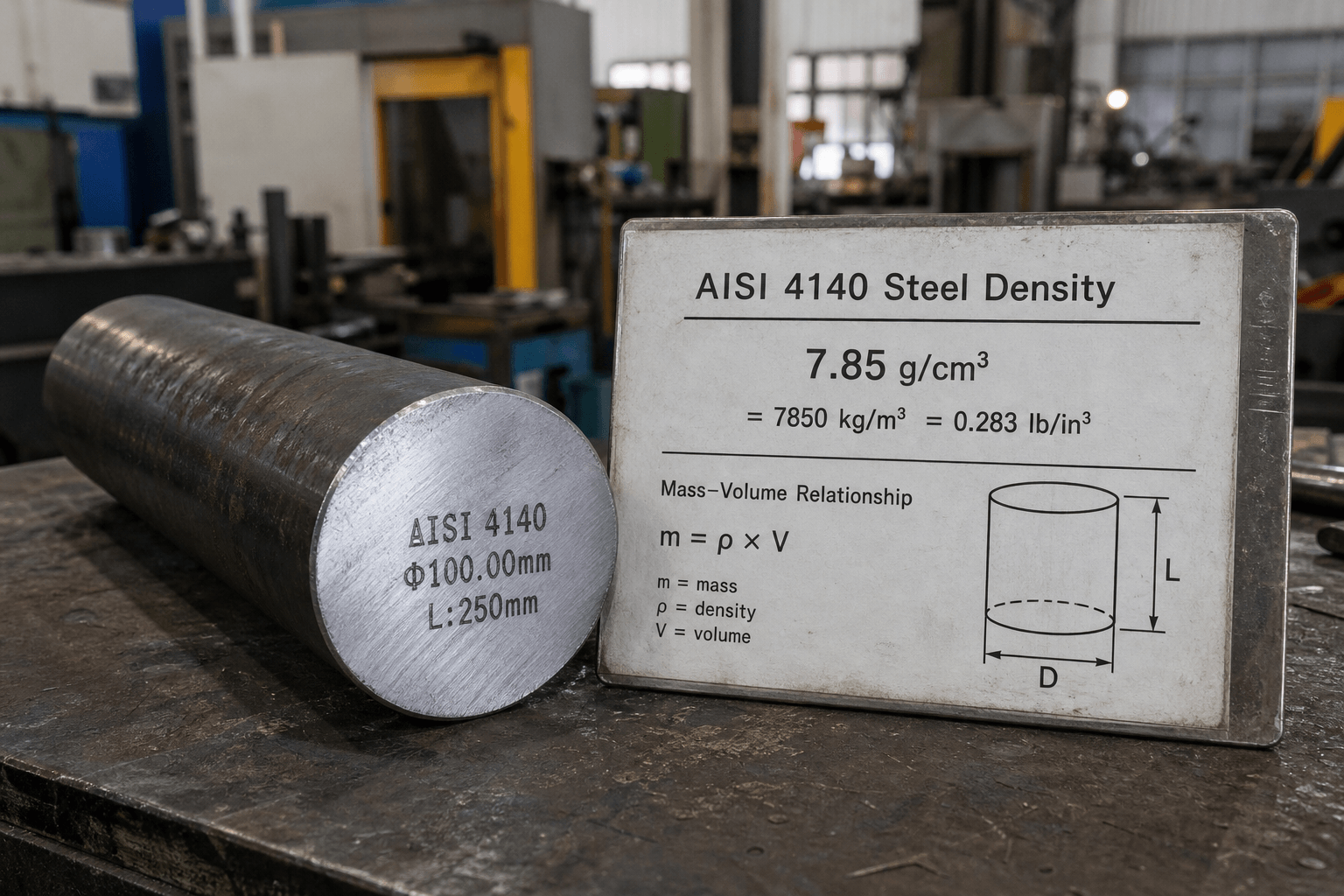
4140 steel density is commonly represented as 7.85 g/cm³ for preliminary engineering calculations. That is equivalent to approximately 7,850 kg/m³, 0.284 lb/in³, or 490 lb/ft³. Use the value as a nominal planning reference unless the applicable material documentation provides a different, condition-specific basis.
The supplied information does not identify an authoritative datasheet, standard, or test report for a particular 4140 heat. Accordingly, 7.85 g/cm³ should not be presented as a certified batch measurement. For a controlled weight requirement, verify the exact grade, specification, condition, dimensions, and available supplier documentation.
4140 Steel Density and Unit Conversions
Density describes mass per unit of volume. The numerical value depends on the unit system, so the density and volume must use compatible units before calculating mass. The following conversions are rounded representations of the same nominal reference value.
| Density unit | Approximate value | Typical use |
|---|---|---|
| g/cm³ | 7.85 | Metric material references and small-volume calculations |
| kg/m³ | 7,850 | CAD, engineering, and material-planning calculations |
| lb/in³ | 0.284 | Imperial part-weight estimates using cubic inches |
| lb/ft³ | 490 | Imperial volume calculations using cubic feet |
For a transparent conversion from g/cm³ to kg/m³, multiply by 1,000 because 1 g/cm³ equals 1,000 kg/m³. Thus, 7.85 g/cm³ becomes 7,850 kg/m³. For an imperial estimate, use the converted value that matches the volume units rather than mixing metric density with imperial volume.
How to Calculate an Approximate 4140 Part Weight
The basic relationship is:
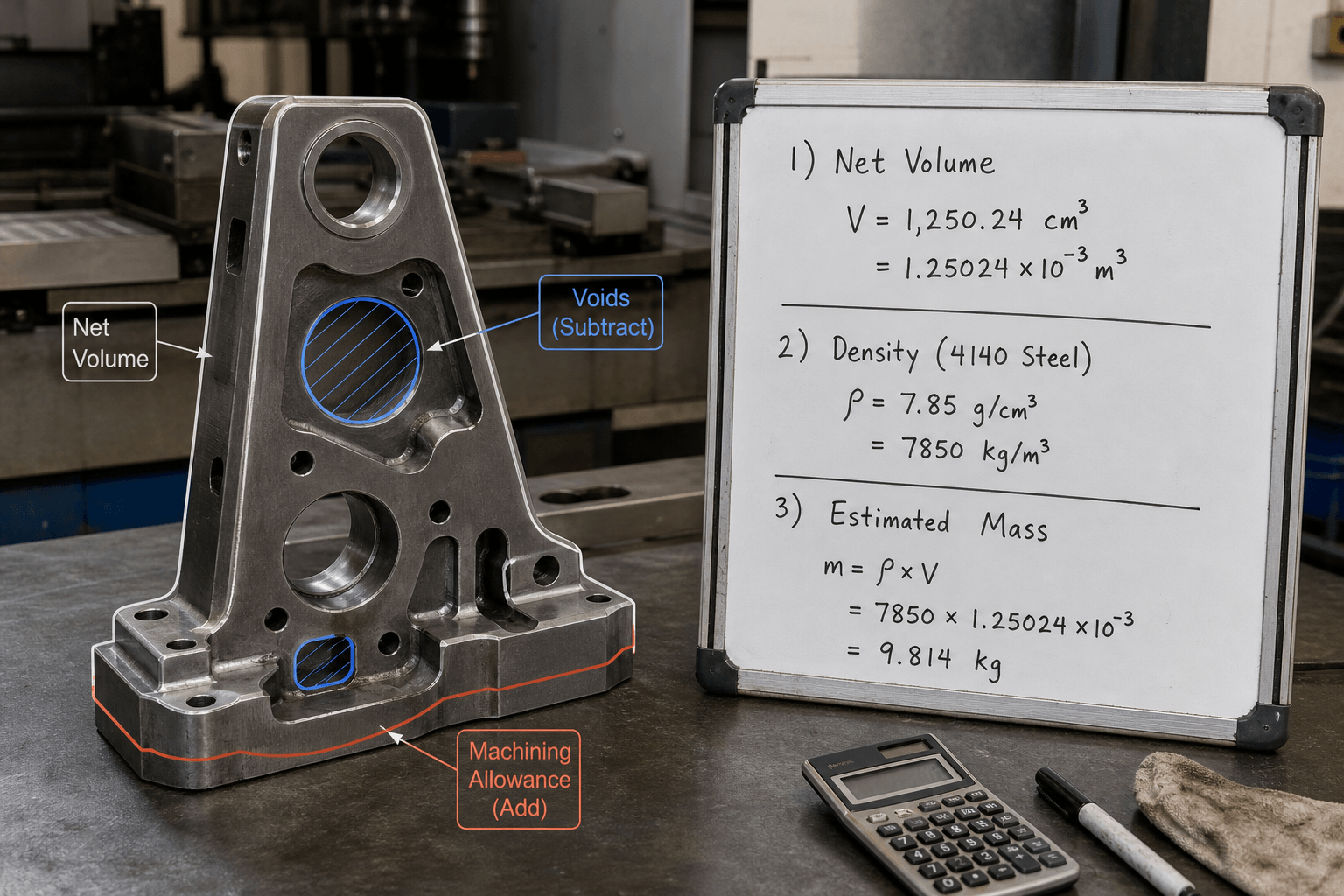
Mass = Density × Volume
Using metric units:
Mass in grams = 7.85 g/cm³ × volume in cm³
Alternatively:
Mass in kilograms = 7,850 kg/m³ × volume in m³
For a part with internal openings or other voids, calculate the net material volume by subtracting the void volume from the external volume. The result is still an estimate when the part includes machining allowance, coating, attached hardware, or dimensional variation.
Illustrative calculation
Assume an illustrative rectangular steel blank measures 100 mm × 50 mm × 20 mm. This geometry is only a calculation example and is not a claimed production part.
- Calculate the volume: 100 mm × 50 mm × 20 mm = 100,000 mm³.
- Convert the volume: 100,000 mm³ = 100 cm³.
- Apply the nominal density: 7.85 g/cm³ × 100 cm³ = 785 g.
- Convert the result: 785 g = 0.785 kg.
The estimated mass of the illustrative solid volume is therefore 0.785 kg. If the finished component has a through-hole, pocket, chamfer, or other removed material, subtract those volumes before applying the density. If the calculation describes raw stock, do not treat it as the final machined-part weight: material removed during machining lowers the finished mass, while coating or attached hardware can increase it.
Why Calculated and Actual Weight Can Differ
A density calculation is useful for early design, material usage, shipping-weight, and quotation estimates, but it depends on both the material assumption and the volume assumption. A difference between calculated and measured weight does not automatically indicate a density problem.
| Source of variation | What to verify | Effect on the estimate |
|---|---|---|
| Grade identity | Whether the material is actually specified as 4140, rather than an unspecified chrome-moly or another grade | A different material basis may make the assumed density inappropriate |
| Condition or heat treatment | The required material condition and any documentation supporting a condition-specific value | Mechanical properties can change substantially; do not assume an alternate density value without a source |
| Actual geometry | Nominal dimensions, internal voids, machining allowance, and drawing tolerances | Small dimensional differences can change the calculated volume and mass |
| Finished features | Coatings, plating, inserts, fasteners, weldments, or other attached items | Finished assembly weight may differ from the bare steel estimate |
| Measurement basis | Whether the comparison is for raw stock, a machined part, a finished part, or an assembly | Different production stages contain different amounts of material |
For preliminary quoting, the density value can help estimate how much raw material may be required and whether a shipping-weight assumption is reasonable. It can also support an early cost model when combined with the calculated stock volume and the supplier’s quoted material basis. It does not replace the supplier’s actual material pricing, yield assumptions, machining allowance, packaging weight, or final weighing process.
Density Is Not a Substitute for Material Qualification
Density identifies a mass-to-volume relationship. It does not determine hardness, yield strength, tensile performance, machinability, weldability, or corrosion behavior. Those properties depend on the selected grade, specification, processing route, material condition, geometry, and other technical requirements.
For example, heat treatment may change the mechanical properties of 4140 without providing a new density value that can be used without supporting documentation. Likewise, a part that has the expected weight is not thereby proven to have the correct grade or required hardness. Weight is one verification input, not a replacement for material identification or applicable inspection.
Do not automatically treat 4140, 4140H, heat-treated 4140, and unspecified chrome-moly material as interchangeable. Confirm the designation and required condition against the drawing, purchase order, and material documentation. Comparisons with 4340 or stainless steel also require separate property and application analysis; density alone is not a material-selection decision.
What to Specify on a Drawing or RFQ
When material identity or weight matters, provide enough information for the manufacturer and purchaser to use the same technical basis:
- Required grade and material specification, including clarification of whether 4140H or another designation is acceptable.
- Required condition or heat-treatment state when it affects the part’s function or documentation.
- Part geometry, nominal dimensions, internal features, and tolerances that affect material volume.
- Whether the requested weight refers to raw stock, the machined part, the finished part, or an assembled item.
- Any relevant finish, inspection, certificate, or documentation requirements.
- A target or controlled weight only when it is genuinely important, together with the measurement basis and permitted dimensional variation.
The manufacturing process should follow the drawing, geometry, quantity, and required condition. Density does not by itself determine whether a part should be machined, turned, milled, formed, welded, or manufactured through another route. Process assumptions should remain separate from the material-density calculation.
For drawing-based production planning, see custom CNC machining from first sample to repeat production. For bracket-shaped components, the related guide to custom metal brackets built to your drawings provides an application path without changing the underlying density calculation.
Where RFQ Assumptions Create Cost and Production Risk
Many sheet metal fabrication problems begin before production starts. If drawings, tolerances, finish expectations, material grades, or assembly requirements are unclear, suppliers may quote based on different assumptions. That can make prices difficult to compare and may lead to rework, cosmetic rejection, assembly misalignment, or production delays later.
For OEM buyers, the goal is not simply to request the lowest price. The goal is to make sure each supplier is quoting the same manufacturing reality. Before confirming an order, clarify which dimensions are fit-critical, which surfaces are cosmetic, whether prototypes must match batch-production conditions, and how finished parts will be inspected.
Frequently Asked Questions
What 4140 steel density details should buyers define before requesting a quote?
Buyers should define the functional requirement, drawing notes, critical dimensions, material or process expectations, and any inspection points related to 4140 steel density. This helps suppliers quote the same manufacturing scope instead of making different assumptions.
How can RFQ details affect cost, fit, or lead time?
RFQ details can change tooling, forming, welding, finishing, inspection, or rework requirements. If buyers do not clarify it early, two supplier quotes may look comparable while covering different production risks.
Why should drawing requirements be reviewed before prototype approval?
drawing requirements may look acceptable on a single sample but become harder to control during batch production. Buyers should confirm whether the prototype reflects the same process, finish, and inspection conditions expected for production.
What inspection points matter most for 4140 steel density projects?
Important inspection points usually include fit-critical dimensions, holes or mating areas, cosmetic surfaces, finish build-up, welded or formed features, and any dimensions that affect downstream assembly. These points should appear in the RFQ or drawing notes.
How can buyers reduce prototype approval risk before batch production?
Buyers can reduce risk by clarifying drawings, locking key material and finish assumptions, defining inspection timing, approving a representative sample, and confirming which dimensions or surfaces require tighter process control.
How can Yishang help review 4140 steel density requirements?
Yishang can review drawings, RFQ notes, material requirements, tolerance expectations, finish details, samples, and assembly needs to identify unclear assumptions before quoting or batch production.