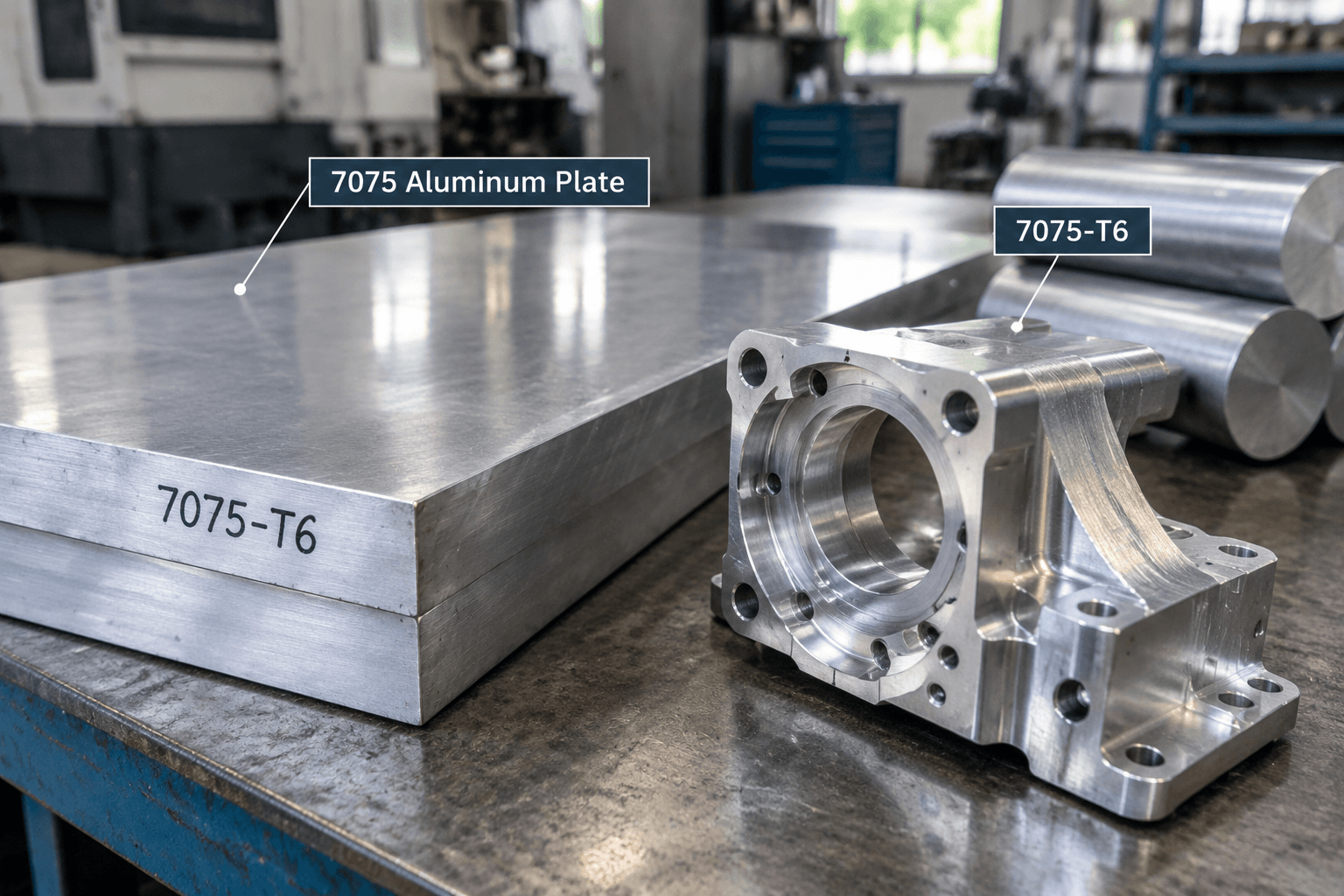
7075 aluminum is a high-strength aluminum alloy used when strength-to-weight performance is a central design requirement. Whether it suits a part depends on more than the alloy name: temper, product form, service environment, manufacturing route, joining needs, and inspection requirements all matter. Consider it when the design needs high strength relative to weight, but do not treat it as the default choice for every aluminum component or as a drop-in replacement for steel.
What 7075 aluminum is and why buyers select it
7075 identifies an aluminum alloy in the 7xxx series, whose principal alloying element is zinc. The designation identifies the alloy family and composition range; it does not, by itself, specify the mechanical properties of a finished part. Those depend on the temper, product form, applicable material specification, and processing history.
Designers evaluate 7075 when reducing component weight while retaining substantial strength is important. That can be relevant to load-bearing or highly stressed components, but the choice must be tied to the actual design loads and service conditions. A higher-strength material does not automatically make a better part: geometry, fatigue demands, corrosion exposure, joining, machining, and the consequences of failure all belong in the decision.
Specify the temper and form alongside the alloy. Plate, bar, sheet, and other forms can have different applicable product requirements and may not be interchangeable for a given part. Likewise, property data should be taken from documentation applicable to the specified product form and temper rather than treated as a universal value for “7075.”
Evaluate performance in the service environment
| Consideration | What it means for selection |
|---|---|
| Strength and weight | Assess whether the design needs the strength-to-weight performance of the specified 7075 product, and verify relevant properties for its form and temper. |
| Corrosion exposure | Review moisture, chemicals, dissimilar-metal contact, and the consequences of surface damage. Do not assume the alloy alone provides the required corrosion protection. |
| Machining and geometry | Plan the stock form, material removal, fixturing, tolerances, and inspection around the part geometry and specified condition. |
| Fabrication and joining | Check forming and joining methods against the design, temper, and service requirements before committing to a route. |
Corrosion behavior deserves particular attention when a component will see a corrosive environment, retain moisture, or contact other metals. The appropriate protection and inspection approach depends on the part and its use. Surface treatment may be considered, but its suitability, effect on dimensions, and compatibility with assembly should be confirmed for the actual specification and design.
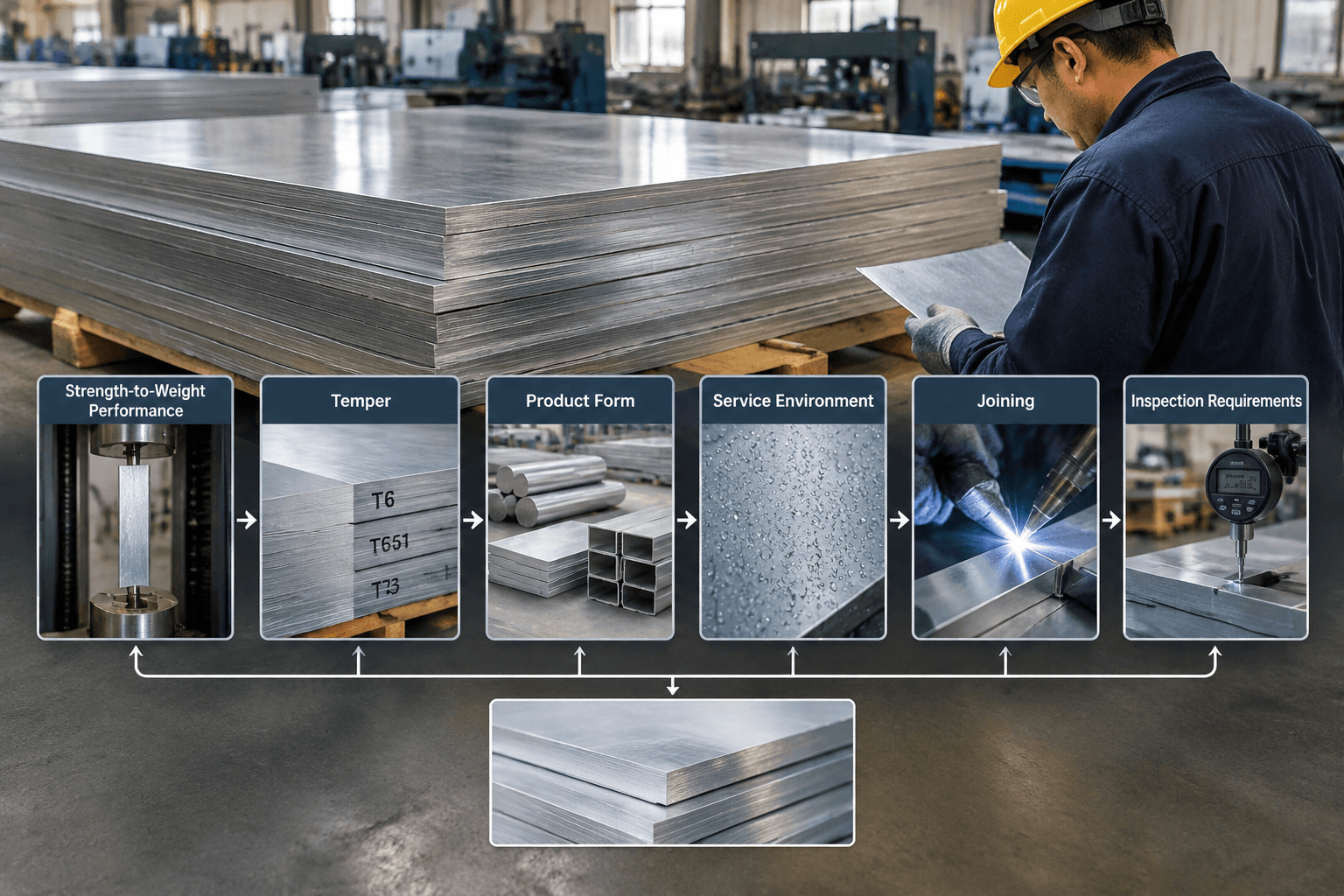
Machinability is one reason 7075 is commonly considered for machined components, but that does not establish a universal production capability or guarantee a particular tolerance, finish, or cycle time. Thin walls, long features, interrupted cuts, and material removal can affect stability and dimensional control. The drawing, stock allowance, workholding, process sequence, and inspection plan should be reviewed together.
For comparison, 6061 may be worth evaluating when the application places different weight on fabrication, corrosion exposure, joining, or cost. Neither alloy is categorically better. Select against the part requirements and applicable material documentation rather than comparing alloy names in isolation.
Match product form and manufacturing route
Stock form and temper
Identify whether the part will be made from plate, bar, sheet, or another specified form. Confirm the required dimensions, temper, material specification, and documentation with the supplier. A route appropriate for one product form or temper should not be assumed to transfer directly to another. If the design is being changed from machined stock to an extruded component, review the section geometry and material requirements separately; extrusion has its own design and supply considerations. See custom aluminum extrusion components for that distinct route.
CNC milling and turning
For milling or turning, provide the part drawing or model and identify critical dimensions, mating features, and surfaces that affect function. Discuss stock orientation and material condition where they matter to the design, as well as the intended inspection points. A machined part’s suitability depends on the specified material and the complete process plan, not solely on the alloy label.
Forming
If the design requires bending or other forming, verify that the chosen product form and temper are appropriate for the operation and geometry. Do not infer formability from the alloy designation alone. Forming sequence, feature placement, and potential changes to the material condition should be considered before releasing the drawing.
Welding and other joining
Do not classify 7075 as universally weldable or non-weldable. Joining suitability depends on the joining method, component design, temper, and service requirements. If a joint is needed, identify its function and loads, the selected method, and any requirements for post-joining inspection or performance review. A mechanical fastener or another joining approach may be considered where appropriate, but that choice also needs design validation.
Finishing, assembly, and inspection
Specify the required finish or surface treatment and identify surfaces where coating, masking, or finish build-up could affect fit. For assemblies, call out mating dimensions, fasteners or other joining features, and any dissimilar-metal contacts that need review. Inspection should focus on drawing requirements and function-critical features, such as interfaces or holes that locate other components. Define the documentation and traceability needed for the order instead of assuming a particular certificate or inspection record is included.
For parts such as a custom metal bracket, the load path, mounting interfaces, and exposure conditions can influence both alloy selection and inspection priorities. In transportation equipment, weight may also be a design consideration, but the application alone does not establish that 7075 is appropriate; evaluate the component’s requirements. Related context is available in automotive and transportation metal fabrication.
7075 aluminum selection worksheet: what to confirm before ordering
Use the following information to make a purchasing or manufacturing request specific enough for technical review and a comparable quote:
- Part definition: Provide the drawing or 3D file, revision, intended function, and critical interfaces.
- Material: State 7075, the required temper, product form, applicable material specification, and any required documentation or traceability.
- Size and order: List stock or finished-part dimensions, quantity, tolerances, and any dimensional features requiring special attention.
- Manufacturing route: Identify the intended operations where known, including machining, forming, or joining, and flag features that constrain the sequence.
- Service conditions: Describe relevant loads, environment, exposure to moisture or chemicals, and contact with other materials.
- Finish and assembly: State surface-treatment requirements, cosmetic or functional surfaces, mating parts, and joining constraints.
- Quality requirements: Define inspection points, acceptance criteria, and required material or inspection records without assuming unspecified supplier capabilities.
For example, a useful request would identify a 7075 component by its required temper and stock form, attach the controlled drawing, specify quantity and tolerances, describe the service environment and joining plan, and list finish, inspection, and traceability requirements. The example is a request structure, not a recommendation for a particular temper or specification; those must be selected for the part.
Cost depends on the specified material and form, required dimensions, quantity, machining or fabrication complexity, tolerances, finish, inspection, and documentation. Requesting a price without these details can leave suppliers quoting different scopes. No alloy designation alone establishes price or availability.
Decide whether 7075 is justified
Continue evaluating 7075 when the part has a defined strength-to-weight need and the selected form and temper can meet the drawing and service requirements. Compare another alloy when corrosion exposure, fabrication, joining, or cost carries more weight than the strength benefit. Request a technical review when the product form, temper, joining method, or environment is not yet resolved.
This material-selection decision is separate from confirming manufacturing capability. Validate the final choice against the controlled drawing, service conditions, applicable material documentation, and the proposed process route. For a project review, provide the part drawing or 3D file together with the required alloy, temper, form, dimensions, quantity, tolerances, environment, joining and finishing needs, inspection criteria, and documentation requirements. That gives an OEM or ODM supplier the information needed to assess whether the requested material and route align with the part before production planning.
Where RFQ Assumptions Create Cost and Production Risk
Many sheet metal fabrication problems begin before production starts. If drawings, tolerances, finish expectations, material grades, or assembly requirements are unclear, suppliers may quote based on different assumptions. That can make prices difficult to compare and may lead to rework, cosmetic rejection, assembly misalignment, or production delays later.
For OEM buyers, the goal is not simply to request the lowest price. The goal is to make sure each supplier is quoting the same manufacturing reality. Before confirming an order, clarify which dimensions are fit-critical, which surfaces are cosmetic, whether prototypes must match batch-production conditions, and how finished parts will be inspected.
Frequently Asked Questions
What aluminum alloy details should buyers define before requesting a quote?
Buyers should define the functional requirement, drawing notes, critical dimensions, material or process expectations, and any inspection points related to aluminum alloy. This helps suppliers quote the same manufacturing scope instead of making different assumptions.
How can 5052 or 6061 affect cost, fit, or lead time?
5052 or 6061 can change tooling, forming, welding, finishing, inspection, or rework requirements. If buyers do not clarify it early, two supplier quotes may look comparable while covering different production risks.
Why should bend radius be reviewed before prototype approval?
bend radius may look acceptable on a single sample but become harder to control during batch production. Buyers should confirm whether the prototype reflects the same process, finish, and inspection conditions expected for production.
What inspection points matter most for 7075 aluminum projects?
Important inspection points usually include fit-critical dimensions, holes or mating areas, cosmetic surfaces, finish build-up, welded or formed features, and any dimensions that affect downstream assembly. These points should appear in the RFQ or drawing notes.
How can buyers reduce finished sample approval risk before batch production?
Buyers can reduce risk by clarifying drawings, locking key material and finish assumptions, defining inspection timing, approving a representative sample, and confirming which dimensions or surfaces require tighter process control.
How can Yishang help review 7075 aluminum requirements?
Yishang can review drawings, RFQ notes, material requirements, tolerance expectations, finish details, samples, and assembly needs to identify unclear assumptions before quoting or batch production.