
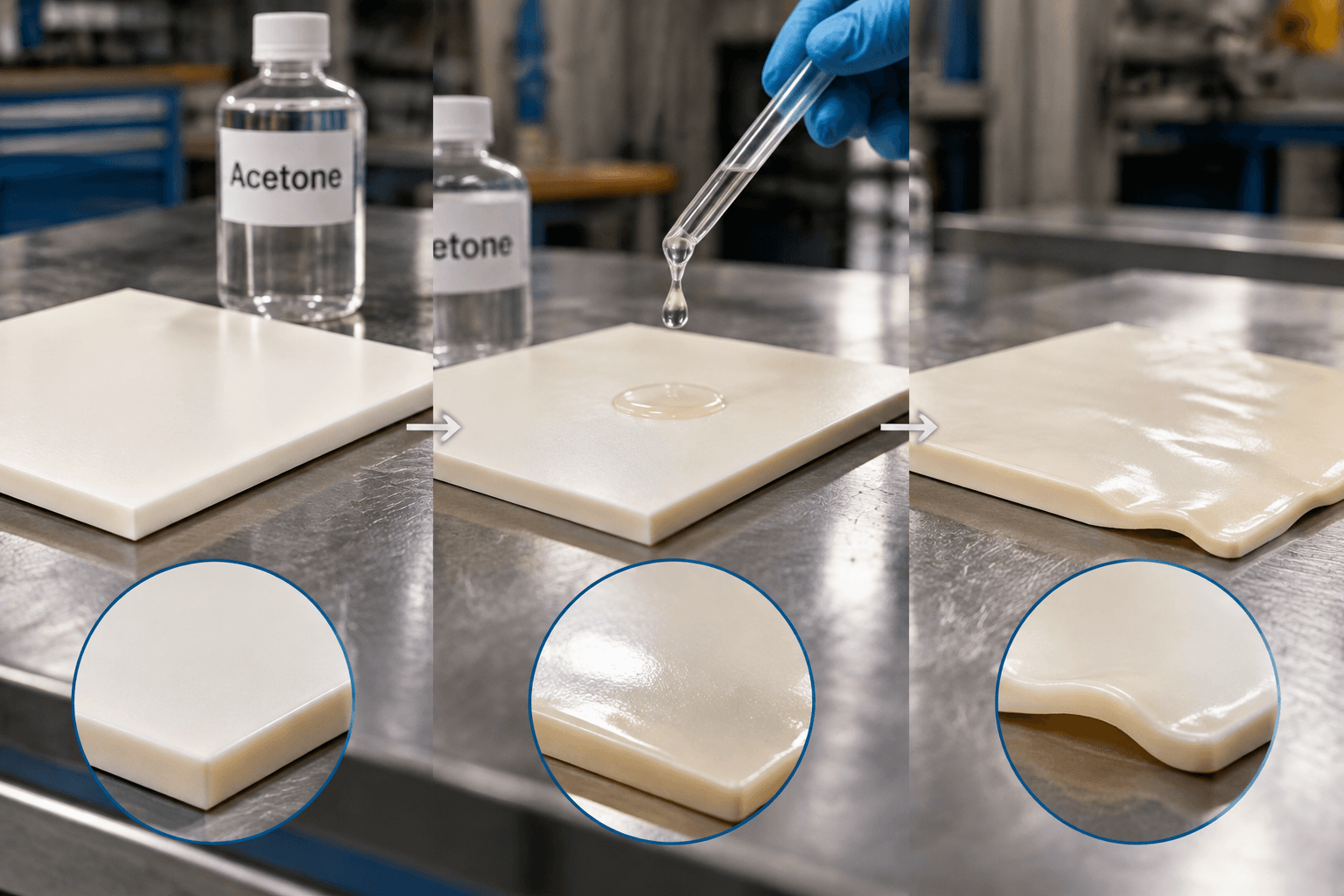
Acetone generally attacks and softens ABS, so it can support controlled solvent joining or surface smoothing but may damage an ABS part during cleaning or accidental exposure. It should not be treated as a compatibility-safe cleaner unless testing on the specific ABS grade and finished part demonstrates an acceptable result.
Depending on the exposure and the component, ABS may swell, craze, lose texture, deform, or partially dissolve. Even when the surface later looks dry or visually normal, dimensions, fit, joint quality, and structural performance may have changed.
What Happens When Acetone Contacts ABS?
ABS is an engineering thermoplastic made from acrylonitrile, butadiene, and styrene components. Acetone can interact strongly with this polymer system instead of remaining on the surface as a neutral cleaning liquid. The immediate result may range from a slight cosmetic mark to pronounced softening and dissolution.
This interaction is neither automatically useful nor automatically acceptable. In solvent joining, controlled softening allows two ABS surfaces to merge at their interface. In smoothing, the same mechanism can reduce visible layer lines or surface irregularities. On a dimensionally controlled housing, clip, boss, seal face, or textured cover, however, softening may constitute product damage.
Acetone is volatile, so an exposed surface can appear to dry quickly. Evaporation does not prove that the polymer has returned to its original condition. A part may retain dimensional change, local stress damage, altered gloss, reduced surface definition, or a weakened region after visible liquid has disappeared. Suitability must therefore be judged against the part’s actual requirements, not merely whether the surface looks clean.
ABS and Acetone by Intended Task: Expected Effect, Main Risk, and Verification Need
The intended task changes what counts as success. A softened surface may be required for joining but unacceptable during cleaning. This application matrix separates those outcomes.
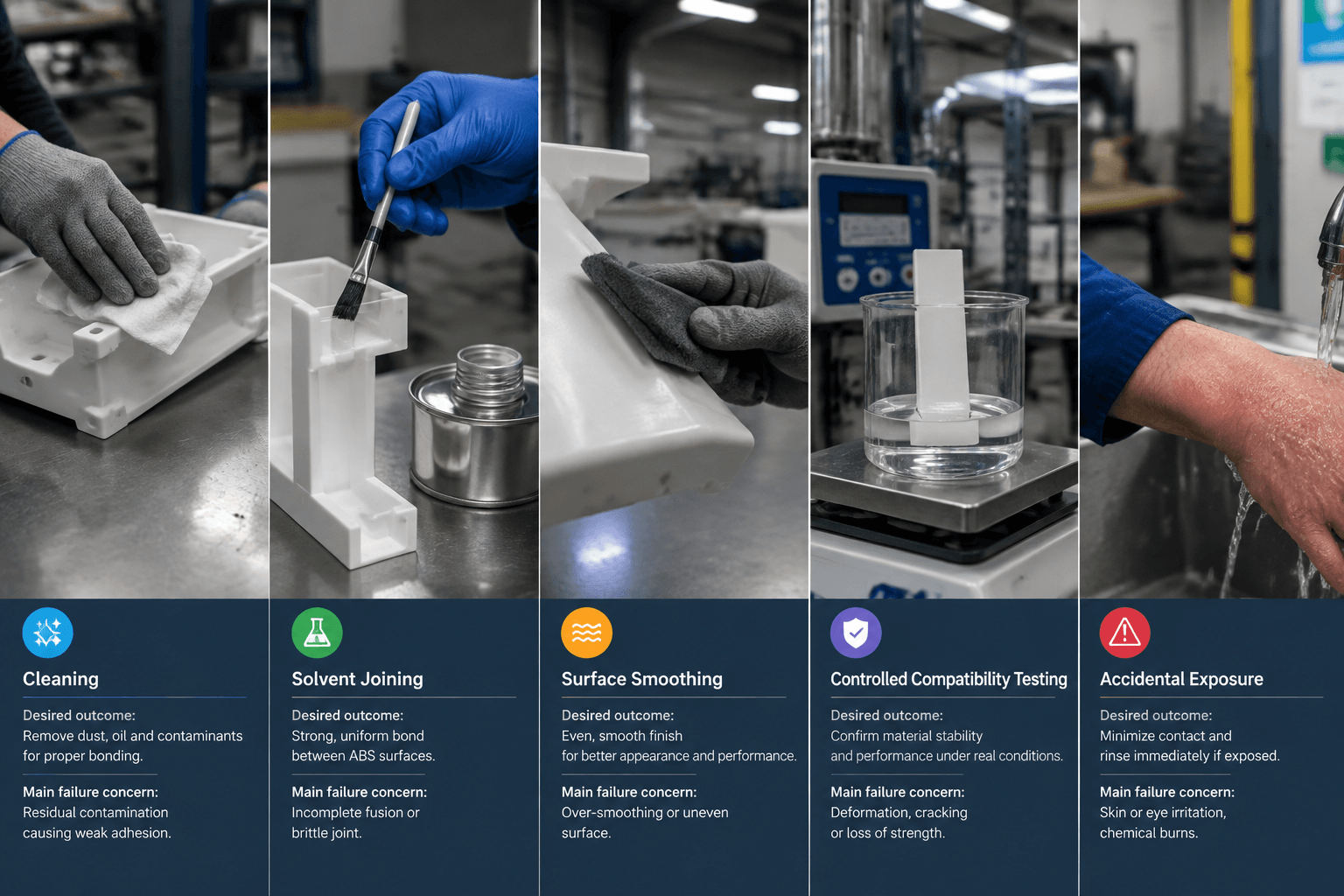
| Intended task | Desired outcome | Likely ABS response | Primary quality concern | Evidence required | Alternative path |
|---|---|---|---|---|---|
| Cleaning | Remove oil, ink, adhesive residue, or contamination without changing the part | Marking, gloss change, swelling, crazing, texture loss, or softening may occur | Cosmetic damage, dimensional change, and reduced performance | Grade-specific compatibility information and testing on a representative finished surface | A cleaner verified for the ABS grade and contaminant |
| Solvent joining | Soften mating surfaces so polymer can form an interface | Intentional local softening or partial dissolution | Joint consistency, alignment, squeeze-out, distortion, and trapped stress | Validated application controls and joint performance testing | A purpose-made ABS adhesive, mechanical fastening, or redesigned joint |
| Surface smoothing | Reduce roughness or visible layer lines | Surface flow and loss of sharp detail | Changed dimensions, rounded features, uneven finish, and uncertain strength | Trials on representative material, geometry, and surface condition | Mechanical finishing, a coating system, or a different manufacturing process |
| Compatibility testing | Determine whether expected exposure is acceptable | Response varies with the controlled test conditions | A test that does not represent production or service exposure | Documented samples, controls, acceptance criteria, and inspection timing | Material substitution or prevention of solvent contact |
| Accidental exposure | Contain the incident and assess the component | Local attack may continue beyond an obvious wet area | Hidden cracking, deformation, fit loss, or functional damage | Exposure record and post-incident dimensional and functional inspection | Quarantine and replacement when acceptance cannot be demonstrated |
Brief wiping is not automatically harmless. A cloth can prolong contact, spread acetone into seams, or repeatedly deliver fresh solvent. Likewise, acetone joining should not be assumed equivalent to a qualified structural adhesive or validated production process. Joint suitability depends on design, loading, environment, process control, and inspection.
Why One ABS Part May React Differently from Another
No universal contact time or concentration can define safe acetone use for every ABS component. Several variables operate together, and changing one can shift the result from light marking to substantial deformation.
Exposure conditions
Concentration, contact time, temperature, and quantity influence the intensity of attack. A larger liquid pool generally behaves differently from a lightly dampened applicator because evaporation, replenishment, and solvent access differ. Immersion, wiping, spraying, brushing, and vapour exposure also produce different contact patterns. Higher temperatures may change evaporation and polymer response, but the effect must be established under controlled conditions rather than assumed.
Repeated short contacts can matter as much as one obvious incident. Acetone may collect in a recess, capillary gap, joint, fastener hole, or absorbent contamination. These locations can retain solvent longer than an open flat face.
ABS formulation and production history
ABS is a family of materials rather than one fixed formulation. Resin composition, pigments, fillers, impact modifiers, recycled content, coatings, and other additives can affect solvent response. A result from one natural-colour test coupon cannot automatically qualify a coloured, plated, painted, or otherwise finished production component.
Molding conditions and post-processing also matter. Residual or molded-in stress can make corners, bosses, snap features, knit-line regions, and areas near inserts more vulnerable to crazing or cracking. Machining, forming, fastening, and assembly loads may introduce additional stress before solvent contact.
Geometry and surface condition
Thin walls and fine details can lose shape sooner than heavy sections. Sharp corners, textured faces, sealing lands, lettering, clips, threads, and interference-fit features may be especially sensitive because a small dimensional change can affect function. Scratches and pre-existing microcracks may provide sites for visible crazing to begin.
Surface appearance provides useful evidence but not a complete acceptance decision. Inspectors may see whitening, gloss variation, tackiness, rippling, or deformation, yet subsurface effects and mechanical changes can exist without dramatic visual signs. Conversely, an intentional cosmetic smoothing result does not demonstrate that the part has retained its original dimensions or strength.
How to Verify an ABS–Acetone Process
A business evaluating acetone should reproduce the intended process or credible accidental exposure as closely as practical. Generic online compatibility charts can help identify risk, but they do not replace evidence for the selected resin, geometry, finish, and service requirements.
- Define the purpose and failure criteria. State whether the task is cleaning, joining, smoothing, or resistance to incidental contact. Establish measurable limits for appearance, dimensions, fit, warpage, cracking, joint integrity, and functional performance before testing.
- Identify representative material. Record the ABS resin or grade when known, colour, additives, molding condition, coating, texture, and relevant production history. Use sacrificial production parts when geometry and molded stress are important; flat coupons alone may miss those effects.
- Document the exposure. Control the acetone source, concentration or supplied form, amount, application method, contact duration, temperature, number of cycles, and drying or observation conditions. Include an unexposed control sample for comparison.
- Inspect immediately and later. Check mass where useful, critical dimensions, flatness, surface texture, gloss, colour, cracking, fit, and assembly behaviour. An appropriate later observation point is important because an immediate check may not reveal delayed distortion or stress cracking.
- Test the required function. Depending on the part, this may include snap engagement, fastener retention, seal fit, enclosure alignment, load response, or joint performance. Test methods and acceptance limits should reflect the actual application.
- Confirm repeatability. One acceptable specimen is not enough to establish a production process. Evaluate variation across representative parts and define controls for solvent application, fixturing, ventilation, handling, inspection, and nonconforming material.
For a new molded component, solvent compatibility should be considered alongside resin selection, wall thickness, ribs, bosses, assembly loads, and finish requirements. Early review through a custom injection molding and component validation process can help align part geometry and joining strategy with the expected environment.
Safety Controls and Reasons to Choose Another Method
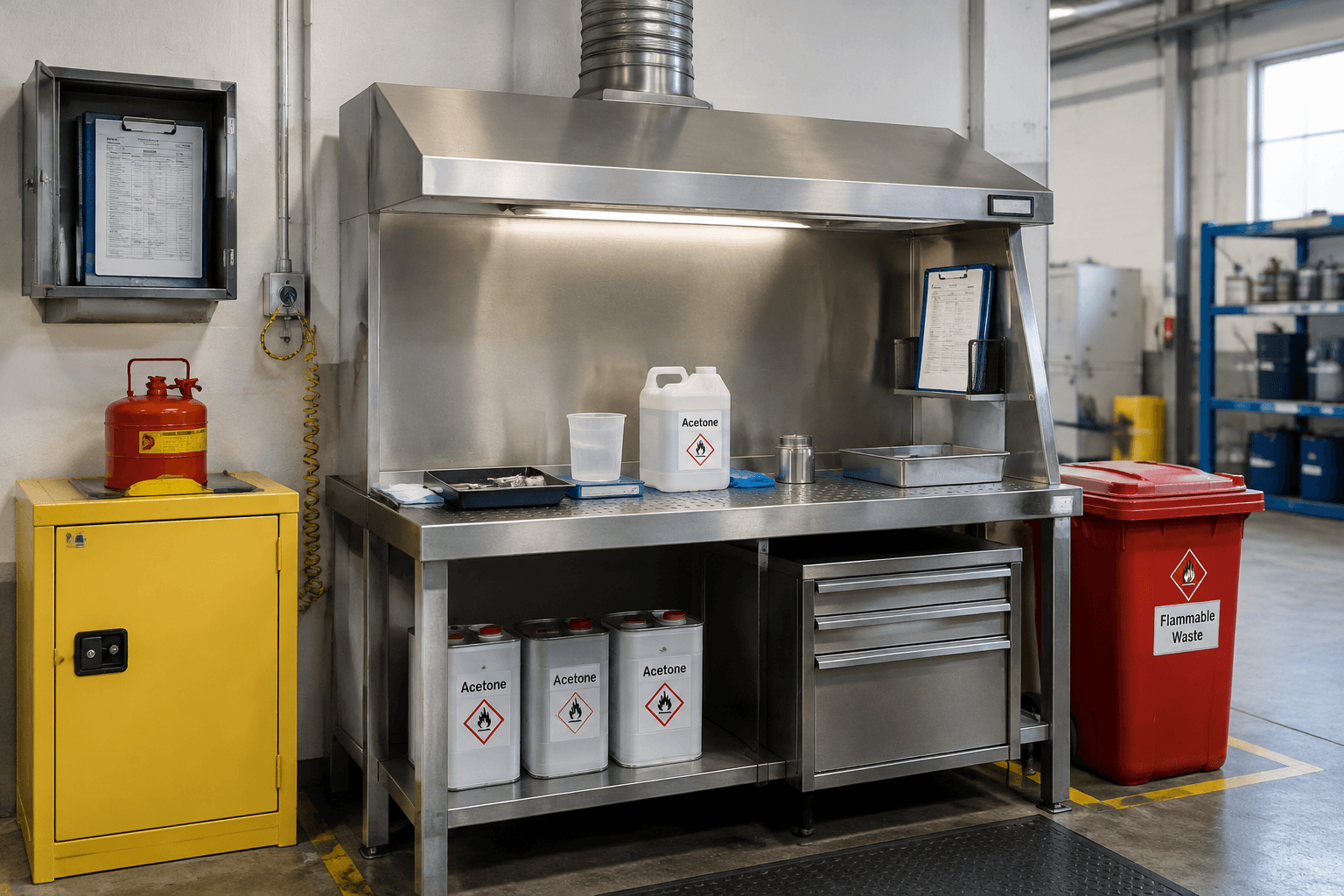
Acetone is a volatile, highly flammable liquid. Its vapour can form a flammable mixture with air, travel away from the point of use, reach an ignition source, and flash back. Static discharge is another potential ignition mechanism. Controls therefore need to cover the wider work area, not only the container or ABS part.
Use the current supplier Safety Data Sheet as the primary source for classification, handling, storage, exposure controls, protective equipment, spill response, waste management, firefighting, and first-aid instructions. The workplace should also complete its own risk assessment and follow applicable safety requirements. This article does not replace those documents.
Key planning points include effective ventilation, closed and labelled containers, control of flames, sparks, hot surfaces, and static, and equipment suitable for the classified hazard. Heated closed containers can become dangerous. Workers also need procedures addressing inhalation and skin or eye contact, as repeated skin exposure may cause drying or irritation and high vapour concentrations may produce more serious effects.
Storage and handling must account for chemical incompatibilities identified by the supplier. Reported concerns include oxidizing agents, organic acids, and strong reducing agents, but the current SDS for the actual acetone product should govern the decision. Solvent-contaminated wipes and waste also require controlled collection because apparent dryness should not be used as the sole indication that a fire hazard has ended.
Choose another method when the required outcome conflicts with material attack or cannot be validated reliably. For cleaning, consider a product verified for the specific ABS grade, finish, and contaminant. For assembly, evaluate purpose-made adhesives, screws, clips, inserts, ultrasonic joining, or another validated method according to load and service conditions. Where solvent exposure is unavoidable, a more resistant material, barrier, or enclosure arrangement may be preferable.
OEM and ODM teams can discuss whether an injection-molded component, joining approach, or alternative enclosure design is best suited to the operating environment and assembly conditions. To support that review, provide the ABS resin or grade if known, a part drawing or representative geometry, the intended environment and possible solvent exposure, surface, dimensional, assembly, and functional requirements, expected production volume, and validation needs.
Frequently Asked Questions
Can acetone be used to clean ABS without damaging it?
It should not be assumed safe. Acetone may mark, soften, craze, swell, or deform ABS even when contact is brief. Cleaning suitability requires evidence for the particular resin grade, surface finish, geometry, application method, and contaminant. Test a representative sacrificial part and use a verified alternative cleaner when material attack is unacceptable.
Is ABS chemically resistant to acetone?
ABS is generally considered susceptible to acetone rather than resistant to it. The severity varies with formulation and exposure conditions, but the possibility of softening or dissolution is the reason acetone can be used intentionally for joining or smoothing. That useful reaction does not represent neutral chemical compatibility.
Can a short acetone exposure permanently weaken or distort an ABS part?
It can, depending on concentration, amount, temperature, residual stress, wall thickness, geometry, and application method. No universal short exposure can be declared harmless without grade-specific testing. A part that appears dry or cosmetically recovered may still have changed dimensions, stress damage, or reduced functional performance.
Can acetone bond ABS, and how is solvent joining different from using an adhesive?
Acetone can soften mating ABS surfaces so polymer from the two parts forms an interface. An adhesive introduces a separate formulated bonding material. Solvent joining can work in suitable designs, but it requires controlled application, fit, fixturing, observation, and performance validation. It should not automatically be treated as equivalent to a qualified structural adhesive or another validated joining process.