
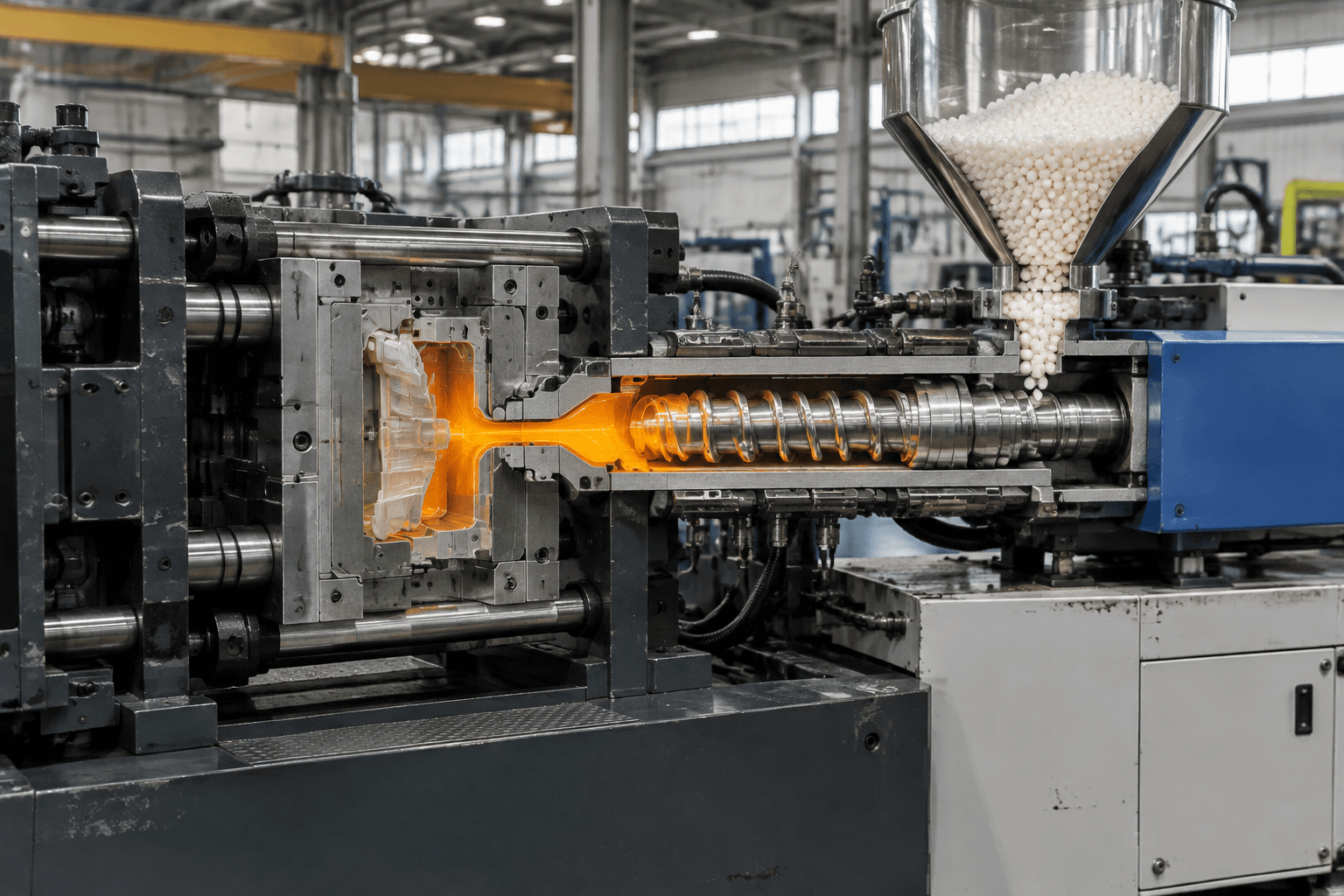
ABS molding usually means injection molding Acrylonitrile Butadiene Styrene thermoplastic into a shaped mold cavity. The process can produce rigid, detailed plastic components with repeatable geometry and varied appearance, but the correct material grade, processing conditions, and part design depend on the application.
Industrial buyers commonly consider ABS for housings, covers, bezels, brackets, control components, and other molded parts. Evaluating it requires more than selecting “ABS” on a drawing: grade, environment, geometry, assembly fit, color, texture, and documentation must all be defined.
What Does ABS Molding Mean?
ABS stands for Acrylonitrile Butadiene Styrene. It is a thermoplastic material, meaning it softens when heated for processing and becomes solid again as it cools. The acrylonitrile, butadiene, and styrene components contribute to the overall balance of rigidity, toughness, processability, and surface appearance. Their proportions, additives, and formulation vary among commercial grades, so ABS should not be treated as a single material with universal properties.
In industrial production, “ABS molding” most often refers to ABS injection molding. Molten resin is injected under controlled conditions into a closed metal mold, where it fills the cavity, cools, and forms the component. The term should not be confused with extrusion, which makes continuous profiles; thermoforming, which shapes heated sheet; or additive manufacturing, which builds a part layer by layer. Those processes can also use ABS or related formulations, but they create parts through different methods and have different design constraints.
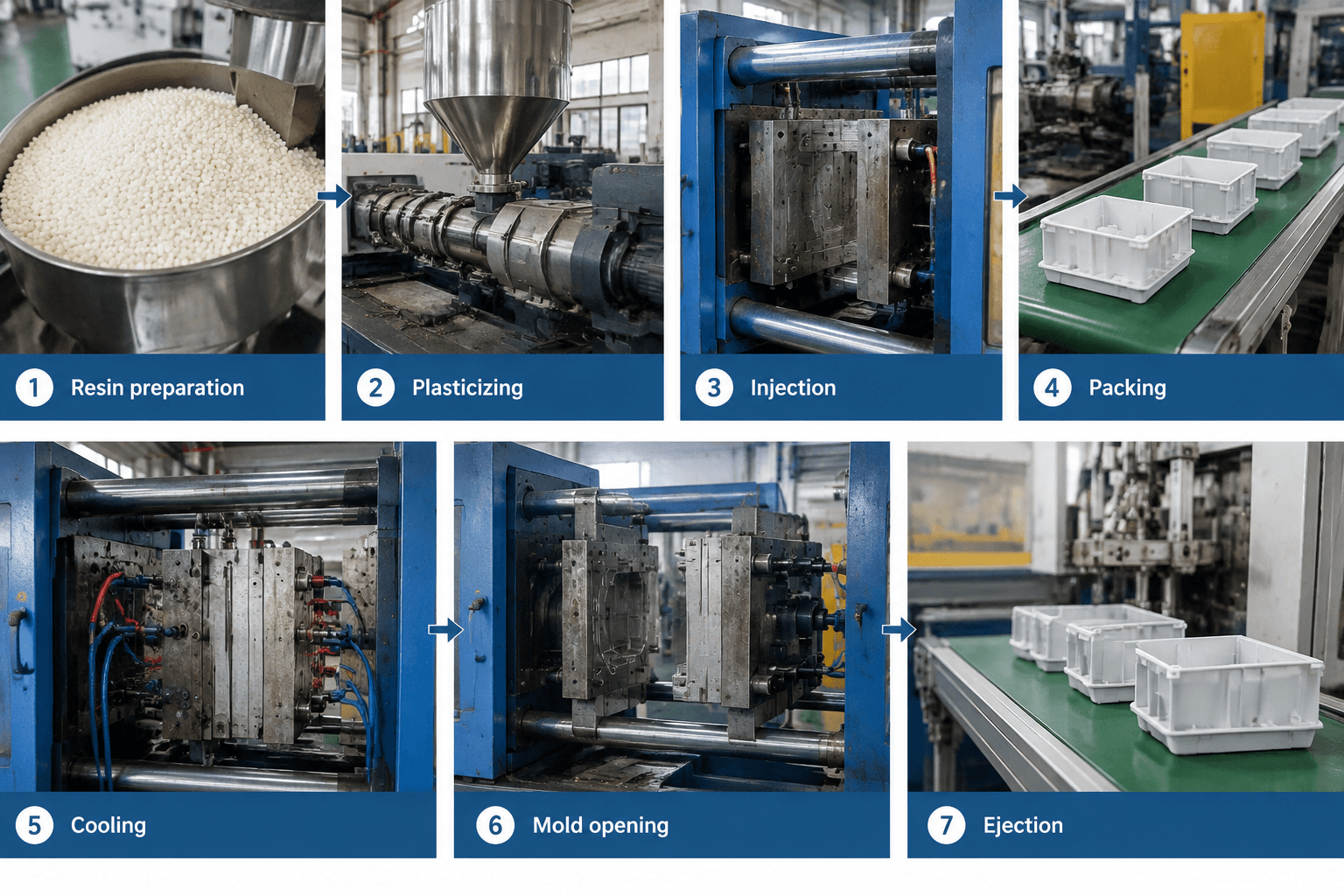
How an ABS Injection-Molded Part Is Made
An injection-molding cycle is a connected sequence rather than a single filling operation. Material condition, mold design, and process stability influence both appearance and dimensions.
- Resin preparation: The specified ABS grade is checked against the production requirements. Pellets may require controlled drying according to the resin supplier’s instructions because excessive moisture can contribute to surface streaking, degradation, or inconsistent results. Colorant may be incorporated in the selected resin or introduced through an approved coloring system.
- Plasticizing: Pellets move from the hopper into the barrel. A rotating screw conveys, compresses, and melts the material through controlled heat and shear. The required settings depend on the grade, equipment, shot size, and part geometry; one universal temperature profile is not appropriate for every ABS product.
- Injection and cavity filling: The screw moves forward, forcing molten ABS through the nozzle, runner system, and gate into the mold cavity. Gate position, flow length, wall transitions, vents, and obstructions affect how the flow fronts advance and meet.
- Packing and holding: Pressure is maintained for a controlled period as the resin begins to contract. This stage helps feed material into the cavity before the gate freezes, influencing sink, weight, dimensions, and internal stress.
- Cooling: Heat transfers from the part into the mold and its cooling channels. Thick sections cool more slowly than thin sections. Uneven cooling can contribute to warpage, sink, or longer cycles, which is why geometry and cooling design must be considered together.
- Mold opening and ejection: After the component is sufficiently rigid, the mold opens and ejector pins, sleeves, plates, or another mechanism release it. Adequate draft and suitable ejector placement reduce sticking and visible deformation.
- Post-cycle secondary handling: The runner or gate vestige may be trimmed, and the part can be inspected, packed, printed, painted, plated, or assembled when specified. Secondary finishes require material and surface preparation compatibility; they should not be assumed to work equally well with every ABS grade.
Early technical review is useful because the resin, mold, appearance requirements, and controlled dimensions interact. Buyers preparing a project can consult a custom injection-molding project overview after defining the basic application and part requirements.
When Is ABS a Suitable Material?
ABS is often considered when a component needs a useful balance of impact behavior, rigidity, moldability, and cosmetic potential. Suitability remains grade-specific and must be checked against the actual operating environment.
| Requirement or condition | General ABS consideration | What must be verified |
|---|---|---|
| Rigid housing or cover | Many grades provide useful stiffness and impact resistance for indoor equipment components. | Loads, impact level, wall design, temperature, and grade data. |
| Visible cosmetic surface | ABS can support molded color, texture, and post-molding decoration. | Color reference, gloss, texture, gate location, weld-line limits, and finishing compatibility. |
| Snap fits or screw assembly | The material can be used for integrated assembly features when strain and local stress are controlled. | Assembly cycles, screw type, boss geometry, engagement, and mating-part variation. |
| Outdoor or high-UV exposure | Standard ABS may not provide the required weathering resistance. | UV-stabilized grade data or an alternative material supported by environmental testing. |
| Elevated-temperature service | Heat resistance varies significantly by formulation. | Continuous and peak temperatures, load at temperature, and supplier data for the exact grade. |
| Chemical contact | Some cleaners, oils, solvents, or environmental stresses can affect ABS. | Actual chemical, concentration, contact time, temperature, and stress state. |
| Flame-sensitive or regulated use | Compliance cannot be inferred from the material name alone. | Specified grade, required rating, traceability, and application-specific documentation. |
Food contact, outdoor exposure, flame-sensitive applications, and regulated products require grade-specific evidence. If the selected ABS cannot meet the environment, another thermoplastic or a modified grade may be more appropriate. Material selection should follow functional requirements rather than familiarity alone.
How Part Geometry Influences Moldability and Appearance
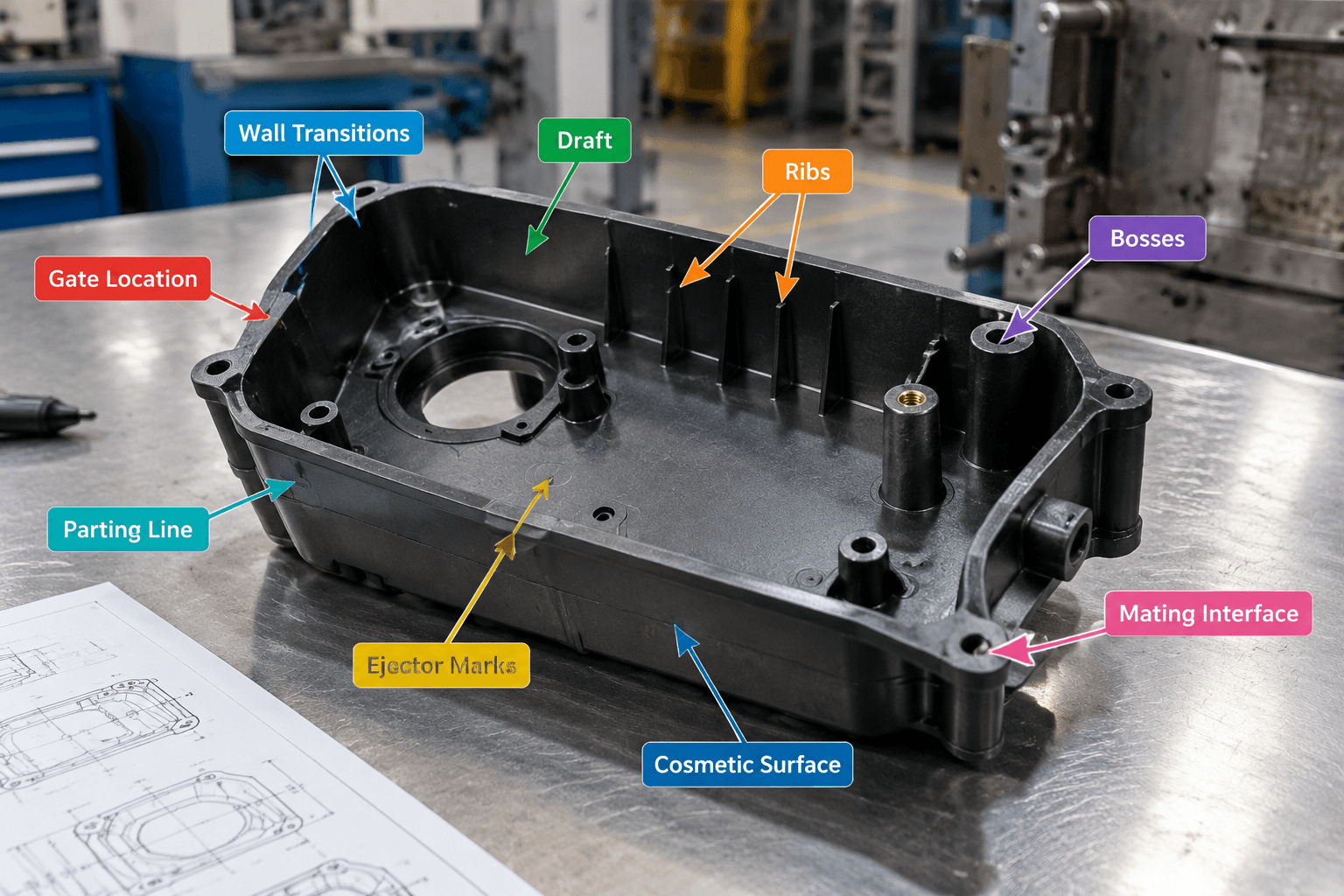
A 3D model can describe the intended shape without proving that the shape will fill, cool, eject, and assemble consistently. The following features should be reviewed as a connected system.
| Design feature | Influence on the molded part | Review focus |
|---|---|---|
| Wall thickness and transitions | Abrupt changes can cool unevenly and increase the risk of sink, voids, flow hesitation, or warpage. | Use reasonably consistent walls and gradual transitions where function permits. |
| Ribs | Ribs add stiffness without making the entire wall thicker, but oversized rib intersections can show sink on the opposite surface. | Rib proportion, spacing, draft, flow direction, and cosmetic-surface location. |
| Bosses | Bosses support screws, inserts, or locating features. Heavy boss-to-wall junctions can create sink and stress concentration. | Core design, supporting ribs, fastener loads, insert method, and clearance from exterior walls. |
| Draft | Draft helps the cooled component release from mold surfaces. Textured or deep features may require additional consideration. | Pull direction, texture depth, shutoffs, and surfaces that cannot tolerate drag marks. |
| Radii and corners | Sharp internal corners can restrict flow and concentrate stress; external and internal radii also affect local wall thickness. | Consistent corner construction and avoidance of unintended thick sections. |
| Gate location | The gate controls where material enters and strongly affects flow marks, weld lines, orientation, packing, and vestige location. | Keep the gate or vestige away from critical cosmetic and mating areas where feasible. |
| Parting line | The mold split can leave a visible witness line or local flash risk. | Identify acceptable locations and any sealing, sliding, or appearance surfaces. |
| Ejector locations | Ejectors transfer force into the cooled part and can leave marks. | Place them on supported, noncritical surfaces and provide enough area for reliable release. |
| Undercuts | Features that block straight ejection may require slides, lifters, collapsible elements, or part redesign. | Tool complexity, visible witness lines, maintenance, and whether the feature is functionally necessary. |
Weld lines, flow marks, gate vestiges, parting lines, and ejector marks cannot always be eliminated. Their location and acceptance level should be agreed during design review. Similarly, a nominal drawing dimension is not the same as guaranteed production variation. Achievable control depends on dimension size, geometry, shrinkage behavior, mold construction, measurement method, and process stability.
ABS Part Definition Matrix: Requirement, Drawing Input, and Why It Matters
Before tooling or production decisions, the buyer should translate functional expectations into controlled engineering inputs. Avoid specifying only “black ABS,” because that does not identify performance, documentation, appearance, or assembly requirements.
| Requirement | Useful project input | Why it matters |
|---|---|---|
| Geometry | Current 3D model plus a revision-controlled dimensioned drawing. | The model defines form; the drawing identifies controlled dimensions, notes, and acceptance requirements. |
| Application | Part function, load, impact exposure, operating temperature, indoor or outdoor use, and chemical contact. | These conditions guide grade selection and can reveal when ABS is unsuitable. |
| Material | Commercial grade if already approved, or required performance with permitted additives. | “ABS” alone does not define heat, impact, UV, flame, color, or processing behavior. |
| Documentation | Required declarations, grade data, traceability, or regulated-use evidence. | Documentation must correspond to the specified resin and application rather than a generic material family. |
| Dimensions | Critical dimensions, datums, inspection method, and mating-part information. | This focuses tool and inspection planning on features that control function and fit. |
| Assembly interfaces | Fasteners, inserts, snap fits, seals, connectors, metal components, and available mating-part drawings. | Interface variation can affect alignment, retention, sealing, and assembly force. |
| Appearance | Approved color reference, gloss range if controlled, texture designation, cosmetic zones, and defect criteria. | Color and texture descriptions are subjective unless tied to agreed references and viewing criteria. |
| Secondary operations | Painting, printing, plating, labeling, or assembly sequence. | Later operations can influence resin choice, surface design, handling, and masking. |
| Demand | Expected batch quantity, annual demand, and program duration. | Volume influences cavity strategy, automation, tooling approach, and unit-cost planning. |
Critical characteristics should be limited to features that genuinely affect safety, function, assembly, or appearance. Over-controlling every dimension can increase tooling, inspection, and process cost without improving the product.
For a technical specification review, B2B OEM and ODM teams can share the 3D model, dimensioned drawing, intended environment, required grade or performance, documentation needs, expected volume, critical interfaces, color, and texture expectations through the injection-molding project page. The first objective should be to confirm that the part definition is ready for molding evaluation, not merely to request a unit price.
Frequently Asked Questions
Can ABS be injection molded?
Yes. Injection molding is the process most commonly associated with industrial ABS parts because the thermoplastic can be plasticized, injected into a detailed cavity, cooled, and ejected. Results depend on the selected grade, geometry, mold, and process control.
What are the main properties of ABS?
ABS commonly offers a balance of rigidity, impact behavior, processability, colorability, and surface appearance. Exact mechanical, thermal, chemical, weathering, and flammability properties must be verified from documentation for the specific commercial grade.
What are the principal stages of an ABS molding cycle?
The sequence covers resin preparation, plasticizing, injection, packing or holding, cooling, mold opening, and ejection. Trimming, inspection, decoration, or assembly may follow. The stages overlap operationally, and their settings cannot be standardized for every part.
What determines ABS resin and molded-part cost?
Resin grade, additives, color, purchasing volume, and market conditions affect material cost. Finished-part cost also reflects part weight, cycle behavior, tooling complexity, cavities, scrap, inspection, secondary finishing, assembly, and packaging. A fixed per-pound resin figure is therefore insufficient for production planning.