
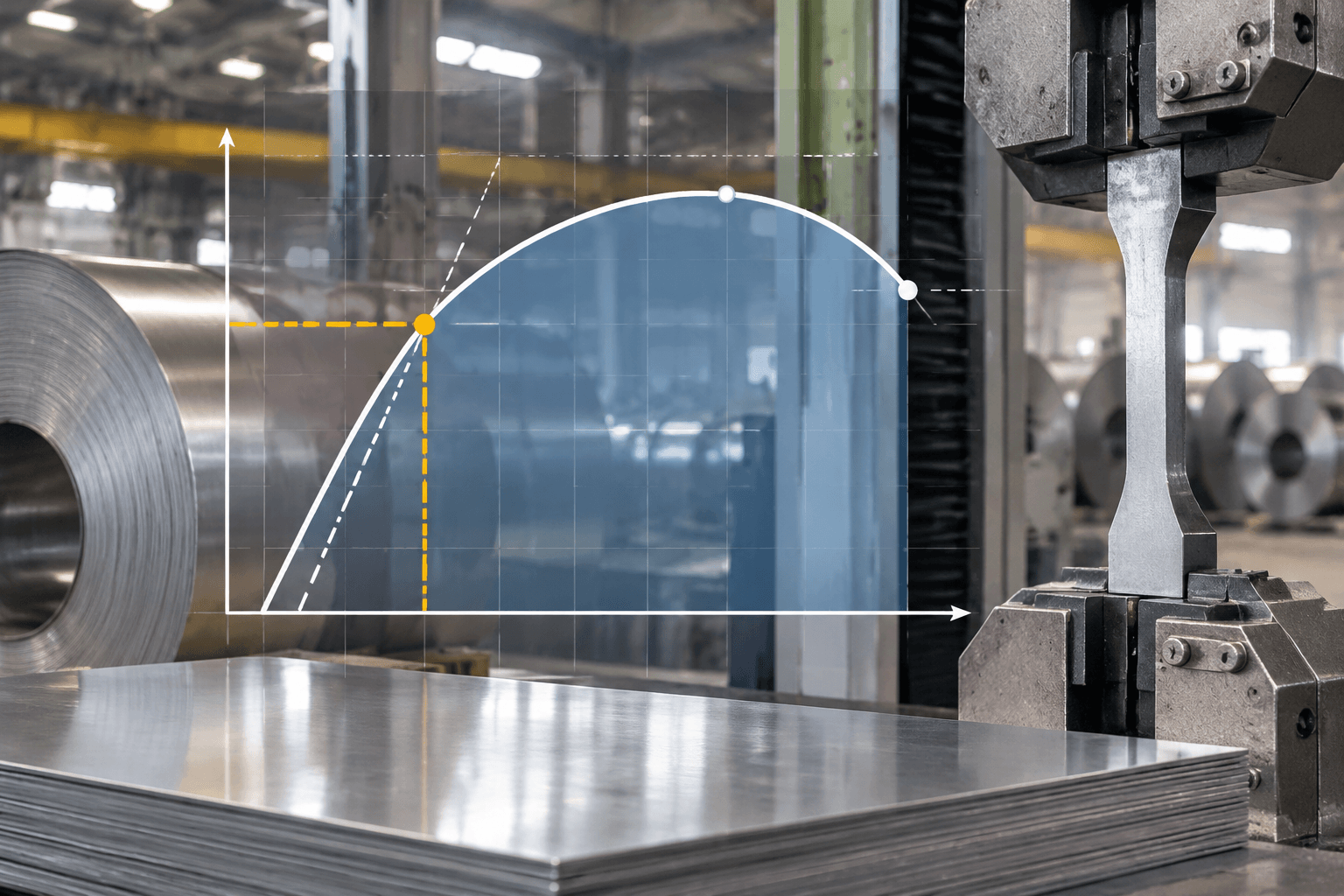
AISI 304 does not have one universal yield-strength value. For annealed plate, sheet, and strip specified to ASTM A240, the minimum 0.2% offset yield strength is 205 MPa, or approximately 29.7 ksi and 29,700 psi. However, values change with the governing specification, product form, 304 variant, thickness, orientation, temperature, and cold-work condition. ([usa.myjacquet.com](https://usa.myjacquet.com/wp-content/uploads/sites/38/2025/04/Technical_Sheet_304_304L.pdf?utm_source=openai))
A figure such as “230 MPa” may be correct for one cold-rolled product but inappropriate for a hot-rolled plate, bar, cold-worked component, or elevated-temperature application. Before using any published value, identify whether it is a specified minimum or a typical test result and confirm the material conditions behind it.
What Is the Yield Strength of AISI 304?
The following values illustrate why the answer depends on the purchase specification. They are not interchangeable design inputs.
| Material and product form | Named basis | Minimum 0.2% proof strength | Important qualifier |
|---|---|---|---|
| 304 plate, sheet, or strip | ASTM A240, annealed | 205 MPa / 29.7 ksi / 29,700 psi | Applies to products ordered and certified to this ASTM specification |
| 304L plate, sheet, or strip | ASTM A240, annealed | 170 MPa / 24.7 ksi / 24,700 psi | 304L has a different specified minimum from 304 |
| EN 1.4301 cold-rolled strip | EN 10088-2, thickness up to 8 mm | 230 MPa / 33.4 ksi / 33,400 psi | Reported for the specified cold-rolled product and thickness range |
| EN 1.4301 hot-rolled strip | EN 10088-2, thickness up to 13.5 mm | 210 MPa / 30.5 ksi / 30,500 psi | Product form and thickness differ from cold-rolled strip |
| EN 1.4301 hot-rolled plate | EN 10088-2, thickness up to 75 mm | 210 MPa / 30.5 ksi / 30,500 psi | The cited EN table reports transverse properties |
| EN 1.4301 bars, rods, and sections | EN 10088, diameter or thickness up to 250 mm | 190 MPa / 27.6 ksi / 27,600 psi | Long-product requirements should not be substituted for sheet requirements |
The ASTM values above are specified minimum properties for annealed material, not predictions of the exact result on every mill certificate. The EN values demonstrate how product form and dimensional limits can change the applicable minimum even when the material is broadly described as “304.” ([usa.myjacquet.com](https://usa.myjacquet.com/wp-content/uploads/sites/38/2025/04/Technical_Sheet_304_304L.pdf?utm_source=openai))
Ultimate tensile strength is a separate property. Under ASTM A240, annealed 304 plate, sheet, and strip have a minimum ultimate tensile strength of 515 MPa, while the minimum 0.2% offset yield strength is 205 MPa. Yield or proof strength identifies the onset of a defined amount of permanent deformation; ultimate tensile strength is the highest engineering stress reached during the tensile test. ([usa.myjacquet.com](https://usa.myjacquet.com/wp-content/uploads/sites/38/2025/04/Technical_Sheet_304_304L.pdf?utm_source=openai))
What Does 0.2% Proof Stress Mean?
Austenitic stainless steels do not normally display the sharp yield point familiar from some carbon steels. Their stress-strain curve transitions progressively from elastic behavior into plastic deformation. For this reason, datasheets usually report 0.2% proof strength, written as Rp0.2, rather than claiming a visually distinct yield point.
During interpretation, imagine a line parallel to the initial elastic portion of the stress-strain curve but shifted by 0.2% strain. The stress where this offset line intersects the measured curve is Rp0.2. In practical terms, it is the engineering stress associated with 0.2% permanent engineering strain after unloading. Some austenitic stainless specifications also report Rp1.0, so the offset must always be checked rather than assumed. ([www-sc10.outokumpu.com](https://www-sc10.outokumpu.com/en/expertise/stainless-basics/mechanical-properties?utm_source=openai))
This distinction matters for formed components. Passing Rp0.2 does not mean immediate fracture; it means measurable permanent deformation has begun under the test definition. A bracket may therefore lose alignment, flatness, or hole position before the material approaches ultimate tensile strength. Geometry, local stress concentration, joints, fatigue, and safety factors remain essential to the design assessment.
Which AISI 304 Yield-Strength Value Applies to Your Part?
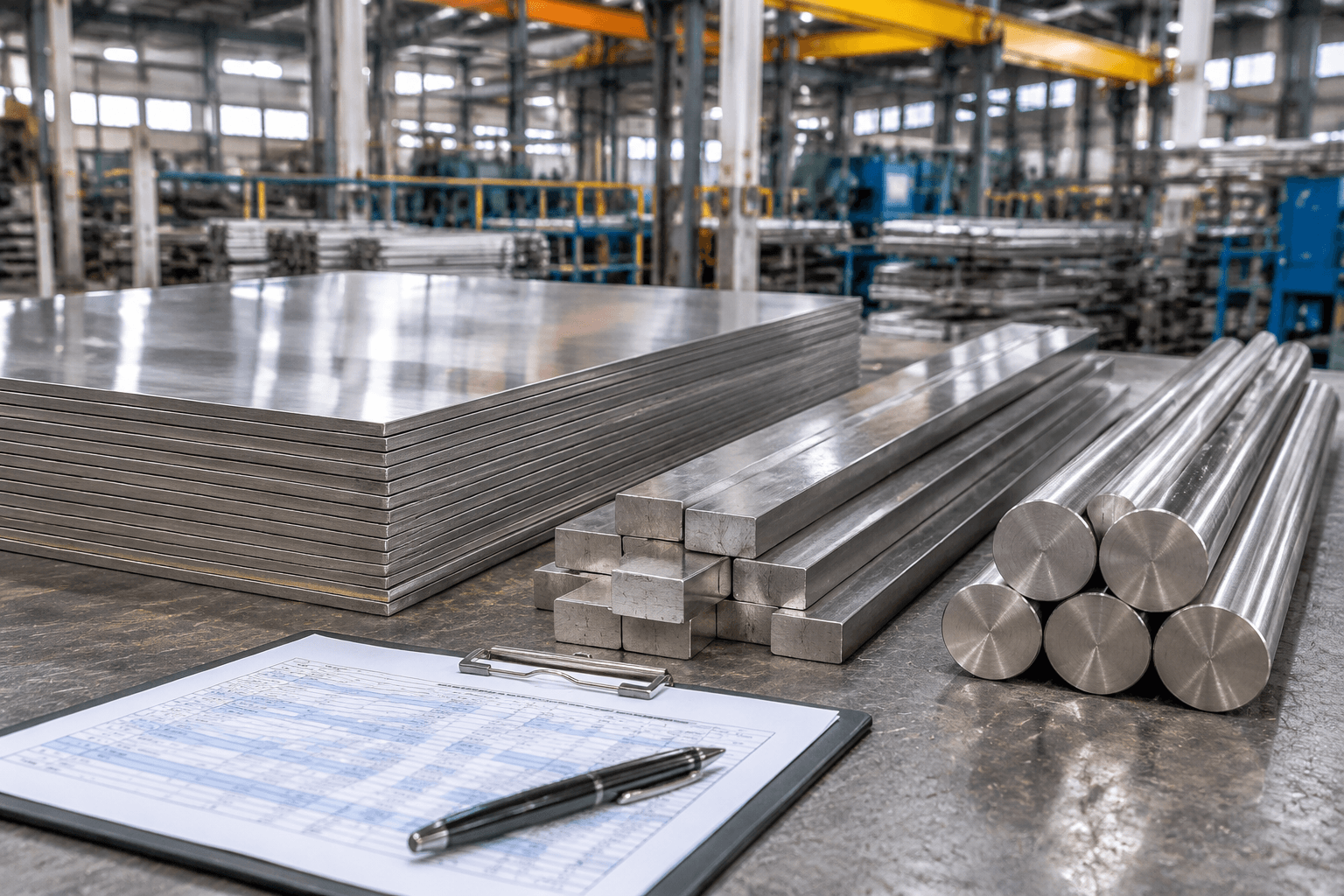
Start with the purchased material identity, not a generic online chart. The following applicability matrix provides a practical screening method.
| Question | What to confirm | Risk if omitted |
|---|---|---|
| Which variant is specified? | 304/S30400, 304L/S30403, 304H/S30409, or another designation | A value for a different chemistry or grade variant may be selected |
| What is the product form? | Cold-rolled sheet, hot-rolled sheet or strip, plate, bar, tube, or section | Product-specific mechanical requirements may be overlooked |
| What is the supply condition? | Solution annealed, cold drawn, temper rolled, or another defined cold-worked condition | Forming force, springback, ductility, and machining response may be misjudged |
| What dimensional range applies? | Thickness, diameter, or hollow-bar wall thickness covered by the source table | A minimum intended for a thinner or smaller product may be used |
| How was the specimen oriented? | Longitudinal or transverse to the rolling direction | Directional differences and specification requirements may be hidden |
| At what temperature was it tested? | Room, elevated, or low temperature, including the named test method | Room-temperature strength may be incorrectly extrapolated to service |
| Is the number minimum or typical? | Specification minimum, producer-typical value, or actual certified test result | A typical value may be treated as a guaranteed minimum |
Grade suffixes also matter. ASTM A240 annealed 304L has a lower specified room-temperature minimum yield strength than 304 in the cited flat-product table. By contrast, 304H is a controlled higher-carbon variant associated with elevated-temperature and creep-resisting service. That purpose does not make 304H, 304, and 304L mechanically interchangeable across all temperatures, welding conditions, or specifications. ([usa.myjacquet.com](https://usa.myjacquet.com/wp-content/uploads/sites/38/2025/04/Technical_Sheet_304_304L.pdf?utm_source=openai))
The same caution applies when comparing 304 with 316. A comparison is meaningful only if both values use equivalent product forms, supply conditions, thickness ranges, orientations, temperatures, and proof-stress definitions.
How Processing History Changes Yield Behavior
Cold work raises strength but consumes formability
AISI 304 strain-hardens substantially during cold rolling, bending, drawing, stretching, or other plastic deformation. Dislocation movement and, depending on composition and strain, deformation-induced martensite contribute to increased strength. The remaining elongation generally decreases as the amount of cold work rises. Cold-worked 304 may also develop a stronger magnetic response than solution-annealed material. ([nickelinstitute.org](https://nickelinstitute.org/media/1705/ign-4-25-02.pdf?utm_source=openai))
This creates a manufacturing distinction between the incoming mill product and the finished part. A bend zone has a different local strain history from a flat flange, and a deep-drawn wall may not share one uniform property value. The increase is not automatically available as a global design credit; its location, direction, uniformity, and treatment under the governing design method must be established.
Thickness and rolling direction affect interpretation
Thickness appears directly in many specification tables because processing history and permitted mechanical requirements change with product dimensions. Rolling can also produce directional behavior. A transverse coupon result should not silently be treated as a universal property in every loading direction.
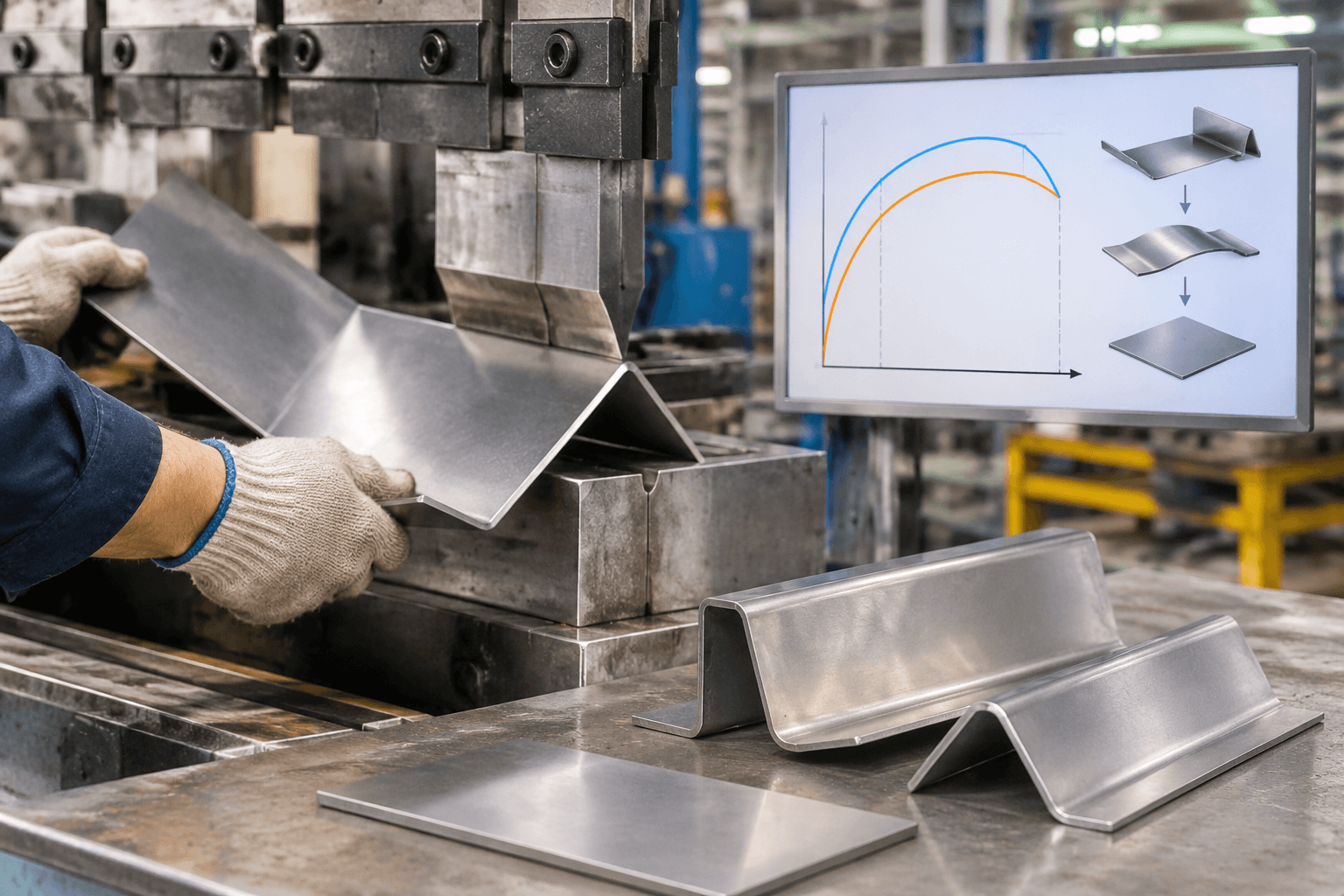
For sheet metal work, these factors affect bend-force estimates, bend radius selection, springback, distortion, and dimensional repeatability. For custom metal brackets built to drawing geometry, yield strength is only one input; section depth, hole position, inside radius, grain direction, joint design, and load path can be equally important.
Temperature changes the applicable strength
Room-temperature figures must not be carried into hot service without temperature-qualified data. As one product-specific example, an Alleima 304/304L hollow-bar datasheet reports a minimum Rp0.2 of 210 MPa at 20°C, 165 MPa at 100°C, and 140 MPa at 200°C. The same source notes a possible reduction of about 10 MPa for hollow-bar wall thicknesses above 10 mm. These values illustrate the importance of product and temperature qualifiers; they are not a universal elevated-temperature table for all 304 products. ([alleima.com](https://www.alleima.com/contentassets/4cbc883cc079401e8379e4764c662077/datasheet-sanmac-304304l-en-v2025-05-09-0637-version-1.pdf/download?utm_source=openai))
Forming and welding can create local property differences
Cold forming can raise local strength and springback, so the finished part may not have uniform mechanical properties across flat and heavily strained regions. Welding can introduce a heat-affected region, residual stress, and distortion; any effect on the joint must be evaluated using the applicable material, welding, and design requirements rather than a generic AISI 304 yield-strength value.
How to Verify and Use a Published Value
Before a yield-strength number enters a drawing note, calculation, or manufacturing review, follow this sequence:
- Identify the full grade. Record the AISI or ASTM type, UNS number, EN number where relevant, and suffix such as L or H.
- Name the governing material specification. “AISI 304” identifies a grade family, but it does not by itself define the product requirements, delivery condition, testing, or dimensional tolerances.
- Match the product form and dimensions. Confirm that the table covers the purchased sheet, plate, strip, bar, tube, or section and its actual thickness or diameter.
- Check the property definition. Verify whether the number is Rp0.2, Rp1.0, a reported yield strength under another convention, or ultimate tensile strength.
- Confirm condition, orientation, and temperature. Do not mix annealed and cold-worked values or room-temperature and elevated-temperature data.
- Separate guaranteed and descriptive values. Use specification minimums and certified results according to the design requirement; do not treat a producer’s typical value as a guaranteed lower limit.
- Review the design system. Yield strength alone cannot establish an allowable load. Geometry, buckling, fatigue, welds, fasteners, stress concentration, corrosion allowance, service temperature, and the applicable safety factors or design code must also be considered.
The material test certificate or mill certificate should be checked for grade and specification, heat or lot identification, dimensions, delivery condition, chemical composition, tensile-test values, test temperature where applicable, and other fields required by the purchase order. The drawing, purchase specification, and certificate should describe the same material rather than three slightly different versions of “304 stainless.”
Application language also needs care. AISI 304 is not automatically suitable for every food-contact use merely because it is commonly associated with stainless equipment. Strength data must be considered alongside corrosion exposure, cleanability, surface finish, fabrication details, and the regulations governing the finished equipment.
Need to confirm whether a published AISI 304 yield-strength value applies to your part? Send the drawing or part geometry, specified 304 variant and product form, material specification or supplier datasheet, service temperature, and critical loading information. Yishang can review whether the material designation and supplied documentation are aligned with the fabrication and service requirements before production planning.
Frequently Asked Questions
Is AISI 304 yield strength normally reported as 0.2% proof stress?
Yes. Because annealed austenitic stainless steel does not normally show a sharp yield point, its yield behavior is commonly represented by Rp0.2: the stress associated with 0.2% permanent engineering strain. Confirm the datasheet notation because Rp1.0 may also be reported. ([www-sc10.outokumpu.com](https://www-sc10.outokumpu.com/en/expertise/stainless-basics/mechanical-properties?utm_source=openai))
How do 304, 304L, and 304H differ in reported mechanical properties?
The differences depend on the specification and product form. For example, ASTM A240 lists lower minimum room-temperature yield and tensile strengths for annealed 304L flat products than for 304. The H variant controls carbon for high-temperature service and requires temperature- and specification-specific evaluation rather than substitution based only on the 304 name. ([usa.myjacquet.com](https://usa.myjacquet.com/wp-content/uploads/sites/38/2025/04/Technical_Sheet_304_304L.pdf?utm_source=openai))
Does cold working increase the yield strength of 304 stainless steel?
Generally, yes. Cold deformation strain-hardens 304 and can substantially raise its proof strength, while reducing remaining ductility and often increasing springback. The resulting property depends on the amount, path, and direction of deformation, so it should not be represented by one generic cold-worked value. ([nickelinstitute.org](https://nickelinstitute.org/media/1705/ign-4-25-02.pdf?utm_source=openai))
How does 304 yield strength compare with 316?
Neither grade has one universal value. Under equivalent EN product conditions, 316-family grades may have a somewhat higher specified minimum proof strength in some tables, but specification, thickness, condition, and temperature must be matched before comparing them. Grade selection must also consider corrosion environment, forming, welding, cost, and service requirements rather than yield strength alone. ([edelstahl-rostfrei.org](https://www.edelstahl-rostfrei.org/fileadmin/user_upload/ISER/downloads/Recommend_EN.pdf?utm_source=openai))