
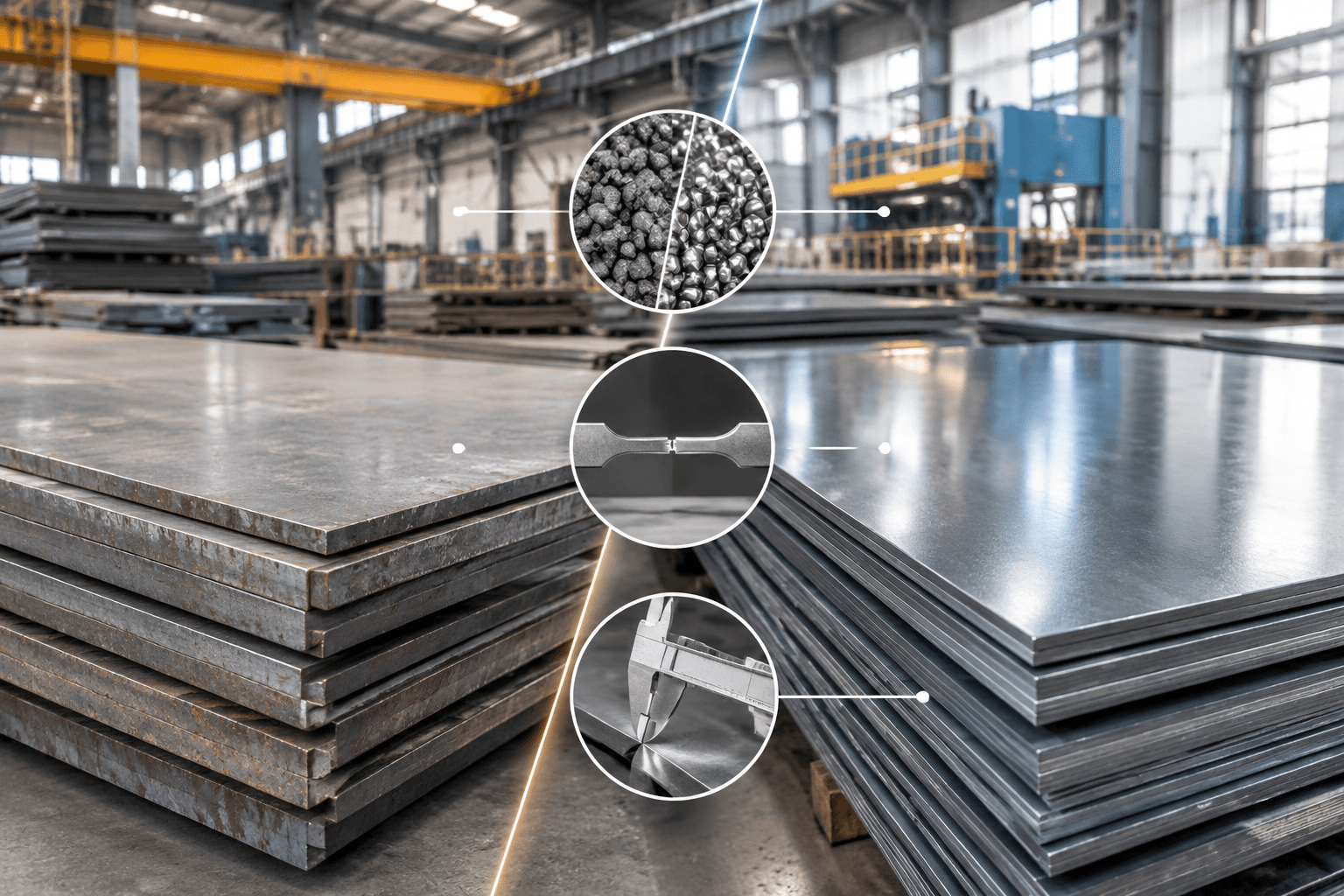
Quick answer: “Alloy carbon” is not normally a complete standardized material designation. It is often an incomplete or reversed search phrase referring to carbon steel, alloy steel, or a carbon steel grade containing specified alloying elements. The correct choice for a manufactured part depends on the exact grade, material condition, loading, environment, geometry, and production requirements—not the family name alone.
Carbon steel and alloy steel are broad classifications rather than single materials. A drawing or purchase order that says only “alloy carbon” does not provide enough information to establish chemistry, mechanical properties, heat-treatment response, weldability, or corrosion behavior. Final engineering and purchasing decisions require a complete grade designation and the applicable delivery or heat-treated condition.
What Does “Alloy Carbon” Mean?
The phrase can be interpreted in several ways depending on where it appears. A buyer may be searching for the difference between carbon steel and alloy steel. A drawing note may have shortened or reversed the wording for an alloyed carbon steel. In other cases, the intended material may be a specific low-alloy or heat-treatable steel whose grade was omitted.
Terminology check: Do not treat “alloy carbon” as the name of one grade, coating, product form, or manufacturing process. Ask for the full material specification, grade, condition, and any required heat treatment.
A complete designation matters because two steels within the same general family can behave differently during forming, machining, welding, heat treatment, and service. Even when two grades have similar carbon content, differences in alloying elements, processing history, section thickness, and material condition can produce different results.
This distinction is especially important when replacing a material or comparing supplier quotations. If one supplier assumes a readily formable carbon steel and another assumes a quenched-and-tempered alloy steel, the quotations may cover different raw materials, production routes, and inspection requirements.
Carbon Steel: Composition and General Categories
Carbon steel is a broad family in which carbon is a principal intentionally controlled element affecting strength and hardening response, while the overall chemistry remains within the carbon-steel definition of the applicable specification. It can also contain manganese, silicon, and residual or specified quantities of other elements. The governing standard and exact grade determine the permitted chemistry.
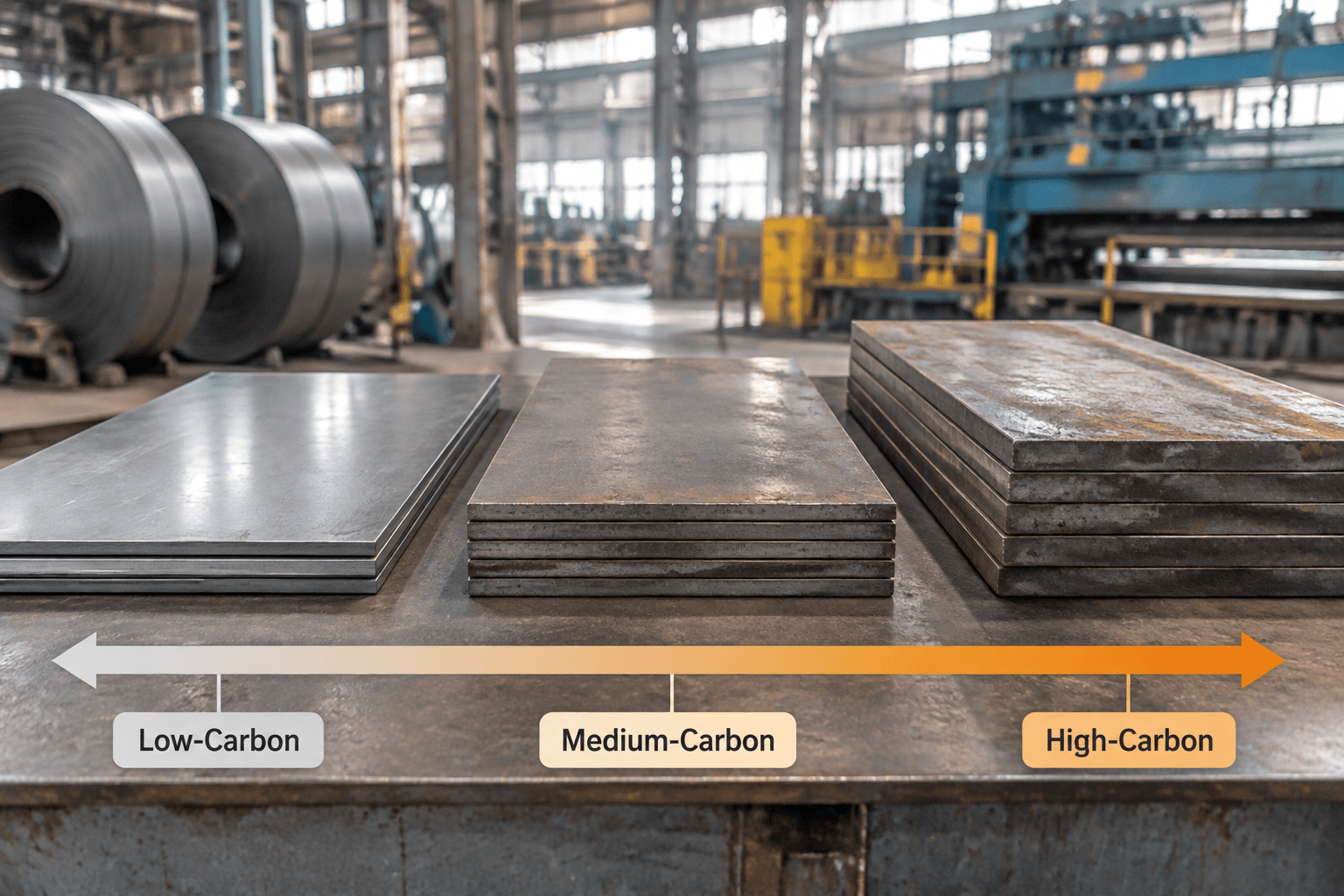
Carbon content is commonly used to discuss low-, medium-, and high-carbon categories. These are useful general groupings, but their boundaries are not universal across every standard, market, or technical reference. Carbon percentage also does not determine final properties by itself. Grain structure, alloy content, cold work, heat treatment, product form, and section size all influence performance.
Low-Carbon Steel
Low-carbon grades are generally selected when formability, weldability, and economical fabrication are important. Depending on the exact grade and condition, they may be suitable for bent components, enclosures, frames, brackets, panels, and welded assemblies. Their relatively limited through-hardening response can be an advantage for forming and joining but may be a limitation when high surface hardness or strength is required.
Medium-Carbon Steel
Medium-carbon grades generally offer a different balance of strength, toughness, machinability, and heat-treatment response. They may be considered for shafts, pins, mechanical components, and parts requiring higher strength or wear performance than a typical low-carbon sheet grade. The achievable result still depends on the complete chemistry, geometry, and material condition.
High-Carbon Steel
High-carbon grades are commonly associated with greater potential hardness and wear resistance after appropriate processing. They may also present greater forming, welding, or cracking concerns than lower-carbon grades. This does not make them automatically more durable: a very hard material can be unsuitable where impact toughness, weldability, or resistance to brittle failure is more important.
The carbon-content spectrum is therefore a starting point, not a final selection method. A designer must still identify the required mechanical properties, service conditions, manufacturing route, and applicable grade specification.
How Alloying Elements Change Steel Behavior
Alloy steel contains intentionally controlled elements used to modify performance or processing response beyond what can be achieved with carbon content alone. The effect of each element depends on its amount, its interaction with the rest of the chemistry, and the material’s thermal and mechanical history.
| Alloying element | Potential influence in an appropriate grade | Selection caution |
|---|---|---|
| Manganese | Can contribute to strength, hardenability, and processing behavior. | Its effect cannot be evaluated separately from carbon content and the rest of the chemistry. |
| Chromium | Can improve hardenability, wear response, and oxidation or corrosion behavior in suitable compositions. | A chromium-containing low-alloy steel is not automatically stainless and may still require corrosion protection. |
| Nickel | Can support toughness and strength, including in demanding service conditions. | The benefit depends on grade, amount, temperature, and heat-treated condition. |
| Molybdenum | Can improve hardenability and support strength retention in selected applications. | Material response varies with section thickness and the complete heat-treatment cycle. |
| Silicon | Can influence strength, deoxidation, and specialized property requirements. | Higher strength does not necessarily mean easier forming or joining. |
| Vanadium and similar microalloying additions | Can contribute to grain refinement, strength, and wear performance. | Processing control and material condition are essential to achieving the intended result. |
These elements can change hardenability, which describes how deeply a steel can develop a hardened structure under a defined heat-treatment process. This is different from hardness itself. Two steels may reach similar surface hardness while behaving differently through the part’s cross-section, particularly when the geometry includes thick sections or abrupt changes.
Alloying may also improve toughness, fatigue performance, wear resistance, or heat-treatment consistency for a particular application. However, it can introduce manufacturing tradeoffs such as more demanding welding procedures, reduced formability, additional heat treatment, distortion control, or tighter material traceability.
Carbon Steel vs Alloy Steel: Compare the Requirement, Not Just the Label
Alloy steel is not universally stronger, harder, more corrosion-resistant, or more durable than carbon steel. The meaningful comparison is between identified grades in specified conditions and at the relevant section size.
| Requirement | Carbon steel considerations | Alloy steel considerations |
|---|---|---|
| Strength | Many grades provide adequate strength for structural and fabricated parts, particularly when load and geometry are well defined. | Selected grades and heat treatments may provide higher or more consistent strength for demanding components. |
| Toughness and impact | Performance varies substantially by grade, temperature, thickness, and condition. | Certain alloy systems may support improved toughness, but the grade and heat treatment must be specified. |
| Hardness and wear | Medium- and high-carbon grades may provide useful hardness and wear resistance after suitable processing. | Greater hardenability may help thick or complex parts achieve the required response more consistently. |
| Corrosion exposure | Unprotected carbon steel can corrode in moisture or aggressive environments, so coatings or finishes may be required. | Some alloy additions can change corrosion behavior, but ordinary alloy steel should not be assumed to have stainless-level resistance. |
| Forming and welding | Appropriate low-carbon grades are often practical for bending and welded fabrication. | Some grades require more controlled forming, preheating, filler selection, or post-weld treatment. |
| Heat-treatment response | Response ranges from limited hardenability to useful hardening in suitable medium- or high-carbon grades. | Alloying can improve hardenability and property control, particularly across larger sections. |
| Specification complexity | A defined grade and condition are still necessary, even for apparently simple fabricated parts. | Heat-treatment condition, chemistry, testing, and traceability may require more detailed documentation. |
Durability should also be separated into its actual requirements. Resistance to abrasive wear is not the same as resistance to impact, fatigue, corrosion, deformation, or high-temperature exposure. Increasing hardness may help one failure mode while reducing suitability for another. The best material is the one that provides the required combination of properties after manufacturing.
A Requirement-Led Material Selection Path
Begin with what the part must do, then identify grades capable of meeting those requirements in a manufacturable condition.
- Define loading. Identify static loads, cyclic loads, impact, contact pressure, and the consequences of permanent deformation or fracture.
- Describe the environment. Note moisture, chemicals, temperature, outdoor exposure, abrasion, and any required protective finish.
- Specify the critical property. Separate yield or tensile strength from hardness, toughness, fatigue resistance, and wear performance.
- Review part geometry. Thickness, section changes, bend radii, holes, weld locations, and overall size can affect forming and heat-treatment response.
- Confirm the manufacturing route. Consider cutting, forming, machining, welding, coating, and assembly only where they are relevant to the selected grade.
- State the material condition. Annealed, normalized, cold-worked, or quenched-and-tempered material can perform differently even when the grade name is unchanged.
- Complete the specification. Record the grade, governing specification, condition, required properties, and any inspection or traceability requirements.
For example, a formed indoor bracket carrying a predictable static load may be well served by an appropriate carbon steel grade if its thickness, bend requirements, joining method, and finish are properly defined. Explore how these factors interact in custom metal brackets built to your drawings.
A transportation component exposed to vibration, repeated loading, impact, or outdoor conditions may require a different balance of strength, fatigue resistance, toughness, corrosion protection, and joining performance. That evaluation could lead to carbon steel or alloy steel depending on the design and required condition. See the application context for custom metal fabrication for automotive and transportation equipment.
A shaft or wear component provides another useful boundary example. A heat-treatable carbon steel may meet the requirement for one diameter and duty cycle, while an alloy steel may offer a more suitable through-section response for another. The family label alone cannot resolve that decision.
Clarify the Grade Before Finalizing Production Documents
If a drawing, bill of materials, or inquiry uses “alloy carbon,” replace it with a complete and reviewable material designation before production. This prevents suppliers from quoting different manufacturing assumptions and helps align raw material, heat treatment, joining, finishing, and inspection.
For a technical specification review, provide the intended grade or available material specification, the part drawing or key dimensions, the service environment, critical performance requirements, expected order quantity, and assembly needs. Yishang can review these details as an OEM and ODM custom metal manufacturer and help identify where the material description or production documentation requires clarification before quoting.
Where RFQ Assumptions Create Cost and Production Risk
Many sheet metal fabrication problems begin before production starts. If drawings, tolerances, finish expectations, material grades, or assembly requirements are unclear, suppliers may quote based on different assumptions. That can make prices difficult to compare and may lead to rework, cosmetic rejection, assembly misalignment, or production delays later.
For OEM buyers, the goal is not simply to request the lowest price. The goal is to make sure each supplier is quoting the same manufacturing reality. Before confirming an order, clarify which dimensions are fit-critical, which surfaces are cosmetic, whether prototypes must match batch-production conditions, and how finished parts will be inspected.
Frequently Asked Questions
What alloy carbon details should buyers define before requesting a quote?
Buyers should define the functional requirement, drawing notes, critical dimensions, material or process expectations, and any inspection points related to alloy carbon. This helps suppliers quote the same manufacturing scope instead of making different assumptions.
How can RFQ details affect cost, fit, or lead time?
RFQ details can change tooling, forming, welding, finishing, inspection, or rework requirements. If buyers do not clarify it early, two supplier quotes may look comparable while covering different production risks.
Why should drawing requirements be reviewed before prototype approval?
drawing requirements may look acceptable on a single sample but become harder to control during batch production. Buyers should confirm whether the prototype reflects the same process, finish, and inspection conditions expected for production.
What inspection points matter most for alloy carbon projects?
Important inspection points usually include fit-critical dimensions, holes or mating areas, cosmetic surfaces, finish build-up, welded or formed features, and any dimensions that affect downstream assembly. These points should appear in the RFQ or drawing notes.
How can buyers reduce prototype approval risk before batch production?
Buyers can reduce risk by clarifying drawings, locking key material and finish assumptions, defining inspection timing, approving a representative sample, and confirming which dimensions or surfaces require tighter process control.
How can Yishang help review alloy carbon requirements?
Yishang can review drawings, RFQ notes, material requirements, tolerance expectations, finish details, samples, and assembly needs to identify unclear assumptions before quoting or batch production.