
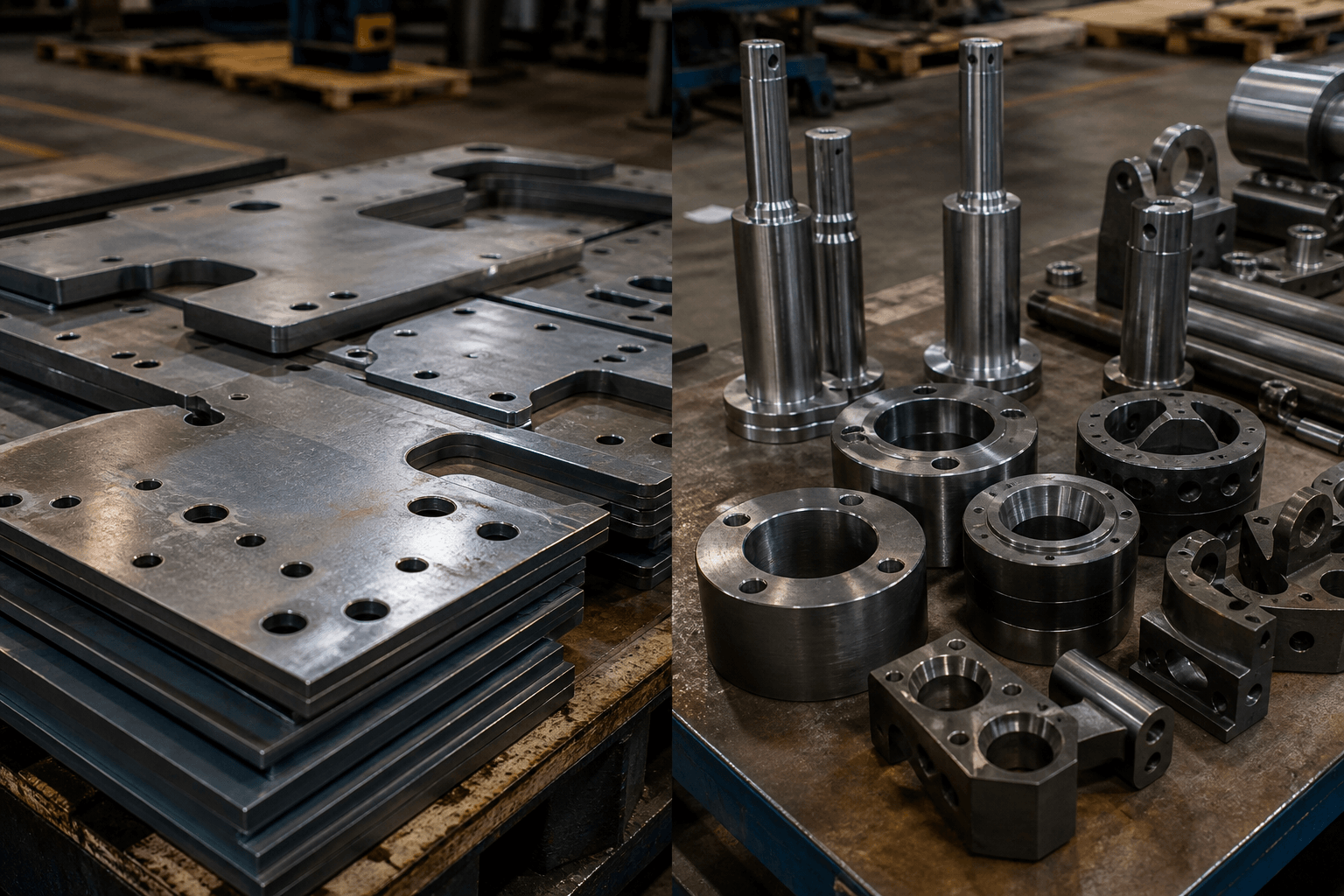
Carbon steel is steel classified mainly by its carbon content and limited amounts of other elements, while alloy steel contains intentionally added alloying elements to achieve selected properties or heat-treatment response. Both are types of steel, and neither label alone guarantees higher strength, better corrosion resistance, easier fabrication, or lower cost.
The practical difference depends on the specific grade, product form, supplied condition, thickness, manufacturing route, and required component performance. A heat-treated alloy steel may suit a highly loaded shaft, while a formable carbon steel or HSLA sheet may be the better choice for a welded bracket or structural enclosure.
How Alloy Steel and Carbon Steel Compare
The term carbon steel does not mean that carbon is its only added element. Carbon steels normally contain manganese, silicon, copper, and other residual or controlled elements within limits established by the applicable material definition. Their classification and behavior are driven primarily by carbon content rather than by a deliberate combination of alloy additions.
Alloy steel contains intentionally added elements—such as chromium, nickel, molybdenum, manganese, vanadium, or boron—to modify properties including hardenability, toughness, wear resistance, high-temperature behavior, or strength after heat treatment. Alloy steel is not automatically stainless steel. Stainless grades are a separate group defined by chemistry and corrosion behavior.
Exact boundaries vary among standards, markets, and designation systems. Buyers should therefore compare specified grades and conditions instead of assuming that every material sold under one broad family behaves alike.
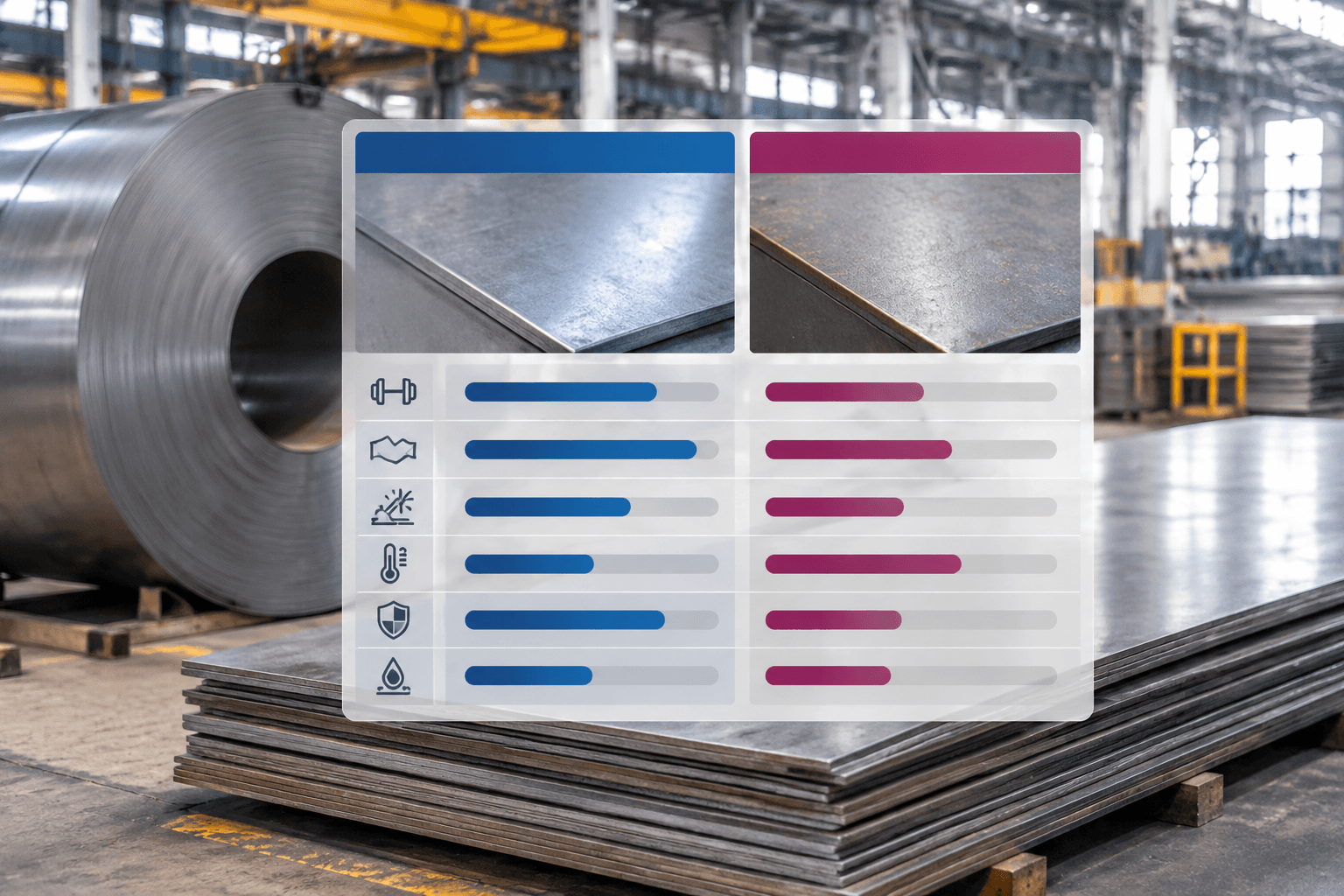
| Decision factor | Carbon steel | Alloy steel |
|---|---|---|
| Composition | Properties are influenced mainly by carbon content, with other elements controlled within the grade definition. | One or more alloying elements are intentionally added to produce a targeted response. |
| Strength potential | Ranges from readily formed low-carbon sheet to hard, high-carbon products. Heat treatment can increase strength in suitable grades. | Can provide high strength through chemistry and heat treatment, although not every alloy grade is stronger than every carbon grade. |
| Ductility and formability | Low-carbon grades are generally preferred for deep drawing, bending, and complex cold forming. | Varies widely. Increased strength or hardenability may reduce forming latitude, especially in hardened conditions. |
| Weldability | Often favorable at lower carbon levels. Higher carbon increases cracking risk and may require more controlled welding procedures. | Depends on carbon equivalent, alloy content, thickness, restraint, and condition. Some grades need preheating or post-weld controls. |
| Corrosion behavior | Usually needs coating, plating, painting, or another protection system in corrosive environments. | Some grades improve atmospheric or high-temperature performance, but conventional alloy steel is not inherently corrosion-proof. |
| Heat-treatment response | Increases as carbon rises, although section size and grade chemistry limit achievable through-hardening. | Alloy additions can increase hardenability and help larger sections develop more uniform properties after quenching and tempering. |
| Typical uses | Formed panels, welded frames, brackets, tubes, plates, wire, rails, springs, and general structural parts. | Highly loaded shafts, gears, fasteners, wear parts, pressure-related components, forgings, and heat-treated mechanical parts. |
| General price tendency | Common grades are often economical and widely available. | Alloy additions and processing may increase cost, but actual price depends on grade, form, condition, quantity, location, and purchase date. |
The overlap is important. A high-carbon steel can be harder and less formable than some alloy steels, while an annealed alloy grade may be easier to machine or shape than the same grade after hardening. Material condition must always accompany the family name.
How Carbon Content and Heat Treatment Affect Steel Performance
Carbon is one of the strongest influences on steel hardness, strength, ductility, weldability, and response to quenching. As carbon content rises, the potential for hardness and wear resistance generally increases. At the same time, cold formability and weldability usually decrease, and the consequences of an uncontrolled heat-affected zone become more significant.
Common descriptions divide carbon steel into three broad groups, but the boundaries are not universal:
- Low-carbon steel: commonly extends to approximately 0.30% carbon. Some references distinguish very-low-carbon or mild grades below about 0.10%. These materials are widely used where bending, stamping, drawing, welding, and general structural fabrication are priorities.
- Medium-carbon steel: often described as approximately 0.30% to 0.60% carbon. Suitable grades may be quenched and tempered to balance strength and toughness for mechanical parts, forgings, rails, and similar applications.
- High-carbon steel: often placed around 0.60% to 1.00% carbon. Its higher hardness and wear potential can suit springs, strong wire, cutting edges, and wear-related products, but fabrication becomes less forgiving.
Quenching cools a heated steel rapidly to create a harder microstructure. Tempering then reheats the quenched material under controlled conditions to reduce brittleness and establish a more useful balance of hardness, strength, and toughness. The final outcome depends on more than nominal carbon content: alloy additions, austenitizing conditions, quench severity, section thickness, geometry, prior processing, and tempering temperature all matter.
This is why a drawing should identify the required supplied condition and final condition. “Alloy steel” alone does not indicate whether the material is annealed, normalized, hardened, or quenched and tempered. Forming a hardened blank is very different from forming annealed material and heat treating it afterward. Welding can also alter locally heat-treated properties, making joint placement and the required post-weld condition part of the engineering review.
Where HSLA Fits in the Classification Map
High-strength low-alloy steel, or HSLA steel, overlaps chemically with low-alloy steel but is usually treated as a performance-oriented category rather than simply a chemistry range. HSLA grades typically combine relatively low carbon—often about 0.05% to 0.25%—with manganese and small additions of elements used for grain refinement, precipitation strengthening, or processing control. Exact limits depend on the grade and governing specification.
Carbon steel: classification is driven mainly by carbon level and conventional composition limits.
HSLA steel: designed to deliver higher strength, useful toughness, and practical weldability with relatively low carbon, often supported by microalloying and controlled rolling or cooling.
Conventional low-alloy steel: commonly selected for its hardenability and ability to develop mechanical properties through heat treatment, particularly in thicker or highly loaded components.
The distinction matters during manufacturing. HSLA sheet or plate may reduce thickness or component weight while retaining fabrication characteristics suitable for welded structures. Conventional alloy steel may be preferred when a part must be quenched and tempered through a meaningful section, resist repeated contact stress, or combine a hard surface with a tough core.
Neither route is automatically superior. A formed crossmember for automotive or transportation equipment may prioritize strength-to-weight efficiency and weldability, while a shaft, gear, or heavily loaded pin in the same assembly may require a heat-treatable alloy grade. The correct category follows each component’s load, geometry, supplied condition, and manufacturing sequence.
Choose by Requirement, Not by Material Label
Material selection should begin with the component’s load path, geometry, manufacturing sequence, and service environment. The following matrix indicates useful starting directions; grade-level validation is still necessary.
| Primary requirement | Likely starting direction | Design review notes |
|---|---|---|
| Deep drawing or complex cold forming | Low-carbon sheet | Confirm elongation, bend direction, surface condition, thickness tolerance, and whether later welding or coating will affect the choice. |
| Welded structure with increased strength | HSLA or a weldable carbon-steel grade | Compare strength with carbon equivalent, bendability, joint restraint, heat input, and the availability of matching plate or sheet. |
| Quench-and-temper response in a thicker section | Heat-treatable alloy steel or suitable medium-carbon steel | Evaluate section size, hardenability, distortion risk, required core properties, and whether machining occurs before or after heat treatment. |
| Wear resistance | High-carbon or alloy steel, depending on loading and heat treatment | Hardness alone is insufficient. Check impact, lubrication, contact stress, toughness, and the possibility of surface treatment. |
| Notch toughness or impact loading | Selected HSLA, carbon, or alloy grade | Required test temperature, thickness, grain direction, welding, and final heat treatment can change the suitable family. |
| Atmospheric exposure | Coated carbon steel or a grade designed for improved atmospheric performance | Do not assume ordinary alloy steel is corrosion-resistant. Consider drainage, crevices, coating access, maintenance, and the full exposure cycle. |
| Strength-to-weight efficiency | Often HSLA, subject to forming and stability checks | Reducing thickness may affect buckling, stiffness, weld design, fatigue life, and local bearing around holes. |
| General fabricated brackets and enclosures | Low-carbon steel or HSLA, depending on load | For custom metal brackets, hole locations, bend radii, welded attachments, finish, and installed loads may be more decisive than the broad material label. |
| Assemblies with different component demands | Carbon steel, HSLA, or alloy steel selected by component | Material handling and logistics equipment may require different material families for structural sections, wear interfaces, and highly loaded pins rather than one material across the entire assembly. |
A complete material callout should identify the grade, product form, thickness, and supplied condition, together with any required mechanical properties, heat treatment, coating, or inspection criteria. This prevents a purchasing team from substituting a material that shares a family name but does not provide the necessary forming response, weldability, toughness, or final strength.
Higher carbon or alloy content should not be treated as an automatic upgrade. Added hardenability may create welding and distortion concerns. Higher strength may require larger bend radii or greater forming force. A thinner high-strength part may also lose stiffness even when its yield strength is sufficient. Conversely, selecting a very formable grade without checking service loads can produce excessive deformation or wear.
Frequently Asked Questions
What are the main types of carbon steel?
Carbon steel is commonly grouped into low-, medium-, and high-carbon categories. Approximate ranges are up to 0.30%, 0.30% to 0.60%, and 0.60% to 1.00% carbon, respectively, but boundaries vary by reference and specification. The grade and supplied condition provide more reliable purchasing information than the category alone.
Is alloy steel the same as ordinary steel?
Alloy steel is one family within the broader category of steel. It contains intentional alloy additions selected to modify properties or processing response. Carbon steel is also steel, and it contains controlled quantities of elements other than carbon. “Ordinary steel” is not a precise engineering specification.
What distinguishes HSLA steel from other low-alloy steels?
HSLA is generally defined through a combination of performance, low carbon, microalloying, and controlled processing. Conventional low-alloy grades are often selected primarily for hardenability and heat-treatment response. The categories can overlap in chemistry, so the specification and required properties determine the practical distinction.
What disadvantages can higher carbon content create during forming and welding?
Increasing carbon generally reduces ductility and cold-forming latitude while raising hardness and cracking sensitivity in welded heat-affected zones. Depending on grade, thickness, geometry, and restraint, production may require controlled bend radii, preheating, carefully selected welding parameters, or post-weld treatment. These measures must be established from the actual material and joint requirements.