
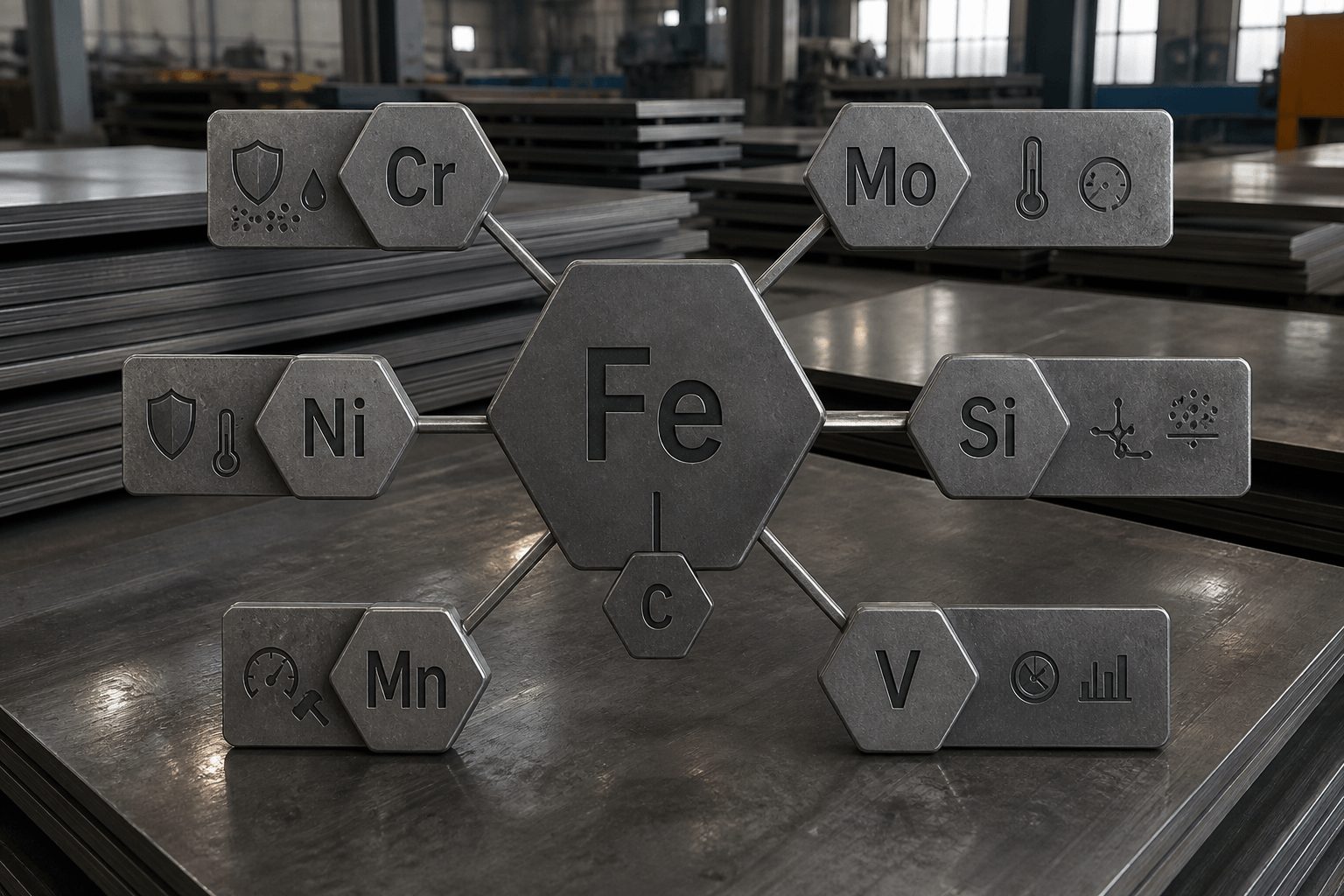
Alloy steel has no single composition percentage or universal formula. It is an iron-carbon material modified with intentionally controlled additions such as chromium, nickel, manganese, molybdenum, silicon, or vanadium. The permitted percentages depend on the grade, governing specification, product form, and sometimes the hardenability or cleanliness variant. Iron generally makes up the balance after the specified elements and controlled residuals are accounted for.
Therefore, a useful alloy steel composition chart must identify the grade and source behind every range. The representative table below compares four documented alloy systems, while the surrounding sections explain what the entries mean and why chemistry alone cannot guarantee final performance. The World Steel Association defines steel as an iron-carbon alloy and notes that thousands of grades exist with different chemical and physical characteristics. ([worldsteel.org](https://worldsteel.org/about-steel/glossary/?glossary_term=68633&utm_source=openai))
What Alloying Elements Change in Steel
Alloying elements influence phase transformations, carbide formation, grain behavior, oxidation response, hardenability, and other metallurgical mechanisms. Their effect depends on concentration, carbon content, interactions with other elements, and processing. An element that is beneficial in one grade or condition may create fabrication or heat-treatment challenges in another.
| Element | Common metallurgical roles | Important qualification |
|---|---|---|
| Chromium (Cr) | Increases hardenability, participates in carbide formation, and can improve oxidation, wear, or corrosion behavior. | The effect depends strongly on percentage and the surrounding composition. Chromium in a low-alloy grade does not automatically provide stainless-steel corrosion resistance. |
| Nickel (Ni) | Can support toughness, strengthen the metallic matrix, stabilize austenite, and contribute to hardenability. | Nickel does not independently define a grade’s strength or low-temperature performance. |
| Manganese (Mn) | Supports deoxidation and sulfur control during steelmaking and commonly increases hardenability. | Manganese is present in many carbon and alloy steels, so its presence alone does not establish the material category. |
| Molybdenum (Mo) | Increases hardenability and can retard softening during tempering. It may also participate in alloy-carbide formation and support elevated-temperature properties. | Useful effects depend on heat treatment and whether the element is dissolved in austenite or tied up in carbides. |
| Silicon (Si) | Commonly acts as a deoxidizer and can provide solid-solution strengthening. Higher intentional levels appear in some spring and electrical steels. | Silicon content must be interpreted within the named grade rather than treated as a universal indicator of performance. |
| Vanadium (V) | Forms stable carbides or carbonitrides, can refine grain size, and may support strength or resistance to tempering. | Its effect varies with thermal history, solution treatment, precipitation, and concentration. |
| Boron (B) | Very small controlled additions can substantially increase hardenability in suitable steels. | The result depends on steelmaking control and the amount of effective boron remaining available at austenite grain boundaries. |
| Niobium and titanium | May form carbides or carbonitrides used for grain control, precipitation strengthening, or stabilization in selected steel families. | These microalloying additions do not make every affected grade equivalent to conventional quenched-and-tempered alloy steel. |
Metallurgical references describe chromium, molybdenum, manganese, nickel, silicon, vanadium, and boron as elements that can modify hardenability, carbide behavior, toughness, grain structure, or tempering response. These are mechanisms, not unconditional property guarantees. ([totalmateria.com](https://www.totalmateria.com/en-us/articles/hardenability-of-steels/?utm_source=openai))
Why Carbon and Heat Treatment Must Be Read Together
Carbon strongly influences the hardness that martensite can develop and affects strength, ductility, toughness, weldability, and cracking risk. Increasing carbon may allow greater hardness after suitable heat treatment, but it can also reduce fabrication tolerance and toughness. Alloying additions are often used to delay ferrite and pearlite formation so that martensitic or bainitic structures can develop more deeply into a component during cooling.
This is the difference between hardness and hardenability. Hardness describes resistance to localized deformation in a particular material condition. Hardenability describes how deeply a steel can develop a hardened microstructure under a given heat-treatment cycle. A low-carbon alloy steel can have useful hardenability without reaching the same maximum hardness as a higher-carbon grade.
Two parts made from steel with chemistry inside the same specified range may still have different properties if their section sizes, austenitizing cycles, quench rates, tempering conditions, grain sizes, cleanliness levels, or prior manufacturing histories differ. Published references similarly distinguish carbon’s influence on martensitic hardness from the effect of alloying elements on transformation behavior and depth of hardening. ([totalmateria.com](https://www.totalmateria.com/en-us/articles/strengthening-mechanisms-in-alloy-steel/?utm_source=openai))
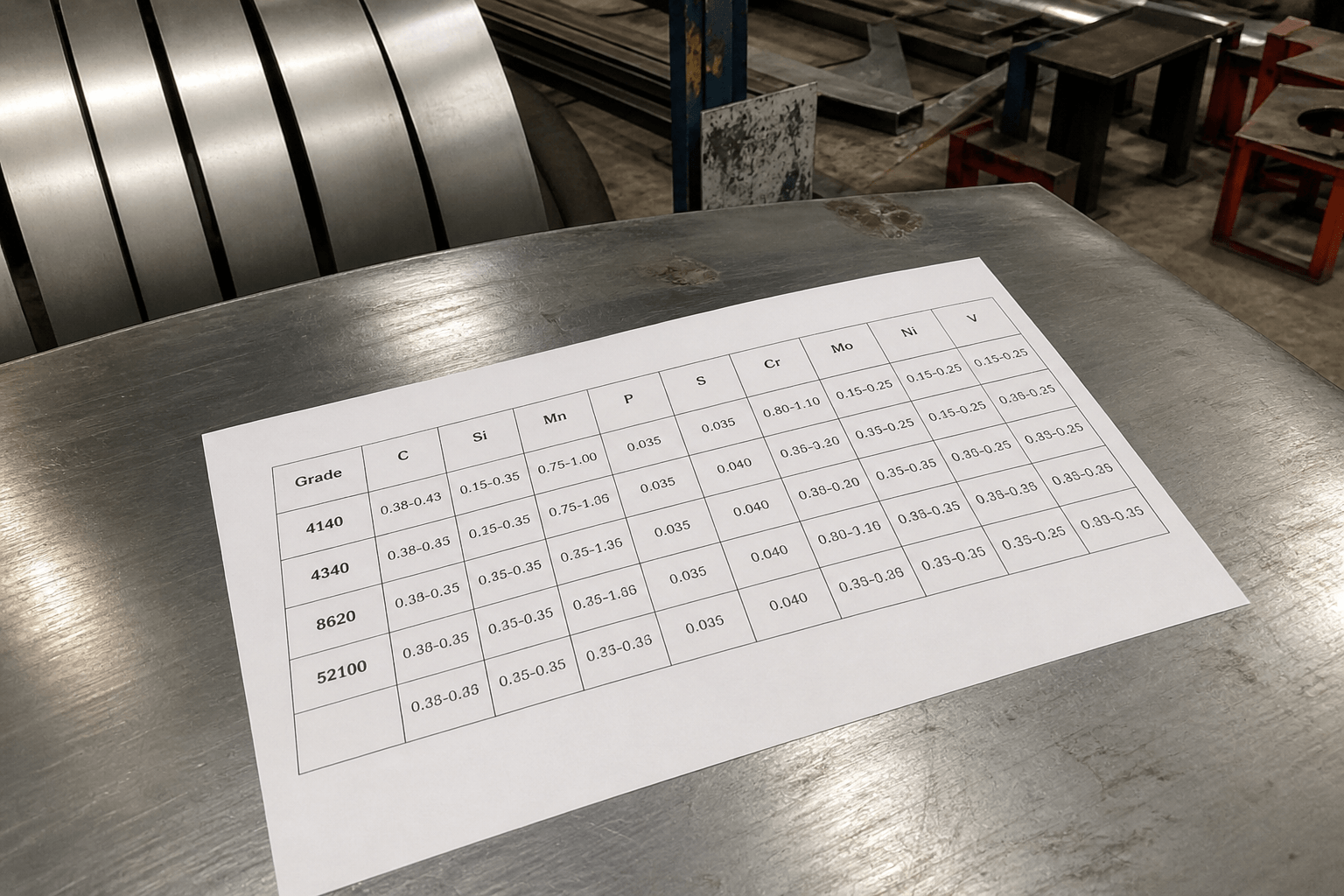
Representative Alloy Steel Composition Ranges
The following examples are percentages by mass. They were selected to show different alloy systems rather than to suggest that one grade is a default choice. The ranges reproduce standard rows presented in Ovako Steel Navigator material data sheets. Always check the current governing specification, because producer variants and specification revisions may use different limits.
| Grade and cited specification | C | Si | Mn | Cr | Ni | Mo | V |
|---|---|---|---|---|---|---|---|
| 20NiCrMo2-2 +H, EN ISO 683-3 | 0.17–0.23 | ≤0.40 | 0.65–0.95 | 0.35–0.70 | 0.40–0.70 | 0.15–0.25 | Not specified in the displayed standard row |
| 34CrNiMo6, EN ISO 683-2 | 0.30–0.38 | 0.10–0.40 | 0.50–0.80 | 1.30–1.70 | 1.30–1.70 | 0.15–0.30 | Not specified in the displayed standard row |
| 51CrV4, EN 10089:2002 | 0.47–0.55 | ≤0.40 | 0.70–1.10 | 0.90–1.20 | Not specified | Not specified | 0.10–0.25 |
| 100Cr6, EN ISO 683-17 | 0.93–1.05 | 0.15–0.35 | 0.25–0.45 | 1.35–1.60 | Not specified in the displayed standard row | ≤0.10 | Not specified |
The examples illustrate why alloy steel cannot be represented by one percentage formula. A case-hardening Ni-Cr-Mo grade, a quenched-and-tempered Cr-Ni-Mo grade, a Cr-V spring grade, and a high-carbon chromium bearing grade have visibly different carbon levels and alloying strategies. Their intended processing routes and specification requirements also differ. ([steelnavigator.ovako.com](https://steelnavigator.ovako.com/steel-grades/20nicrmo2-2/?utm_source=openai))
How to Read an Alloy Steel Composition Table
A composition table is a set of acceptance limits, not a recipe that requires every heat to land at the center of each range.
- Minimum: The reported content must not fall below the stated value under the applicable analysis rules.
- Maximum: The content must not exceed the stated limit. Entries for phosphorus, sulfur, residual nickel, copper, or molybdenum are frequently maximum-only controls.
- Range: Both a lower and upper limit apply. A result anywhere inside that permitted interval may comply.
- Nominal or typical: An informative target or representative analysis, not necessarily the formal acceptance range. It should not replace specification limits on a drawing or purchase order.
- Balance iron: Iron comprises the remainder after the listed elements and other permitted constituents are counted. It does not mean chemically pure iron.
- Residual: An element not intentionally used as a principal addition but present from raw materials or steelmaking. Specifications may limit individual residuals or their total.
- Trace or microalloy addition: A very small amount may still influence transformations, grain behavior, inclusions, or precipitation. Its importance cannot be judged solely by the number of decimal places.
- Blank or dash: This usually means that the displayed row does not specify a value. It should not automatically be interpreted as zero.
Also confirm whether the certificate reports a heat analysis or product analysis. A heat analysis represents the molten steel sample, while a product analysis is taken from the finished material and may be governed by separate permissible variations. ([totalmateria.com](https://www.totalmateria.com/en-us/material-basics-properties/steel-composition/?utm_source=openai))
Low-Alloy and High-Alloy Are Context-Dependent Terms
There is no universally applied percentage boundary that separates every low-alloy steel from every high-alloy steel. Definitions vary among handbooks, industries, and specifications. One ASM reference, for example, explicitly notes widespread inconsistency and uses approximately 2% to 10% total alloy content for the alloy or low-alloy steels covered by that handbook, while treating stainless and tool steels separately. Other standards and commercial systems use different category boundaries. State the source whenever a percentage threshold matters. ([asminternational.org](https://www.asminternational.org/wp-content/uploads/files/16867815/16867815-preview.pdf?utm_source=openai))
Alloy Steel Versus Adjacent Steel Categories
Stainless steel
Stainless steel is itself an alloyed steel family, but it is normally treated as a distinct category because sufficient chromium enables formation of a protective passive film. Common definitions use at least 10.5% chromium. That threshold does not make stainless steel immune to corrosion, and lower-chromium engineering alloy steels should not be described as stainless merely because they contain chromium. ([worldsteel.org](https://worldsteel.org/wp-content/uploads/steelFacts-2024.pdf?utm_source=openai))
Mild steel
Mild steel is an informal term generally used for relatively low-carbon steels. Such steels still contain controlled manganese, silicon, and other elements. The mere presence of these constituents does not provide a reliable dividing line between mild steel and alloy steel; the named grade and governing classification are more useful.
Tool steel
Tool steels are a separate functional family developed around requirements such as wear resistance, cutting behavior, hot hardness, dimensional response, or resistance to thermal cycling. They may contain chromium, molybdenum, vanadium, tungsten, or other elements also found in engineering alloy steels, but overlapping elements do not make the classifications interchangeable.
HSLA steel
High-strength low-alloy steel commonly combines relatively low alloy additions with controlled rolling, grain refinement, precipitation, or other processing strategies. HSLA is therefore not simply another name for every low-alloy quenched-and-tempered grade. ASM identifies niobium, vanadium, and titanium as important additions in various HSLA systems. ([dl.asminternational.org](https://dl.asminternational.org/technical-books/monograph/120/chapter-abstract/2266468/High-Strength-Low-Alloy-Steels?redirectedFrom=fulltext&utm_source=openai))
Electrical steel and superalloys
Electrical steels are specified around magnetic and electrical behavior produced through composition and processing. Superalloys are separate high-performance alloy families, frequently based on nickel, cobalt, or iron-nickel systems for demanding temperature or environmental conditions. Neither category should be substituted for alloy steel based only on one shared element.
Magnetism also cannot be answered for all alloy steels with one yes-or-no statement. It depends on composition, microstructure, temperature, and condition. Many ferritic or martensitic steels are strongly magnetic, while sufficiently austenitic structures may respond differently.
How to Specify Alloy Steel for a Custom Part
Writing only “alloy steel” on a drawing leaves major decisions undefined. A material callout should normally identify the exact grade, governing specification and revision where required, product form, delivery condition, heat treatment, and any mechanical, hardness, impact, cleanliness, or testing requirements that apply to the part.
For example, “34CrNiMo6” identifies a chemical family, but the usable specification still needs to establish which standard controls the chemistry, whether the material is annealed or quenched and tempered, and which section-dependent properties must be met. The fabricator also needs to determine whether forming, machining, welding, and final heat treatment are compatible with that condition. Chemistry should not be used as a substitute for the required condition or properties.
The same discipline applies to a custom metal bracket built to a drawing or to components for automotive and transportation equipment and material-handling equipment. Loading, impact, abrasion, temperature, environmental exposure, joining method, and manufacturing sequence may affect the appropriate grade and condition, but the decision should be based on documented engineering requirements rather than a generic claim that alloy steel is “stronger.”
Technical specification review: If you are defining material for a custom metal part, provide the intended grade or governing specification, required material condition or heat treatment, part drawing, and service environment. Yishang can discuss whether the stated material requirements are sufficiently defined for manufacturing review without treating a quotation as the only next step.
Where RFQ Assumptions Create Cost and Production Risk
Many sheet metal fabrication problems begin before production starts. If drawings, tolerances, finish expectations, material grades, or assembly requirements are unclear, suppliers may quote based on different assumptions. That can make prices difficult to compare and may lead to rework, cosmetic rejection, assembly misalignment, or production delays later.
For OEM buyers, the goal is not simply to request the lowest price. The goal is to make sure each supplier is quoting the same manufacturing reality. Before confirming an order, clarify which dimensions are fit-critical, which surfaces are cosmetic, whether prototypes must match batch-production conditions, and how finished parts will be inspected.
Frequently Asked Questions
What alloy steel composition details should buyers define before requesting a quote?
Buyers should define the functional requirement, drawing notes, critical dimensions, material or process expectations, and any inspection points related to alloy steel composition. This helps suppliers quote the same manufacturing scope instead of making different assumptions.
How can RFQ details affect cost, fit, or lead time?
RFQ details can change tooling, forming, welding, finishing, inspection, or rework requirements. If buyers do not clarify it early, two supplier quotes may look comparable while covering different production risks.
Why should drawing requirements be reviewed before prototype approval?
drawing requirements may look acceptable on a single sample but become harder to control during batch production. Buyers should confirm whether the prototype reflects the same process, finish, and inspection conditions expected for production.
What inspection points matter most for alloy steel composition projects?
Important inspection points usually include fit-critical dimensions, holes or mating areas, cosmetic surfaces, finish build-up, welded or formed features, and any dimensions that affect downstream assembly. These points should appear in the RFQ or drawing notes.
How can buyers reduce prototype approval risk before batch production?
Buyers can reduce risk by clarifying drawings, locking key material and finish assumptions, defining inspection timing, approving a representative sample, and confirming which dimensions or surfaces require tighter process control.
How can Yishang help review alloy steel composition requirements?
Yishang can review drawings, RFQ notes, material requirements, tolerance expectations, finish details, samples, and assembly needs to identify unclear assumptions before quoting or batch production.