
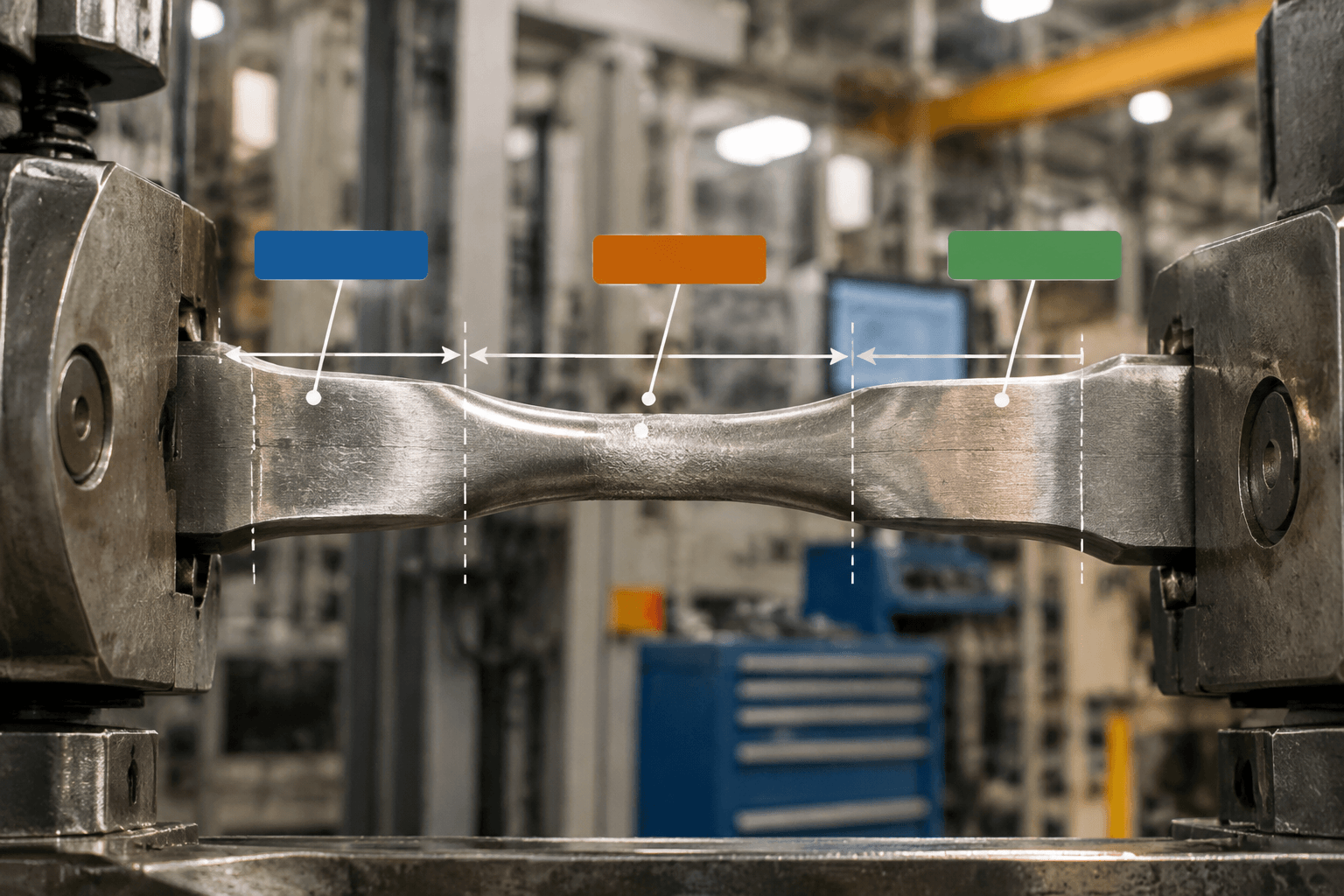
Alloy steel does not have one universal strength rating. Alloy steel strength must be evaluated using a named grade, heat-treatment or delivery condition, product form, section size, test temperature, and loading mode.
Yield strength and ultimate tensile strength describe different stages of tensile loading, while hardness, toughness, fatigue behavior, and compressive performance answer different design questions. A material is suitable only when these properties match the component’s likely failure mode and manufacturing route.
What Does “Strength” Mean for Alloy Steel?
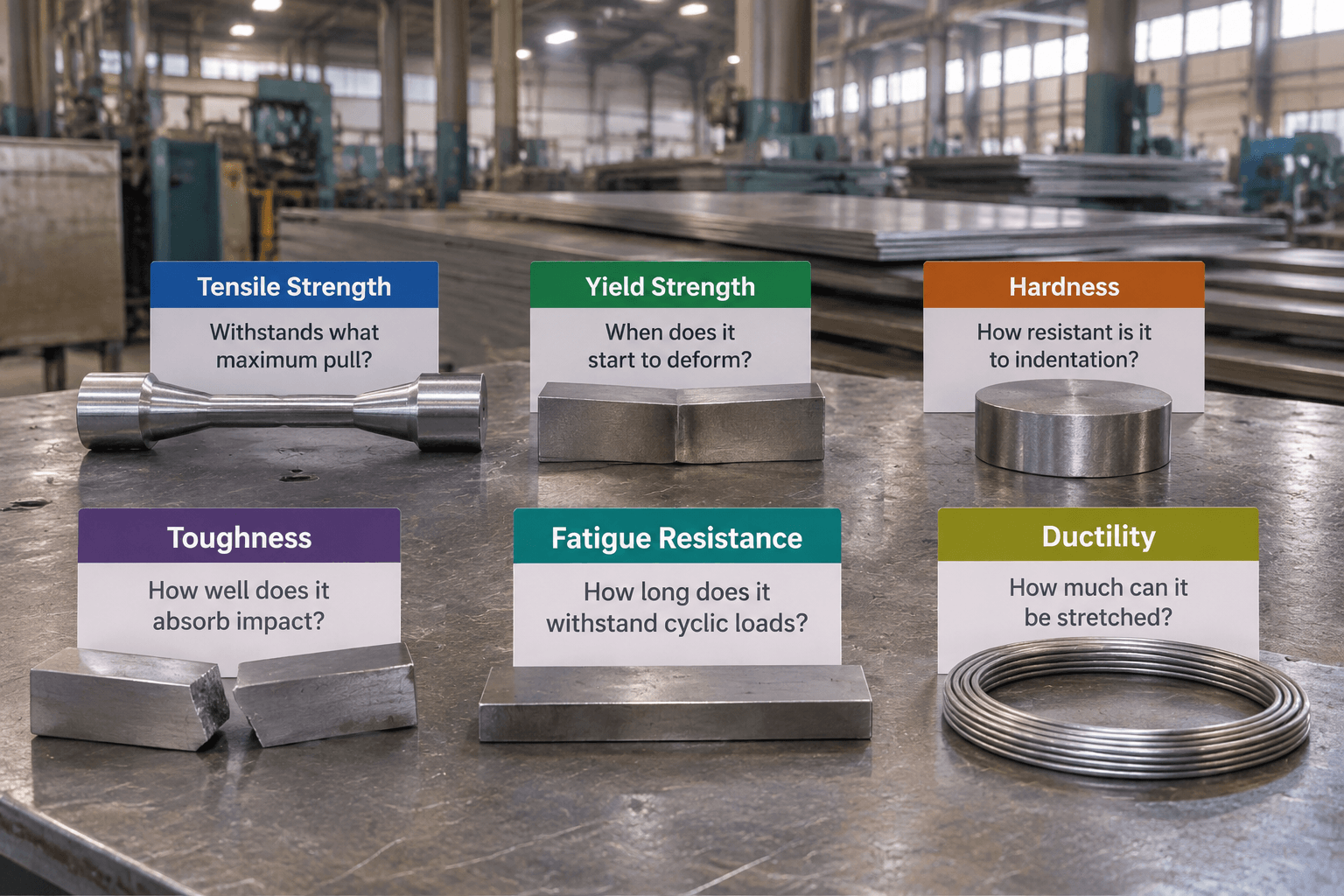
Calling an alloy steel “strong” is incomplete unless the required property is identified. A mounting bracket that must resist permanent bending, a shaft exposed to repeated cycles, and a guard subject to occasional impact do not depend on the same material characteristic.
| Property | Engineering question it answers | Typical design relevance |
|---|---|---|
| Yield strength | When does permanent deformation begin? | Loaded brackets, frames, supports, and structural members |
| Ultimate tensile strength | What is the maximum engineering tensile stress reached during a tensile test? | Tensile-property comparison and margin beyond yield |
| Hardness | How resistant is the surface or material to localized indentation? | Wear surfaces, contact points, and heat-treatment verification |
| Toughness | How much energy can the material absorb before fracturing? | Shock, impact, notches, and low-temperature service |
| Ductility | How much plastic deformation can occur before fracture? | Forming, overload tolerance, and visible deformation before failure |
| Fatigue behavior | How does the material perform under repeated or fluctuating stress? | Vehicles, lifting equipment, vibrating assemblies, and cyclic mechanisms |
| Compressive performance | How does the component resist crushing, yielding, or instability under compression? | Columns, spacers, loaded frames, and bearing-contact regions |
These properties are related, but they are not interchangeable. Higher hardness may accompany higher tensile strength in a particular material condition, yet it does not independently prove adequate toughness, fatigue life, or wear performance. Compressive design also involves geometry: a slender member may buckle before the material reaches its compressive limit.
Why the Same Alloy Steel Grade Can Perform Differently
Alloying additions influence hardenability, grain behavior, tempering response, corrosion behavior, and other characteristics. Composition alone, however, does not guarantee a finished mechanical property. The result depends on how the material was produced, processed, tested, and incorporated into the component.
Heat treatment changes the material condition
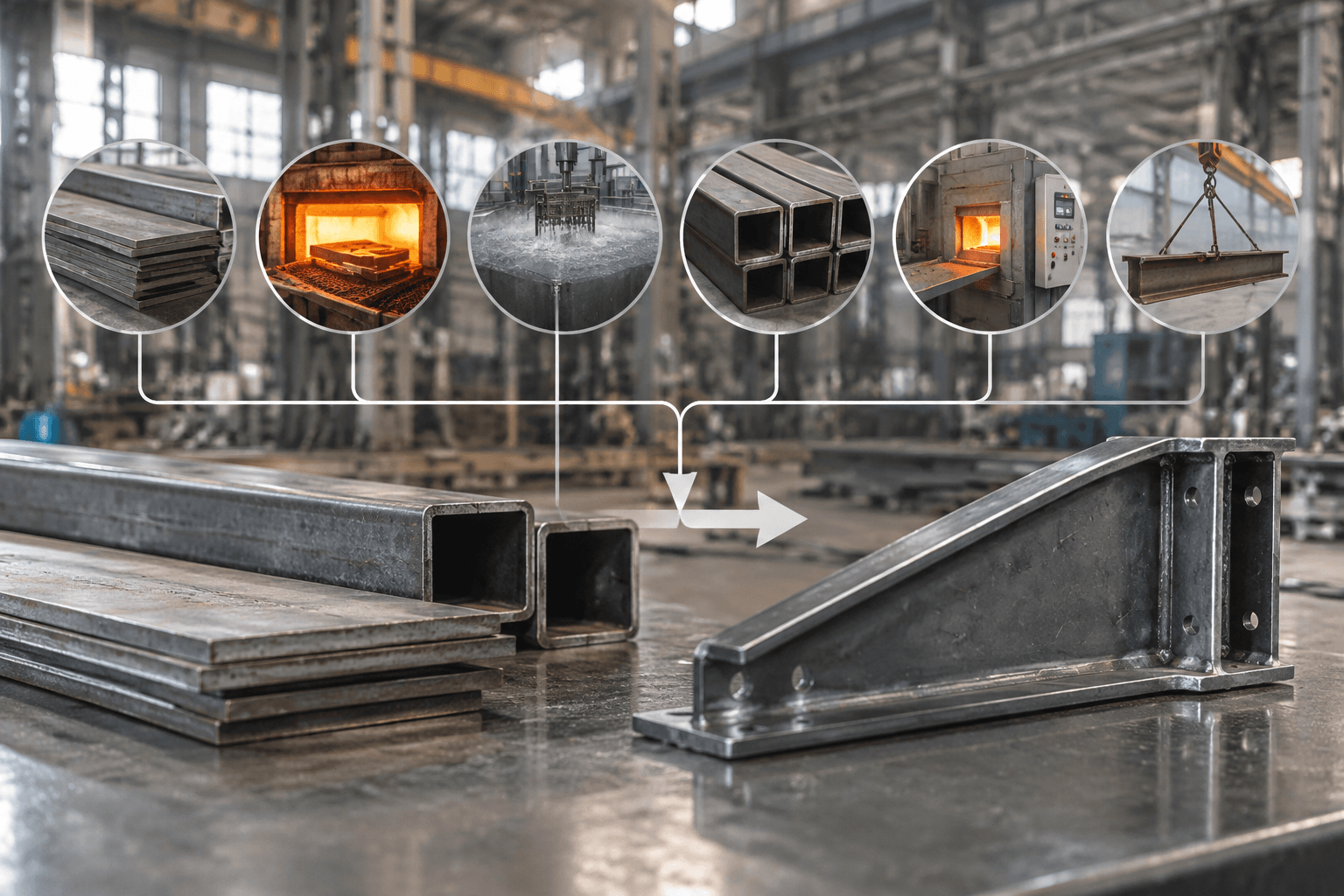
Quenching can create a harder, higher-strength structure, but the as-quenched condition may carry excessive brittleness or residual stress for the intended application. Tempering modifies that structure to obtain a selected balance among strength, hardness, ductility, and toughness. Annealing is generally used to produce a softer condition that can improve machinability or formability, while normalizing can refine and equalize the structure compared with some prior conditions.
Consequently, a grade name without its delivery or heat-treatment condition is not enough for comparison. Even when two suppliers identify the same grade, the applicable property values may differ if one product is annealed and the other is quenched and tempered.
Section size affects heat-treatment response
Cooling rate varies between a surface and the center of a thick section. A composition that hardens effectively in a thin part may develop a different through-section structure in a thicker component. Datasheet values should therefore be checked against the relevant diameter, plate thickness, bar size, or other product dimension.
This is especially important when a design combines thick load-bearing regions with thin formed or welded features. The strongest published value should not be assigned automatically to the entire part.
Grain structure, direction, and temperature also matter
Grain size and microstructural uniformity affect strength and toughness. Rolled products may also show directional differences, so the test direction should reflect the critical load path where specifications provide that information.
Temperature can change the controlling risk. At low temperatures, toughness and brittle-fracture resistance may become more important. At elevated temperatures, engineers must consider strength retention, oxidation or corrosion exposure, and—when loads and temperatures are sustained—creep behavior. Room-temperature tensile data cannot answer these questions alone.
How to Compare Alloy Steel Strength Data Correctly
A valid comparison places equivalent data side by side. Comparing the yield strength of one material with the hardness of another, or comparing a quenched-and-tempered bar with an annealed sheet, does not establish which option is stronger for the part.
- Identify the exact material designation. Avoid broad labels such as “alloy steel,” “carbon steel,” or “stainless steel” when making a final decision.
- Match the condition. Record whether each option is annealed, normalized, cold worked, quenched and tempered, or supplied in another specified condition.
- Match the product form and size range. Sheet, plate, bar, tube, forging, and casting data may not be directly transferable.
- Use the same property and units. Compare yield with yield, tensile with tensile, and equivalent hardness methods where conversion is appropriate and permitted.
- Separate minimum values from typical values. A specified minimum is a compliance threshold. A typical value describes representative performance and should not automatically become the design minimum.
- Confirm test temperature and direction. This is essential when the component operates outside ambient conditions or has a directional load path.
- Review ductility and toughness. A higher tensile value can be a poor trade if elongation or impact performance falls below the service requirement.
Consider a hypothetical comparison between Option A and Option B. Option A has the higher published tensile strength, but its value applies to a small quenched-and-tempered bar. Option B has a lower value reported for plate in a normalized condition. If the intended part is a formed and welded plate assembly, Option B’s data may be more relevant even before fabrication effects are evaluated.
The same discipline applies to an OEM metal bracket. Material strength must be reviewed with thickness, bend geometry, hole position, joining method, stiffness, and load direction. A high-strength material cannot compensate automatically for an unfavorable stress concentration or insufficient section modulus.
Match the Property to the Actual Load and Environment
| Service condition | Properties to prioritize | Questions for the design review |
|---|---|---|
| Steady static load | Yield strength, tensile strength, stiffness, compressive stability | Will the part yield, stretch, crush, or buckle under the design load and safety factor? |
| Repeated or fluctuating load | Fatigue behavior, toughness, surface condition | Where are the holes, weld toes, bends, scratches, and section transitions that concentrate stress? |
| Shock or impact | Toughness, impact resistance, ductility | Can the material absorb energy without sudden brittle fracture? |
| Sliding or abrasive contact | Hardness, wear behavior, surface treatment compatibility | Is wear controlled by bulk hardness, surface condition, lubrication, contact pressure, or trapped abrasive material? |
| Sustained high temperature | Strength retention, creep resistance, oxidation or corrosion behavior | How long will the load be applied, and at what operating temperature? |
| Low temperature | Toughness and fracture resistance | Could notches, welds, restraint, or impact initiate brittle failure? |
| Corrosive exposure | Corrosion resistance plus retained mechanical integrity | Will coating, plating, painting, material substitution, or maintenance be required? |
In automotive and transportation metal fabrication, repeated loading, impact, weight, weld configuration, and corrosion exposure may all influence the material decision. Selecting only by tensile strength can overlook the fatigue-sensitive details that control service life.
Similarly, material-handling equipment can experience repeated loading, shock, wear, and frame distortion. The relevant question is not simply whether alloy steel is strong, but whether the selected condition supports the actual load spectrum and component geometry.
When Higher Strength Creates Manufacturing Tradeoffs
Pursuing maximum strength can make a component harder to manufacture or less tolerant of service damage. As strength and hardness increase, available ductility may decrease. Forming may require larger bend radii, different tooling, intermediate processing, or a revised material condition. Springback may also change, affecting dimensional control.
Welding requires a separate review. Material chemistry, thickness, restraint, heat input, joint design, filler selection, and pre- or post-weld procedures can influence cracking risk, distortion, and the properties of the weld and heat-affected zone. The raw material’s tensile value does not describe the finished welded assembly.
Machinability may also decline in harder conditions, increasing tool wear or making chip control and dimensional consistency more difficult. Machining is distinct from sheet metal fabrication, although machined holes, bushings, turned inserts, or precision interfaces may be incorporated into a fabricated assembly.
Corrosion resistance is another tradeoff. Alloy steel should not be assumed to provide the environmental resistance associated with a suitable stainless steel. A coating or other finishing system may be required, and its performance depends on surface preparation, geometry, exposure, handling, and maintenance.
A lower-strength material may therefore be preferable when it provides adequate design margin with better toughness, forming behavior, weldability, corrosion performance, or cost control. The correct comparison concerns the finished component—not the strongest value printed on a material datasheet.
Confirm the material condition before production planning. For a technical specification review, provide the part drawing or dimensional requirements, candidate grade and delivery condition, expected load type and service temperature, plus any corrosion, wear, impact, forming, or welding requirements. This review can help confirm whether the selected material condition and component design align with manufacturing constraints and service demands before quotation or production planning.
How to Compare Two Alloy Steel Options on Equal Terms
Use the following worksheet before approving a material. If an entry is missing, treat the comparison as incomplete rather than assuming the values are equivalent.
| Comparison field | Option A | Option B | Review note |
|---|---|---|---|
| Material grade | Use the complete designation. | ||
| Delivery or heat-treatment condition | Do not compare different conditions without adjustment. | ||
| Product form | Record sheet, plate, bar, tube, forging, or other form. | ||
| Applicable section size | Confirm that the property data cover the component thickness or diameter. | ||
| Test temperature and direction | Match the service environment and critical load path. | ||
| Yield and tensile strength | Label minimum and typical values clearly. | ||
| Elongation and toughness | Check deformation capacity and fracture risk. | ||
| Hardness and wear requirement | Use equivalent test methods and consider the contact system. | ||
| Fatigue requirement | Include cycle count, stress range, surface condition, and stress concentrations. | ||
| Manufacturing requirements | Review forming, welding, machining interfaces, finishing, and inspection. | ||
| Corrosion exposure | Define environment, protection method, and maintenance expectations. |
Frequently Asked Questions
Is alloy steel always stronger than carbon steel?
No. Both categories contain many grades and conditions. A heat-treated alloy steel may exceed a particular carbon steel in yield or tensile strength, but another carbon steel condition may outperform a softer alloy steel. Compare named grades, conditions, product forms, sizes, and relevant mechanical properties.
Is alloy steel stronger than stainless steel?
There is no universal winner. Some alloy steels offer very high strength after suitable heat treatment, while some stainless steels combine useful strength with better corrosion resistance. Other stainless grades prioritize formability, temperature performance, or hygiene. Selection depends on the required property and environment.
Does higher hardness mean higher strength and better durability?
Not automatically. Hardness can correlate with tensile strength within certain materials and conditions, but it is not a substitute for verified tensile, toughness, fatigue, or wear data. Excessive hardness may also reduce ductility or increase sensitivity to cracking.
How does heat treatment change alloy steel strength?
Heat treatment changes the microstructure. Quenching may increase hardness and strength, while tempering adjusts the balance among strength, toughness, ductility, and residual stress. Annealing or normalizing creates different property combinations. The outcome depends on grade, section size, process control, and the specified final condition.