
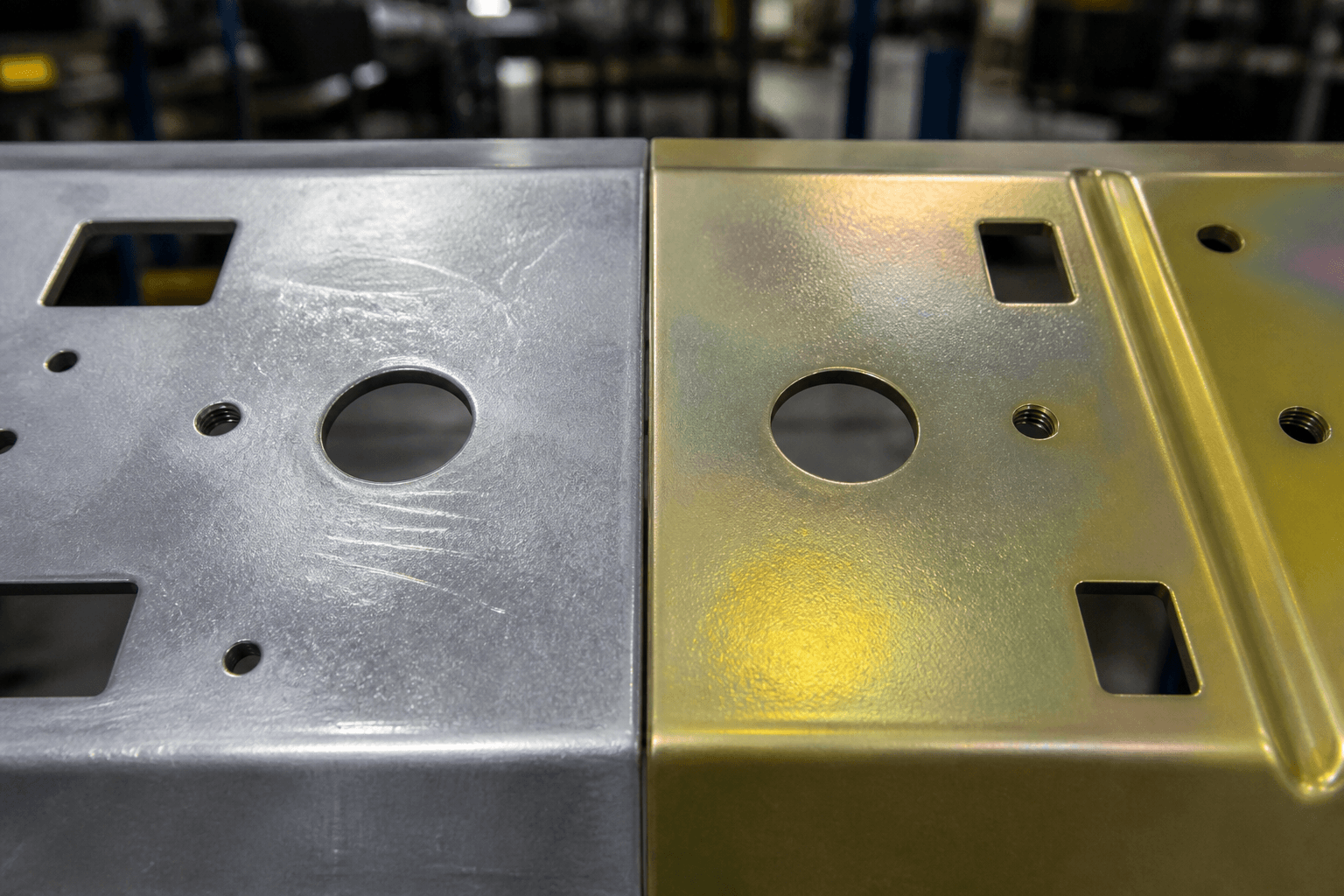
Alodine chromate commonly refers to a chemical conversion coating applied to aluminum, but the phrase is not a complete technical specification. “Alodine” may identify a product family, while “chromate” describes a chemistry category that cannot be assumed for every product sold under that name.
Before selecting or specifying an Alodine chromate coating, confirm whether the required product contains chromium, uses a non-chrome chemistry, or is simply intended to meet a broader chemical conversion requirement. The product technical data sheet, safety data sheet, governing specification, substrate, application method, and inspection criteria should resolve the ambiguity.
What Does “Alodine Chromate” Actually Mean?
Three different concepts are often compressed into this two-word phrase. Alodine is commonly used as a trade or product-family name. Chromate describes conversion chemistry involving chromium compounds. Chemical conversion coating is the generic process category in which a metal surface reacts with a treatment solution to form a protective conversion layer.
These terms are related, but they are not interchangeable. Some Alodine-branded products are associated with traditional chromium-containing conversion processes, while other products are positioned as non-chrome alternatives. It is therefore incorrect to assume that every product carrying the Alodine name contains hexavalent chromium, another form of chromium, or any chromium at all.
Product names can also remain in drawing notes long after a finishing system has changed. A note stating only “Alodine chromate” may leave the finisher uncertain about the required chemistry, appearance, application process, coating weight, test method, or governing standard. Current manufacturer documentation should take priority over informal terminology.
The first technical question is not simply, “Can you apply Alodine?” It is, “Which documented chemical conversion product and acceptance requirement apply to this aluminum part?”
How the Conversion Layer Forms on Aluminum
A chemical conversion coating is formed by a controlled reaction at the aluminum surface. After contamination and unsuitable oxide residues are removed, the treatment solution interacts with the exposed surface and changes its chemistry. The reaction produces a thin, adherent conversion layer rather than depositing a thick film in the same way as paint or electroplated metal.
The resulting layer may support corrosion protection, improve the bonding surface for a compatible paint system, or satisfy electrical-contact considerations. The actual outcome depends on the selected chemistry, aluminum substrate, pretreatment quality, bath condition, application parameters, film weight, and subsequent handling. Performance should therefore be tied to defined tests and acceptance limits rather than broad claims about the product name.
Conversion coatings are often selected where dimensional change must be limited and where aluminum parts will later be painted, bonded, assembled, or used with defined contact surfaces. Examples may include fabricated panels, brackets, covers, custom aluminum enclosures, and aluminum extrusion components finished for assembly.
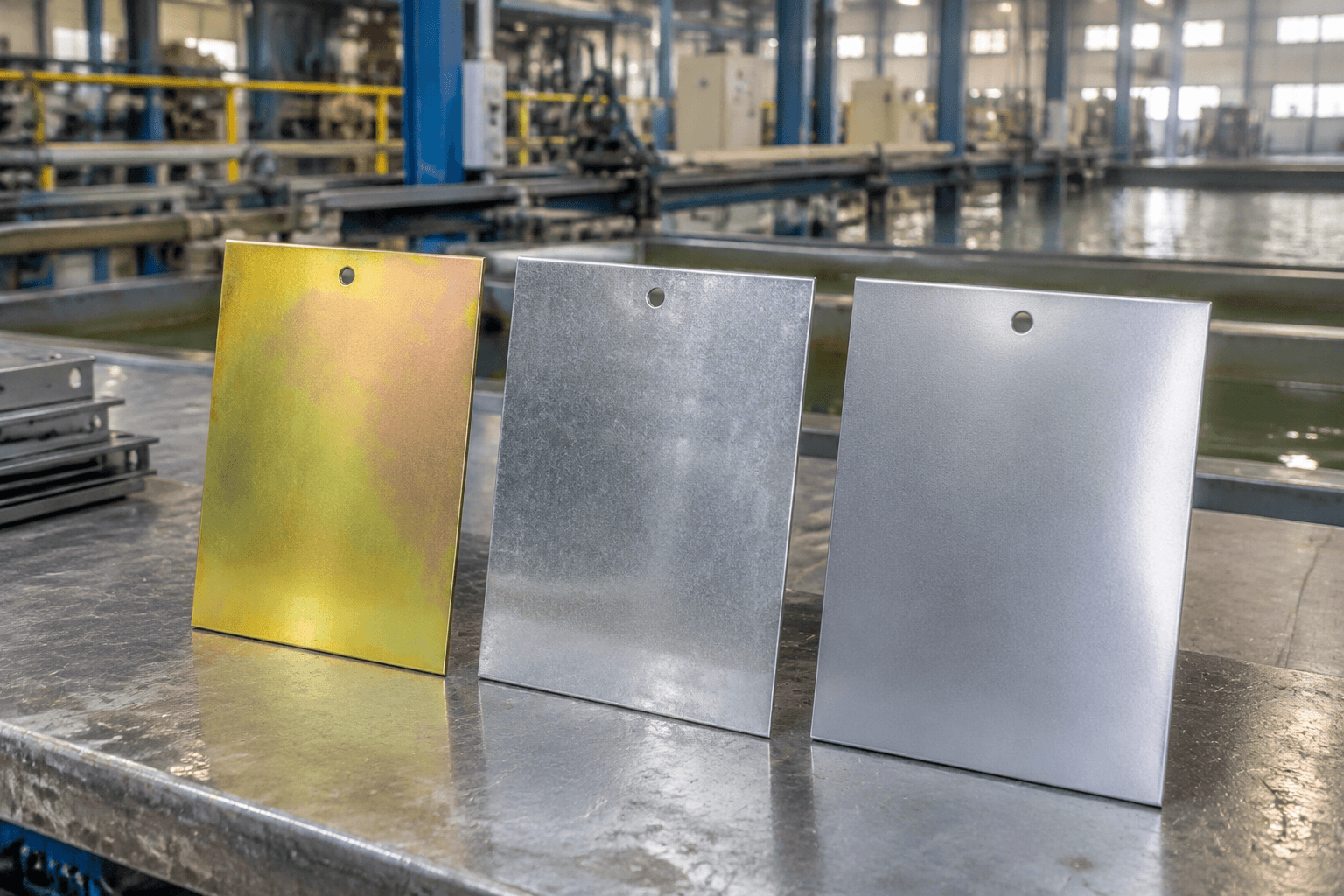
Color can sometimes indicate that a reaction occurred, but it is not universal proof of coating quality. Film appearance may vary with chemistry, alloy, surface condition, application method, and coating weight. Some non-chrome products also produce a visible film, while other acceptable conversion layers may be subtle.
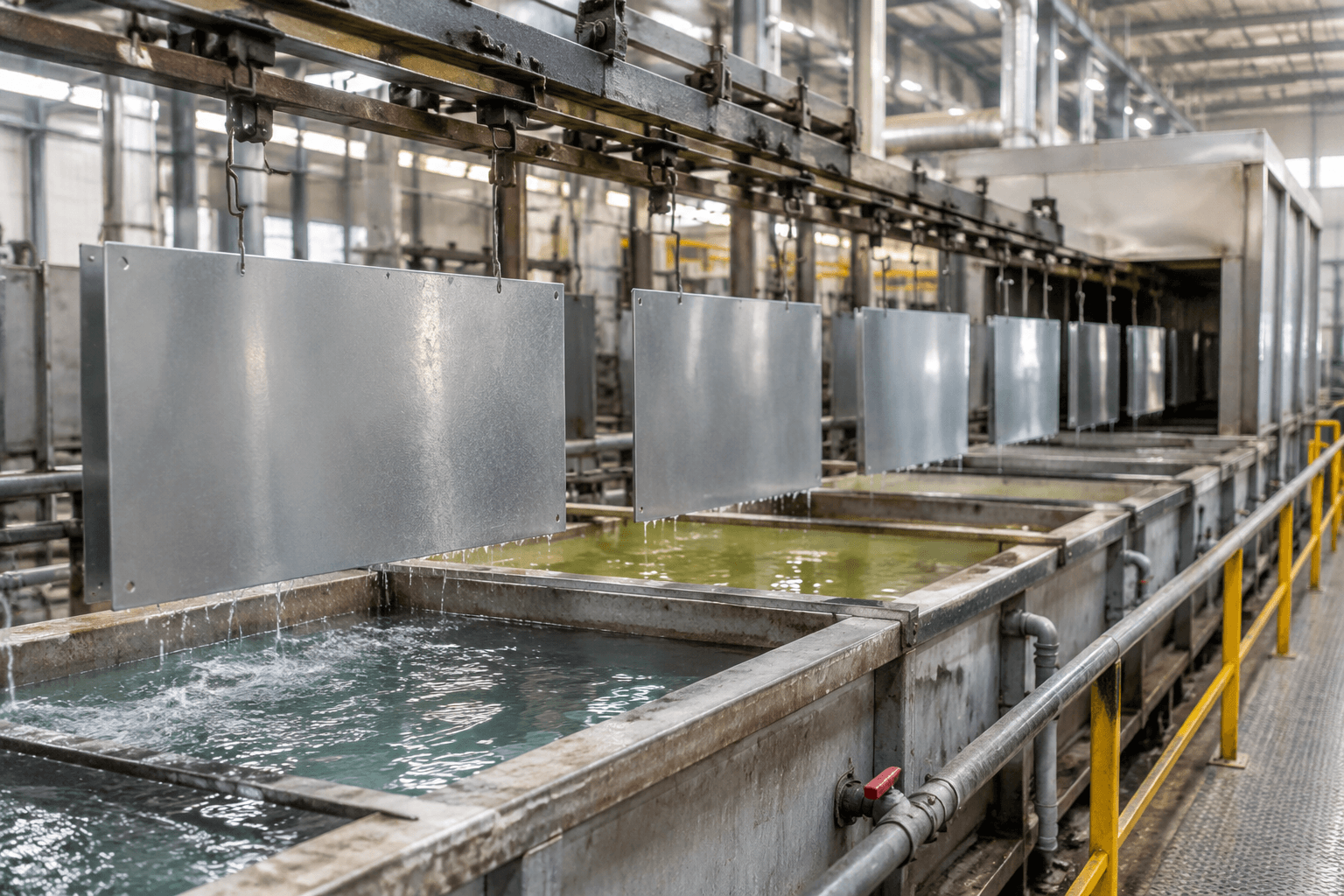
Core Stages in an Aluminum Conversion-Coating Process
The exact number and arrangement of stages depend on the selected product, contamination level, substrate, equipment, water quality, and required performance. A line may use spray processing, immersion processing, or a product-approved combination. A representative sequence includes the following functions:
- Cleaning: Oil, forming lubricant, fingerprints, shop soil, and other contaminants are removed. Incomplete cleaning can prevent uniform wetting and create bare, stained, or weakly bonded areas.
- Rinsing and surface conditioning: Rinses limit cleaner carryover into later tanks. Depending on the alloy and process specification, a separate etching, deoxidizing, or desmutting stage may be required before conversion treatment. These operations should not be added or omitted without checking the approved process documentation.
- Conversion treatment: The prepared aluminum is exposed to the specified chemical solution by spray or immersion. Concentration, pH, temperature, contact time, agitation, loading, and contamination influence the reaction. The allowable ranges must come from the current technical data sheet and the applicable specification.
- Final rinsing: Controlled rinsing removes residual process solution without damaging the newly formed layer. Water quality, rinse sequence, and any specified final rinse can affect cleanliness and later paint compatibility.
- Drying and handling: Parts are dried under conditions suitable for the selected product. Excessive temperature or rough handling may affect certain conversion films. Clean gloves, protected storage, and controlled time before painting may also be relevant.
A higher stage count is not automatically better, and a shorter line is not automatically more efficient. Additional stages may improve contamination control or prepare difficult surfaces, but they also add tanks, rinsing demand, maintenance, floor space, and process time. Fewer stages can simplify production only when the product documentation and required test results support that configuration.
Process Variables and Coating Verification
Conversion coating is a controlled chemical process, not merely a color application. Operators need defined operating windows and inspection methods appropriate to the product and line.
| Variable or check | What it influences | What must be confirmed |
|---|---|---|
| Surface preparation | Wetting, reaction uniformity, adhesion, and appearance | Cleaner, deoxidizer, rinse sequence, and substrate condition |
| Bath concentration and pH | Reaction rate and conversion-layer formation | Product-specific control range and analysis method |
| Contact time and temperature | Film development and production throughput | Limits in the current technical data sheet |
| Spray or immersion | Coverage, drainage, equipment layout, and process consistency | Whether the selected product approves the intended method |
| Visible film | Provides a useful process indication in some systems | Acceptable color range and limits of visual inspection |
| Coating-weight measurement | Supports quantitative process monitoring | Instrument method, calibration, sampling plan, units, and acceptance range |
| Performance testing | Evaluates the finished system against its intended function | Test method, specimen preparation, exposure conditions, and pass criteria |
Some documented systems support quantitative coating-weight measurement using an approved instrument or test method. This capability should not be generalized to every conversion product. The procedure, calibration reference, measurement location, sampling frequency, units, and acceptable range must be defined by the relevant manufacturer instructions or governing specification.
Visual inspection remains useful for detecting obvious nonuniformity, staining, powdery deposits, handling damage, or missed areas. However, visible color alone cannot prove corrosion resistance, paint adhesion, electrical performance, or compliance. Those conclusions require an identified test method and controlled conditions.
Environmental, waste-treatment, and worker-handling requirements also differ between chromium-containing and non-chrome products. Review the current safety data sheet, technical data sheet, local regulations, and facility controls rather than relying on a product’s historical reputation.
When “Alodine Chromate” Is Too Vague: Terms to Confirm
| Term | Practical meaning | Information still needed |
|---|---|---|
| Alodine | A trade or product-family reference, not a complete chemistry description | Exact product designation and current documentation |
| Chromate conversion coating | A chemical conversion category involving chromium chemistry | Chromium type, process class, specification, and acceptance tests |
| Chrome-free conversion coating | A conversion process formulated without chromium | Product chemistry, approved substrates, paint compatibility, and performance criteria |
| Chemical conversion coating | The generic surface-treatment category | Required product, layer class, application method, and inspection plan |
| Anodizing | An electrochemical process that grows a controlled oxide layer on aluminum | Anodizing type, thickness, sealing, color, dimensions, and contact requirements |
The distinction from anodizing is especially important. Both processes modify the aluminum surface, but anodizing uses an electrolytic process to grow a more substantial oxide layer. Chemical conversion usually creates a much thinner reactive layer. They should not be substituted solely because both can improve surface durability or support later finishing.
How to Write a Clear Finish Requirement
A useful drawing or purchase-order note should describe the functional and inspection requirements rather than rely on “Alodine chromate” as shorthand. Include the following information where it is known or required:
- Substrate: State the aluminum alloy and condition, and identify cast, sheet, machined, or extruded surfaces when relevant.
- Chemistry: Specify whether chromium-containing chemistry is required, prohibited, or open to an approved non-chrome alternative.
- Product or specification: Give the exact product designation, governing specification, class, or approved-equivalent rule.
- Part function: Explain whether the coating is for paint pretreatment, corrosion protection, bonding preparation, electrical contact, or a combination.
- Downstream finish: Identify the primer, paint, powder coating, adhesive, masking requirement, or bare-contact area that must interface with the conversion layer.
- Application and appearance: Define spray or immersion restrictions, visible-film expectations, color limits, and cosmetic surfaces if these matter.
- Verification: State the inspection method, coating-weight range if applicable, performance test, sampling plan, and acceptance criteria.
For transportation parts, the service environment, electrical grounding points, paint system, and corrosion test requirement can be more important than the informal finish name. These considerations also affect aluminum components used in automotive and transportation equipment.
If the product has not yet been selected, write the functional requirements and ask the responsible finishing specialist to propose documented options. The proposal should identify the chemistry, process sequence, operating window, substrate limitations, inspection method, environmental controls, and evidence supporting the required performance.
Yishang supports drawing-based B2B OEM and ODM custom metal projects. For a technical finish-requirement review, provide the part drawing or finish note, aluminum alloy if known, intended paint or assembly requirements, service environment, appearance expectations, and any required specification or inspection method. This review can clarify an ambiguous coating note before manufacturing without assuming that a particular conversion product or finishing process is already approved.
Frequently Asked Questions
Where is Alodine chromate commonly used?
Chemical conversion coatings are commonly considered for aluminum panels, brackets, housings, enclosures, extrusions, and other components that need paint pretreatment, supplementary corrosion protection, or controlled electrical-contact characteristics. Suitability depends on the exact product, substrate, service environment, and required test results. Automotive use is one possible context, but the phrase alone does not establish compliance with an automotive specification.
Can an Alodine product be chrome-free?
Yes. The Alodine name may appear on products using different chemistry families, including products positioned as non-chrome conversion treatments. Do not determine chromium content from the brand name. Confirm it through the exact product designation, current safety data sheet, technical data sheet, and supplier declaration.
Can coating color confirm that the conversion process succeeded?
Color can provide a useful visual process indication when the selected product is designed to form a visible film. It cannot by itself confirm coating weight, corrosion protection, paint adhesion, conductivity, or specification compliance. Quantitative measurement or performance testing may be required, with acceptance limits defined in advance.
What is the practical difference between chemical conversion coating and anodizing?
Chemical conversion produces a thin layer through a surface reaction with a treatment solution. Anodizing uses an electrical process to grow an aluminum oxide layer that is generally more substantial and may require sealing. The two finishes have different effects on dimensions, appearance, electrical contact, wear behavior, and paint preparation, so they should not be treated as interchangeable.