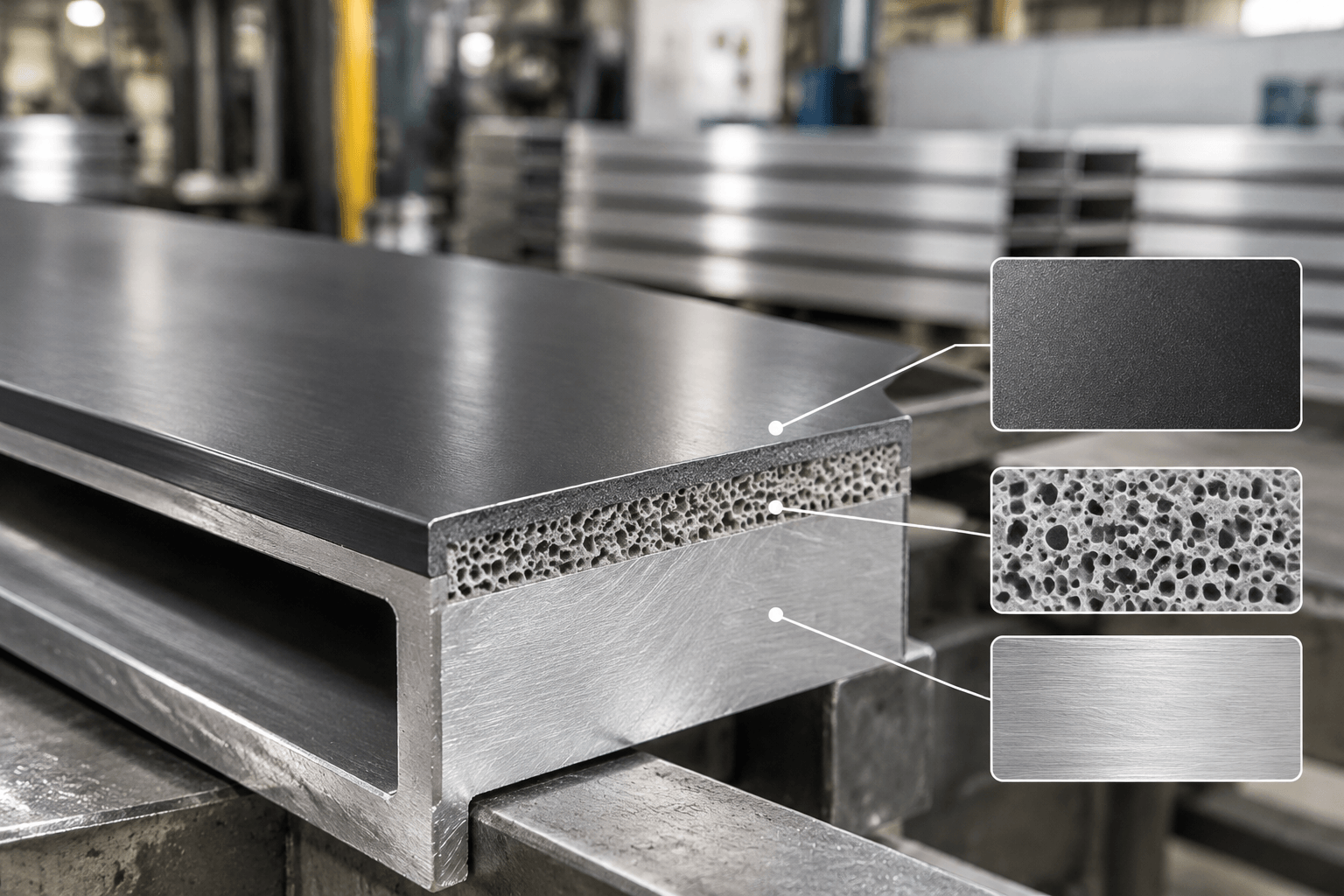
“Alu anodized” usually refers to anodized aluminum—aluminum treated electrochemically to grow a controlled aluminum oxide layer from the metal surface. Compared with untreated aluminum, it can provide better corrosion protection, wear performance, appearance control, electrical insulation, and cleanability, but the result depends on anodizing type, alloy, coating thickness, sealing, surface preparation, and service conditions.
Anodizing is not paint, plating, powder coating, or chromate conversion coating. The oxide forms partly within and partly above the original aluminum surface, so it does not delaminate in the same way as an applied film. It can still be scratched, stained, worn through, chemically attacked, cracked, or damaged by later forming.
What Is Anodized Aluminum?
Untreated aluminum naturally reacts with oxygen and develops a very thin oxide film. This film helps slow further oxidation, but its thickness and consistency are not controlled for demanding decorative, corrosion, or wear requirements.
Anodizing uses an electrolytic process to make that oxide layer thicker and more ordered. The aluminum component is connected as the positive electrode—the anode—and immersed in a conductive electrolyte. A cathode completes the electrical circuit. When direct current passes through the bath, oxygen-containing ions react at the aluminum surface, converting part of the substrate into aluminum oxide. The resulting structure is porous before sealing, which allows it to accept dyes or other coloring treatments. ([anodizing.org](https://www.anodizing.org/anodized-aluminum-faq/?utm_source=openai))
Because the coating grows from the aluminum, it generally follows the existing texture rather than hiding it. Extrusion lines, machining marks, weld discoloration, scratches, polishing variation, and handling damage may remain visible. Anodizing should therefore be treated as part of the complete material and surface specification, not as a final operation expected to correct an inconsistent substrate.
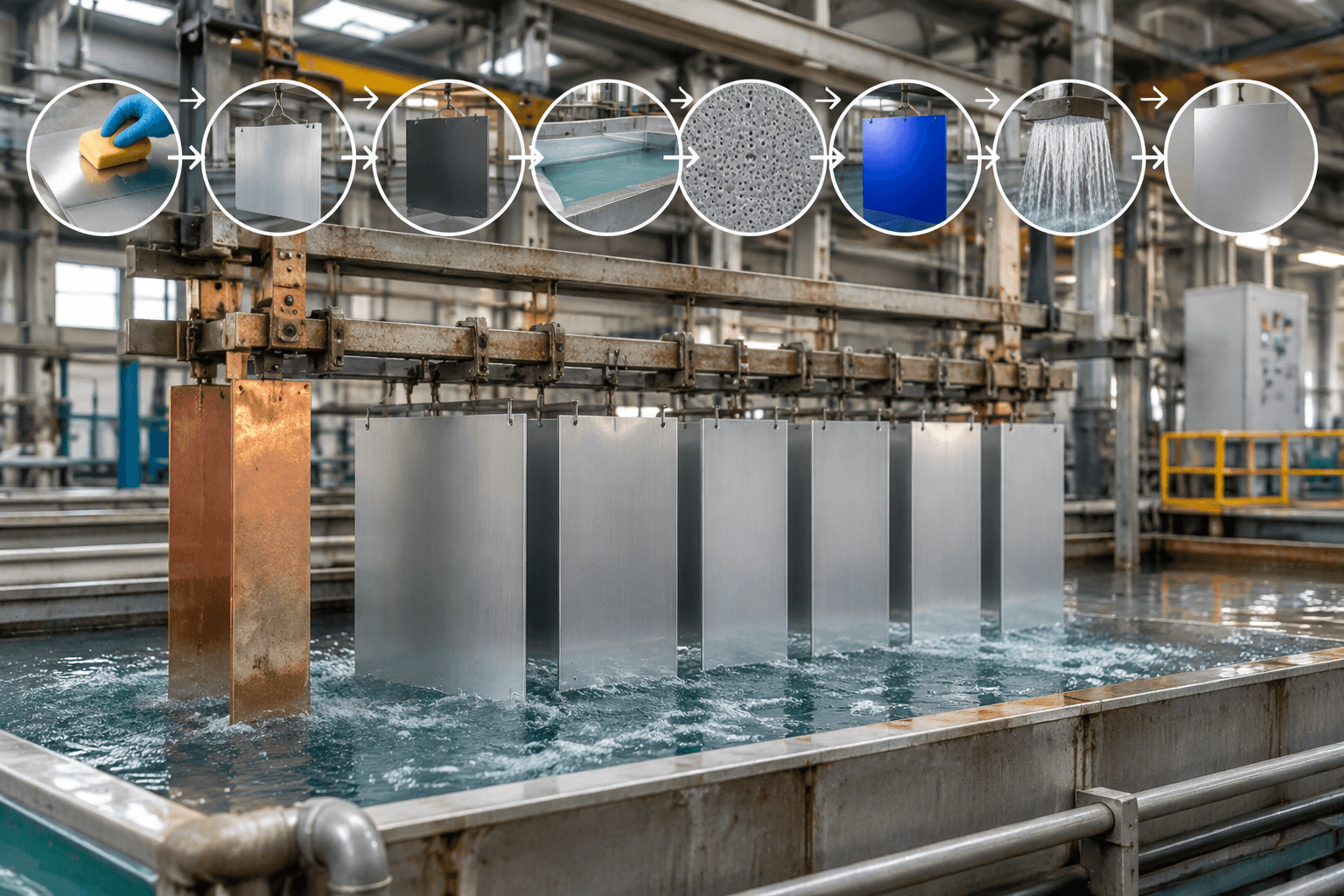
How the Anodizing Process Builds the Oxide Layer
- Cleaning: Oils, fingerprints, polishing compounds, and fabrication residues are removed so they do not interrupt coating formation.
- Surface preparation: The part may be etched for a matte appearance, chemically brightened, mechanically brushed, or desmutted. These operations change gloss, texture, dimensions, and the visibility of defects.
- Anodizing: The aluminum anode and a suitable cathode are placed in the electrolyte. Current, treatment time, bath temperature, chemistry, agitation, alloy, and part geometry affect oxide growth and uniformity.
- Rinsing: Controlled rinsing after anodizing and between subsequent coloring and sealing stages limits residue and cross-contamination.
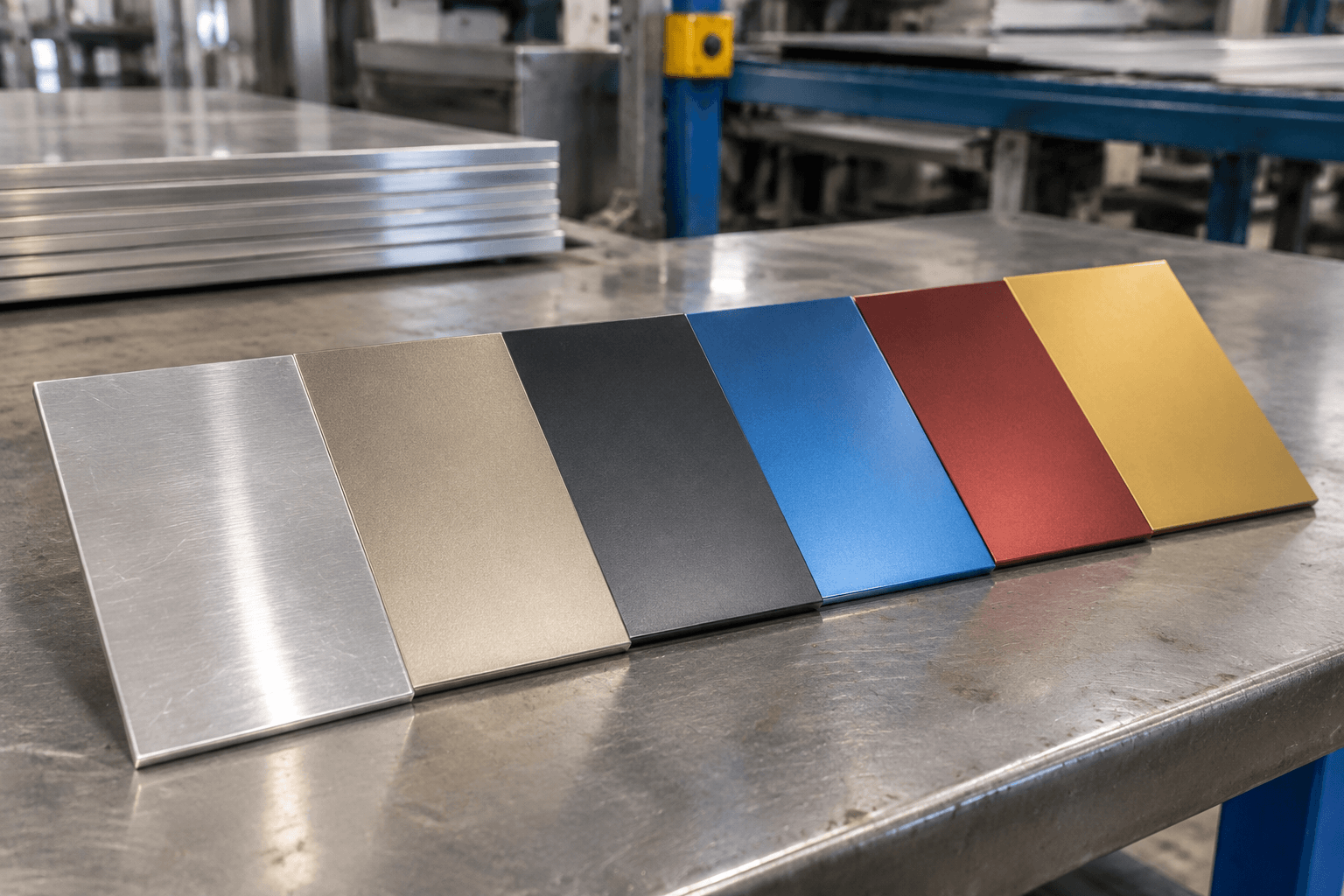
- Optional coloring: Dye can enter the open pores, or other coloring processes can deposit material within the oxide structure. Natural, clear, black, bronze, and other appearances require different controls and may not behave identically outdoors.
- Sealing: The pores are closed or restricted using a suitable sealing process. Common approaches include hydrothermal sealing and chemical seals such as nickel-acetate or cold-sealing systems.
- Final inspection: Relevant checks may include appearance, coating thickness, seal quality, color range, electrical isolation, dimensions, and corrosion or abrasion tests when specified.
Sealing is not a cosmetic afterthought. It affects corrosion behavior, staining resistance, dye retention, cleanability, and the surface condition. Seal performance depends on chemistry, time, temperature, pH, water quality, coating thickness, and contamination control. Some hard anodic coatings intended primarily for abrasion service are left unsealed because sealing may reduce surface hardness or abrasion performance. ([dl.asminternational.org](https://dl.asminternational.org/handbooks/edited-volume/63/chapter-abstract/1394471/Sealing-of-the-Anodized-Aluminum-Coating?redirectedFrom=fulltext&utm_source=openai))
Anodizing Types and Variables That Change the Result
“Anodized” is not a complete engineering specification. MIL-PRF-8625, for example, recognizes multiple anodic coating types and separates non-dyed and dyed classes. The correct designation depends on the governing industry specification, end use, and required verification. ([quicksearch.dla.mil](https://quicksearch.dla.mil/qaDocDetails.aspx?ident_number=7074&utm_source=openai))
| Common category | Typical purpose | Important specification points |
|---|---|---|
| Type I and related thin anodizing processes | Corrosion protection, paint preparation, or applications where a relatively thin coating is preferred | Electrolyte system, alloy restrictions, sealing, environmental requirements, and the governing specification must be defined. Type I, Type IB, and non-chromic Type IC processes should not be assumed equivalent. |
| Type II sulfuric acid anodizing | General corrosion protection and decorative clear or dyed finishes | Specify alloy, preparation, target thickness, color range, sealing, visible surfaces, rack-mark locations, and acceptance criteria. |
| Type III hard anodizing | Wear, abrasion, dielectric, and engineering surfaces | Thickness, dimensional allowance, surface roughness, sealing condition, contact points, and alloy suitability are especially important. The Aluminum Anodizers Council notes that hardcoat applications may range from approximately 0.001 to 0.005 inch, or 25 to 127 µm, depending on the product and requirement. ([members.anodizing.org](https://members.anodizing.org/page/anodized-aluminum-faq?utm_source=openai)) |
Coating thickness affects more than durability. Anodizing consumes aluminum while also building outward. As a process-design rule of thumb, nominal Type II growth may be approximately two-thirds penetration and one-third outward buildup, while Type III may be closer to half penetration and half buildup. These ratios vary with alloy and process conditions. A bore receives coating on both sides, so its diameter reduction is approximately twice the outward growth per surface. Chemical etching or brightening before anodizing can cause additional dimensional change. ([members.anodizing.org](https://members.anodizing.org/page/anodized-aluminum-faq?utm_source=openai))
Alloy and temper also influence color and consistency. Two parts processed together can differ if one is a casting and the other is wrought material, or if different alloy series, heat treatments, extrusion batches, or surface textures are mixed. Copper, silicon, magnesium, manganese, and other alloying elements affect oxide color and response. Exact color should therefore be approved against agreed samples and viewing conditions, rather than relying only on names such as “natural,” “black,” or “bronze.” ([members.anodizing.org](https://members.anodizing.org/page/anodic-coating-specifications?utm_source=openai))
This issue is particularly important for custom aluminum extrusion components, where die lines, profile orientation, alloy selection, visible faces, and post-extrusion machining can affect the finished appearance.
What Anodizing Changes—and What It Does Not
- Corrosion behavior
- A properly specified and sealed coating can improve resistance to atmospheric exposure compared with bare aluminum. It is not corrosion-proof. Marine salts, trapped moisture, galvanic contact, strong alkaline materials, damaged edges, inadequate sealing, and unsuitable alloys can reduce performance.
- Wear versus scratching
- Hard anodizing can improve resistance to sliding or abrasive wear, but wear resistance and scratch resistance are not identical. A hard surface may still show scratches caused by sharp particles or impacts. On dark dyed parts, a scratch that reaches bright aluminum may be more visually obvious.
- Appearance
- Anodizing preserves much of aluminum’s metallic character and does not normally hide substrate texture. This can be attractive for visible panels and lighting fixture components, but it also makes alloy, grain direction, welds, polishing, and fabrication marks important. Organic dyes may have different lightfastness from electrolytic or inorganic coloring systems, so outdoor color requirements should be stated explicitly.
- Electrical insulation
- Aluminum oxide is electrically insulating. This can be useful for dielectric separation, but it is a problem at grounding points, electrical contacts, threaded current paths, and welding locations. Such areas may require masking, conductive hardware design, or controlled oxide removal.
- Cleaning
- A well-sealed surface can be easier to clean than rough, oxidized bare aluminum. Cleanability still depends on texture and contamination. Abrasive tools, harsh alkaline cleaners, or incompatible chemicals may dull, stain, or attack the coating.
- Repair and later fabrication
- Local repair is difficult to make visually identical. Welding or machining after anodizing exposes bare metal, while bending or forming can crack the comparatively brittle oxide. Parts are normally cut, formed, welded, and machined before final anodizing unless the design intentionally uses pre-anodized material.
Chromate conversion coating should not be called anodizing. Conversion coatings are much thinner and are commonly selected when electrical conductivity, paint adhesion, or minimal dimensional change is important. Paint and powder coating are also separate applied systems: they generally offer broader opaque color selection and more hiding power, but they build a polymer film that can chip or delaminate differently from an anodic oxide.
Is Anodizing Suitable for This Aluminum Part?
| Part requirement | Anodizing may fit when | Questions to resolve first |
|---|---|---|
| Outdoor or marine exposure | The alloy, coating type, thickness, sealing, drainage, and maintenance are specified for the actual environment | Will the part face salt spray, standing water, galvanic contact, alkaline materials, or damaged cut edges? |
| Sliding or abrasive contact | Hard anodizing is compatible with the alloy and mating materials | Is the priority abrasion resistance, friction control, scratch appearance, corrosion protection, or a combination? |
| Decorative visible surface | The project can control alloy, preparation, texture, batch variation, color range, and rack-mark location | Are matching samples, gloss limits, grain direction, acceptable color variation, and critical viewing faces defined? |
| Electrical enclosure or assembly | Insulating surfaces are acceptable and grounding locations can be masked or mechanically connected | Which surfaces require conductivity, bonding, shielding, welding, or low-resistance contact? |
| Threads, bearings, bores, or close fits | The drawing includes coating growth and pre-anodize machining allowances | Should the feature be masked, plugged, anodized and resized, or designed with added clearance? |
| Frequently cleaned equipment | The seal and surface texture suit the cleaning chemicals and hygiene procedure | Will the surface contact strong alkalis, acids, abrasives, food, beverages, or drinking water? |
| Complex welded or formed assembly | Fabrication marks and weld areas can meet the appearance requirement after preparation | Are different alloys, weld filler, sharp edges, trapped solution areas, or inaccessible rinsing zones present? |
For custom sheet metal enclosures, the decision often combines several rows of this matrix. A housing may need decorative external panels, corrosion protection, bare grounding points, masked threaded inserts, and controlled clearances at doors or mating panels.
Frequently Asked Questions
How long will anodized aluminum last?
There is no universal service life. Performance depends on alloy, anodizing type, thickness, seal quality, color system, exposure, cleaning, contact with other materials, physical damage, and maintenance. An interior decorative panel and an unwashed marine component should not be assigned the same expectation.
What are the disadvantages of anodized aluminum?
Potential disadvantages include color variation between alloys or batches, dimensional change, visible rack marks, limited hiding of substrate defects, cracking during later bending, insulation of required contact points, and difficult local repair. Dark colors can also make damage exposing the bright substrate more noticeable.
Is anodized aluminum safe for food, drinkware, or drinking-water contact?
Anodizing alone does not automatically establish compliance. The complete product must be evaluated for its alloy composition, dyes, seal chemistry, manufacturing residues, expected temperature, cleaning method, migration risk, and applicable market regulations. FDA guidance treats cookware and other food-contact products according to their intended conditions of use, so suppliers and product owners should verify the relevant authorization and testing requirements. ([fda.gov](https://www.fda.gov/food/food-ingredients-packaging/food-packaging-other-substances-come-contact-food-information-consumers?utm_source=openai))
Does anodized aluminum conduct electricity?
The aluminum substrate conducts electricity, but the anodic aluminum oxide layer is insulating. Grounding pads, terminals, weld zones, and other conductive interfaces may need masking or controlled oxide removal. The contact design should not rely on fasteners unpredictably breaking through the coating.