
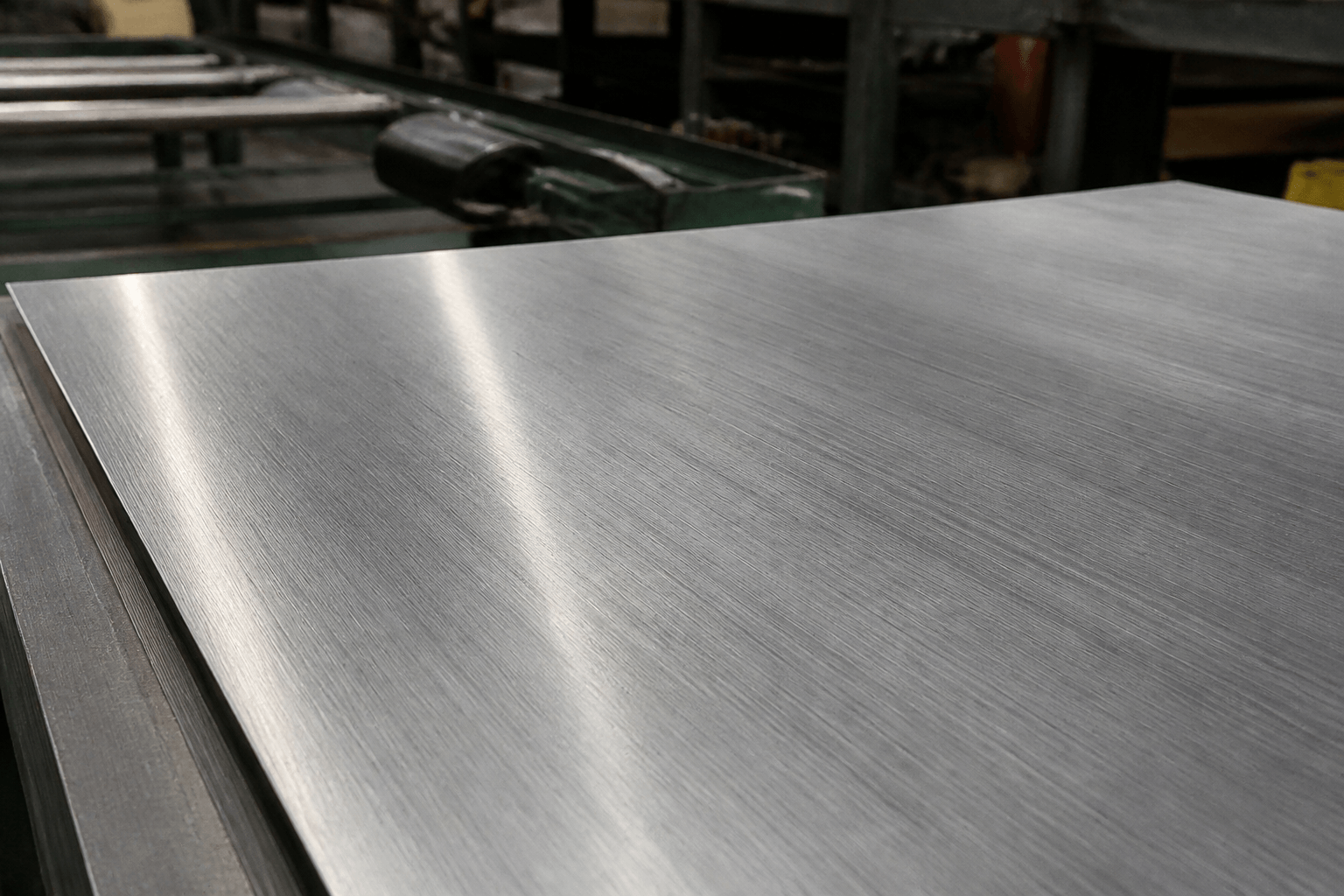
An aluminium brushed finish is a directional surface texture produced by mechanically abrading aluminium to create fine, generally parallel lines. It reduces mirror-like reflection and gives the metal a controlled linear grain, but it is not automatically a corrosion-protective coating.
The final appearance depends on the alloy, temper, starting surface, abrasive system, equipment settings, grain direction, part geometry, and agreed visual standard. A grit number by itself cannot guarantee that two suppliers—or even two different production setups—will produce an identical finish.
Brushed aluminium is used where the metal surface remains visible, including enclosures, retail displays, furniture, lighting products, signs, control panels, and architectural components. It can be supplied as a mechanical finish alone or followed by clear anodizing, clear coating, paint, or another specified treatment.
What Does a Brushed Aluminium Surface Look Like?
Brushing creates a visible grain by moving an abrasive across the aluminium in a controlled direction. Under directional light, the surface shows fine linear marks rather than the irregular reflections associated with untreated material. The result is usually less reflective than polished aluminium, while retaining a metallic appearance.
The grain can appear fine and subdued or comparatively pronounced. Its visibility changes with lighting angle, viewing direction, surface cleanliness, and subsequent treatment. Clear anodizing or a transparent coating, for example, may alter the apparent color, gloss, or contrast of the underlying lines.
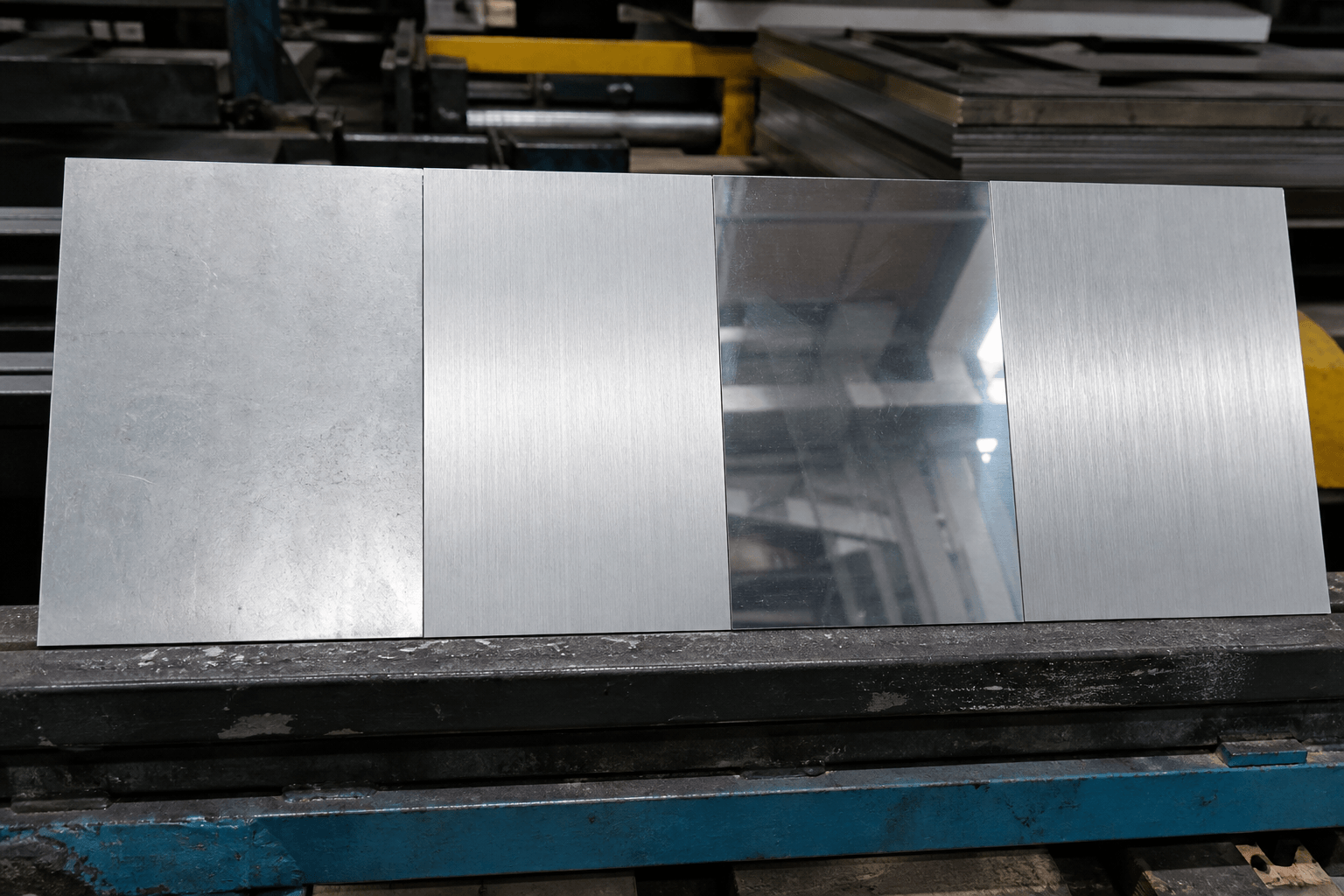
Labeled surface comparison:
- Mill finish: The as-produced surface of sheet, plate, or extrusion. It may show rolling, extrusion, handling, oxidation, or storage marks.
- Brushed finish: A deliberately created directional texture with visible linear grain and reduced reflectivity.
- Polished finish: A mechanically refined surface intended to be smoother and more reflective, generally with less obvious directional grain.
- Brushed and protected: The brushed texture remains visible beneath a specified anodized or coated layer, although its appearance may change after treatment.
Brushing can help establish a uniform visual direction, but it does not necessarily remove deep scratches, dents, pits, stains, or severe substrate defects. Aggressive processing intended to remove defects can also change dimensions, soften edges, or create local differences in texture.
Which Variables Control the Final Texture?
A repeatable finish begins with a defined substrate and a documented process. The same nominal abrasive grit can look different when used on another alloy, with another tool, or under different pressure and feed conditions.
| Variable | Effect on appearance or production |
|---|---|
| Alloy and temper | Different aluminium compositions and hardness conditions respond differently to cutting, smearing, and scratch formation. They should not be assumed to produce identical grain. |
| Product form | Rolled sheet, plate, and extrusion begin with different surface histories. Aluminium extrusion components may also have profile faces that require separate finishing consideration. |
| Starting condition | Rolling lines, extrusion marks, oxidation, dents, welding discoloration, and handling scratches can remain visible or require preparation before final brushing. |
| Abrasive type and sequence | Belts, wheels, pads, and other abrasive media cut differently. A multi-stage sequence may produce a more controlled result than one abrasive designation used without process context. |
| Tooling condition | A new abrasive may cut differently from a worn one. Contamination, loading, belt tracking, and tool maintenance can introduce streaks or inconsistent bands. |
| Pressure, speed, and feed | These variables influence cutting action, heat, line density, and uniformity. Excessive local pressure can overwork an area or contribute to distortion on thin parts. |
| Grain direction | The travel direction establishes the visible orientation. It should be marked on drawings, especially when several panels meet in one assembly. |
Process order also matters. Brushing flat stock before cutting and forming can simplify grain control over broad surfaces, but later fabrication may mark the cosmetic face. Brushing after forming may address fabrication marks, yet bends, corners, recesses, and assembled features can limit tool access. The preferred sequence therefore depends on geometry, cosmetic requirements, and the post-brush treatment.
Brushed, Polished, Mill Finish, Anodized, Clear-Coated, or Painted?
These terms describe different surface conditions or treatment categories. Brushing and polishing are mechanical finishing operations. Anodizing, clear coating, and painting add or create a surface layer and may be applied after suitable preparation.
| Finish option | Primary purpose | Visible character | Selection notes |
|---|---|---|---|
| Mill finish | Retains the supplied metal surface | Variable and process-dependent | Appropriate when appearance is secondary or another finish will follow. |
| Brushing | Creates directional mechanical texture | Linear grain with moderated reflection | Does not by itself make aluminium corrosion-proof. |
| Polishing | Refines the surface toward greater smoothness and reflection | Brighter, often with less visible grain | May make fingerprints, handling marks, or local surface differences more noticeable. |
| Anodizing | Creates a controlled oxide layer through an electrochemical process | Can retain underlying grain while changing tone and gloss | Brushing and anodizing are separate processes. Alloy and starting condition can influence the anodized appearance. |
| Clear coating | Adds a transparent protective layer | Shows the substrate but may change depth, gloss, or color | Coating compatibility, adhesion preparation, and service environment must be specified. |
| Paint | Adds an opaque decorative and protective coating system | Usually covers the metallic appearance | Visible brush grain may be reduced or hidden. Paint choice depends on substrate preparation, environment, and performance specification. |
For exterior use, select the complete finish system according to moisture, pollutants, salt exposure, ultraviolet exposure, cleaning chemicals, and expected maintenance. A bare brushed surface is not inherently suitable for every exterior environment. A qualified coating or anodizing specification may be required, with exposed cut edges, joints, and contact with dissimilar metals considered as part of the assembly.
How Part Geometry Affects Finish Quality
Large flat panels
Broad cosmetic faces reveal changes in grain direction, overlap, waviness, and pressure more readily than small parts. Thin panels may also be sensitive to heat or mechanical stress. Flatness requirements should be reviewed together with finishing and forming operations rather than treated as unrelated drawing notes.
Bends and formed areas
Grain running across a bend can look different from grain running parallel to it because the surface orientation changes relative to the viewer and light source. Forming after brushing can mark or stretch the finished face; brushing after forming can produce different textures near the bend where tooling access is restricted.
Holes, corners, and cut edges
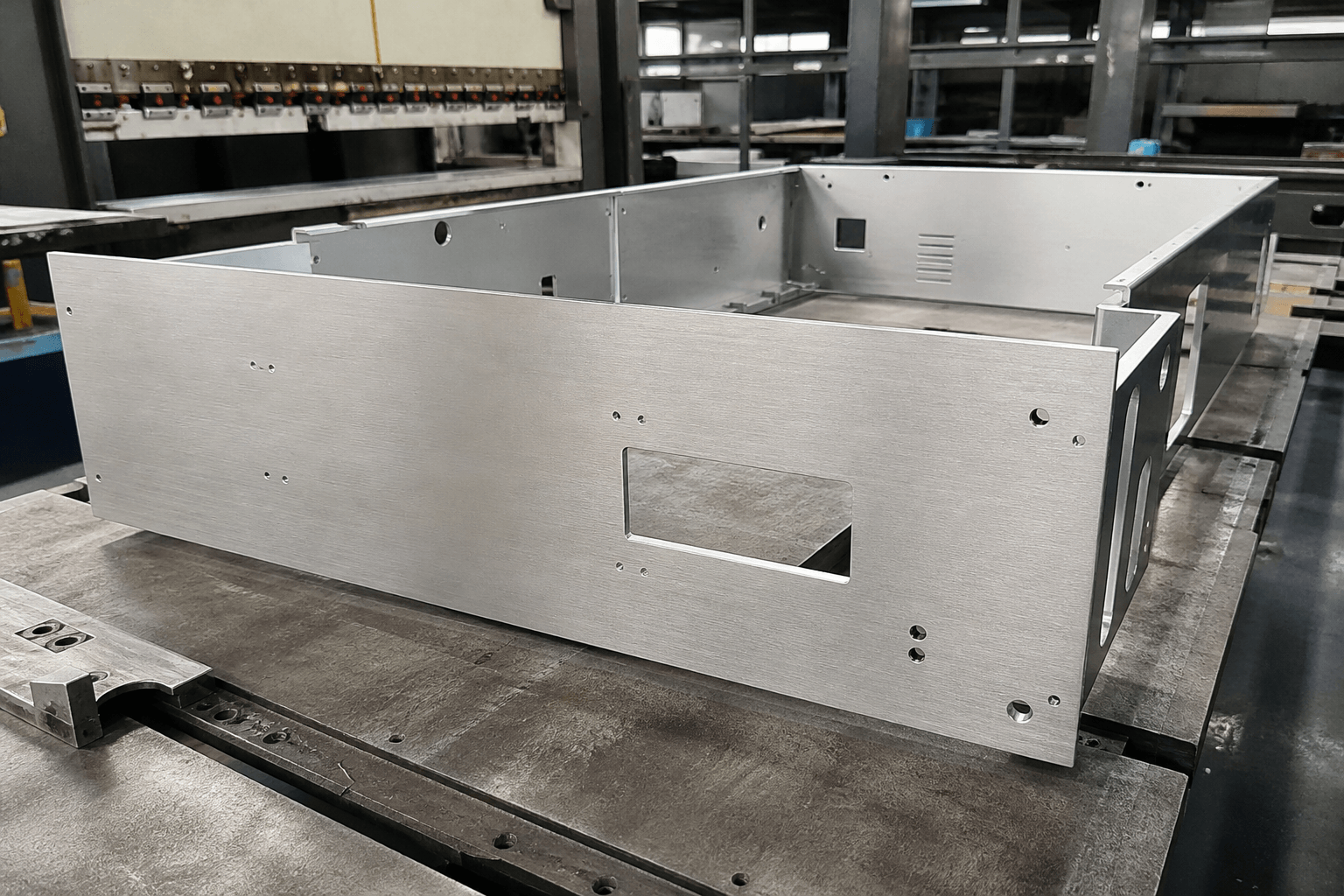
Abrasive contact can round exposed edges or produce a halo around holes if local pressure is not controlled. Cut edges usually do not look the same as a brushed face unless an edge treatment is separately defined. Masking or restricted finishing zones may be needed around grounding points, gasket seats, threaded features, locating surfaces, or close-fit interfaces.
Multi-panel assemblies
Two individually acceptable panels can look mismatched when their grains run in different directions. On cosmetic aluminium enclosure panels, drawing arrows should coordinate the top, sides, doors, and removable covers as they appear in the final assembly—not merely as they lie flat during manufacture.
Cosmetic faces should be protected during subsequent fabrication, assembly, inspection, and packaging. Protective film can be useful when compatible with the production sequence, but its type, removal timing, adhesive residue, and exposure to heat require consideration. Packaging should also prevent finished surfaces from rubbing against one another in transit.
What to Include in an Aluminium Brushed Finish Callout
“Brushed aluminium” or “brushed look” is not a complete acceptance specification. A useful drawing note connects the required appearance to material identity, part orientation, inspection conditions, protected features, and any treatment applied after brushing.
- Identify the substrate: State the aluminium alloy, temper, product form, thickness or profile designation, and required starting condition.
- Mark cosmetic surfaces: Label the visible faces on the drawing. Distinguish primary cosmetic faces from hidden, non-cosmetic, or functionally critical surfaces.
- Show grain direction: Add arrows on each relevant view. For assemblies, define how grain should align across neighboring parts.
- Describe the finish process: Specify the approved abrasive system or process sequence when known, without assuming that grit alone defines the appearance.
- Control visual results: State the required texture, gloss category, color expectation, and acceptable variation. Use an approved physical sample or controlled visual reference alongside written criteria.
- Define inspection: Where appearance is critical, document lighting, viewing angle, inspection distance, surface cleanliness, and acceptance rules for scratches, streaks, dents, stains, pits, and cross-grain marks.
- Protect functional features: Identify masked zones, electrical contact points, gasket faces, threads, holes, datums, critical dimensions, and assembly interfaces that must not be adversely affected.
- Name the post-treatment: State whether the part remains mechanically brushed or receives clear anodizing, clear coating, paint, or another treatment.
- Address production consistency: Define sample approval, batch comparison, handling, packaging, and any requirement to keep visibly adjacent components within an agreed appearance range.
Example annotation structure:
Material: [alloy, temper, and product form]. Cosmetic faces: [drawing labels]. Apply directional brushed finish with grain aligned to drawing arrows. Appearance to match [approved sample or controlled reference] within documented texture, gloss, color, and defect criteria. Protect [masked features and interfaces]. Apply [specified post-treatment]. Inspect under [agreed viewing conditions]. Package to prevent face-to-face abrasion and cross-grain damage.
This structure intentionally uses placeholders rather than invented values. The appropriate criteria depend on the alloy, geometry, application, finishing route, and buyer’s appearance standard. A sample is valuable for visual alignment, but it should not replace documented acceptance criteria.
Frequently Asked Questions
How should brushed aluminium be cleaned without creating cross-grain scratches?
Remove loose particles first, then use a soft, non-abrasive cloth and a cleaner compatible with the aluminium and any anodized or coated layer. Wipe along the grain rather than across it. Avoid steel wool, aggressive abrasive pads, and unapproved chemicals. Test the method on a concealed area because cleaning recommendations depend on the complete finish system.
Is a brushed finish alone suitable for exterior aluminium products?
Not automatically. Exterior suitability depends on the alloy, atmospheric conditions, salt or pollutant exposure, drainage, joints, dissimilar-metal contact, and maintenance expectations. Brushing establishes texture but is not itself a universal corrosion-protection system. Specify a suitable anodized or coating system when the application requires additional protection.
What is the difference between brushed aluminium and clear-anodized brushed aluminium?
Brushed aluminium has a mechanically abraded directional surface. Clear-anodized brushed aluminium receives a subsequent electrochemical treatment that creates a controlled oxide layer while generally retaining the underlying grain. Anodizing can change tone, gloss, and contrast, so approval should evaluate the completed finish rather than the brushed substrate alone.
Can brushed aluminium be painted or clear-coated?
Yes, provided the surface preparation and coating system are compatible. Clear coating can preserve visibility of the grain but may change gloss or apparent color. Opaque paint may reduce or hide the brushed appearance. Coating adhesion, pretreatment, masking, service environment, and the desired final appearance should all be defined before selecting the process sequence.