Abrasive waterjet cutting uses a high-pressure water stream carrying abrasive particles to cut materials that pure water alone may not process effectively. Suitability depends on the material, thickness, geometry, required edge quality and tolerance, production speed, and operating cost; there is no single result that applies to every part.
What abrasive waterjet cutting does
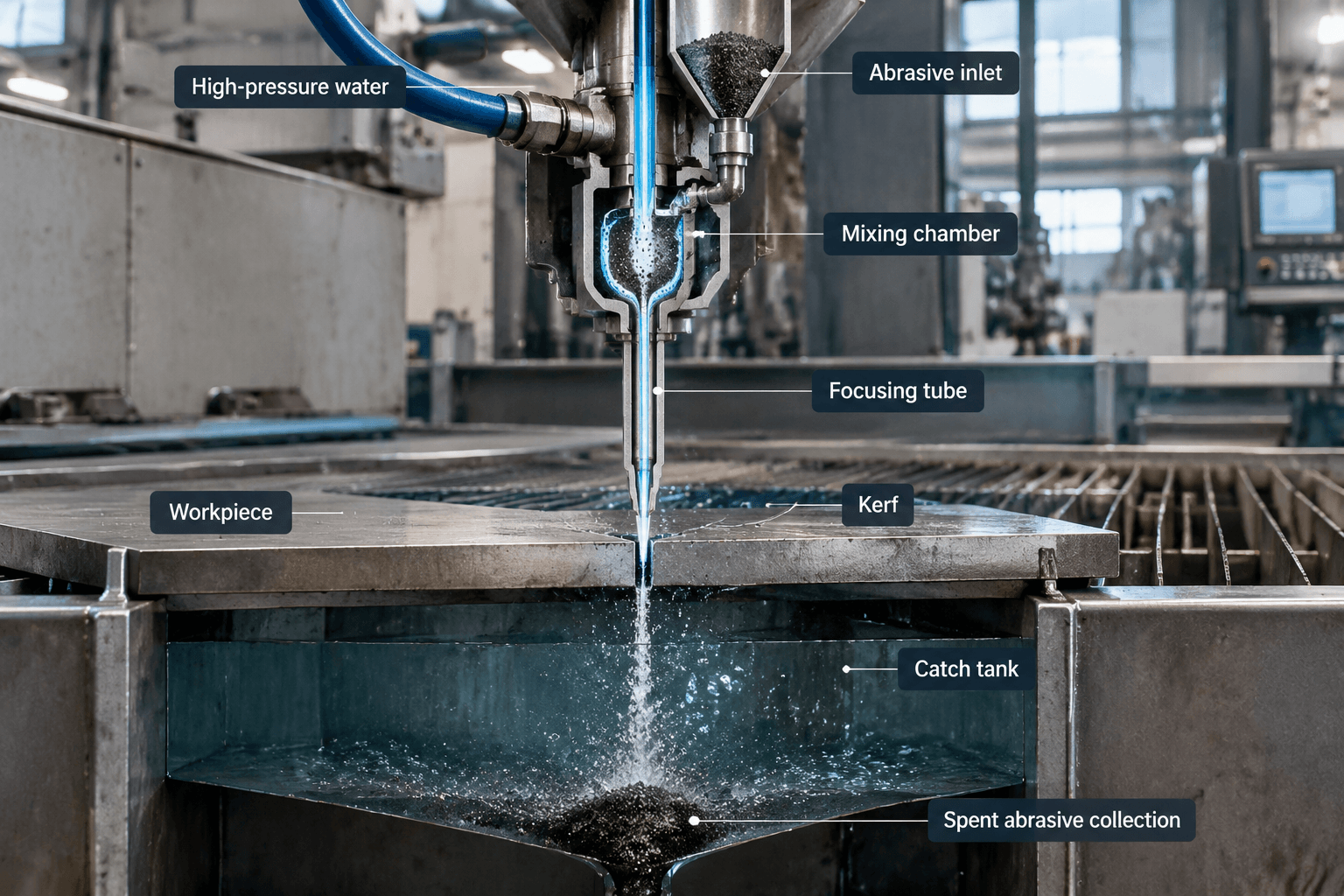
In abrasive waterjet cutting, pressurized water passes through a small orifice and forms a fast jet. Abrasive is introduced downstream into a mixing chamber, where the water stream accelerates the particles. The resulting abrasive-laden stream travels through a focusing tube and erodes material along a programmed path.
The water supplies the energy that moves the abrasive; the abrasive particles do much of the cutting work on hard materials. This is different from a pure waterjet, which cuts with water alone and is commonly selected for suitable softer materials. Adding abrasive can make waterjet cutting applicable to many metals, stone, glass, and composites, subject to the material and machine setup. It does not make every material or part geometry suitable.
Waterjet cutting is a non-thermal cutting process: it does not rely on a heat source to melt the cut path. That can be useful when heat-related changes are a concern, but the finished edge and dimensions still depend on the material, cutting settings, support, and inspection method. A cut may need secondary machining or finishing when the drawing requires a particular fit, edge condition, or surface.
From pump to cut edge
- Pressurization: A high-pressure pump supplies water to the cutting head. Pressure is one process input, not a standalone predictor of cut quality or production rate.
- Jet formation: Water passes through an orifice, creating a concentrated jet that enters the head’s mixing chamber.
- Abrasive entrainment: Abrasive is metered into the chamber and accelerated by the water. The abrasive type and flow rate affect cutting behavior and consumable use.
- Focusing and cutting: A focusing tube directs the mixed stream toward the workpiece. The programmed head motion traces the part profile. Stand-off distance, tube condition, motion control, material support, and cutting settings all influence the result.
- Catch and removal: The stream passes through the workpiece into a catch tank, which reduces the jet’s remaining energy. Spent abrasive and cut material must be managed and removed according to the machine’s handling system.
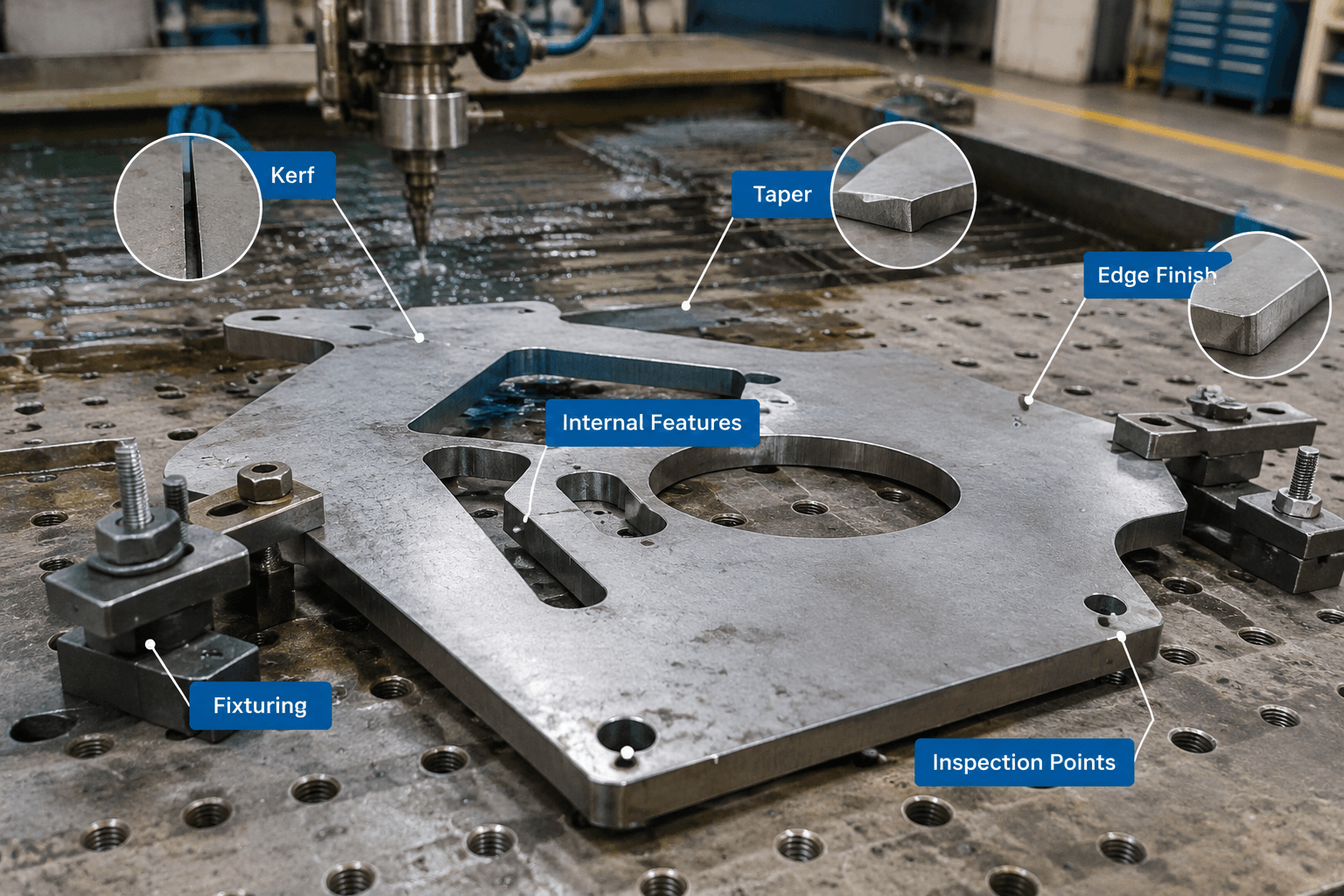
Kerf is the width of material removed by the cut. Taper is the difference in cut width or position between the top and bottom of the workpiece. Both vary with material, thickness, cut direction, settings, and machine condition. A worn or damaged orifice or focusing tube, inconsistent abrasive feed, an unsuitable stand-off, or poor workholding can affect edge geometry and repeatability. For that reason, a drawing should state the required dimensions and inspection approach instead of relying on a generic claim about waterjet accuracy.
Abrasive waterjet vs. pure waterjet
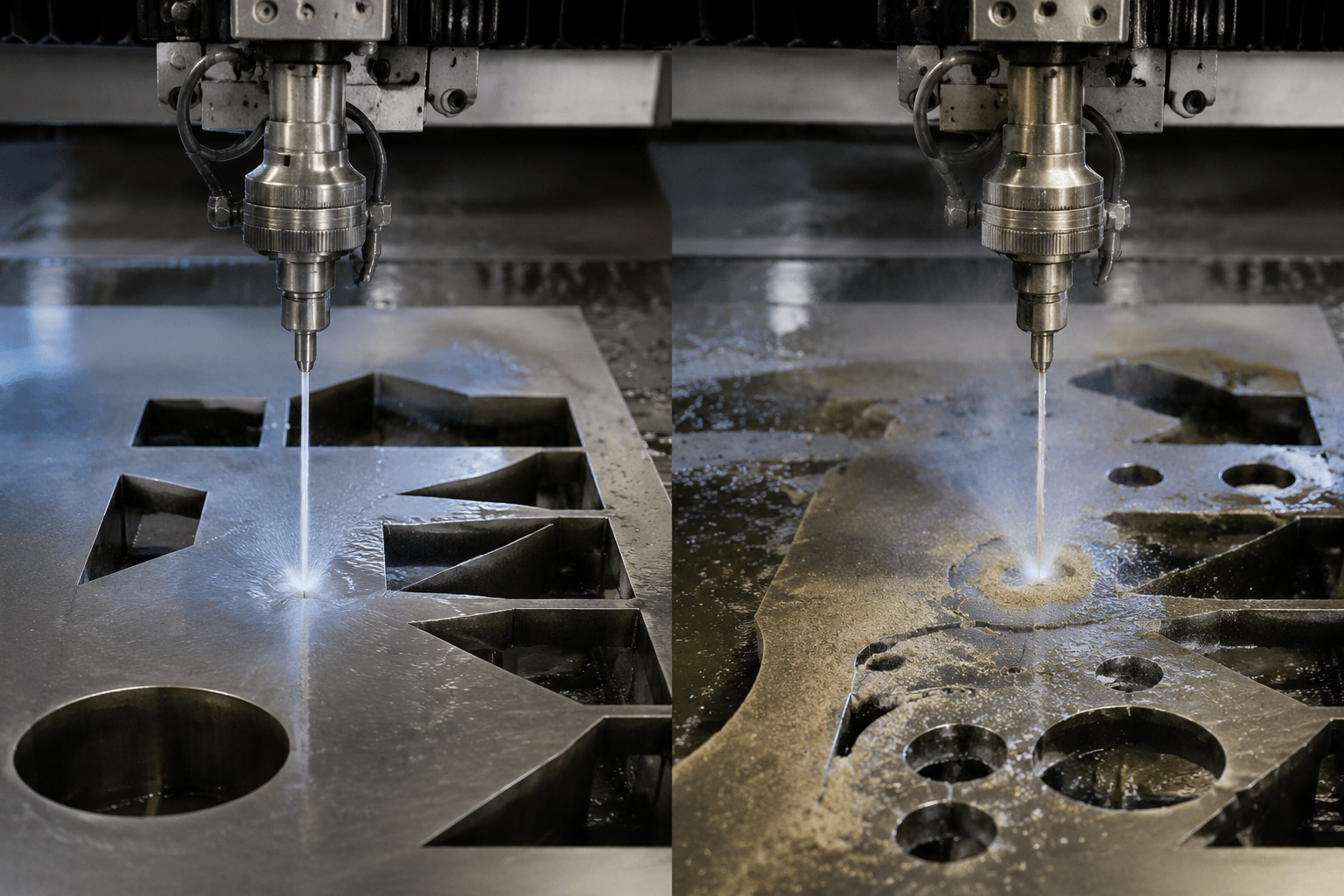
The practical distinction is whether abrasive is needed to cut the material and meet the part requirement. Pure waterjet is often considered for softer materials; abrasive waterjet is considered when the material is harder or otherwise requires abrasive erosion. Exact suitability, quality, throughput, and cost remain application-dependent.
| Decision factor | Abrasive waterjet | Pure waterjet |
|---|---|---|
| Cutting medium | Water accelerates abrasive particles through a focusing tube. | A water stream cuts without added abrasive. |
| Material category | Often evaluated for metals and other hard materials, subject to grade, thickness, and setup. | Often evaluated for softer materials that can be cut effectively with water alone. |
| Thickness and geometry | Feasibility depends on the workpiece, feature access, required edge, and available machine setup. | Feasibility likewise depends on material, thickness, feature size, and the required result. |
| Edge and feature requirements | Kerf, taper, small features, and finish need to be checked against the drawing and inspection method. | Feature detail and edge condition also depend on material and process settings; no universal edge result should be assumed. |
| Speed and throughput | Cutting speed depends on material, thickness, quality target, path complexity, and setup. | Cutting speed depends on its own material and quality constraints. Compare representative parts rather than assuming one process is always faster. |
| Consumables and upkeep | Uses abrasive as well as waterjet components. Abrasive handling and nozzle wear contribute to operating demands. | Avoids abrasive consumption, but still has machine, water, nozzle, maintenance, and operating costs. |
| Cost drivers | Consider machine time, abrasive use, wear parts, programming, handling, inspection, and any secondary operations. | Consider machine time, maintenance, programming, handling, inspection, and any secondary operations. |
For example, a flat metal plate with a profiled outline and holes may be a candidate for abrasive waterjet evaluation when the drawing’s edge and hole requirements are compatible with the process. A soft sheet or gasket-like part may instead warrant pure waterjet consideration if the material can be cut to the required geometry that way. These are starting points for process selection, not guarantees: the material grade, thickness, geometry, quantity, and inspection requirements can change the decision.
A detailed bracket illustrates why the part drawing matters more than the process label. Holes used for fasteners, narrow slots, mating edges, and surfaces that will be assembled can carry different requirements from non-critical profile edges. A manufacturer should assess the critical features and whether cutting alone can meet them. See custom metal brackets built to your drawings for an example of drawing-led part requirements. In transportation applications, repeatability, material selection, and inspection may also shape process decisions; see custom metal fabrication for automotive and transportation equipment.
Quality, speed, and operating cost
Cut quality settings involve tradeoffs. A faster cut may not produce the same edge condition as a slower setting chosen for a higher finish requirement. The right balance depends on the part’s function: an edge that will be hidden or machined later may not need the same finish as a visible or mating edge. State those differences on the drawing or in the inspection notes.
Dimensional accuracy and repeatability depend on more than the pump. Material variation, thickness, nozzle and focusing-tube condition, abrasive type and flow, stand-off distance, machine motion, programming, and fixturing can all affect the cut. Thin or poorly supported stock may move; a complex path or closely spaced features may require additional review. Edge taper and surface roughness can vary through the thickness and with cutting settings. Ask how a critical dimension will be measured, where it will be measured, and whether the requirement applies before or after any secondary operation.
Production economics should include the whole route, not only the cutting time. Abrasive consumption, orifice and focusing-tube wear, preventive maintenance, setup and programming, part loading and unloading, spent abrasive handling, inspection, and secondary machining or finishing can all contribute to cost. Quantity and nesting may affect machine utilization, while a tight tolerance or specified edge condition may change the selected cutting settings and time. Compare quotes against the same material, drawing revision, quantity, quality requirements, and included operations.
Where a cut edge must meet a tight fit or surface requirement, a manufacturer may recommend inspection or a follow-on operation. The appropriate choice depends on the drawing and the part’s function; abrasive waterjet should not be assumed to replace every machining or finishing step.
Assessing a custom part
To assess feasibility, provide the part drawing or CAD file and identify:
- Material grade or family, condition if relevant, and thickness.
- Maximum part dimensions and quantity, including whether the request is for prototypes, repeat production, or both.
- Overall geometry, hole and slot sizes, internal features, narrow sections, and any areas that may be difficult to support or inspect.
- Critical dimensions and tolerances, with the relevant datums and inspection method where specified.
- Required edge condition or surface finish, and which edges or faces are functionally or cosmetically important.
- Downstream operations such as machining, deburring, finishing, assembly, or additional inspection.
Very small features, deep cuts, tight fit requirements, or fragile and difficult-to-support parts may need a different setup or process. Heat-sensitive materials may benefit from considering a non-thermal process, but compatibility and edge quality still require review. Micro-abrasive waterjet machining is a specialized option for some small-feature requirements, not the default assumption for ordinary waterjet work. A manufacturer can compare abrasive waterjet, pure waterjet, and other suitable processes against the drawing rather than selecting a process from the keyword alone.
Yishang can review an OEM or ODM custom metal project and help clarify whether the stated requirements call for abrasive waterjet cutting or another suitable manufacturing process, subject to project review. Include the drawing or CAD file, material and thickness, critical dimensions and tolerances, edge or surface-finish requirements, part dimensions, quantity, and any required secondary operations.
Frequently Asked Questions
What laser cutting precision details should buyers define before requesting a quote?
Buyers should define the functional requirement, drawing notes, critical dimensions, material or process expectations, and any inspection points related to laser cutting precision. This helps suppliers quote the same manufacturing scope instead of making different assumptions.
How can cut hole locations affect cost, fit, or lead time?
cut hole locations can change tooling, forming, welding, finishing, inspection, or rework requirements. If buyers do not clarify it early, two supplier quotes may look comparable while covering different production risks.
Why should bend-to-hole dimensions be reviewed before prototype approval?
bend-to-hole dimensions may look acceptable on a single sample but become harder to control during batch production. Buyers should confirm whether the prototype reflects the same process, finish, and inspection conditions expected for production.
What inspection points matter most for abrasive water projects?
Important inspection points usually include fit-critical dimensions, holes or mating areas, cosmetic surfaces, finish build-up, welded or formed features, and any dimensions that affect downstream assembly. These points should appear in the RFQ or drawing notes.
How can buyers reduce batch consistency risk before batch production?
Buyers can reduce risk by clarifying drawings, locking key material and finish assumptions, defining inspection timing, approving a representative sample, and confirming which dimensions or surfaces require tighter process control.
How can Yishang help review abrasive water requirements?
Yishang can review drawings, RFQ notes, material requirements, tolerance expectations, finish details, samples, and assembly needs to identify unclear assumptions before quoting or batch production.