
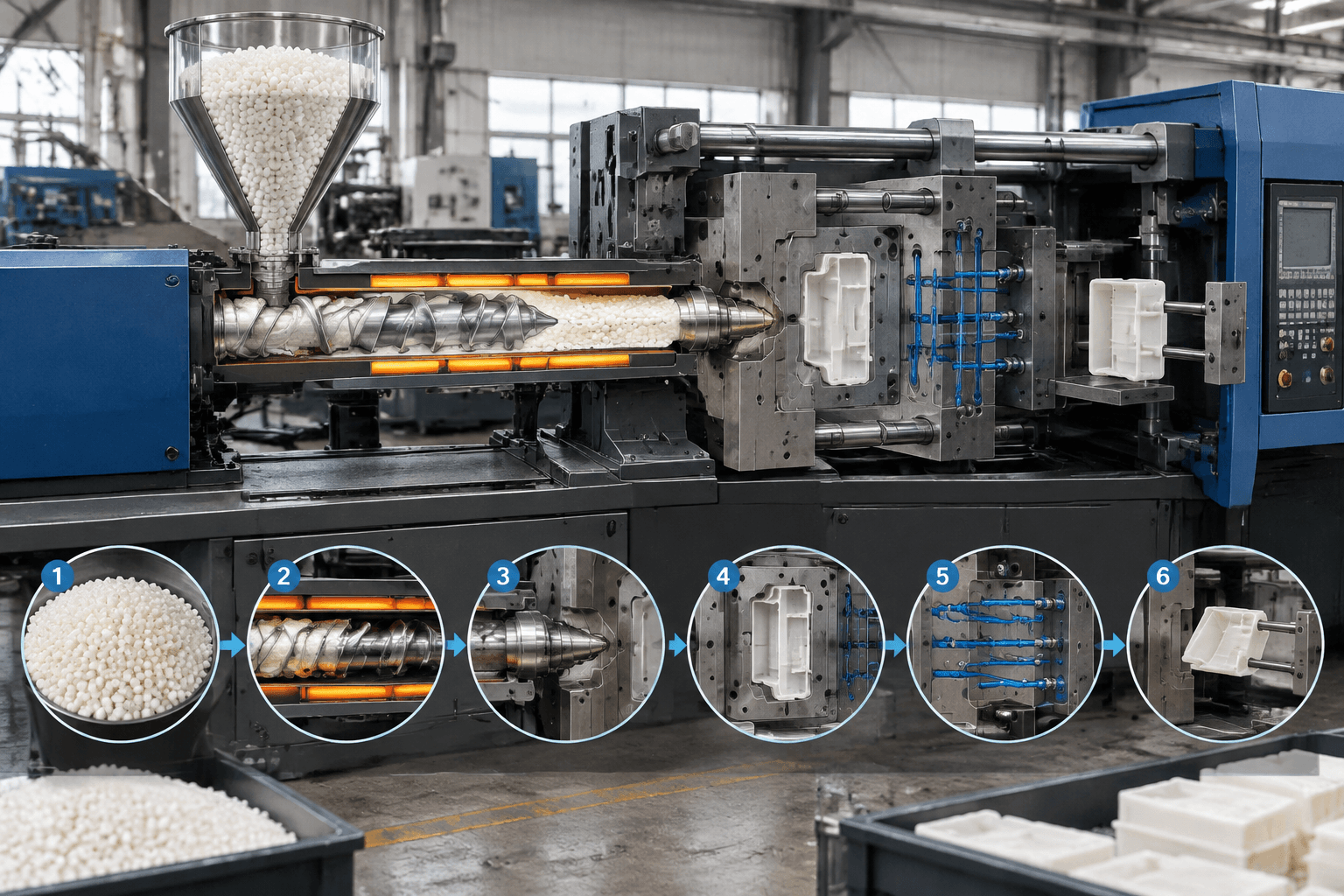
ABS moulding means shaping acrylonitrile butadiene styrene, a thermoplastic commonly called ABS, by heating it and forming it in a mould. Yes, ABS can be injection moulded, but the appropriate equipment, tooling and process controls depend on the resin grade, part geometry and production objective.
Manual experiments, benchtop machines, prototype tooling and controlled production injection moulding are not equivalent routes. Each can answer a different development question, and success with an early prototype does not automatically demonstrate production readiness.
What ABS Moulding Actually Means
ABS is a plastic rather than an alternative to plastic: its full name is acrylonitrile butadiene styrene. It is a thermoplastic, which means an appropriate grade can be softened by controlled heating, shaped and then solidified by cooling. The balance among its constituent phases contributes to the toughness, rigidity, processing behaviour and appearance associated with many ABS grades.
In industrial usage, ABS moulding most often refers to injection moulding. Prepared resin is heated in an injection unit, forced into a closed mould cavity, cooled sufficiently to retain its shape and then ejected. Other techniques may also shape ABS, but they should remain conceptually distinct. Extrusion produces continuous profiles, while 3D printing builds a part layer by layer; neither is a form of injection moulding.
The selected material must be more specific than simply “ABS.” Suppliers offer grades formulated for different priorities, potentially including higher impact performance, improved heat resistance, flame-retardant behaviour, plating or particular surface requirements. The grade designation and its technical data should therefore be part of the design and tooling discussion.
How Durable Is a Moulded ABS Part?
ABS is frequently considered for equipment covers, control housings, bezels and functional consumer or industrial components because suitable grades can combine rigidity, impact resistance and a good moulded appearance. Its actual durability is conditional, however. Loading, wall design, temperature, sunlight, chemicals, assembly stresses and the chosen grade all influence service life.
| Material consideration | General tendency | Design or sourcing implication |
|---|---|---|
| Impact resistance | Many ABS grades resist everyday knocks better than more brittle plastics. | Confirm grade-specific impact data at the expected service temperature. Corners, ribs and fastener features can still concentrate stress. |
| Surface appearance | ABS can reproduce mould texture and support glossy or textured cosmetic surfaces. | Flow, gates, weld lines, ejector locations and mould finish affect the visible result. Colour and gloss should be defined rather than assumed. |
| Heat exposure | ABS softens as temperature rises, with meaningful differences among grades. | Specify continuous and short-term exposure conditions. A higher-heat grade or another material may be necessary near motors, heaters or hot process equipment. |
| Outdoor service | Standard grades may change colour or lose properties under prolonged ultraviolet exposure. | Review UV-stabilised grades, coatings or alternative polymers when outdoor durability matters. |
| Chemicals and cleaners | Resistance depends on the chemical, concentration, temperature, stress and contact time. | Check compatibility with oils, cleaning agents and process chemicals under realistic conditions. |
| Flame and regulated uses | Flame behaviour and regulatory status are grade-specific. | Request documented compliance for the exact resin. Do not infer food contact, child-use or flame performance from the name ABS alone. |
A visually acceptable sample can still be unsuitable in service. Functional validation should reproduce relevant loads, temperatures, chemicals, fastening conditions and environmental exposure.
What Happens During ABS Injection Moulding?
- Material identification and preparation: The processor confirms the resin grade, colour system and use of any permitted regrind or additives. ABS can absorb moisture, so storage and drying must follow the resin supplier’s instructions. Inadequate preparation may contribute to surface streaks, bubbles or degraded properties.
- Controlled heating: Resin enters the injection unit, where heat and screw action bring it to a flowable state. Settings cannot be universal because the grade, machine, residence time, shot size and part affect the suitable processing window. Excessive heat or residence time can degrade the material.
- Filling and packing: The machine injects the material through the nozzle, sprue and runner or hot-runner system, then through the gate into the cavity. Pressure and speed must fill the geometry without causing excessive shear, trapped air, flash or unnecessary internal stress. Additional material may be applied during packing to compensate for contraction as the part begins to cool.
- Cooling: Heat moves from the plastic into the mould and its cooling system. Wall thickness, mould temperature, cooling-channel arrangement and feature geometry influence cooling uniformity. Uneven cooling can contribute to sink, distortion or dimensional variation.
- Mould opening and ejection: Once the part has enough rigidity, the mould opens and ejector pins, sleeves or another mechanism remove it. Draft and appropriate ejection support reduce dragging, whitening, deformation and visible pin marks.
- Inspection and secondary work: The part may be checked for dimensions, appearance, fit and function. Gate trimming, assembly, printing, coating or other finishing may follow, subject to material and surface compatibility.
Heating ABS requires process-appropriate ventilation to control fumes, particularly if the resin is overheated or degraded, and handling must follow the resin supplier’s safety data sheet. Operators also need protection from hot polymer, heated moulds, moving platens, stored pressure and pinch points. Machine guarding, interlocks and operating instructions should never be bypassed. Improvised heating in an uncontrolled or poorly ventilated area is not a substitute for moulding equipment.
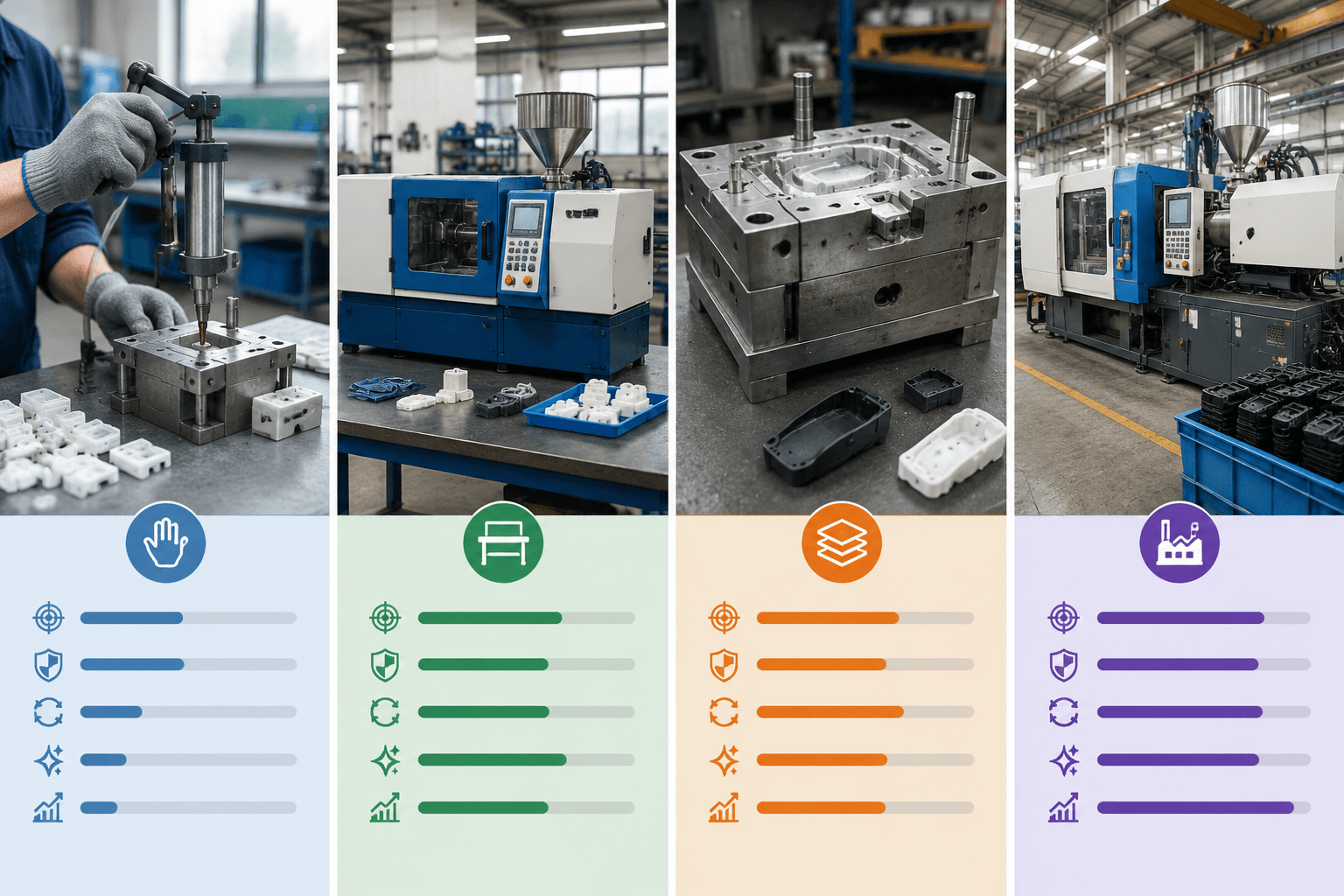
Manual, Benchtop, Prototype and Production Routes Compared
The term ABS moulding sometimes hides major differences in process control. Feasibility in every category depends on shot and clamp capacity, mould construction, resin grade and part geometry.
| Route | Useful purpose | Typical boundaries | What it does not prove |
|---|---|---|---|
| Improvised or manual method | Learning basic flow behaviour or making a simple experimental shape. | Limited control of material condition, heating, pressure, filling, cooling and operator safety. Complex cavities and consistent cosmetics are difficult. | Repeatability, validated properties or scalable production. |
| Benchtop injection machine | Small-part experiments, education and early design trials when machine capacity and tooling are suitable. | Shot volume, clamp force, injection control and mould features may be more restricted than on production equipment. | That the same tool or process settings will transfer directly to a production machine. |
| Prototype tooling | Checking moulded geometry, assembly, appearance or function using a process closer to production. | Tool material, cooling, automation, cavity count and intended run size may differ from the eventual production system. | Final cycle performance, tool life or production capability unless those points are specifically validated. |
| Production injection moulding | Repeatable manufacture using defined equipment, process controls, inspection criteria and production-oriented tooling. | Requires greater investment in design review, tool development and validation. Results still depend on disciplined control. | Automatic suitability for every application; resin and part requirements must still be verified. |
Prototype tools are sometimes described as “soft tooling,” while longer-term tools may use production steels. Those labels alone are not enough for a decision. Tool material, hardness, cavity count, expected maintenance, surface texture, cooling design and resin additives all affect cost and suitability. An overview of custom injection moulding for housings, covers and industrial components can provide context for the production route.
Part and Mould Features That Control the Result
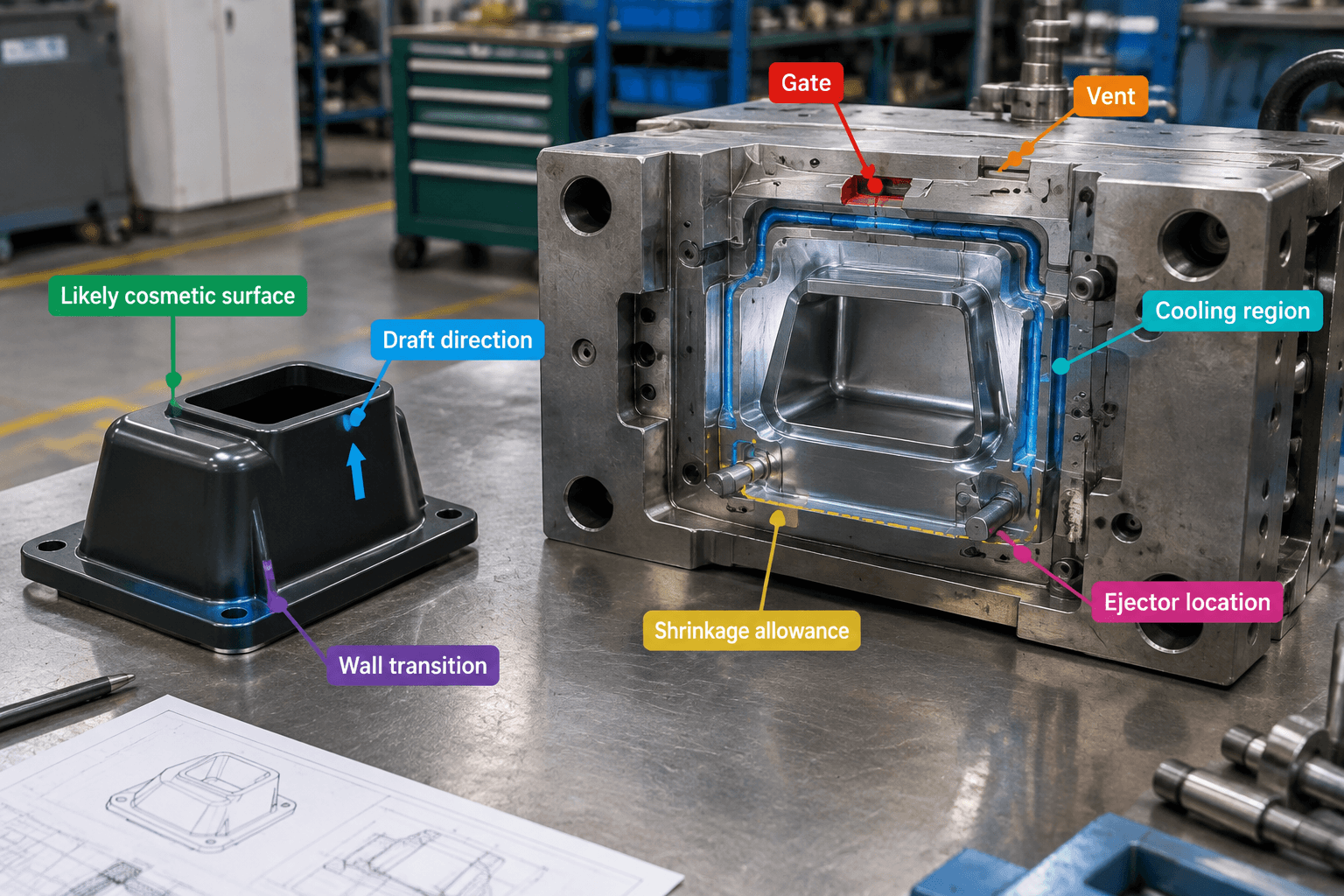
Conceptual design path: injection unit → gate → cavity and wall transitions → vent locations → cooling regions → draft direction → ejector locations.
Wall consistency helps the cavity fill and cool more evenly. Abrupt changes from thin to thick sections can produce hesitation, sink or differential shrinkage. Ribs and bosses should be proportioned to the surrounding structure rather than added as isolated heavy masses.
Draft provides clearance as the component leaves the cavity or core. The required draft depends partly on depth, texture, material behaviour and the cosmetic standard. A deeply textured surface generally creates more release resistance than a smooth one.
Gate position and type determine where material enters and influence flow length, weld-line location, orientation and the remaining gate mark. The gate should be considered alongside the likely cosmetic face, structural loads and trimming method.
Vents allow displaced air and process gases to leave as the melt advances. Inadequate venting may cause incomplete filling, burns or weak joining of flow fronts. Vent design must prevent excessive plastic leakage while remaining maintainable.
Shrinkage allowance is built into the cavity so the cooled component approaches its intended dimensions. It is not one universal ABS percentage: grade, flow direction, packing, wall thickness, mould conditions and geometry matter. Critical dimensions may require mould trials and controlled steel adjustments.
Cooling and ejection complete the design system. Cooling should manage temperature distribution around cores, bosses and thick regions. Ejectors need enough support area to release the part without unacceptable marks or deformation, preferably away from critical cosmetic surfaces.
These relationships also guide troubleshooting. Splay can prompt a review of drying and degradation; a short shot may involve flow resistance, venting or machine capacity; sink and warpage can point to wall geometry, packing or uneven cooling. A defect should be investigated systematically rather than corrected by changing one setting without considering the mould and material.
Choose an ABS Moulding Route by What You Need to Prove
| Development question | Potential route | Evidence to collect |
|---|---|---|
| Can I learn the basic moulding principle? | Guarded manual or benchtop equipment with appropriate training. | Basic filling observations and safe operating experience, not production approval. |
| Does the shape communicate the concept? | 3D printing or another visual prototype method may be faster than moulding. | Form, access and approximate assembly relationships. |
| Will a moulded part assemble and function? | Prototype tooling and a specified ABS grade. | Fit, fastener behaviour, loads, appearance and environmental test results. |
| Can a pilot process reveal production risks? | Production-representative tooling and equipment where practical. | Defined defects, inspection results, process stability and required tool changes. |
| Is the design ready for repeatable supply? | Validated production tooling and controlled injection moulding. | Approved material, drawings, cosmetic criteria, inspection plan and agreed acceptance requirements. |
Frequently Asked Questions
Is ABS strong enough for functional parts?
It can be, depending on the grade, geometry, loads and environment. ABS is often selected where rigidity and impact resistance are both useful, but thin sections, stress concentrations, heat, UV exposure and chemicals can change performance. Validate the exact grade under representative service conditions.
Is ABS safe to mould, and what precautions are required when it is heated?
ABS should be processed only under resin-specific handling guidance. Use suitable ventilation, control processing temperature and residence time, keep guards and interlocks operational, and protect personnel from hot material, tooling, pressure and moving machinery. Review the supplier’s safety data sheet. ABS should not be assumed food-safe, child-safe or harmless under uncontrolled heating.
Can ABS be moulded at home with manual or benchtop equipment?
Simple experiments may be possible when suitable equipment, compatible tooling, training and ventilation are available. Open-flame or improvised heating is inappropriate. Benchtop results may support learning or early validation, but limited clamp force, shot control and cooling can prevent production-level repeatability and cosmetic quality.
What information is needed before selecting prototype or production tooling?
Prepare a dimensioned drawing or 3D model, the exact resin grade where known, use environment, appearance standard, critical dimensions, assembly method, expected quantity range and validation objective. The tool designer also needs to understand the intended moulding equipment, gate restrictions, ejection surfaces and any required secondary operations.