
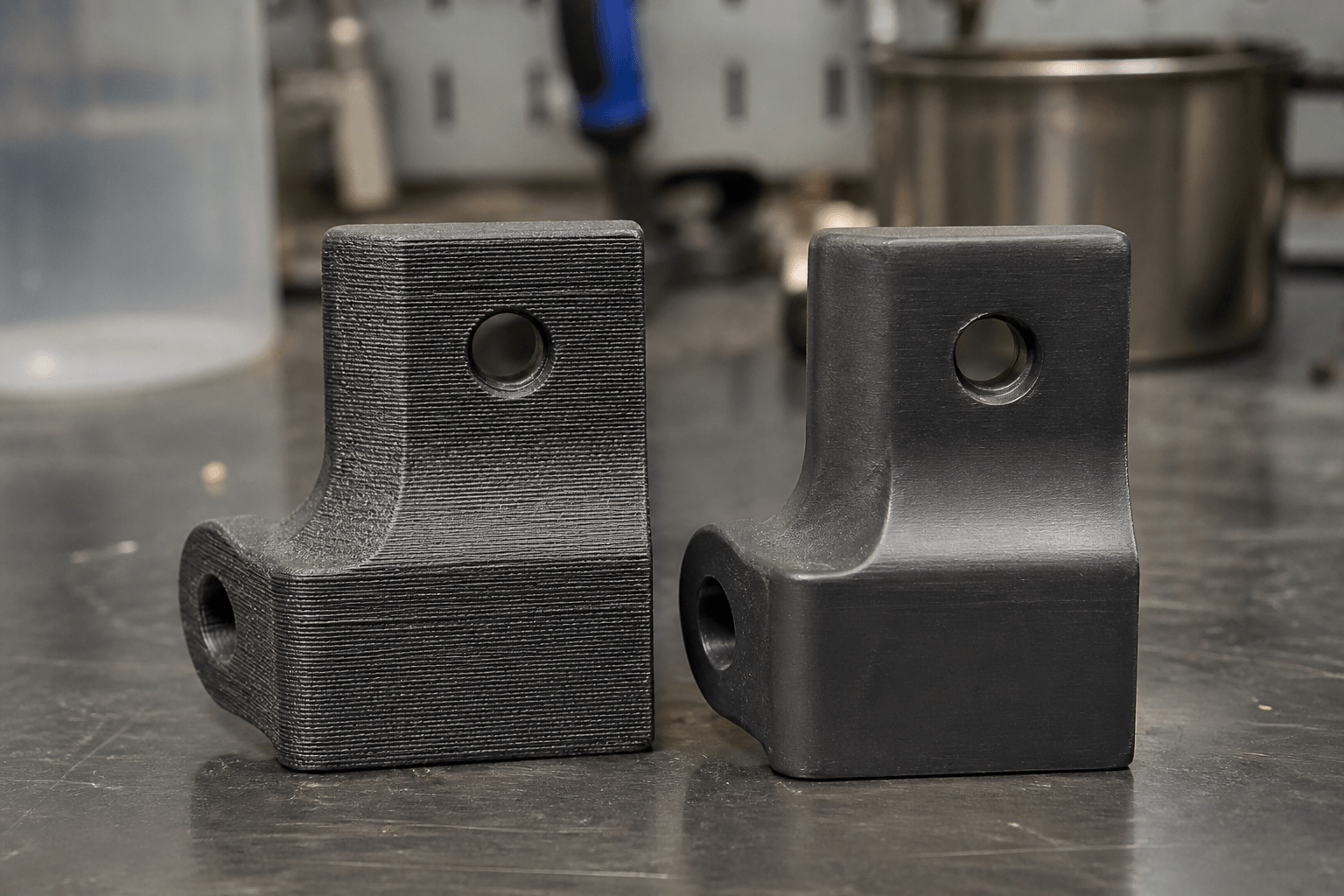
An ABS smoother can be a chemical product, vapor chamber, machine, hand tool, or finishing process used to reduce visible layer lines on an ABS 3D print. It can improve gloss and visual continuity, but it cannot repair inaccurate geometry, deep gaps, warping, or other print defects, and it may soften edges or alter critical features.
The term does not describe one standardized product. Choosing an appropriate method requires checking the exact polymer, desired appearance, part geometry, dimensional requirements, batch size, and available environmental and safety controls.
What Does “ABS Smoother” Actually Mean?
In product listings and technical discussions, “ABS smoother” may refer to several different things: a solvent, a liquid applicator, a vapor smoothing chamber, an automated smoothing machine, an abrasive tool, or even a coating intended to hide print texture. These options do not produce identical surfaces or carry the same dimensional and safety implications.
Practical definition: An ABS smoother is any controlled product, tool, equipment system, or finishing process intended to make the layer structure of an ABS printed surface less visible.
Chemical methods generally soften or partially reflow the outer polymer surface. As adjacent layer ridges blend, the part may look more uniform and often glossier. This is a surface effect rather than a geometric correction. A smoother will not straighten a warped wall, close a major void reliably, restore a missing feature, or bring an inaccurate print back to its nominal CAD dimensions.
The result should therefore be specified as a cosmetic finish with defined limits, not simply as “perfectly smooth.” Surface gloss can increase while sharp edges, lettering, holes, or mating details become less distinct. Visual improvement and dimensional acceptance must be evaluated separately.
ABS Smoothing Methods Compared
The best ABS smoother depends on what “smooth” means for the project. A glossy display surface, a matte painted enclosure, and a dimensionally sensitive assembly component may require different processes.
Controlled vapor smoothing
Controlled vapor smoothing exposes the printed surface to a compatible solvent atmosphere rather than placing liquid directly onto it. When exposure is sufficiently uniform, it can reduce layer-line visibility across complex external surfaces and reach areas that are difficult to sand. The resulting surface is commonly glossy, although appearance varies with material formulation, print quality, color, geometry, and process control.
Part orientation, vapor distribution, loading, exposure consistency, and post-process conditioning all influence the outcome. Recesses and sheltered areas may respond differently from prominent surfaces. A purpose-built vapor smoothing machine may offer more controlled handling and exposure than an improvised chamber, but machine use does not eliminate the need for material validation, dimensional inspection, ventilation, and trained operation.
Direct solvent application
Direct application uses a compatible liquid on the surface, such as by wiping or brushing. It is distinct from vapor exposure because liquid contact can be concentrated in local areas. Runs, streaks, pooling, uneven gloss, and excessive softening are possible, especially around corners, recesses, and downward-facing features.
This method is highly dependent on operator technique and access to the surface. It may be considered for localized cosmetic work, but it is generally harder to make uniform across intricate geometry or repeated batches. Compatibility must be confirmed for the exact ABS blend and any pigment, filler, support residue, insert, adhesive, or previous coating.
Mechanical finishing
Sanding, abrasive media, filing, and polishing remove surface material rather than chemically reflowing it. Mechanical finishing gives the operator direct control over selected areas and can produce matte, keyed, or progressively refined surfaces. It can also preserve solvent-sensitive materials when correctly planned.
Access is the main limitation. Internal corners, fine textures, narrow channels, and complex curves can be difficult to finish evenly. Abrasion may flatten high points, change contours, expose porosity, or erase small details. Labor content and operator dependence can become significant as quantities increase.
Coating-based finishing
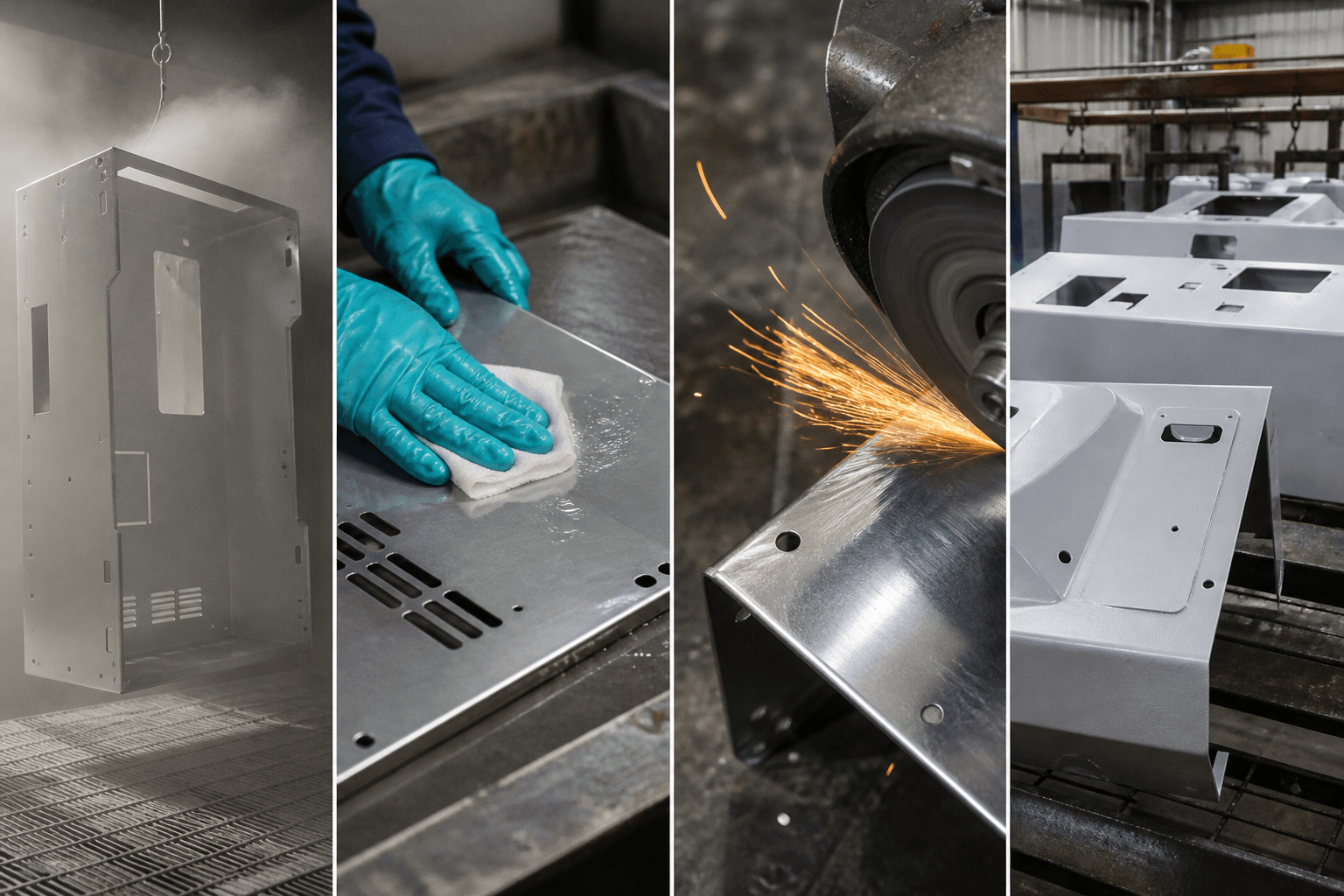
Primers, filler coatings, paint systems, and other surface films conceal or fill print texture instead of dissolving the underlying ABS. Coatings are useful when a specific color, matte finish, protective appearance, or consistent painted surface is more important than retaining the as-printed polymer surface.
A coating adds material, so holes, threads, interfaces, and masking boundaries require attention. Adhesion and appearance depend on cleaning, surface preparation, coating compatibility, application control, and curing. A cosmetic coating alone does not qualify a part for food-contact, regulated, or safety-critical service.
Effects on Edges, Holes, Threads, and Assembly Fit
Any process that softens, removes, or adds surface material can influence geometry. The extent depends on the polymer, feature size, exposure or abrasion pattern, coating build, print orientation, and local part shape. It should not be assumed that dimensions or strength remain unchanged.
| Part feature | Possible smoothing effect | Design or inspection response |
|---|---|---|
| Sharp external edges | Chemical reflow, sanding, or coating can reduce edge definition. | Identify edges that are cosmetic and those needed for location, sealing, or alignment. |
| Small holes and slots | Softened material or coating may reduce an opening; abrasion can change its shape. | Inspect with the required mating component or an appropriate gauge. |
| Printed threads | Thread crests and roots may lose definition or collect coating. | Protect critical threads or plan a validated secondary finishing operation. |
| Embossed or recessed text | Fine strokes and shallow characters may become less legible. | Use a representative test coupon or sample carrying the actual text size. |
| Mating and sealing faces | Gloss may improve while flatness, texture, or local dimensions become less suitable. | Mask or exclude these surfaces where possible and inspect them independently. |
| Thin walls and fine features | Local softening or aggressive abrasion may distort or weaken delicate geometry. | Test the actual wall and feature design rather than a generic flat sample. |
A useful drawing or finishing specification separates cosmetic surfaces from functional ones. For example, the outside face of an enclosure may permit visible smoothing, while screw locations, connector openings, locating bosses, and internal mating ribs remain protected. Approved appearance samples can define the visual target, but they should be accompanied by dimensional acceptance criteria.
Decision Matrix: Choosing an ABS Smoothing Approach
Material identity is the first filter. Acetone is often discussed in relation to ABS, but that does not establish compatibility with every ABS blend. ASA formulations, other printing polymers, pigments, fillers, support materials, inserts, and prior coatings can respond differently. If the material is uncertain, verify it before considering chemical treatment.
| Project condition | Approach to evaluate | Main limitation to check |
|---|---|---|
| Glossy cosmetic ABS surface with complex external curves | Controlled vapor smoothing | Material response, edge softening, exposure uniformity, and dimensional change |
| Small localized cosmetic area | Direct application under an approved process | Streaks, pooling, operator variation, and nearby sensitive features |
| Matte surface or preparation for paint | Mechanical finishing | Labor, access to recesses, dust control, and contour changes |
| Specified color or filled painted appearance | Coating-based finishing | Film build, adhesion, masking, curing, and fit |
| Repeated batches requiring controlled exposure | Purpose-built smoothing equipment | Validated recipes, loading consistency, maintenance, safety systems, and inspection |
| Unknown polymer or mixed-material assembly | Material verification and representative testing first | Unexpected attack, discoloration, residue, insert damage, or coating incompatibility |
| Deep gaps, warping, or inaccurate geometry | Correct the print or manufacturing process | Smoothing cannot restore the intended geometry |
Representative parts are more informative than simple flat coupons when geometry is sensitive. A test should include the actual color and polymer formulation as well as comparable holes, lettering, edges, walls, and mating features. The inspected result should cover both appearance and fit after the part has completed its required conditioning period.
Repeatability and Safety Require a Controlled Process
An attractive one-off result does not automatically establish a repeatable production process. Consistency begins with comparable printed surfaces. Contamination, support residue, variable layer quality, moisture, and previous finishing can all change the response. Smoothing cannot compensate reliably for unstable printing.
For repeated work, process planning should address:
- Part preparation: Define cleaning, support removal, and the acceptable starting condition.
- Orientation and loading: Hold parts without damaging cosmetic faces and maintain comparable exposure around the geometry.
- Protected features: Identify holes, threads, text, inserts, sealing faces, and mating surfaces that must not be affected.
- Exposure consistency: Control the relevant equipment variables without assuming that one setup suits every geometry or material.
- Drying or conditioning: Allow the part to stabilize according to the validated process before judging fit, odor, appearance, or handling condition.
- Inspection: Compare gloss and layer-line visibility with an approved sample while checking critical dimensions and assembly interfaces separately.
- Traceability: Record the confirmed material, batch identity, equipment setup, loading arrangement, and acceptance result when repeatability matters.
Chemical smoothing also introduces ventilation, ignition, exposure, storage, and waste-handling concerns. Solvent vapor can be flammable and harmful, and ordinary electrical devices or improvised enclosures may not provide suitable control. Users should follow the chemical safety data, local requirements, and equipment manufacturer instructions. Compatible ventilation, handling equipment, personal protection, fire controls, and waste procedures must be selected through an appropriate workplace risk assessment.
A homemade ABS smoothing chamber should not be treated as equivalent to purpose-built equipment. Enclosure alone does not provide controlled vapor distribution, ignition protection, exposure management, safe recovery, or repeatable cycle control.
Define the Finish Before Choosing a Method
There is no universal best ABS smoother. The practical choice is the method that meets an agreed appearance while keeping critical geometry, assembly fit, material behavior, repeatability, and safety within acceptable limits. Define cosmetic faces, protected features, approved samples, inspection points, and rejected defects before treating a batch.
When quantities increase, it may also be worth comparing post-processed printing with a separate production route. Custom injection molding for industrial housings and components is not a smoothing method, but it may be relevant when a project moves beyond prototypes and requires a different balance of surface appearance, geometry, and production volume.
Review the transition from printed prototypes to production parts
For an engineering discussion, provide the part drawing or 3D model, confirmed material, target appearance, critical dimensions and mating features, and expected production quantity. These details help determine whether post-processing remains appropriate or whether an alternative such as custom injection molding should be evaluated.
Frequently Asked Questions
Does an ABS smoother work on ASA and other 3D-printing plastics?
Not automatically. ABS, ASA, and other polymers can have different chemical responses, and behavior may also vary with blends, pigments, fillers, support residue, and coatings. Confirm the exact material and smoothing medium, then test a representative part before processing a batch.
Will vapor smoothing change hole size, threads, or assembly fit?
It can. Surface softening may reduce edge definition, affect small openings, or change printed thread profiles and mating surfaces. The magnitude is process- and geometry-dependent, so critical features should be protected where practical and inspected after conditioning.
Is an ABS smoothing machine more repeatable than a manual or improvised chamber?
Purpose-built equipment may provide better exposure, loading, and safety controls, but repeatability is not guaranteed by the machine alone. Material consistency, part orientation, preparation, validated settings, maintenance, conditioning, and inspection remain necessary. An improvised chamber should not be assumed to provide equivalent safeguards or control.
Can smoothing remove deep print defects, gaps, warping, or inaccurate geometry?
No. Smoothing can make layer lines less visible and blend minor surface texture, but it does not reliably repair warped walls, major gaps, missing material, incorrect dimensions, or unstable prints. Those problems should be corrected in the design, printing, or manufacturing process.